Showing posts with label AI. Show all posts

Monday, June 26, 2023

Douglas Arner and team on Regulating Artificial Intelligence in Finance and other Regulated Industries (new book chapter)

Douglas W. Arner, Ross P. Buckley, Dirk A. Zetzsche, Brian W. Tang & Lucien J. van Romburg
Edited by Nydia Remolina & Aurelio Gurrea-Martinez (Edward Elgar Publishing, 14 Apr 2023)
Chapter 12
Abstract: This chapter develops a regulatory framework for understanding and addressing the increasing role of AI in finance, and focuses on human responsibility, the ‘human-in-the-loop’, as central to tackling AI ‘black box’ issues ie the risk that AI results in processes and operations unknown to and uncontrolled by human beings, producing undesirable results for which only the AI is responsible. Part II highlights the risks created by the increased reliance on AI in finance. Part III summarises the regulatory challenges concerning financial services AI and the tools available to address them and highlights the necessity to address the ‘black box’ problem. Part IV presents our solution to the latter problem. Part V concludes suggesting that our framework offers the potential to address ‘black box’ issues in the context of AI in finance but also in any regulated industry.

Friday, March 31, 2023

Ryan Whalen on ChatGPT (RTHK Radio 3 Backchat)

Ryan Whalen, an expert on AI from the perspective of law and policy from HKU Law, joined the panel discussing the use ChatGPT at the university level on RTHK Radio 3's Backchat programme on 30 March 2023.  HKU has adopted an initial policy barring students from using ChatGPT in submitted work without a teacher's consent. In the panel discussion, Dr Whalen shared his views on whether there shoudl be regulation of this new technology.  To listen to the discussion, click here. 

Thursday, March 23, 2023

Benjamin Chen et al on HAVING YOUR DAY IN ROBOT COURT (Harvard Journal of Law & Technology)

 "HAVING YOUR DAY IN ROBOT COURT"
Benjamin Minhao Chen, Alexander Stremitzer & Kevin Tobia
Harvard Journal of Law & Technology, 
Volume 36, Number 1, pp. 127-169
Published in Fall 2022 
Abstract: Should machines be judges? Some say “no,” arguing that citizens would see robot-led legal proceedings as procedurally unfair because the idea of “having your day in court” is thought to refer to having another human adjudicate one’s claims. Prior research established that people obey the law in part because they see it as procedurally just. The introduction of “robot judges” powered by artificial intelligence (“AI”) could undermine sentiments of justice and legal compliance if citizens intuitively view machine-adjudicated proceedings as less fair than the human-adjudicated status quo. Two original experiments show that ordinary people share this intuition: There is a perceived “human-AI fairness gap.” However, it is also possible to reduce — and perhaps even eliminate — this fairness gap through “algorithmic offsetting.” Affording litigants a hearing before an AI judge and enhancing the interpretability of AI decisions reduce the human-AI fairness gap. Moreover, the perceived procedural justice advantage of human over AI adjudication appears to be driven more by beliefs about the accuracy of the outcome and thoroughness of consideration, rather than doubts about whether a party had adequate opportunity to voice their opinions or whether the judge understood the perspective of the litigant. The results of the experiments can support a common and fundamental objection to robot judges: There is a concerning human-AI fairness gap. Yet, at the same time, the results also indicate that the public may not believe that human judges possess irreducible procedural fairness advantages. In some circumstances, people see a day in a robot court as no less fair than a day in a human court.

Wednesday, March 22, 2023

Benjamin Chen et al on Would Humans Trust an A.I. Judge? More Easily Than You Think (Slate)

"Would Humans Trust an A.I. Judge? More Easily Than You Think"
Benjamin Chen, Alexander Stremitzer, and Kevin Tobia
Slate
Published on 28 February 2023
Introduction: Artificial intelligence judging has become a reality. Last month, a Colombian judge used ChatGPT to generate part of his judicial opinion. Colombia is not alone. Estonia has piloted a robot judge, and the United States. and Canada increasingly use A.I. tools in law.
      These recent events have sparked a debate about “unethical” uses of A.I. in the judiciary. As the technological hurdles to A.I.-judging recede, the remaining barriers are ones of law and ethics.
        Would it be fair to citizens for an A.I. judge—an algorithmic decision-maker—to resolve disputes? 

Thursday, January 19, 2023

Law Tech Talk: Data Protection and (In)accuracy Emotional AI as a Case Study by Dr Damian Clifford (ANU College of Law), Feb 9 (Thurs), 2023, HKT 1-2pm

Faculty of Law, the University of Hong Kong
Data Protection and (In)accuracy
Emotional AI as a Case Study

Dr Damian Clifford
Senior Lecturer, Australian National University College of Law

Date: Thursday, February 9, 2023
Time: 1pm – 2pm (Hong Kong Time)

This event will be conducted via Zoom. Prior registration is required. The link to the webinar will be provided upon successful registration.

Abstract: There is an increasing reliance on digital technologies. From smart phones to smart watches and other internet-enabled consumer products, we are increasingly reliant on technological developments. But these products and services also present challenges and there have been repeated scandals. Underlying such applications is the purported capacity to infer through intensive data processing whereby seemingly innocuous device-related data are processed to reveal sensitive personal inferences.

The purpose of this talk in particular is to explore how inaccurate inferences drawn through the use of such technologies may be understood in data protection law. To contextualise the discussion, this seminar will explore the rise of ‘emotional AI’ or the buzzword now used to refer to the affective computing sub-discipline and more specifically, technologies that aim to detect, classify and respond appropriately to users’ emotional lives thereby appearing to understand their audience in particular. There have been well documented concerns as to the accuracy of these technologies and therefore, they present an excellent case study to set the scene for this talk.

About the speaker: Damian Clifford is a senior lecturer at the Australian National University, College of Law and a chief investigator of the ANU Humanising Machine Intelligence Grand Challenge project and the Socially Responsible Insurance in the Age of Artificial Intelligence ARC Linkage Project. He is also an affiliate of the ARC Centre of Excellence for Automated Decision-Making and Society and the Institute of Advanced Legal Studies (University of London).

All are welcome!

Please register as soon as possible at
https://hkuems1.hku.hk/hkuems/ec_regform.aspx?guest=Y&UEID=86059 

To learn more about the HKU Law and Technology Centre, visit https://www.lawtech.hk.

For enquiries, please contact Ms. Grace Chan at mcgrace@hku.hk / 3917 4727.

Sunday, December 5, 2021

"The Appeal of Machine Justice" (Benjamin Chen Profiled in HKU Bulletin)

"The Appeal of Machine Justice"
Benjamin Chen
HKU Bulletin
Published in November 2021
Jurisdictions around the world are increasingly using artificial intelligence (AI) to help mete out justice, nowhere more so than in Mainland China. Legal scholar Dr Benjamin Chen has been studying the drivers and implications of this trend.
     The Chinese judicial system has put millions of case judgements online and installed machines in courthouses that tell would-be litigants their chances of success. In one sense, this puts legal matters in the hands of ordinary citizens. But at the same time, AI-mediated justice also serves the needs of the Chinese Communist Party (CCP), says Dr Benjamin Chen of the Faculty of Law.
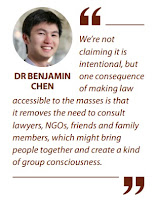
     Dr Chen and his collaborator Dr Li Zhiyu of Durham University have explored the implications behind the fervent embrace of AI and information technology in the Chinese legal system. “We’re not saying that technology is being intentionally deployed to achieve the results we describe, only that technology has grown out to fill gaps and respond to tensions latent in the Chinese legal order,” he said.
     They have identified three such tensions where an AI solution has appeal. The first is quite simple: it addresses the heavy caseload that has arisen from government efforts to professionalise the courts by weeding out under-qualified judges. “In the past, just about anyone could be appointed a judge,” he said. “Judicial reforms have culled the ranks but that means there are fewer judges and they are increasingly overworked. Technology is supposed to alleviate this.”
     The second tension relates to strains between social harmony and the law. Law-based order was restored following the Cultural Revolution. But the insistence on legal rights and procedure sometimes worsened social conflicts rather than resolving them, so the government started promoting social harmony and encouraging mediation rather than adjudication. However, the judges were also given quotas, which incentivised them to badger and bully parties into settlement. …Click here to read the full text. 

"Using AI to Predict Trafficking Sentences" (Anne Cheung Profiled in HKU Bulletin)

"Using AI to Predict Trafficking Sentences"
Anne Cheung
HKU Bulletin
Published in November 2021
Computer Science and Law have joined forces to produce a predictor which uses artificial intelligence (AI) to calculate the likely sentencing for drug trafficking.
     Under the auspices of the Law and Technology Centre, the research team led by Professor Ben Kao of the Department of Computer Science and Professor Anne Cheung of the Faculty of Law have developed a Stage-1 model of HKU AI Lawyer, which can predict sentencing associated with eight different types of dangerous drugs. Users simply provide information, in the form of answering four straightforward questions, and the AI Lawyer will predict what sentencing will be, as well as breaking down individual factors that will lead to the sentence.
     “We wanted to find an answer to the challenging issue of how legal knowledge that is embedded in previous court judgments can be captured and modelled using machines,” said Professor Cheung. “Lawyers have to familiarise themselves with previous court cases or ‘precedents’ which serve as important guidelines to future cases. In Hong Kong alone, there are more than 80,000 historical judgments.
     “Although there are guidelines on determining prison term ‘starting points’, these starting-point penalties have to be adjusted based on various mitigating and aggravating factors specific to each case. Predictions are more difficult for more complicated cases, such as those involving multiple drug types.”
     It would be a Herculean task for a human lawyer to recall all relevant precedents when he or she is researching and preparing for a new case. The team therefore took on the task of studying how to train a machine to comprehend and memorise court judgments using AI techniques and to reason based on the logic discovered from judgments. …Click here to read the full text. 

Monday, July 19, 2021

CMEL Newsletter (June 2021)

The Centre for Medical Ethics and Law (CMEL) develops new ideas and solutions in response to the big ethical, legal and policy questions of medicine and health.

 CMEL is the first cross-faculty interdisciplinary institution of its kind in the region. It was founded in 2012 by the LKS Faculty of Medicine and Faculty of Law at The University of Hong Kong as a joint inheritor of their vibrant intellectual traditions dating back to 1887 and 1969 respectively.

 Today, CMEL brings together bioethicists, academic lawyers, medical scientists, and other scholars to conduct cutting edge bioethical and legal research and contribute to policy development in flagship areas like population and global health, mental health and capacity, and digital health and emergent technologies.

 Research, teaching and knowledge exchange—CMEL’s core initiatives—aim to ensure that developments in biomedicine and public health will be underpinned by ethical and legal considerations.


To view the latest newsletter, click: CMEL June 2021 Newsletter.


Highlights of the June newsletter:
  • New WHO Guidance on Artificial Intelligence for Health
  • When learning is continuous
  • The constitutional determinants of Planetary Health
  • Regulation of e-commerce platforms and strict product liability
  • Perspective from a Forensic Pathologist and expert witness in court
  • Youth vaccination
  • Ethical controversies over vaccination incentives
  • Prospect of returning to normality despite continuing COVID-19 concerns
  • Artificial Intelligence in healthcare and COVID-19 prevention poses challenges to privacy in Taiwan
  • Drugs giant reached US$230M settlement agreement for opioids lawsuit in the US

If you would like to take a look at past issues, please visit https://www.cmel.hku.hk/newsletter.php.

Friday, June 4, 2021

HKU Law and Technology Centre launched HKU AI Lawyer: Sentencing Predictor for Drug Trafficking

Recent advances in artificial intelligence (AI) and machine learning bring disruptive changes to legal practice. AI can be used to draw insights from past judicial decisions to predict future outcomes. In the criminal justice system, one essential aspect is sentencing. Much attention has been placed on how AI informs decisions about sentencing and how to use AI to assist people to obtain and make use of sentencing information.
Professor Anne Cheung of the Faculty of Law and Professor Ben Kao of the Department of Computer Science at the University of Hong Kong and their research team have developed a Stage-1 model of HKU AI Lawyer - an AI-assisted sentencing predictor for the offence of trafficking in dangerous drugs in Hong Kong. The predictor is based on an innovative combination of legal domain knowledge and machine learning techniques. Users only need to provide relevant information through responding to four simple questions, and the predictor will generate an estimated term of imprisonment. Another useful feature of the predictor is that it will at the same time show the links to court decisions which are most relevant to the given facts. The sentencing predictor is a pragmatic tool for professionals including lawyers, social workers and teachers. It also serves to inform the public of likely legal consequences of committing drug trafficking offences.

A workshop was held on May 18 (Tuesday) to introduce the background of HKU AI Lawyer, with a demonstration of how to use the sentencing predictor, to lawyers, social workers and members of the community. Mr. Chan Man Ho, Deputy Director of the Hong Kong Federation of Youth Groups, also shared his experience.

Media representatives were cordially invited to attend the workshop, with details as follows:
Date: May 18, 2021 (Tuesday)
Time: 2:00 – 3:15pm
Venue: Academic Conference Room, 11/F, Cheng Yu Tung Tower, Centennial Campus, HKU (map)
Language: Cantonese

Speakers:
Professor Anne Cheung
Co-Director, Law and Technology Centre
Professor of Law, Faculty of Law, HKU

Professor Ben Kao
Co-Director, Law and Technology Centre
Professor, Department of Computer Science, Faculty of Engineering, HKU

Mr. Michael Cheung
Research Officer
Law and Technology Centre, Faculty of Law, HKU

Mr. Chan Man Ho
Deputy Director
The Hong Kong Federation of Youth Groups

** The workshop was simultaneously aired through Zoom:
Meeting ID: 961 8639 6394

For media enquiries, please contact:
Ms. Grace Chan, Secretary, Law and Technology Centre, Faculty of Law, HKU (Tel: 3917-4727; Email: mcgrace@hku.hk)

Media Coverage
"Hong Kong drug offenders get clearer view of options as new computer program scans thousands of cases to determine likely sentences", SCMP, 19 May 2021.  For other media coverage, see the list on the Law and Technology Cente webpage.

Tuesday, May 11, 2021

Benjamin Chen, Alexander Stremitzer, and Kevin Tobia on Having Your Day in Robot Court (SSRN)

"Having Your Day in Robot Court"
Benjamin Chen, Alexander Stremitzer, and Kevin Tobia
SSRN & the University of California, Los Angeles School of Law, Public Law & Legal Theory Research Paper Series​.
Featured on the Legal Theory Blog  ​
Published in May 2021
Abstract: Should machines be judges? Some balk at this possibility, holding that ordinary citizens would see a robot-led legal proceeding as procedurally unfair: To have your “day in court” is to have a human hear and adjudicate your claims. Two original experiments assess whether laypeople share this intuition. We discover that laypeople do, in fact, see human judges as fairer than artificially intelligent (“AI”) robot judges: All else equal, there is a perceived human-AI “fairness gap.” However, it is also possible to eliminate the fairness gap. The perceived advantage of human judges over AI judges is related to perceptions of accuracy and comprehensiveness of the decision, rather than “softer” and more distinctively human factors. Moreover, the study reveals that laypeople are amenable to “algorithm offsetting.” Adding an AI hearing and increasing the AI interpretability reduces the perceived human-AI fairness gap. Ultimately, the results support a common challenge to robot judges: there is a concerning human-AI fairness gap. Yet, the results also indicate that the strongest version of this challenge — human judges have inimitable procedural fairness advantages — is not reflected in the views of laypeople. In some circumstances, people see a day in robot court as no less fair than day in human court.