Showing posts with label PCLL. Show all posts

Thursday, July 9, 2026

New book by Gary Meggitt: Wilkinson's Professional Conduct of Lawyers in Hong Kong Desk Edition 2026 (LexisNexis)

Wilkinson's Professional Conduct of Lawyers in Hong Kong Desk Edition 2026
Gary Meggitt
LexisNexis
Published in May 2026
1122 pp.

Wilkinson's Professional Conduct of Lawyers in Hong Kong - Desk Edition 2026 continues to incorporate the best of its previous editions, enhanced by recent developments introduced by legislation, Law Society Circulars, Bar Circulars, Law Society and Judiciary Practice Directions and numerous cases from many relevant jurisdictions. This new edition contains much new material, the most significant developments include annotations on admission to practice; confidentiality and legal professional privilege; competence;, undertakings; and disciplinary proceedings. This title will prove indispensable to law students studying the PCLL and Overseas Lawyers Qualification Examination candidates.

Friday, April 24, 2026

HKU ranks 9th and wins M. Cherif Bassiouni Award – Top Memorials from the National & Regional Rounds for Written Memorial in the Jessup Moot in Washington DC

From left: Mr Thomas Lam (Coach), Mr Matthew See, Ms Cherie Cheung, Mr Jonathan Ho, Mr Evan Robinson, Mr Fergus Tam (Coach)

Congratulations to HKU Jessup team for winning the M. Cherif Bassiouni Award – Top Memorials from the National & Regional Rounds for Written Memorial, in the Jessup Moot in Washington DC.

After prevailing as the Overall Champion in the regional rounds of the 2026 Philip C. Jessup International Law Moot Court Competition, the HKU Jessup Team represented Hong Kong in the White & Case Jessup International Rounds held in Washington DC, USA from 28 March 2026 to 4 April 2026. 

Out of more than 700 teams who participated in National Rounds and Regional Rounds, 164 teams went on to participate in the White & Case Jessup International Rounds in one of the largest and most prestigious international mooting competitions in the world. 

This year, the Team captured the M. Cherif Bassiouni Award (known until 2025 as the Hardy C. Dillard Award) for ranking 9th worldwide out of more than 700 teams for its excellent combined scores of both the Applicant and Respondent memorials. This is the first time HKU has won the M. Cherif Bassiouni Award (or its predecessor) since 2006. 

The M. Cherif Bassiouni Award recognises excellence in Memorial writing. The Memorials of the Team with the highest total Memorial score in each National or Regional Round shall be entered to compete for the M. Cherif Bassiouni Award. Each Memorial eligible to compete for the M. Cherif Bassiouni Award is graded by five judges. 

This year’s Jessup moot problem concerned the issues of intervention of non-party states, indigenous rights, general principles of international law and immunities of state-owned enterprises. The 2026 HKU Team, consisting of Cherie Cheung (PCLL), Jonathan Ho (PCLL), Evan Robinson (PCLL), and Matthew See (LLB III), displayed excellence in both written and oral advocacy at all stages of the competition. 

The Team would like to express their sincerest gratitude to the coaches, Mr Fergus Tam and Mr Thomas Lam, for their valuable feedback and support in their final year of coaching HKU’s Jessup Team. The Team would also like to thank the guest judges, Ms Natalie So, Mr Ryan Cheung, Mr Raphael Leung, Mr Jason Louie, Mr Alex CH Chan, Mr Ambrose Yu, Ms Tiffany Ng, Ms Faith Lee, Ms Holly Leung, Ms Ally Chan, Mr Leo Pang, Mr Chung Hin Yue, and Ms Veronica Yu for their kind assistance, helpful advice and rigorous advocacy training before the Hong Kong regional round, as well as in preparation for the international rounds.

Friday, January 7, 2022

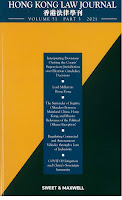
Thomas Yeon and Trevor Wan on Interpreting Provisions Ousting the Courts’ Supervisory Jurisdiction over Election Candidacy Decisions (HKLJ)

"Interpreting Provisions Ousting the Courts’ Supervisory Jurisdiction over Election Candidacy Decisions"
Thomas Yeon (PCLL (HKU)) and Trevor T. W. Wan  (LLB (Government and Laws (HKU) )
Hong Kong Law Journal, 
2021, Vol. 51, Part 3 of 2021, pp. 829-844
Abstract: Following the National People’s Congress’s decision to overhaul Hong Kong’s electoral system in March 2021, its Standing Committee resolved to amend Annexes I and II of the Basic Law, providing for the establishment of a Candidate Eligibility Review Committee for elections of the Chief Executive, members of the committee responsible for electing the Chief Executive, and members of the Legislative Council. The amendment also added an ouster clause, replicated statutorily in the Legislative Council Ordinance (Cap 542) and Chief Executive Election Ordinance (Cap 569), to the effect that “no legal proceedings may be instituted in respect of a decision” made by the Candidate Eligibility Review Committee. This article seeks to illustrate the constitutional–statutory hybrid character of the ouster clause and the interpretive principles applicable towards it. It also responds to two objections against qualifying the ouster clause’s effect based on the clause’s constitutional character and its relationship with the National Security Law.

Tuesday, November 9, 2021

Thomas Yeon & Diana Siu on Judicial Control and Interpretation of Emergency Powers: Lessons from Hong Kong (Oxford U Commonwealth LJ)

"Judicial Control and Interpretation of Emergency Powers: Lessons from Hong Kong"
Thomas Yeon (PCLL 2020) & Diana Siu (JD 2021)
Oxford University Commonwealth Law Journal
Published online: 26 Sep 2021
Abstract: This case note examines the judicial controls on emergency powers established by the Hong Kong Court of Final Appeal in Kwok Wing Hang v Chief Executive in Council [2020] HKCFA 42. It argues that, despite the Court’s promises to the contrary, none of those controls offer a meaningful constraint on the Chief Executive in Council’s power to enact regulations under the Emergency Regulations Ordinance (Cap 241). It also observes that the Court’s flawed articulation of the judicial controls is of cautionary value for courts in the United Kingdom interpreting the Civil Contingencies Act 2004.

Thomas Yeon & Trevor Wan on Comparative Constitutional and Administrative Law in Hong Kong: In Search of Coherence (Public Law)

Thomas Yeon (PCLL 2020) and Trevor Wan (BSS(GL)&LLB 5)
Published: 1 April 2021
Abstract: This commentary analyses the decision of the Hong Kong Court of First Instance (the court) in Kwok Wing Hang v Chief Executive in Council and critically analyses and evaluates the court’s approach to the limitation of executive powers and the protection of fundamental rights with respect to its approach in citing foreign jurisprudence from the UK, Australia and under the European Convention on Human Rights. The authors argued that while the court’s treatment of constitutional and administrative cases from common law jurisdictions is generally coherent (albeit with room for improvement in dissecting technical details), the court’s approach to Strasbourg jurisprudence is incoherent and fails to appreciate analytical nuances both as a matter of law and fact. A two-step approach will be proposed for Hong Kong courts’ future consideration in adopting constitutional and/or administrative jurisprudence from foreign jurisdictions.  Note that the Court of Final Appeal's decision in this case can be found here.

Wednesday, July 21, 2021

Cedric Tang (PCLL 2021, JD 2020) on Liability for Dispensing Errors in Hong Kong (Asian Bioethics Review)

"Liability for Dispensing Errors in Hong Kong"
Cedric Tang (PCLL 2021, JD 2020)
Published on 28 May 2021
Abstract: The United Kingdom (UK) case R v Lee (2010) EWCA Crim 1404 resulted in a pharmacist being convicted for an inadvertent dispensing error and paved way for the decriminalisation of such errors by way of a due diligence defence enacted in 2018. In relation to Hong Kong (HK), what is its legal position for dispensing errors, and can it follow the decriminalising steps of UK? The primary objective of this paper is to explore whether and how HK can reach the normative position for a dispensing error legal regime: (1) I posit that the normative position for healthcare professional (HCP) liability for dispensing errors should prioritise the public interest of minimisation of future dispensing errors over the retribution of past wrongs; (2) I illustrate HK’s current position for the liabilities of HCPs on dispensing errors, focusing analysis on the relatively controversial aspects of HK’s criminal liability, referencing the landmark cases Hin Lin Yee v HKSAR (2009) 13 HKCFAR 142 and Kulemesin v HKSAR (2013) 16 HKCFAR 195 to assist my analysis of the requisite mental element for relevant statutory offences; (3) through comparison with UK’s development post-R v Lee and application of Rule of Law principles, HK’s current position is critiqued, coming to the conclusion that while there are compelling reasons for the decriminalisation of dispensing errors in HK, the prerequisite for this to happen is an overhaul of regulatory frameworks by significantly increasing levels of accountability.

Thursday, January 24, 2019

Martin Kwan (PCLL) on Should There Be a Limitation Period for Section 214 of the Securities and Futures Ordinance? (HKLJ

"Should There Be a Limitation Period for Section 214 of the Securities and Futures Ordinance?" 
Martin Kwan (PCLL)
Hong Kong Law Journal, Volume 48, Part 3, pp. 883-898
published in December 2018
Abstract: Section 214 of the Securities and Futures Ordinance is commonly deployed by the Securities and Futures Commission (SFC) to deal with misconduct within listed companies. A usual remedy sought by the SFC is disqualification orders against the misbehaved directors. However, there isn't an express provision regarding the limitation period for s 214. This article explores the vital questions on whether there is and whether there should be a limitation period, especially given its complicated nature of being in effect a combination of an unfair prejudice petition and a director disqualification petition. The courts have recognised unfair prejudice actions as burdensome and disqualification orders as being drastic in interfering with the rights of directors. Furthermore, s 214 has wide policy implications concerning the financial markets. It is submitted that there are three equally tenable but conflicting views regarding the applicable limitation period. Therefore, there is a pressing need for full consideration and reform.

Tuesday, September 4, 2018

Congratulations to Ho Lok Hei (LLB 2017, PCLL 2018) on His Winning Law Reform Essay

Congratulations to our former student Mr. Ho Lok Hei (LLB 2017, PCLL 2018) who was one of five finalists in the Law Reform Commission of Hong Kong's Law Reform Essay Competition 2018.  This year's essay topic asked whether ride-hailing services should be regulated in Hong Kong and, if so, how.  Lok Hei argued that ride-hailing services should be allowed in Hong Kong but regulated to ensure safety to passengers and fair competition with those working in the existing taxi industry.  His paper can be viewed here.
    At an award ceremony officiated by the Secretary for Justice on 26 July 2018, Lok Hei's essay was recognised along four other finalists who were law students from the City University of Hong Kong and the Chinese University of Hong Kong.

Thursday, August 2, 2018

Martin Kwan Warns Practitioners on the Precedential Value of Unreported Judgments on the Interpretation of Standard Contract Terms (Business L Rev)

Martin YC Kwan (PCLL candidate)
2018, Vol. 39, Issue 4, pp. 136-8
Abstract: In the recent Court of Appeal decision Allianz Insurance Plc v. Tonicstar Limited [2018] EWCA Civ 434, the Court did not follow the previous interpretation of a standard contract term made by an unreported High Court judgment in 2000. Whilst the Court could lawfully not follow the unreported judgment given (1) the contractual interpretation was just a non-binding finding of fact and (2) the unreported judgment was made by a lower court, a critical reason why the Court did not follow it was because the Court considered the unreported status meant the interpretation was not well known. The meaning of the contract term thus has not been settled by the previous inconspicuous interpretation, which meant it was amenable to reinterpretation. This note suggests that practitioners should be mindful when relying on unreported judgments on contractual interpretation. Although the Court did not expressly and generally devalue any unreported judgment, the Court’s reasoning may be understood to have diminished its precedential value on the interpretation of standard contract terms. It will also be argued that there would be more certainty if the Court had not made such a distinction based on the status of being reported and unreported when considering whether a clause has been given a settled meaning by a previous judgment.

Monday, July 16, 2018

HKU Law Students Excel in Mooting Competitions (Maritime Law and Competition Law)

L-R: A Fung, J Ma, K Lee, F Chan,
R Cheung
The 19th International Maritime Law Arbitration Moot 
Competing against 29 universities from 14 overseas jurisdictions, the HKU Maritime Law Moot Team was awarded the 1st Runner-Up of the Oral Hearings held in Brisbane, Australia from 29 June to 3 July 2018. The 2018 Maritime Law Moot Team consisted of Alex Fung (PCLL), Justin Ma (PCLL), Ferrida Chan (BBA-Law) and Ryan Cheung (LLB), coached by Mr. Ken Lee. 
L-R: K Lee, R Cheung, A Fung, J Ma,
F Chan
    During the group stages, the Team came in 6th overall and later defeated both the National University of Singapore and University of Malaya to advance into the grand finals held in the Federal Court of Australia in Brisbane. Our heartfelt thanks go to Professor Anselmo Reyes, Dr Felix Chan, Mr. Winky So and the previous award-winning team for their comments in various practice sessions; and Mr. Ken Lee, our team coach, for his unwavering support throughout the year. 
HKU Competition Law Team Captured Best Written Pleadings Award 
The HKU Competition Law Team won the Best Written Pleadings Award for the written round on route to the semi-finals of the annual Herbert Smith Freehills Competition Law Moot from 15 to 16 June 2018. Guided by Mr. Thomas Cheng and Mr. Kelvin Kwok, the 2018 Competition Law Moot Team comprised of 4 PCLL students –Yuet Yi Cheng, Law Wai Tsun Hazel, Ng Chun Wai Jonathan and Karen Tsang Nga Yue. The Team advanced to the oral rounds hosted by King’s College London based on the strength of its written memorandum. 
L-R: J Ng, H Law, T Cheng, YY Chen,
K Tsang
     After winning all its moots in the preliminary stage with Wai Tsun Hazel capturing an oralist award, the Team subsequently lost in the semi-finals to KCL which was ultimately the winner of this year’s competition. The Faculty is grateful for the valuable support from team coaches Thomas Cheng and Kelvin Kwok and various practitioners and ex-mooters including Mr. Sunny Chan, Ms. Tiffany Chan, Ms. Jasmine Cheung, Mr. Tommy Cheung, Mr. Byron Chiu, Mr. Joshua Kanjanapas, Mr. Kevin Lau, Mr. Joe Lee, Ms. Rosa Lee, Ms. Allison Wong, and Ms. Stephanie Wong for their kind assistance. 

Tuesday, June 5, 2018

Martin YC Kwan on Restoring Transactions Unknowingly Tainted by Insider Trading (Common Law World Review)

"Restoring transactions unknowingly tainted by insider trading: A Hong Kong case"
Martin YC Kwan (PCLL candidate)
First published online on May 11, 2018
Abstract: In the Hong Kong Court of Appeal decision The Securities and Futures Commission v Young Bik Fung and others, the Court applied s. 213(2)(b) of the Securities and Futures Ordinance (SFO) to restore two transactions of shares entered into by an investor who invested based on ‘information, advice or tips’ given by an insider, despite the investor did not know that the advice was based on inside information and was not guilty of insider trading. Nevertheless, the investor was ordered to repay the profits made as if the transactions had not been made. It is suggested that the restoration order in Hong Kong has the widest scope of application among the major common law jurisdictions, because Hong Kong is the only jurisdiction where a person who has not committed any market conduct can nevertheless be subject to a restoration order. The Court justified such wide scope of application with reference to the paramount policies of minimizing market misconduct and ensuring no benefits is obtained from insider dealing by anyone. By a comparative law analysis, it is argued that s. 213(2)(b) SFO has been wrongly interpreted. The paramount policies should not be blindly applied without giving proper consideration to other established principles of law, such as the fundamental right to property of the unknowing investor.

Friday, April 27, 2018

HKU Jessup Team Ranks 11th in Washington DC and Wins Top Oralist Award

From left: Coach Ms Astina Au, Jason Ko, Natalie So, Brian Lee, Michelle Sum, and Sakinah Sat
Congratulations to the HKU Jessup Team for achieving 11th place in the preliminary round of the 59th Philip C Jessup International Law Moot Competition, held in Washington, DC from 1-7 April 2018, where 121 teams competed. Demonstrating outstanding advocacy skills, team member, Natalie So, was crowned the top oralist in the International Rounds Top 100 Oralists. "The Jessup" is known internationally as the most prestigious public international law mooting competition for law students, where teams, having won their respective regional round, represent their country in a mock case before the International Court of Justice. The 2017-2018 competition problem involved a dispute between two fictional countries, Anduchenca and Rukaruku, concerning issues related to the validity of an arbitral award, the law of the sea, international arms disarmament, and the use of force.
    This year 600 law schools from 100 jurisdictions competed in the competition.  The HKU team won the Hong Kong regional championship in February 2018, capturing the best memorial prizes for both the applicant and respondent teams.
     At the International Rounds, the team defeated Argentina, Pakistan, Indonesia and Armenia in the preliminary round, before losing to the United States in the advanced rounds. The team members, Jason Ko Lun, Natalie So Tsz Ching, Brian Lee Chun-Hin, Michelle Sum Hiu-Yan, and Sakinah Sat are all students studying in the PCLL programme.  Brian and Jason ranked 17th and 75th respectively in the the list of top 100 best oralists.
     The team thanks Professor Po Jen Yap, Eva Sit, Tim Parker, Lester Lee, Adrian Lai, Terrence Tai, Kevin Lau, Isaac Chan, Jeff Chan, Winky So, Victor Lui, Sunny Hor, Henness Leung, Angel Cheng and Jonathan Lee for their kind assistance, and express their indebtedness to team coaches, Astina Au and Peter Barnes, barristers at Parkside Chambers, for their unfailing support.

Thursday, January 25, 2018

Chow, Ng & Jen on Experientialization of Legal Education in Hong Kong (new book chapter)

As a former British colony, the legal system in Hong Kong is deeply rooted in and influenced by the common law tradition, and culture of England and Wales. Even its model of legal education and training was first guided by the English Report of the Committee on Legal Education, under the chairmanship of Sir Roger Ormrod, in 1971. Hence a vocational year, the Postgraduate Certificate in Law (PCLL), following the three year undergraduate law curriculum that was to be recommended in England and Wales was also implemented in the first law school in Hong Kong - the University of Hong Kong (HKU) - in 1972. The larger picture has not changed much despite the handover of Hong Kong in 1997 to People's Republic of China, which is a civil law jurisdiction. Nevertheless, like every other legal transplant which typically starts with the adoption of legal rules which work elsewhere and often continues to modify, develop and evolve in order to suit the particular jurisdictional social and cultural context, Hong Kong has also seen an extended four-year instead of three-year, LLB, joint degree programmes with law, and the degree of Juris Doctor (JD), all of which are not typical features of the traditional English common law educational framework and, with the exception of the lengthened LLB, are just other examples of legal transfer from outside Hong Kong...

Tuesday, December 16, 2014

Book Chapter on Simulated Learning in HKU's PCLL Programme

Edited by Caroline Strevens, Richard Grimes & Edward Phillips
Ashgate, December 2014
The Introduction by Richard Grimes describes the chapter in the following terms: Chapter 11 looks at the overtly vocational context of professional legal education in Hong Kong.  Chow suggests that when ranking learning experiences in terms of purposeful experience, a synonym of 'doing the real thing' occupies the most privileged position in that structure, followed by contrived experiences that are synonymous to simulations.  Both require the learner to apply principle to practice, either in real life or through simulated exercises.  This, he says, is echoed by a range of reports that together criticize legal education for typically paying limited attention to the needs of professional practice, resulting in habits of thinking like a student rather than an apprentice practitioner and conveying the impression that lawyers are more likely to be seen as scholars than legal practitioners engaged with the problems of client.  
     Chow notes that 2012 marked the fortieth anniversary of professional legal education in Hong Kong.  Prompted by a comprehensive review on legal education, the curriculum, in terms of content and delivery, underwent major reform in 2008, but a survey carried out a year later revealed that in general, students still encountered difficulties in making the transition from the undergraduate to the professional stage of study.  Specifically, students found it hard to practically apply the legal knowledge which they had learnt from their undergraduate studies to address and solve legal problems.  In Chow's view, they needed to undergo a change in mindset from studying the law to applying it in practice.  Hence, at one institution, in order to make the programme more akin to real-life legal practice, a team of teachers and supporting staff decided to pilot a model comprising two new approaches to learning and teaching: (a) the use of the Simulated Professional Learning Environment (SIMPLE), a transactional e-learning platform; and (b) the use of 'standardized clients' who the students could 'represent'.
     This chapter traces the evolution of a particular vocational programme: from a content-rich curriculum to one with increasing emphasis on transactional knowledge and lawyering skills; from the use of discrete hypotheticals to files adapted from real cases.  Chow then explains the circumstances leading to the pilot initiatives.  The chapter describes the objectives and expected outcomes of the pilot test, how it will run and what is being done.
    The chapter is particularly valuable in that it is able to take a look back at the reasons for change and to reflect not only on the impact of alternatives to methodologies but also how this has informed more recent developments.  Wilson Chow is currently the Head of the Department of Professional Legal Education in the Faculty of Law.