Showing posts with label arbitration. Show all posts

Monday, November 3, 2025

Hilary So and Anfield Tam on The Interface between Arbitration Clauses and Insolvency Proceedings (HKLJ)

"The Interface between Arbitration Clauses and Insolvency Proceedings"
Hilary So (PCLL graduate) and Anfield Tam (PCLL graduate)
Hong Kong Law Journal, Vol. 55, Part 2 of 2025, pp.321 - 340

Abstract: This article reviews the line of authorities laid down by the English, Singaporean and Hong Kong courts concerning the approach to stay or dismiss an insolvency petition where the underlying debt is subject to an arbitration clause. While the Hong Kong Approach exhibit logically inconsistencies with its policy preferences by requiring parties to take steps to arbitrate (ie the third Lasmos requirement) before the court’s discretion to stay insolvency proceedings is triggered, the English Approach is overly restrictive with excessive emphasis on the doctrinal mechanism of insolvency law. Accordingly, this article shows preference for the Singaporean Approach, which strikes a fair balance in integrating the policy and doctrinal concerns in relation to arbitration law in the insolvency context, as the basis for Hong Kong’s legal reform. This article concludes by suggesting that the court’s discretion to stay insolvency petitions should generally be exercised unless in so doing an abuse of process would be resulted. Meanwhile, it would be best practice for the parties to spell out in the arbitration clause whether they intend the clause to cover insolvency proceedings in any event.

Wednesday, October 15, 2025

Zhang Jiaqi on Rethinking Lasmos: The effect of Arbitration Clauses on Insolvency Proceedings in Hong Kong (HKJLS)

"Rethinking Lasmos: The effect of Arbitration Clauses on Insolvency Proceedings in Hong Kong"
Zhang Jiaqi (BBA(Law)&LLB)
Hong Kong Journal of Legal Studies (Volume 18, 2024), pp. 1 - 29

Abstract: When the Companies Court in Hong Kong examines a winding-up petition on insolvency grounds, and the debt that is relied on contains a valid arbitration clause, what is the correct approach for the Court so as to balance all competing interests and achieve a fair and reasonable outcome? This seemingly vanilla question has given rise to enormous debates and uncertainties in a variety of common law jurisdictions, including Hong Kong, Singapore, and the UK. This paper aims to present the development on the area of law, reconcile the competing values underlying arbitration and insolvency, and propose an ideal standard to be adopted by the Hong Kong courts. It also makes observations on judicial practices of Hong Kong courts on this issue since 1997, which may offer some insights to practitioners when drafting agreements which are governed by Hong Kong law and contain an arbitration clause.

Friday, September 5, 2025

Yun Zhao and Yanru Chen on The evolving lex mercatoria: a game-changer for transparency in international commercial arbitration (JIDS)

"The evolving lex mercatoria: a game-changer for transparency in international commercial arbitration"
Yun Zhao, Yanru Chen (PhD Candidate)
Journal of International Dispute Settlement, Volume 16, Issue 3
Published online: July 2025

Abstract: Transparency has been a crucial element in the evolution of lex mercatoria from its medieval origins to the contemporary lex informatica in cyberspace. The ongoing development of the medieval lex mercatoria underscores the significance of making arbitration reasoning publicly available, for two main reasons. Historically, medieval merchant courts did not favour strict confidentiality of decisions, and the modern requirement for safeguarding party, community, state, and global legitimacy in lex mercatoria also advocates for enhanced transparency in international commercial arbitration. The current transparency framework in investment arbitration and domain-name dispute resolution may serve as a roadmap for achieving a balance between transparency and confidentiality in international commercial arbitration. A restructuring of the transparency mechanism for such arbitration should focus on a mandatory system of publishing redacted arbitral awards.

Monday, August 25, 2025

Weixia Gu on All Flowers Blossom: The New Dynamic of Arbitration in Asia (Asian Dispute Review)

Published online: July 2025

Abstract: This article sets out the results of a study which examines and compares dispute and caseload data from six leading Asian international arbitral institutions over the period 2018-2024, updating the results of a study of 2018. The findings reveal that several Chinese institutions, notably the Shanghai International Arbitration Centre (SHIAC) and the Hong Kong International Arbitration Centre (HKIAC), have outpaced their Singaporean counterpart, the Singapore International Arbitration Centre (SIAC), by a significant margin, in terms of (1) percentage growth in both total and average amounts in dispute and (2) what this means as to their role and influence in developing arbitration in the Asia region.

Thursday, May 29, 2025

Weixia Gu spoke at International Arbitration Symposium at Cornell Law School

International Arbitration Symposium Provides Better Understanding of International Arbitration
Pictured (from left to right): Dr. Yuh-Ming Yan, Dr. Weixia Gu, Bianca Lin, and Professor Yun-chien Chang
On 18th April 2025, the International Arbitration Society, in collaboration with the Clarke Program in East Asian Law and Culture, hosted the Cornell International Arbitration Symposium at the Cornell Law School. This event brought together leading experts in the field to discuss various aspects of international arbitration in the East and the West. Dr. Weixia Gu, a leading scholar on international arbitration at our Law Faculty, has been invited to speak at this eminent event.

The symposium began with a morning panel featuring experts with Sinophone backgrounds. Dr. Yuh-Ming Yan, Associate Professor from Taiwan’s leading law school, National Chengchi University Law School, shared insights on arbitration developments in Taiwan. Dr. Weixia Gu, Associate Professor from Hong Kong’s top law school, The University of Hong Kong Faculty of Law, then provided law and development insights into international arbitration in Hong Kong. Dr. Wei Gao, Associate Professor from mainland China’s top law school, Peking University Law School, analysed mainland China's arbitration landscape, and Bianca Lin, Partner from Allegaert Berger & Vogel, shared her experiences combining East Asian background with her legal practice in the U.S. The panel emphasized on how international arbitration frequently involves cross-border collaboration, and how understanding the practices and contexts of different jurisdictions is crucial. Moderated by Yun-chien Chang, Jack G. Clarke Professor in East Asian Law and Culture at Cornell Law School, the morning panel laid the groundwork for a deeper understanding of international arbitration in a cross-border and cross-cultural context.

The discussions continued in the afternoon panel, which focused more on American perspectives of international arbitration. Lee Caplan, leader of Arent Fox Schiff’s international arbitration practice group and a former assistant attorney at the State Department Office of the Legal Adviser, discussed the politics of investment arbitration in the U.S.. Afterwards, Ted Lynch, Partner of International Arbitration at Jones Day, talked about the enforceability of international arbitral awards in US. Stephen Anway, global co-chair of International Dispute Resolution at Squire Patton Boggs, compared arbitration practices in mainland China and the U.S., and finally Muna Ndulo, William Nelson Cromwell Professor of International & Comparative Law and Director of the Berger International Legal Studies Program, outlined global efforts to reform international arbitration laws and practices. Justice Gambino 26′, President of the Cornell International Arbitration Society at Cornell Law School, moderated the afternoon panel.

The Cornell International Arbitration Symposium provided better understanding of international arbitration, highlighting the importance of collaboration and understanding diverse legal contexts of international arbitration in today's globalized world.

The official news report from the Cornell Law School is available here.

Monday, March 10, 2025

New Book Edited by Yun Zhao and Jędrzej Górski: Aviation Law and Governance - Navigating Global Challenges and Conflicts (Routledge)

Aviation Law and Governance - Navigating Global Challenges and Conflicts
Edited by Jędrzej Górski, Yun Zhao
Routledge
Published in February 2025
444 pp.

Book Description: Exploring the intricate relationship between law, economics, and global politics, this book examines the regulatory environment of the aviation industry.


Tracing the historical development of aviation law, the book has a particular focus on how economic polycentrism and the liberal international economic order have influenced the sector's regulatory framework. It discusses the aviation industry's responses to unforeseen global events, such as the COVID-19 pandemic and geopolitical conflicts, providing a detailed analysis of the legal mechanisms that ensure industry stability and resilience. Key topics include the role of arbitration in resolving disputes, the impact of international regulations, and the critical contributions of both public and private actors in shaping aviation law. Additionally, the book explores the challenges posed by new and emerging technologies, such as the increasing automation in aviation systems and the legal considerations surrounding cybersecurity in aviation operations. The collection also features diverse international case studies, offering practical examples of legal challenges and solutions in different contexts. By examining the intersection of various legal disciplines and the global nature of aviation, this comprehensive exploration not only reflects on past and present challenges but also provides forward-looking insights into the future of aviation law.

The book will be of interest to researchers in the field of air transport law and dispute resolution, offering a thorough understanding of the legal and economic complexities facing the industry today.

Friday, December 6, 2024

Shahla Ali's Project Update with the Institute for Transnational Arbitration (ITA)

With a growing attention to inclusivity and representation in the context of increased global integration, Professor Shahla Ali's research is inspired by the necessity to expand inclusivity and collaboration in the development of global legal instruments, as well as in the study and participation in cross-border dispute resolution and in the resolution of infrastructure disputes.


To learn more about this, and to hear Professor Ali talk about her research on access to justice, watch this short video prepared for the ITA Academic Council "What I Am Working On" project.

(Please click here to view the original post prepared by ITA on LinkedIn.)

Friday, November 15, 2024

Weixia Gu on China’s Modernization of International Commercial Arbitration and Transnational Legal Order (JITCL)

Published online: October 2024

Abstract: China’s interaction with international commercial arbitration (ICA) norms reveals a trajectory from initial resistance to gradual alignment and potential emergence as a rule contributor. This early resistance manifested in its unique dual-track arbitration mechanism and institutional arbitration monopoly. Reforms signal a shift towards global standards, driven by pro-arbitration judicial efforts and institutional competition in China’s vibrant arbitration market. As China’s global influence expands, it is innovating to shape the ICA landscape through initiatives like the China-Africa Joint Arbitration Centre, the China International Commercial Court’s one-stop dispute resolution platform, and the International Commercial Dispute Prevention and Settlement Organization. The role of transnational legal elites in China further facilitates this evolution.

Wednesday, October 2, 2024

Weixia Gu and Robin Hui Huang on China’s recognition and enforcement of foreign securities judgments against overseas-listed Chinese companies (OUP)

China’s recognition and enforcement of foreign securities judgments against overseas-listed Chinese companies
Robin Hui Huang, Weixia Gu
Journal of International Economic Law, Volume 26, Issue 3, September 2023, Pages 577–594
Published online: 26 May 2023


Abstract: Over the past decades, a growing number of Chinese companies have been listed overseas, notably in the USA and Hong Kong. They are subject to the securities regulation of listing places and can be sued thereunder against their securities misconduct. As overseas-listed Chinese companies usually have their main assets located in China, it is important that Chinese courts recognize and enforce foreign securities judgments. However, there are many difficulties in this area, which undermine the efficacy of the regulation of cross-border securities transactions. In quest of solutions, this article assesses the possibility of suing Chinese companies in the offshore financial centres where they are incorporated, finding that there would be similar issues with judgment enforcement in China. It also examines the viability of using arbitration as an alternative, arguing that arbitration may only supplement, rather than substituting, court litigation for resolving securities disputes. China should consider signing a bilateral treaty with the USA, clarifying the principle of reciprocity, and ratifying the 2005 Hague Choice of Court Convention and even the 2019 Hague Judgment Convention. Hong Kong is also advised to expand its current judgment recognition arrangement with Mainland China to cover securities judgments and join the relevant international conventions.

Thursday, January 11, 2024

2nd Runner-Up of the HK45 2023 Essay Competition (Asia Emerging Economies Category)

Congratulations to our RPG student Miss Prakritee Yonzon for winning this year's HK45 Essay Competition with 2nd Runner-Up in the Asia Emerging Economies Category. Miss Yonzon's article is about the jurisdiction v. admissibility debate in contractual pre-conditions and how it impacts the arbitral tribunal. HK45 Essay Competition was established in 2022 to promote interest in and knowledge of issues relating to arbitration. The prizes are categorized into Asia Emerging Economies Category, and Hong Kong / Global Category. Winning essays are selected by an esteemed panel of judges. The top essay from both categories will be considered for publication in Asian Dispute Review. The essay from 1st runner up and 2nd runner up will be considered for publication in the Kluwer Arbitration Blog.

Tuesday, January 31, 2023

Shahla Ali et al on Introduction: Reaching Sustainable Diversity in International Arbitration (new book chapter)

"Introduction: reaching sustainable diversity in international arbitration"
Giorgio Fabio Colombo, Shahla F. Ali, Filip Balcerzak, and Joshua Karton
in Diversity in International Arbitration: Why it Matters and How to Sustain It,
ed. by Shahla F. Ali, Filip Balcerzak, Giorgio Fabio Colombo and Joshua Karton  (Edward Elgar Publishing, 2022), Chapter 1, pp.2-5
Introduction: For decades, arbitration has been a preferred means for settling cross-border business and investment disputes. Given its inter-, trans-, and to some extent a-national character, there has been a natural and mostly positive trend toward harmonization in the ways arbitration is practiced and in the laws that support the international arbitration system. 

Monday, January 9, 2023

New Book edited by Shahla Ali et al: Diversity in International Arbitration: Why it Matters and How to Sustain It (Edward Elgar Publishing)

Edited by: Shahla F. Ali, Filip Balcerzak, Giorgio Fabio Colombo, and  Joshua Karton 
Published in November 2022 
312 pp.
Description: After decades of focus on harmonization, which for too many represents no more than Western legal dominance and a largely homogeneous arbitration practitioner community, this ground-breaking book explores the increasing attention being paid to the need for greater diversity in the international arbitration ecosystem. It examines diversity in all its forms, investigating how best to develop an international arbitral order that is not just tolerant of diversity, but that sustains and promotes diversity in concert with harmonized practices.
    Offering a wide range of viewpoints from a diverse and inclusive group of authors, Diversity in International Arbitration is a comprehensive and insightful resource on a controversial, fast-moving subject. Chapters present arguments from practitioner, academic, institutional and governmental perspectives that identify the underlying issues and address the various ways in which the goal of diversity, whether demographic, legal, cultural, professional, linguistic, or philosophical, can be reached.
     This book’s analysis of the contemporary state of diversity in international arbitration will be a crucial read for researchers in the field. Practitioners and policy makers will also find its discussion of best practices and innovative initiatives for enhancing diversity to be invaluable.
Critical Acclaim: 
‘Ali, Balcerzak, Colombo, and Karton have edited a unique tour-de-force of diversity issues ranging from personal identity to legal culture to environmental impact. The editors have compiled an impressive anthology of approaches to fostering diversity from a “who's who” of authors making an impact on the ground already in this space. This is a must-read book for any law firm lawyers, corporate counsel, organizational leaders, arbitration institution administrators, and concerned arbitrators looking for ways to increase the environmental, social, and governance (ESG) savviness of their organizations and independent practices.’
– Victoria Sahani, Boston University, US

‘Two generations ago, the international arbitration community comprised an arcane brotherhood – a mafia of the pale, male and stale. “[O]ur own cultures are largely invisible to us; they are simply our “common sense” understandings of the world.” The fascinating chapters in this book lift the veil on unconscious biases, demonstrating how inclusion is crucial to maintaining the legitimacy of arbitration today. I love it!’
– Louise Barrington, Arbitrator, co-founder of ArbitralWomen and of Hong Kong’s Vis East Moot

Friday, July 30, 2021

HKU Law Welcomes the Chair of Comparative and International Law, Professor Alec Stone Sweet

HKU Law Welcomes Professor Alec Stone Sweet who joins the Department of Law as the Chair of Comparative and International Law, working in the fields of comparative and international politics, comparative and international law, international arbitration and human rights. 
     Prior to moving to HKU, Alec was the Saw Swee Hock Centennial Professorship at NUS, and held chaired professorships at the Yale Law School and Nuffield College, Oxford. He has also held visiting appointments at the Columbia Law School, as well as in universities in Aix-en-Provence, Bologna, Florence, Hong Kong, Leiden, Madrid, Milan, Paris, Stockholm, Sydney, and Vienna.
     Alec has published thirteen books, ten with Oxford University Press, including the most recent: Proportionality Balancing and Constitutional Governance: A Comparative and Global Approach (2019); A Cosmopolitan Legal Order: Kant, Constitutional Justice, and the European Convention on Human Rights (2018); and The Evolution of International Arbitration: Judicialization, Governance, Legitimacy (2017). His current book project is a comparative analysis of regional human rights courts. A regular contributor to assorted American law reviews, he has also published articles in peer-reviewed journals, including the American Journal of Sociology, the American Political Science Review, Comparative Political Studies, the German Law Journal, the International Journal of Comparative Constitutional Law, the Journal of Common Market Studies, the Journal of Global Constitutionalism, the Journal of European Public Policy, the Journal of Law and Courts, and West European Politics.

Research Area
  • International Law and Politics
  • Comparative Law and Politics
  • International Arbitration
  • Human Rights

Tuesday, March 16, 2021

New Book by Weixia Gu: Dispute Resolution in China: Litigation, Arbitration, Mediation and their Interactions (Routledge)

Dispute Resolution in China:Litigation, Arbitration, Mediation and their Interactions
Weixia Gu
Published in February 2021, 288 pp.
Description: China's ever-expanding commercial influence has attracted global attention on how its civil and commercial disputes are resolved. This compelling new book, Dispute Resolution in China, offers a detailed examination of the elements in the Chinese legal system and the relevant reforms to the multiplicity of approaches to civil and commercial disputes in China today. This book reveals how civil litigation, commercial arbitration, mediation, and their hybrid dispute resolution have distinctly responded to, reformed, and developed in the context of China’s transformational economic growth, societal development, and international interaction in the last two decades. It situates these developments and continued experimentation within a unique hybrid of empirical, contextual, and comparative analytical framework, while paving productive pathways towards the future.
    This book argues that, rather than being a legal project, China’s civil and commercial dispute resolution system is essentially a social development project, which distinguishes the Chinese approach to civil justice reform from contemporary civil justice movements elsewhere. Among the primary methods of dispute resolution, commercial arbitration in China today uniquely transcending the traditional socio-political constraints, its reform has developed in favor of market-oriented considerations and shaped by China’s socio-economic dynamics and internationalization needs. By contrast, civil litigation and mediation being more instrumentalist in nature, their reform is socio-politically embedded and continues to prioritize social stability. This book also shines a fresh light on comparative assessments of top-down and bottom-up changes in China’s dispute resolution discourse, as well as on how China speaks to international dispute resolution systems. Original and rich in its analysis, this book will be essential reading and invaluable reference tool for scholars with a focus on Chinese law, comparative and international dispute resolution, and on broader legal, institutional, economic, social, political and cultural dimensions of dispute resolution development.
Praise: 
"One of the best works on dispute resolution in China, this timely and insightful study offers an unrivalled account of the changing landscape of commercial dispute resolution in China. Against the background of China's ever-expanding commercial influence, it offers an invaluable and impressively informed guide to the multiplicity of approaches to civil disputes in China, formal and informal, and shines a fresh light on topics which often seem mysterious, and are often misunderstood. Original and rich in its analysis, it is stimulating reading for anyone interested in comparative law, civil procedure, and in how legal institutions are shaped by their social, political and economic context. The author deserves congratulations on a fascinating work, which is scholarly and absorbing and assured of its place in the literature."
    -Richard Fentiman QC (Cambridge Law Faculty) – Professor of Private International Law and Former Dean
"This is an impressive study of dispute resolution in China covering litigation, arbitration, mediation and mixed processes. A particular strength is its extensive research and its academic contribution and impact on the topic of civil and commercial dispute resolution in China from a comparative, empirical and contextual perspective. There are also law and society and law and economics assessments. This is most certainly now the most comprehensive and definitive analysis on the topic."
  -Loukas Mistelis (Queen Mary University of London School of Law) – Clive M Schmitthoff Professor of Transnational Commercial Law and Arbitration
"Professor Gu has produced the state-of the-art study of civil dispute resolution in China. Covering the entire dynamic landscape, it chronicles changing developments and continued experimentation, while providing an intelligent roadmap for productive reforms. The book will be essential reading for China law scholars, but also for practitioners and business leaders who work with Chinese partners."
  -Tom Ginsburg (Chicago Law School) – Leo Spitz Professor of International Law and Member of the American Academy of Arts and Sciences
"Gu’s book is a must for scholars and practitioners who really want to understand the development on commercial dispute resolution in China: insightful, resourceful, exhaustive. One of the best works on dispute resolution in China."
  -Franco Ferrari (NYU Law School) – Professor of Law and Director, Center for Transnational Litigation, Arbitration and Commercial Law

"One of the finest works on dispute resolution in China, this book is essential reading for everyone interested in the evolution of civil and commercial dispute resolution in China. The book blends empirical analysis with a thorough understanding of the economic and social transformation of dispute resolution in China. It highlights China’s salient divergence from international dispute resolution systems. Gu’s outstanding book is both a compelling manifesto and an indispensable pathway into the future."
  -Leon Trakman (UNSW Law School) – Professor of Law and Former Dean

"Dr Weixia Gu has produced a highly valuable work that examines the current regime for resolution of civil commercial disputes in China. Dr Gu goes well beyond the existing English language treatments of the subject to fully examine the legal principles, literature and practice relating to dispute resolution in China. The book also considers the topic through the prism of law and development and the immense recent changes in Chinese society.  It is an impressive book."
   -Richard Garnett (Melbourne Law School) – Professor of Law

"Professor Gu’s Dispute Resolution in China: Litigation, Arbitration, Mediation and their Cross-Interactions is an outstanding study of how civil litigation, commercial arbitration, and mediation have responded to, reformed, and developed in the context of China’s transformational economic growth and societal development of the last two decades. Gu analyzes the different degrees to which mediation and litigation remain politicized and continue to prioritize social stability, often at the expense of rights; the extent to which civil litigation has evolved to address public interest objectives, especially with respect to environmental and consumer issues; and the way in which commercial arbitration, uniquely among the three principal methods of dispute resolution, has transcended traditional socio-political constraints in favor of market-driven international standards, with the support of the Chinese judiciary. Gu offers invaluable comparative assessments of "top down" versus "bottom up" changes in China’s dispute resolution discourse, along with compelling empirical analyses in support of her arguments. An indispensable comprehensive study, Gu’s book makes an exceptional contribution to the literature on contemporary dispute resolution in China. It is a "must read" for legal scholars, social scientists, lawyers, policymakers and business leaders alike who focus on Chinese law and dispute resolution."
  -Philip J. McConnaughay (Peking University School of Transnational Law) – Dean and Professor of Law

"Professor Gu’s wonderful study of dispute resolution processes in China explores important issues of procedural law, including the substantial reforms attempted in recent years in response to the economic transformation and social changes that have been taking place in China. The insightful analysis offered by Professor Gu locates developments in the legal and institutional framework of civil litigation, arbitration, mediation and mixed dispute resolution in their social and cultural contexts. Among other key themes, this important book argues that the system which has emerged is more a project of social transformation than it is of legal development, especially in areas of dispute resolution that are less directly linked to the functioning of the economic system."
  -Michael Palmer (University of London School of Oriental and African Studies) – Emeritus Professor of Law and Former Head

Weixia Gu on Arbitration in Comparative Perspective (new book chapter)

"Arbitration in Comparative Perspective"
Weixia Gu
in Comparative Dispute Resolution  edited by Maria Federica Moscati, Michael Palmer, and Marian Roberts (Edward Elgar, 2020), Chapter 21
Abstract: This chapter explores various arbitration issues from East-West and common law-civil law comparative viewpoints. The term “East” refers generally to certain prominent Asian jurisdictions (e.g., China, Hong Kong, Singapore, Japan and Korea); while the “West” represents some of the major Continental European civil law jurisdictions (e.g., France, Germany and Switzerland), as well as the main Anglophonic jurisdictions traditionally viewed as main players in the common law world in the “West” (e.g., the United Kingdom, the United States, Canada and Australia).
     Three driving forces, as argued in this chapter, exert varying degrees of influence and account substantially for variations in the arbitration issues considered: (1) cultural dissimilarities between the East and the West; (2) operational differences in the practice of common law and civil law legal systems; and (3) variances in dispute resolution traditions among jurisdictions (e.g., a longstanding preference for using mediation rather than litigation and arbitration).
     Various arbitration issues will be examined. First, the relationship between alternative dispute resolution (ADR) and arbitration at a conceptual level in differing legal cultures is discussed. Next, the different permutations underlying the formation and operation of the arbitral tribunal across the surveyed jurisdictions will be analyzed, before examining the issue of juridification of arbitration tribunal processes. Finally, dispute resolution traditions are discussed and the diverse attitudes toward med-arb among legal systems and cultures are analyzed. In each section, this chapter explores whether and to what extent the aforementioned three driving forces contribute to the jurisdictional differences.

Weixia Gu on Harmonizing the Public Policy Exception for International Commercial Arbitration along the Belt and Road (new book chapter)

"Harmonizing the Public Policy Exception for International Commercial Arbitration along the Belt and Road"
Weixia Gu
in New Frontiers in Asia-Pacific International Arbitration and Dispute Resolution
edited by Luke Nottage, Shahla Ali, Bruno Jetin, Nobumichi Teramura (Kluwer Law International, 2020), Chapter 7 
Abstract: Following the Introduction, in subsequent sections, international commercial arbitration ("ICA") – and in particular, the public policy exception – are identified as prime initial targets for harmonization efforts. This chapter then considers the practical mechanics of harmonizing the public policy exception, proposing designation of the Asian Infrastructure Investment Bank (“AIIB”) as a coordinating authority for the drawing up of common standards and normative regulations. The possible substantive contents of a public policy exception, utilizing a “negative list” approach, are considered, with reference to similar harmonization efforts of the European Union (“EU”) and the Organization for the Harmonization of African Business Law (“OHADA”) evaluated as comparative case studies. The far-reaching implications of China’s BRI upon a steadily evolving global landscape will also be considered.

Monday, March 15, 2021

New Book co-edited by Shahla Ali: New Frontiers in Asia-Pacific International Arbitration and Dispute Resolution (Wolters Kluwer)

Edited by Luke Nottage, Shahla Ali, Bruno Jetin and Nobumichi Teramura
Wolters Kluwer
Published in November 2020
Description: An invaluable book that challenges the existing procedures and frameworks for cross-border dispute resolution in commercial and treaty arbitration. The eastward shift in international dispute resolution has already involved initiatives not only to improve support for international commercial arbitration (ICA) and investor-state dispute settlement (ISDS) but also to develop alternatives, such as international commercial courts and mediation. This remarkable book focuses on these initiatives and their accompanying case law and trends in the Asia-Pacific region.
     What’s in this book: An outstanding team of experienced and insightful arbitrators and scholars describes the following pertinent developments:
  • ICA and ISDS in the context of China’s Belt and Road Initiative;
  • the Singapore Convention on Mediation;
  • the shift to virtual hearings and other challenges from the COVID-19 pandemic;
  • mistrust of the application of the rule of law in certain East Asian jurisdictions;
  • growing public concern over ISDS arbitration;
  • tensions between confidentiality and transparency; and
  • potential regional harmonisation of the public policy exception to arbitral enforcement.
Evolving practices and high-profile cases have been charted out by the contributors to make informed observations about where changes are needed and educated guesses about the pros and cons of reforms. The leading jurisdictions covered are China, Hong Kong, Japan, Malaysia, India, Australia and Singapore.
     How this will help you: Being a pioneer in-depth study of recent trends in dispute resolution practice related to business in the Asia-Pacific region, the book’s practical analysis of new resources for dealing with the increasing competition among countries to become credible regional dispute resolution hubs will prove to be of great value to specialists in the international business law sector. Lawyers will make informed decisions on the venue and dispute resolution methods that are the most suitable for any specific dispute in the region, and policymakers will confidently assess emerging trends in international dispute resolution policy development and treaty-making.
     Professor Ali authors chapter 6 titled "New Frontiers in Hong Kong's Resolution of 'One Belt One Road' International Commercial and Investor-State Disputes" and co-authors the concluding chapter with Nobumichi Teramura and Anselmo Reyes.

Saturday, February 27, 2021

Shahla Ali on Cultural Issues in International Arbitration (updated book chapter)

"Cultural Issues in International Arbitration"in International Arbitration Practice : 21st Century Perspectives, (LexisNexis), Vol 3. Ch. 6. (2013; 2020)
Abstract: This paper addresses the theme of cultural convergence and divergence in international arbitration practice. Applying theoretical insights to unique arbitral practices in Hong Kong and Mainland China, the chapter draws on the authors survey and field work in the region. Examining both the convergence and divergence of approaches to arbitration in diverse settings provides an avenue to understanding the impact of globalization on the international practice of law.

Sunday, May 24, 2020

New Book: Water Services Disputes in International Arbitration (Xu Qian)

"Water Services Disputes in International Arbitration"
Xu Qian
2020, Wolters Kluwer
Book description: 
Water Services Disputes in International Arbitration is a well-timed book which focuses on an economic area of substantial importance for the society as a whole—governance of water. Water is not only a vital human need but also extremely precious and valuable. It is a finite resource having “economic value,” facing tremendously increasing demands and challenges, and considerable legal issues (at both theoretical and empirical levels). The legal consequences of the multifaceted nature of water and sanitation services are investigated in this book. In this respect, it concentrates on an analysis of the international law (law in norms in the form of international treaties and their interpretation by international arbitral tribunals that have developed a case law over the years) which applies to cross-border (or foreign) investment made in water and sanitation services.

What’s in this book:
Being the first of its kind, this book aims to fill a significant gap in the existing literature and dwells on how to harmonize the economic and fundamental human interests arising from investment in water and sanitation services under the international investment regime. Among the many key issues, the author highlights the importance of the following:
  • legitimacy of a State’s alleged regulatory objectives, the suitability of the measures undertaken to achieve the objective, and whether there are less-restrictive means available;
  • legal framework and stability of the State;
  • applicable law, changes in law, and emergency circumstances;
  • economic issues such as water pricing;
  • profit-driven private companies’ reluctance to serve the poor;
  • investment tribunals’ generation of a “regulatory and jurisprudential regime” on water and sanitation services; and
  • determination of liability in relation to expropriation, fair and equitable treatment, and necessity.
     The author, a leading expert in the intersection between international economic law and human rights, offers viable, sustainable, and reasonable legal solutions to the increasing number of investment disputes with water services. A detailed annex also presents cases decided before a variety of arbitral tribunals, as well as relevant World Trade Organization and International Court of Justice cases, and reviews critical literature in the field.

How this will help you:
This book, an in-depth and unique analysis, will be welcomed by not only the scholarly and student community but also trade and investment officials, policy makers, diplomats, economists, lawyers, think tanks, and business leaders interested in the subject areas of water governance and regulation, water economy, economic policy reforms and the evolution of the new types of regional trade agreements. It also suggests ways to enable States to better manage vital water services, even after privatization to foreign companies.

Friday, May 15, 2020

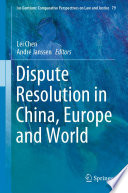
Gu Weixia on the Key Ingredients for Successful Reform of International Commercial Arbitration in the Asia (new book chapter)

"Reflections on the Key Ingredients for Successful Reform of International Commercial Arbitration in the Asia"
Gu Weixia
in Lei Chen & André Janssen (eds), Dispute Resolution in China, Europe and World (Springer 2020), pp.131-152
Abstract: Many states have recognized the economic importance of being 'arbitration-friendly', and many have naturally advertised themselves as such. Beyond the catch phrase lie these questions: What arbitration regimes are sufficiently 'arbitration-friendly'? Looking into the past, is there a standard pathway of arbitration reform in the Asia Pacific? Or are there divergent modes of development? To what degree have political, legal, social, cultural and other factors influenced a jurisdiction's ability to replicate successful reform patterns? This chapter looks into the development of arbitration regimes across the Asia Pacific, and aims to reflect on key ingredients for successful arbitration reform in the East. Among the Asia Pacific jurisdictions, some have reached greater success and have attracted many more commercial disputes within and outside the region. Others have been less successful, even with efforts to substantially reform the arbitration laws and institutions. To examine arbitration reforms and outcomes of Asia Pacific jurisdictions, this chapter relies on a hypothetical model of arbitration reform. This model is then tested again the reform pathways undertaken by 12 Asia Pacific jurisdictions for accuracy as a 'formula' for arbitration reform in the region.