Showing posts with label remedies. Show all posts

Monday, November 17, 2025

Hilary So on Estoppel: adopting constructive trust to remedy an unhonoured promise (Trusts & Trustees)

"Estoppel: adopting constructive trust to remedy an unhonoured promise"
Hilary H W So (JD 2024, PCLL 2025)
Trusts & Trustees
Published online: October 2025

Abstract: This article examines the scope for England’s recognition of remedial constructive trusts (RCTs) after reviewing the respective legal positions across common law jurisdictions. Having regard to relevant doctrines, jurisprudence and policy concerns, this article proposes estoppel with the following elements as the proper basis for recognising RCTs under English law: (i) a clear and unequivocal assurance by the promisor, (ii) detrimental reliance by the promisee, (iii) justice in all circumstances, and (iv) an appropriate apportionment by the Court. It further suggests that legislative intervention and proper judicial assessment are appropriate solutions to the general concerns about RCT in insolvency contexts.

Wednesday, July 2, 2025

HKU Law Welcomes Prof. David Winterton

Welcome to Prof. David Winterton, who joins the Faculty of Law as an Associate Professor.

David is an Associate Professor at the University of Hong Kong, with a specialization in contract law, commercial remedies, restitution and private law theory. He has published in several leading academic journals, as well as a monograph based on his doctrinal dissertation, entitled Money Awards in Contract Law (Bloomsbury 2015), which was shortlisted for the St Petersburg International Legal Forum Private Law Prize in 2018. His work has also been cited in various judicial decisions, including in the ultimate appellate courts of Australia and Canada.

Prior to his arrival in Hong Kong, David was a Senior Lecturer at the University of Sydney, and prior to that a Lecturer at UNSW and a stipendiary lecturer at St Anne’s College, Oxford. He holds a BSc (Pure Mathematics) and an LLB from UNSW and a BCL (Dist), MPhil and DPhil from the University of Oxford. Additionally, David has spent some time in legal practice in both Sydney (commercial litigation) and New York (Bankruptcy & Restructuring). He is admitted as a legal practitioner in NSW (2006) and as an Attorney in New York (2012).

Tuesday, March 14, 2023

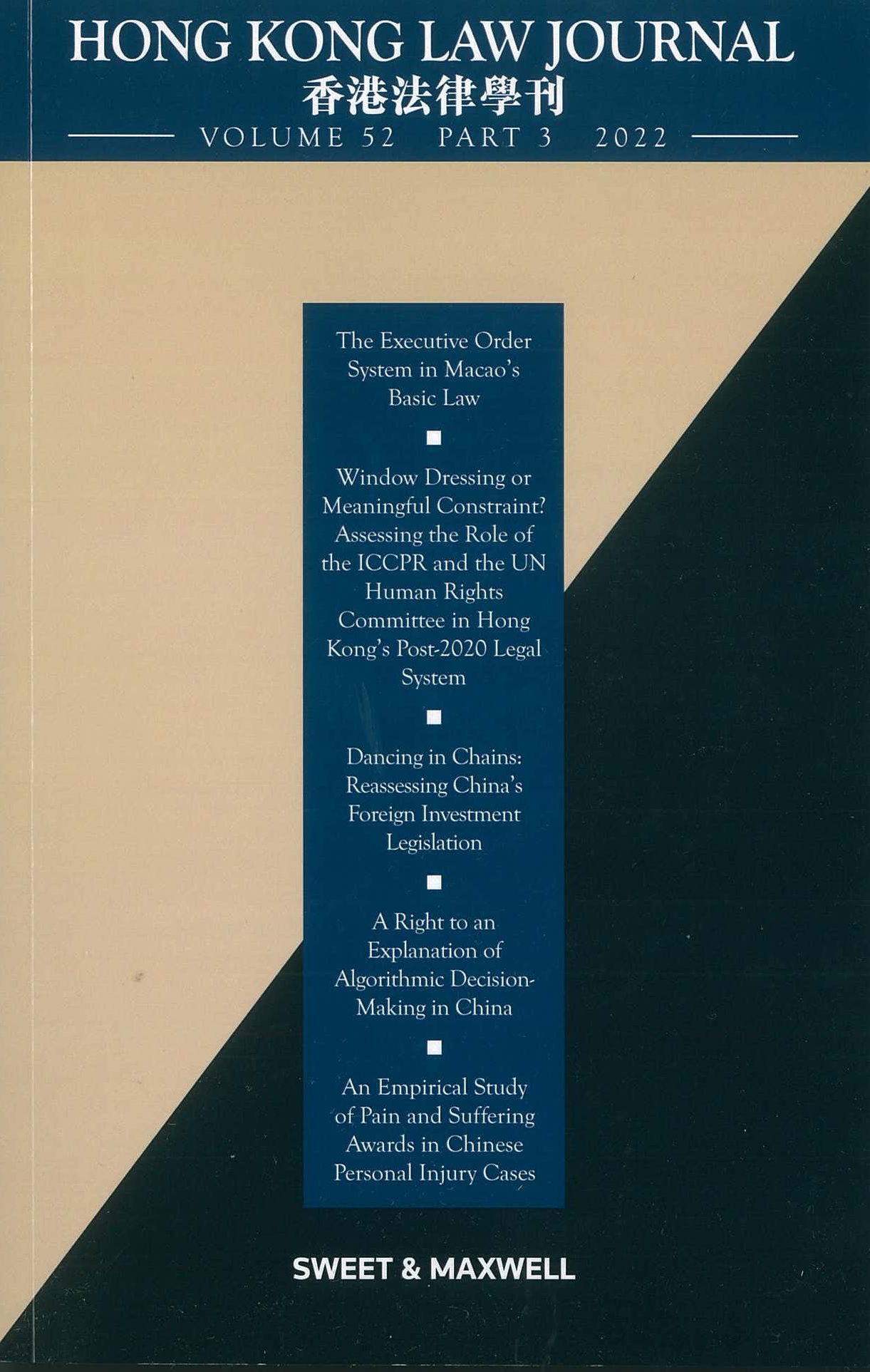
Jing Hui on Proprietary Estoppel Remedies in Hong Kong (HKLJ)

Proprietary Estoppel Remedies in Hong Kong
Jing Hui
in Hong Kong Law Journal (Vol. 52, Part 3 of 2022), pp.789 - 798
Abstract: In Hong Kong law, the courts have always declined to introduce the remedial constructive trust device, characterising it as a moot point or as a device that does not exist in Hong Kong. However, the most recent Court of Final Appeal (CFA) decision in Cheung Lai Mui v Cheung Wai Shing [2021] HKCFA 19 deviated from the foregoing attitude to remedial constructive trusts. It recognised “unconscionability” as the basis of relief, demonstrating the departure of Hong Kong law from the principles of proprietary estoppel currently applied in the English law. Contrary to the English approach of minimum equity to do justice, the exercise of broad discretion by the CFA in Cheung Lai Mui was more similar to the Australian approach to proprietary estoppel remedies. This case note analyses the reasons why the CFA adopted the remedial constructive trust approach in Cheung Lai Mui, as well as the problems that arise from the adoption of such an approach in Hong Kong law.

Thursday, January 23, 2020

Po Jen Yap on Remedial Discretion and Dilemmas in Asia (UTLJ)

"Remedial discretion and dilemmas in Asia"
Po Jen Yap
University of Toronto Law Journal
Nov 2019, Vol 69, Supp 1, pp 84-104
Abstract: Asian courts have mitigated the individual harms and institutional uncertainties associated with the judicial use of delayed remedies by incentivizing the government to comply with the court’s ruling or putting in place judicial safeguards against any legislative delinquency. Expedited remedies like remedial reinterpretation and judicial directives in certain contexts may also be necessary or desirable, even if the judicially imposed result may not be what the enacting legislature had originally intended. Insofar as the legislature can respond and amend these judicial reinterpretation or directives by ordinary legislation, the judiciary does not have the final word and has merely facilitated a constitutional dialogue on rights with the current legislature.

Monday, October 30, 2017

Lusina Ho's Account of Accounts (Singapore Academy of Law Journal)

"An Account of Accounts"
Lusina Ho
Singapore Academy of Law Journal
2016, Volume 28, pp 849-883 (Special Issue on Remedies)
Abstract: The equitable accounting rules are notorious for being ancient and technical, and hence hinder the development of the rules governing compensating claims against trustees. The present article seeks to overcome these difficulties by conducting a historical survey of the traditional accounting rules in order to identify their governing principle. It argues that equity acts on a principle different from common law, in that the purpose of accounting is to restore the beneficiaries or the trust fund, as from the time when the trustee departed from his duty, to the position they would have been in had the trustee performed his duty. This way, equity achieves exact justice so that the beneficiaries will not be kept out of their rights from the time when performance was due to the time when it is actually obtained. To do so, equity adopts the legal fiction of treating the unauthorised disbursement as having never been made and the property as having already been obtained. The article argues that this fundamental norm should also be applicable to equitable compensation, and proposes analysing this remedy on the basis of the duties breached, rather than the type of breach as in traditional accounting rules. It then uses this new framework to propose detailed remedial rules for various breaches of duty by the trustee.  Click here to download the full article.

Friday, September 29, 2017

Rebecca Lee on Disgorgement of Unauthorised Fiduciary Gains (J of Equity)

"Disgorgement of unauthorised fiduciary gains: An exercise in causation?"
Journal of Equity
2017, vol 11, pp. 29-47
Abstract: This article examines the relevance of causation in attributing and quantifying unauthorised fiduciary gains. Proceeding from some recent accounts of the fiduciary no-profit rule being merely a primary rule of attribution, it considers whether fiduciary accountability necessarily entails that liability to account for profits is an order that enforces the trustee’s primary duty directly, and thus excludes causal inquiries; as well as whether deterrence as a normative rationale for complete disgorgement applies to all breach of fiduciary duty cases. Based on the principles developed from the foregoing analysis, the article then illustrates its implications by reference to a recent Hong Kong case on disgorgement. It is suggested that the lower courts in that case mistakenly applied causation in deciding whether an account of profits should be available in a misapplication of trust fund situation, which mistake was corrected by Lord Millett NPJ [in Libertarian Investments Ltd v Thomas Alexej Hall (2013) 16 HKCFAR 681]  only when the case reached the Court of Final Appeal.

Wednesday, July 19, 2017

Po Jen Yap on New Democracies and Novel Remedies (Public Law)

"New Democracies and Novel Remedies"
Public Law
Abstract: Discusses the novel constitutional remedies adopted by courts in emerging democracies to ensure the Government's observance of the law. Reviews, with reference to case law, the approach of courts in South Africa, India and Hong Kong to: (1) the granting of engagement orders; (2) the making of suspension orders with "bite"; and (3) the making of judicial directives in response to political incompetence or intransigence.