Showing posts with label trust law. Show all posts

Friday, December 26, 2025

Congratulations to Professor Hui Jing!

Congratulations to Prof. Hui Jing on his promotion to Associate Professor! Prof. Jing is a prolific researcher with an excellent publication record. He is a rare scholar of comparative trust law who can effectively cover both the Chinese and common law jurisdictions. He is one of the few experts worldwide capable of engaging deeply with both legal traditions. Prof. Jing is a valuable member of our Faculty, and this promotion is a well-deserved recognition of his contributions. To read more about Prof. Jing's research and publications, click here.

Friday, September 19, 2025

Hui Jing on The Concept of Beneficial Ownership in Express Trust: A Necessity? (Journal of Equity)

"The Concept of Beneficial Ownership in Express Trust: A Necessity?"
Hui JING
Journal of EquityVol 18 issue 2, pp.131-164
Published: February 2025

Abstract: The symmetry between legal and equitable estate is often considered a defining characteristic of an express trust. Consequently, the concept of beneficial ownership plays a crucial role in understanding how an express trust is established and operated. However, concentrating solely on beneficial ownership leads to the categorisation of charitable and non-charitable purpose trusts as exceptions within the express trust framework. This also creates challenges in understanding the entitlement of discretionary trust beneficiaries to initiate legal proceedings regarding the mismanagement of trust property by trustees. This article argues that due administration, instead of beneficial ownership, is a shared concern applicable to all kinds of express trusts. By shifting the focus from beneficial ownership to due administration, it is possible to establish a doctrinal connection among all types of express trusts. Furthermore, the increasing adoption of express trusts in civil law jurisdictions demonstrates that trust law has surpassed the confines of the common law sphere, and the understanding of trusts is no longer limited to the context of common law. By emphasising due administration, it becomes feasible to encourage a conversation between civil and common law jurisdictions regarding their unique approaches to express trusts.

Please click here to read the full article on SSRN.

Friday, August 29, 2025

Rebecca Lee on Liberalisation of Trust Laws in Hong Kong: Continued Growth or Concealed Wealth? (New Book Chapter)

"Liberalisation of Trust Laws in Hong Kong: Continued Growth or Concealed Wealth?"
Rebecca Lee
Asia-Pacific Trusts Law, Volume 3, Boundaries in Context, Part IV, Chapter 17
Hart Publishing
Published online: May 2025

Abstract: This chapter critically examines the challenges faced by the liberalisation of trusts law in harmonising traditional trusts principles with the growing demand for settlor control and flexibility. The study focuses on two recent proposals put forth by the Law Society of Hong Kong, namely the legalisation of non-charitable purpose trusts and the legislative enshrinement of settlor reserved powers. These proposals serve as examples to illustrate the evolving trusts landscape, which aims to sustain the growth of the trusts industry while addressing the complication arising from concealed wealth. This chapter argues that non-charitable purpose trusts are conceptually feasible, their scope can be carefully delineated, and their practical utility outweighs the moral and social apprehensions surrounding them. In contrast, reserved powers trusts present more complex issues, and its wholesale acceptance deserves more close examination.

Wednesday, August 27, 2025

Kelvin Low and Jeremiah Lau on Reforming the Singapore Trust: Pushing or Breaking Boundaries? (New book chapter)

"Reforming the Singapore Trust: Pushing or Breaking Boundaries?"
Jeremiah Lau and Kelvin Low
Asia-Pacific Trusts Law, Volume 3, Boundaries in Context, Part III, Chapter 13
Hart Publishing
Published online: May 2025

Abstract: This chapter assesses the various enacted and proposed legislative reforms to Singapore’s trust law in the new millennium, including the Business Trusts Act, the Trust Companies Act and the amendments to the Trustee’s Act. We also consider the recent proposal to introduce non charitable purpose trusts. The tricky process of law reform is an interesting setting in which to consider various ‘boundary problems’ in trusts. Can statutory reform refine or sharpen the unclear boundaries of a judge-made trust law rule? To what extent can the conceptual boundaries of the English trust be modified by statute? Do these reforms push the boundaries of the trust to better adapt it to modern circumstances? Or do they threaten to break the institution of the trust altogether?

Full text of this chapter is available on SSRN, please click here.

Monday, June 9, 2025

Lusina Ho and Hui Jing on The Dominance of Regulatory Oversight in Chinese Investment Trusts (Asia-Pacific Trusts Law, Volume 3)

"The Dominance of Regulatory Oversight in Chinese Investment Trusts"
Lusina Ho and Hui Jing
Asia-Pacific Trusts Law, Volume 3, Boundaries in Context, Part II, Chapter 10
Hart Publishing
Published online: May 2025

Abstract: A fundamental tenet in the relationship between regulations and private law is their functional dichotomy. Private law deals with the adjudication of bilateral rights and duties between individuals. Its main purpose is to protect the rights of individuals from infringement by others. In contrast, regulations primarily serve public interests, and are typically enforced by regulatory agencies through administrative sanctions or criminal liability. In this chapter, we argue that the Chinese legal regime for investment trusts departs from this paradigmatic dichotomy. Regulatory supervision not only addresses public interest concerns, but also frequently displaces private law in resolving disputes amongst trust parties, blurring the boundary between private law and regulations. We examine the unique circumstances in China that account for this regulatory dominance and argue that it can be justified only as a temporary measure.

Following this introduction, Part II discusses the main reason for regulatory dominance in China. We examine how the widespread use of investment trusts for shadow banking raises public interest concerns when private law rights are enforced in such trusts. In Part III, we explore the use and limitations of regulatory supervision to address both the public interest and private law concerns raised by trust (mal)practice. Part IV contends that whilst regulations can be an effective interim measure for addressing private law disputes, legislators should in the long term adopt a proactive approach and enact trust laws that clearly define the rights and responsibilities of the trust parties. Part V concludes.

Full text of this chapter is available on SSRN, please click here.

Wednesday, February 26, 2025

Hui Jing and Wanyi Zhang on Enforcing Chinese charitable trusts (Trusts & Trustees)

"Enforcing Chinese charitable trusts"
Wanyi Zhang, Hui Jing
Trusts & Trustees, ttaf002
Published Online: January 2025

Abstract: This article examines the enforcement mechanisms of Chinese charitable trusts, highlighting the limitations of public law enforcement by civil affairs departments due to resource constraints. Through a comparative analysis of the English particular interest rule, it explores alternative enforcement frameworks, arguing that the beneficiary–recipient debate, while academically insightful, does not address practical enforcement challenges. The study suggests that the public law elements of charitable trusts necessitate a flexible, context-sensitive enforcement approach. For Chinese courts, the focus should be on whether supporting a plaintiff-charitable trust beneficiary’s claim ensures proper management of trust property and preserves the public benefit.

Monday, May 27, 2024

Hui Jing on Third-Party and Bankruptcy Effects under Chinese Trust Law: Comparisons with English Trust Law (Asian Journal of Comparative Law)

"Third-Party and Bankruptcy Effects under Chinese Trust Law: Comparisons with English Trust Law"
Hui Jing
Asian Journal of Comparative Law
Published online: April 2024

Abstract: In English law, the trust's third-party and bankruptcy effects contribute significantly to its wide use in commercial transactions. In view of the trust's attractiveness in conducting commercial dealings, China has also introduced the trust model into its domestic legal system to enhance its financial infrastructure. However, given the extent to which Chinese law has been influenced by the Roman-Germanic tradition, China's replication of the trust's third-party and bankruptcy effects has encountered doctrinal obstacles. Drawing upon the experience of its Northeast Asian forerunners, China has established two mechanisms to achieve the third-party and bankruptcy effects: the regime of trust fund independence and the granting of the right of rescission to beneficiaries. These two mechanisms represent the adjustments made by Chinese legislators in the process of transplanting the trust model into the Chinese legal context. Adopting a comparative law perspective, this article examines these mechanisms in the Chinese law setting for two reasons: first, to explore the mechanisms’ constituent elements and their operation, as well as the roles of both mechanisms in the Chinese trust law system; and second, to furnish comparative law scholarship with broader insights into rule transplantation and reconciliation.

Monday, April 15, 2024

Hui Jing on Regulating donation-based crowdfunding platforms in Hong Kong: A trust law framework (Common Law World Review)

"Regulating donation-based crowdfunding platforms in Hong Kong: A trust law framework"
Hui Jing
Common Law World Review
Published online: March 2024

Abstract: With the advance of technology, several crowdfunding platforms have emerged in Hong Kong to host informal public donation appeals. Unlike charitable crowdfunding activities, these appeals focus on crowdfunding to provide relief to specific individuals or groups in need. Due to the recent emergence of online informal public donation appeals and their lack of public benefit, regulatory bodies have not paid much attention to their regulation. However, recent media coverage highlighting scandals of maladministration of donation funds in the context of informal public donation appeals has impelled regulators to establish a systemic framework to govern crowdfunding platforms that host informal public donation appeals. This article addresses two main aspects of this topic. First, it discusses the operation of crowdfunding platforms that host informal public donation appeals and the risks associated with them. Second, it explores the feasibility of utilising trust law to regulate the administration of donation funds by these crowdfunding platforms.


Tuesday, January 16, 2024

Rebecca Lee on Transnational Legal Ordering of Modern Trust Law (CUP book chapter)

"Transnational Legal Ordering of Modern Trust Law"
Rebecca Lee
in Seth Davis (ed), Thilo Kuntz (ed), Gregory Shaffer (ed), Transnational Fiduciary Law, (Cambridge University Press, January 2024), pp. 169-187
Published online: 22 November 2023

Summary: This chapter studies transnational legal orders (TLOs) in the context of trusts and demonstrates that such ordering is evident in the processes through which modern trust norms develop and flow across borders to become a substantive body of transnational and comparative trust law. By reference to innovations and transformations in trust embraced by offshore trust jurisdictions and the rise of the civil law trust in East Asia, this chapter argues that modern trust norms produce multiplicities of legal orders that transcend both offshore and onshore jurisdictions, as well as both common law and civil law jurisdictions.

Wednesday, September 27, 2023

New book by Dr Jing Hui: The Governance of Chinese Charitable Trusts (Cambridge University Press)

Published on 7 September 2023
350 pp.
Overview: Legislators in China introduced the charitable trust model in 2016 with the passage of the Chinese Charity Law. They constructed a new legal framework for this model, in order to unlock the potential of trust institutions to further and develop charitable causes. This is the first English-language monograph exploring the governance of Chinese charitable trusts from the perspective of law and sociology. Through the application of doctrinal analysis and semi-structured qualitative interviews, this book reveals that China's particular political, social, and economic conditions are essential to understanding the legislated governance framework for charitable trusts and its implementation in practice. Embedded in China's unique institutional context, the governance of Chinese charitable trusts can only be fully understood in light of relevant law, administrative practice, and private actions taken by charitable trust parties.

Tuesday, February 7, 2023

Hui Jing on Political Influence in the Regulation of Chinese Charitable Trusts (Canadian Journal of Law and Society)

"Political Influence in the Regulation of Chinese Charitable Trusts"
Hui Jing
Canadian Journal of Law and Society / La Revue Canadienne Droit et Société
Published online on 26 January 2023
Abstract: With the 2016 Charity Law, Chinese legislators created a public-private hybrid model for the governance of charitable trusts. By endowing private actors with greater rights in the creation and management of charitable trusts, this hybrid model demonstrates the State’s intention of changing the functioning of the charitable trust sector from complete dependence on the State to a partnership. However, embedded in China’s particular institutional environment, the partnership relationship still bears the mark of strict government control, which is secured by granting extensive powers to regulators. This article analyzes the newly established regulatory framework for charitable trusts and outlines how regulators exercise their power in practice. The findings show that the tradition of regulators being subject to intense administrative pressures remains unchanged and that political concerns permeate every aspect of the regulation of charitable trusts.

Monday, October 25, 2021

Lusina Ho on The Mental Element in Equitable Accessory Liability (Current Legal Problems)


"The Mental Element in Equitable Accessory Liability"
Lusina Ho
Published: 1 June 2021
Abstract: There has been heated debate over the test of dishonesty since it was first laid down in Royal Brunei Airlines v Tan. This paper argues that the essence of ‘dishonest’ assistance is willing participation in a breach of trust, that is, assistants endorse or accept their causal role in bringing it about. Three implications follow. First, the mental element should be fixed at the minimum level necessary to reflect endorsement rather than varying by the degree of causal contribution to the primary wrong. Second, the test of neither dishonesty nor knowledge fully captures the requisite mental element for endorsement. Third, a test framed in terms of intention and belief concerning the core elements of a breach would better identify the mental element of accessory liability in equity. This reformulated test would add much-needed transparency to mental element determination for equitable accessory liability.

Sunday, January 3, 2021

Jeremy Lam (LLB 2020) on Constructive Trusts and Email Frauds (Trusts & Trustees)

"Constructive trusts and email frauds"
Jeremy Lam (LLB 2020)
Trusts & Trustees 
Published in November 2020
Abstract: Discusses, with reference to the conflicting decisions in Hong Kong including TOKIĆ D.O.O. v Hongkong Shui Fat Trading Ltd and Wismettac Asian Foods Inc v United Top Properties Ltd, the nature of constructive trust in email fraud cases.

Tuesday, May 26, 2020

Zixin Jiang on Unifying and Defining ‘Dishonesty’ in the Law of Trusts (Trusts & Trustees)

"Unifying and defining ‘dishonesty’ in the law of trusts"
Zixin Jiang (JD 2018)
Published in May 2020
Abstract: In this article, I argue that ‘dishonesty’ should be unified and defined in the law of trusts. I argue: (1) the UK Supreme Court in Ivey v Genting Casinos was correct to reject the Ghosh test for dishonesty and to endorse the Royal Brunei test for all legal contexts; (2) the present law on trustee exemption clauses is inconsistent with Ivey, and Walker v Stones must accordingly be overruled; (3) the subjective factors relevant to dishonesty are reducible to a person’s intentions and beliefs; and (4) ‘dishonest’ assistance of a breach of trust should be defined more precisely in terms of what knowledge is required to hold a defendant liable.

Saturday, December 7, 2019

Rebecca Lee on the Adult Guardianship Dilemma in Hong Kong (Trusts & Trustees)

"The adult guardianship dilemma in Hong Kong"
Trusts & Trustees
Published on 12 November 2019
Abstract: Today, there is worldwide consensus that ageing has become an issue of global concern. The frail elderly, together with other vulnerable sections of the community, may turn to adult guardianship, a mechanism for planning for and the protection of individuals with cognitive impairment. There is, however, an inherent tension at the heart of the legal institution of adult guardianship: although it protects individuals with cognitive impairment from potential abuse and exploitation, that protection is often provided by subjecting individuals to the plenary authority of their guardians. Against this backdrop, this article critically examines the struggle with the tension within the adult guardianship regime in Hong Kong and, drawing on reforms in major jurisdictions with long-standing experience of guardianship experimentation, explores the features of a guardianship system that tackles this dilemma.

Sunday, August 11, 2019

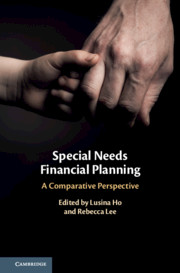
New Book: Special Needs Financial Planning: A Comparative Perspective (Cambridge University Press)

Special Needs Financial Planning: A Comparative Perspective
Edited by Lusina Ho & Rebecca Lee
June 2019, Cambridge University Press, 368 pp
Description: Countries around the world are facing pressing needs to enhance financial planning mechanisms for individuals with cognitive impairment. The book provides the first comparative study of the three most common of such mechanisms in Asia and the West, namely guardianship, enduring/lasting powers of attorney, and special needs trusts. It involves not only scholarly overviews of the mechanisms in the jurisdictions studied, but also thorough, structured and critical reviews of their operational experiences. This book will have broad appeal to scholars, students, law and policy makers and practitioners in the fields of mental disability, healthcare and elder law. It is widely recognised in the field that books like this one are needed. This book will also be of interest to undergraduate and graduate students in mental health, disability law and elder law.

Sunday, February 17, 2019

Lusina Ho and Rebecca Lee Awarded HKU's KE Excellence Award 2018 for Special Needs Trust

L-R: L Ho & R Lee
Congratulations to Lusina Ho and Rebecca Lee who were awarded HKU's Knowledge Exchange (KE) Excellence Award 2018 for their impactful special needs trust (SNT) project.  In 2016, Ho and Lee researched and recommended the innovative idea of a government-led trust to assist persons with special needs, including those with intellectual disabilities and cognitive impairments, and their families by providing affordable long-term asset management services.  The Hong Kong government readily took up the idea, which was mentioned in the Chief Executive's Policy Addresses in 2016, 2017 and 2018.  In late 2018, the Hong Kong rolled out the new service (see Press Release) and announced that it would begin to accept applications in March 2019.  Ho and Lee's idea of a government-led SNT is already informing policy-making in other jurisdictions including South Korea.  This is the second time the Faculty of Law has won this university wide award since 2015 when it was created.

Wednesday, August 22, 2018

Rebecca Lee on The Evolution of the Modern International Trust: Developments and Challenges (Iowa Law Review)

"The Evolution of the Modern International Trust: Developments and Challenges"
Rebecca Lee
Iowa Law Review
July 2018, Vol. 103, Issue 5, pp. 2069-2095
Abstract: As the first generation of wealthy entrepreneurs in Hong Kong begin to age, the issue of how best to transfer their family fortunes to the next generation has emerged. This Article first discusses the recent trends in financial planning for high-net-worth individuals in Hong Kong. It then addresses the growing use and evolution of trusts in wealth transfers from two perspectives, namely, (i) the innovative features of the modern international trust that render the use of a trust more palatable to Hong Kong settlors and (ii) the challenges posed by those features for both the validity of the trust and integrity of the trust concept. As the discussions show, the Hong Kong experience is indeed shared by most trust jurisdictions worldwide and provides the latter useful reference in confronting the controversies arising from the evolution of the trust.

Thursday, June 15, 2017

Lusina Ho on Causation in the Restoration of a Misapplied Trust Fund (new book chapter)

"Causation in the Restoration of a Misapplied Trust Fund: Fundamental Norm or Red Herring?"
in S Degeling & JNE Varuhas (eds), Equitable Compensation and Disgorgement of Profit (Hart Publishing, 2017) ch 8
Introduction: When a beneficiary seeks relief for misapplied trust assets, the emerging if not prevailing view amongst commentators is that he is but exercising his primary right to performance of the trust. The beneficiary is not seeking compensation for the factual detriment caused by the breach. Thus, whether the claim assumes the form of taking a common account or equitable compensation (an unfortunate misnomer in this context), the substance of the ultimate monetary award is essentially one for an ‘equitable debt’, for which issues of breach or causation – whether factual or legal – are irrelevant. 
     The United Kingdom Supreme Court in AIB Group (UK) Plc v Mark Redler & Co, however, was not swayed by these advocacies. The Court subsumed substitutive performance and reparative compensation under a unitary principle that it considered fundamental to all remedies, namely that: ‘the basic purpose of any remedy [is] to put the beneficiary in the same position as if the breach had not occurred. It held that ‘but for’ causation applies to the accounting of misapplied trust funds. Lord Toulson dismissed arguments based on the orthodox accounting procedure as ‘fairy tales’. Lord Reed, in a more forward-looking approach, preferred to fashion remedies to reflect the characteristics of the particular obligation breached rather than its historical origin, albeit his Lordship did not explain how this was to be done. The reasoning in AIB Group has drawn considerable criticism, predictably from commentators who consider that the debt characterization self-evidently demonstrates the irrelevance of but-for causation. 
     Unfortunately, the impasse between the UK Supreme Court and its critics is due, in great part, to the failure to address the policy justification of the orthodox position. On the one hand, the switching of the label of the claim from account to equitable compensation has confusingly misled the Supreme Court into compensatory thinking. On the other hand, even if there is a grain of truth in analogizing the traditional accounting remedy with debt and specific performance, it does not prohibit fashioning equitable compensation to ameliorate any potential hardship and injustice that may be brought by a strict adherence to the analogy. 
     The chapter seeks therefore to reinforce the underlying policy justifications of the orthodox position, and at the same time investigate possible situations where modification of the orthodox position is called for. To achieve this task, the chapter will, first, examine the historical approaches in common accounts, whereby it observes that amongst the plethora of earlier cases cited by critics of the compensation view, only a few expressly pronounce on the irrelevance of but-for causation; but, notwithstanding the dearth of direct authority on causation, it is well established that the nature of falsification is performance of the trustee’s fundamental duty to account rather than compensation. Secondly, to bolster arguments based on the nature of the remedy as debt or specific performance, the chapter will take up Lord Reed’s appeal to fashion remedies based on the justification of the duties breached; such a line of inquiry will show the orthodox position to be fully justified, at least as a default rule. The chapter will also explore situations where these underlying policies justify modifying the orthodox position. Lastly, the chapter examines how the decision in AIB Group may be reconciled with existing orthodox rules that permit beneficiaries to adopt or ratify the breaches of defaulting trustees, albeit it could also have provided the occasion for modifying the orthodox rules.

Thursday, January 12, 2017

Strong Demand for Special Needs Trust for Intellectually Disabled (HKU Study)

A survey has found that there is a strong demand for a Special Needs Trust (SNT) in Hong Kong to provide affordable financial planning services for individuals with intellectual disability, and for the Government to act as the trustee of such a trust. 
     The survey, which targeted at parents of individuals with intellectual disability, was carried out in 2016 by Professor Lusina Ho and Associate Professor Rebecca Lee at the Faculty of Law of the University of Hong Kong (HKU) and the Concern Group of Guardianship System and Financial Affairs*.
     According to government statistics, between 71,000 and 101,000 people in Hong Kong are persons with intellectual disability. As existing mechanisms for the financial planning for these individuals are limited, many parents are concerned that after their passing, the care for their children with intellectual disability would be upset. Following the 2016 Policy Address of the Hong Kong Government, the Labour and Welfare Bureau is exploring the feasibility of setting up a trust to provide affordable financial services to these individuals.

What is a Special Needs Trust (SNT)?
An SNT is an affordable trust specially designed for people with special needs (including people with intellectual disability). An SNT can reduce the cost of administration by pooling funds contributed by parents for management and investment. However, like in an MPF, the amounts designated for each beneficiary will be segregated. 
     To participate in such trusts, the parents (as settlors) with the help of the trustee and its case manager devise a care plan, which sets out the expenditures needed for the dependent-beneficiary, write a letter of intent that appoints a caregiver to succeed them and explains how the trust fund should be disbursed for the benefit of the dependent and after the dependent passes away, and then transfer a nominal sum to set up the trust. They also execute a will to transfer a substantial amount from their estate into the trust on their death, e.g. they may instruct the executor to sell their flat and put the proceeds into the trust fund. Of course, the parents may also transfer substantial assets into the trust during their lifetime.
     When the parents pass away, the trust will be activated. The trustee will then make periodic distribution to the succeeding caregiver according to the letter of intent and care plan. The trustee’s case manager can make periodic visits to the dependent to check that the caregiver is looking after the dependent. Upon the dependent’s passing, the trustee will distribute the surplus to any person(s) indicated in the letter of intent.

Strong demand for a government-operated SNT
The first territory-wide questionnaire survey of parent opinions on setting up an SNT received an overwhelming response of over 2,500 valid returns. The survey results show that parents of individuals with intellectual disability consider existing legal mechanisms for financial planning inadequate. The results suggest that:
(1) there is a strong demand for an SNT to be established in Hong Kong;
(2) the parents’ top priority (and the exclusive preference of almost half of them) is for the Government to act as the trustee of the SNT;
(3) if the Government acts as trustee, nearly half of the parents surveyed are likely or very likely to participate in the SNT;
(4) the following features of the SNT are most attractive to parents:
  • the provision of a case manager to monitor the care received by their children;
  • the annual fees of the SNT do not exceed 1% of the managed assets; and
  • the presence of parent representation in trust management; and
(5) parents who are most likely to participate in the SNT are aged 40-59 looking after dependents with intellectual disability aged 39 or below, and the dependents are with mild or moderate intellectual disability and are not in receipt of any social welfare benefits
(except Disability Allowance).
     The research is supported by RGC General Research Fund 2016-2017 (project number: 17612916). The survey report (in bilingual versions), press photos and presentation slides can be downloaded from www.snt.support. Or click this link to view the survey report. A video of the event launching the survey can be viewed here.
      For media enquiries, please contact: Ms Scarlette Cheung, Faculty of Law, HKU (Tel: 39172919; Email: scarlettecheung@hku.hk); or Ms Melanie Wan, Communications and Public Affairs Office, HKU (tel: 2859 2600; Email: melwkwan@hku.hk).
* The Concern Group of Guardianship System and Financial Affairs is established by a group of parents and caregivers of persons with intellectual disability. Its mission is to strive for a better adult guardianship system through examining its current weaknesses and seeking for improvements of the policies and institutions pertaining to adult guardianship. It is hoped that these efforts will enhance personal care and financial management arrangements for individuals with intellectual disability in Hong Kong.