Showing posts with label jurisprudence. Show all posts

Wednesday, August 6, 2025

Cora Chan’s book awarded Special Mention for ICON-S Book Prize

Congratulations to Professor Cora Chan for winning a Special Mention for the International Society of Public Law (ICON-S) Annual Book Prize with her book Deference in Human Rights Adjudication (Oxford University Press 2024). This prize is one of the most prestigious book awards in the field of public law. The judges awarded the honorary mention to Cora’s book for its “sophistication, analytical depth, and comprehensiveness with which [it] tackles the subject matter, promising to be a guide not just to courts and practitioners, but also to academics interested in the theoretical problems raised by the question of deference in adjudication.” 

Cora’s book was also one of two finalists for the 2024 Book of the Year Award from the International Forum on the Future of Constitutionalism.


Wednesday, November 27, 2024

New book by Alec Stone Sweet and Wayne Sandholtz: The Law and Politics of International Human Rights Courts: The Dilemma of Effectiveness (Oxford University Press)

The Law and Politics of International Human Rights Courts: The Dilemma of Effectiveness
Alec Stone Sweet, Wayne Sandholtz
Oxford University Press
Published online: July 2024

Abstract: The Law and Politics of International Human Rights Courts addresses three key topics. First, the book provides an account of the origins and evolution of six regional human rights courts. In each, judges sought to overcome political forces and legal obstacles that threatened to neutralize the regime and render it irrelevant to the daily lives of the people. Second, it analyzes the emergence of a common “jurisprudence of effectiveness,” the express purpose of which has been to raise standards of rights protection within nascent, multi-level “transnational systems of justice.” A transnational system of justice is comprised of three components: a charter of rights, a court tasked with enforcing the charter, and the right of individuals to petition the court with a claim that their rights have been violated. The book analyzes the case law on diverse topics, covering both absolute rights (the right to life and prohibitions of torture and slavery) and selected qualified rights (self-determination, abortion and privacy, family law, and indigenous rights to property). Third, the book examines how state officials respond to the development of systems of transnational justice (STJs), in particular, the extent to which the prospect of more effective rights protection is embraced by state officials. In each of the cases, the activities of the STJ have generated significant political “backlash,” leading some states to seek to curb the court’s authority or to exit the regime. The book describes and evaluates these attempts, the results of which have been mixed, with most court-curbing exercises failing.

New book review available in March 2025 (Click here for details)
New book review available in November 2025 (Click here for details)

Wednesday, September 4, 2024

New book by Cora Chan: Deference in Human Rights Adjudication (Oxford University Press)

Deference in Human Rights Adjudication
Cora Chan
Oxford University Press
Published in June 2024
224 pp.

Abstract: In human rights adjudication, courts sometimes face issues that they lack the expertise or constitutional legitimacy to resolve. One way of dealing with such issues is to ‘defer’, or accord a margin of appreciation, to the judgments of public authorities. Although there is a rich literature on the subject of deference, two important questions remain unresolved: what devices courts should use to exercise deference, and how deference can be made more workable for judges and predictable for litigants. This book offers the first comprehensive analysis of these questions. It introduces six devices for deference (namely, the burden of proof, standard of proof, standard of review, giving of weight, choice of interpretation, and choice of remedy), analyses how courts should choose amongst them, and proposes techniques for rendering deference practicable. The book’s arguments will enable human rights adjudication to be more principled and more in line with the rule of law and separation of powers. The book has two distinctive features. First, it engages with the jurisprudence of six common law jurisdictions that apply a structured proportionality test in rights adjudication, namely, Canada, Hong Kong, Ireland, Israel, New Zealand, and the United Kingdom. Second, the book offers guidelines for judges who wish to apply its theoretical arguments. Combining theory with practice in a broad range of jurisdictions, the book will be an important reference for researchers and students of constitutional theory, comparative constitutional law, and human rights law around the world. It will also assist practitioners, judges, and policymakers who have to grapple with issues of deference in adjudication.

Thursday, February 2, 2023

New Book in translation by Paul KC Chung Professor Scott Veitch in Jurisprudence et al: Jurisprudence: Themes and Concepts (3rd Ed., Peking U Press)

Jurisprudence: Themes and Concepts (3rd edition) by Professor Scott Veitch, Paul KC Chung Professor in Jurisprudence, and Emilios Christodoulidis and Marco Goldoni (of the University of Glasgow) has just been published in translation by Peking University Press in January 2023. The translator introduces the book in a recent issue of the Shanghai Review of Books.
To view the book, please click here. 

Friday, November 4, 2022

HKU Law Welcomes Professor Daniel A Bell, Chair of Political Theory

Welcome to Professor Daniel A Bell who joined the Faculty of Law!  Daniel A Bell (貝淡寧) is Professor, Chair of Political Theory with the Faculty of Law at the University of Hong Kong. He served as Dean of the School of Political Science and Public Administration at Shandong University (Qingdao) from 2017 to 2022. 
     His books include The Dean of Shandong (2023), Just Hierarchy (co-authored with Wang Pei, 2020), The China Model (2015), The Spirit of Cities (co-authored with Avner de-Shalit, 2012), China's New Confucianism (2008), Beyond Liberal Democracy (2007), and East Meets West (2000), all published by Princeton University Press.  He is also the author of Communitarianism and Its Critics (Oxford University Press, 1993).
     He is founding editor of the Princeton-China series (Princeton University Press) which translates and publishes original and influential academic works from China. His works have been translated in 23 languages. He has been interviewed in English, Chinese, and French. In 2018, he was awarded the Huilin Prize and was honored as a “Cultural Leader” by the World Economic Forum.

Tuesday, January 11, 2022

On Veitch's Obligations: Four Reponses and the Author's Reply (Critical Legal Thinking)

In December 2021, Critical Legal Thinking published four responses to the recent book authored by Professor Scott Veitch, who is Paul KC Chung Professor in Jurisprudence at HKU Law.  Professor Veitch then responded to the responses.  An excerpt from the first response is provided below with links to the other responses and Professor Veitch's reply.

"Rights, Obligations and Torture: On Veitch’s Obligations"
Julen Etxabe
Critical Legal Thinking 
Published on 14 December 2021
We continue our series on contemporary critical (legal) books with a series of responses to Scott Veitch’s, Obligations: New Trajectories in Law (Routledge, 2021). We will post four responses to Scott’s new work, each picking distinct themes which together testify to the richness of the book’s scholarship. Next week Scott will respond.
Those familiar with Scott Veitch’s earlier body of work will not be surprised by the wide-ranging, incisive and witty style of Obligations, his contribution for Routledge’s series New Trajectories in Law. This is not to diminish the accomplishment: Veitch’s impressive capacity of condensation, its intellectual and historical breadth, and the clinical precision with which he dissects the subject-matter deserve high praise. His “new trajectory” is at once a retrieval of an overlooked genealogy, a critical diagnosis of the times, and the groundwork for its renewal.
     The book is not a critique of rights per se, but of their dominant role as the defining, almost exclusive, language of our age. Not only are obligations historically prior, but they are substantially more robust and perform a “connective work” that rights simply do not. Above and beyond a primordial “right to have rights,” then, Veitch envisages an antecedent world of obligations that ground human relations and their political institutions, which make rights possible (34). However, he is too acute a thinker simply to suggest a reversal: “To expose and understand the fact of their [obligations’] priority must not therefore entail necessarily valorizing it: context matters” (18). ... Click here to read the full commentary, here to read the commentary by Matt Stone, here to read the commentary by Margaret Davies, here to read the commentary by Stacy Douglas, and here to read Professor Scott Veitch's reply.

Tuesday, October 26, 2021

Scott Veitch's Observations on Hong Kong (Critical Legal Thinking)


Observations on Hong Kong
by
19 October 2021

It has been said that a poem is never finished, just abandoned. Academic writing has a touch of that too. The visions and revisions it has taken to get a text into decent shape could always do with one more run through, one more update, one more check for meaning and style. It is true also of research. It could be – it is – endless, but one must just stop somewhere otherwise the writing will never get done. If one is doing research on contemporary issues, a decision must be made about what to include and when to end the period for analysis. The process of selection and exclusion is one of the skills of judgement in research and writing one seeks to learn, test out, pass on, but always facing it afresh with each new project. For as Borges illustrates so well with Funes the Memorious – who remembers every detail but knows nothing of meaning, which only comes with generalization – without selection and exclusion, no sense will be possible. And if this is a concern that applies to research on current issues, it applies even more to historical research, since in addition to the question of when to stop, there is the much more challenging question of when to start. Each event, each effect, has a range of causes, and each of them in turn a further range. And so selection and exclusion – methodology – become key to making any sense, contested as that will always be. In the end perhaps, all you might say about your research and writing is that there are better and worse ways of abandoning it; and that what is offered in the text is the best you are able to do for now. ...Click here to read the full article.

Tuesday, October 5, 2021

Podcast Interview with Professor Scott Veitch on his latest book, Obligations: New Trajectories in Law (New Books Network)

Professor Scott Veitch was interviewed by Jane Richards, a doctoral student at the University of Hong Kong for the New Books Network. In the interview, Professor Veitch discusses his latest book Obligations: New Trajectories in Law. In his book, Professor Veitch challenges the normative assumptions that shape law and social practices, and shows how obligations and practices of obedience are core to sustaining the inequalities faced by members of the global community. In doing so, Professor Veitch explores the potential and enduring role that obligations have in furthering individual and collective well-being. He offers an alternative trajectory for the current crises faced by all citizens today, including environmental degradation and human inequality and injustice. Click here to listen to the podcast.

Friday, September 24, 2021

Giuliano Castellano & Andrea Tosato on Commercial Law Intersections (Hasting Law Journal)

"Commercial Law Intersections"
Giuliano Castellano & Andrea Tosato
Hasting Law Journal, 
Vol. 72, Issue (19 April 2021)
Abstract: Commercial law is not a single, monolithic entity. It has grown into a dense thicket of subject-specific branches that govern a broad range of transactions and corporate actions. When one of these events falls concurrently within the purview of two or more of these commercial law branches – such as corporate law, intellectual property law, secured transactions law, conduct and prudential regulation – an overlap materializes. We refer to this legal phenomenon as a commercial law intersection (CLI). Some notable examples of transactions that feature CLIs include bank loans secured by shares, supply chain financing, patent cross-licensing, and blockchain-based initial coin offerings. 
     CLIs present a complex and multi-faceted challenge. The convergence of commercial law branches is frequently beset with failures in coordination that both distort incentives for market participants and increase transaction costs. Crucially, in the most severe cases, this affliction deters business actors from entering into the affected transactions altogether. The cries of scholars, judges, and practitioners lamenting these issues have grown ever louder yet methodical, comprehensive solutions remain elusive.  
     This article endeavors to fill this void. First, it provides a comprehensive analysis of CLIs and their coordination failures. Drawing from systems theory and jurisprudence, it then identifies the deficiencies of the most common approaches used to reconcile tensions between commercial law branches, before advancing the concepts of “coherence” and “unity of purpose” as the key to addressing such shortcomings. Finally, it formulates a two-step interpretive method that unties the Gordian knot created by CLI coordination failures.  Click here to read the full article. The article has been cited in the following policy documents: Cape Town Convention Academic Project, 
Guide on Best Practices For Electronic Collateral Registries (Cambridge, UK and Rome, Italy 2021); International Finance Corporation, Coordinating Prudential Regulation and Secured Transactions Frameworks: A Primer(Washington D.C., 2020); World Bank, Distributed Ledger Technology and Secured Transactions: Guidance Note 3 (Washington D.C., 2020).

Friday, March 12, 2021

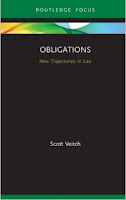
New Book by Scott Veitch: Obligations: New Trajectories in Law (Routledge)

Obligations: New Trajectories in Law
Published on 24 February 2021, 132 pp.
Book Description: Obligations: New Trajectories in Law provides a critical analysis of the role of obligations in contemporary legal and social practices. As rights have become the preeminent feature of modern political and legal discourse, the work of obligations has been overshadowed. Questioning and correcting this dominant image of our time, this book brings obligations back into view in a way that fits better with the realities of contemporary social life. Following a historical account of the changing place and priorities of obligations in modernity, the book analyses how obligations and practices of obedience are core to understanding how law sustains conditions of inequality. But it also explores the enduring role obligations play in furthering individual and collective well-being, highlighting their significance in practices that prioritize human and environmental needs, common goods, and solidarity. In doing so, it also offers an alternative and cogent assessment of the force, and the potential, of obligations in contemporary societies. This original jurisprudential contribution will appeal to an academic and student readership in law, politics, and the social sciences.

Monday, August 20, 2018

New Book: Law, Obligation and Community (Dan Matthews and Scott Veitch)

Law, Obligation and Community
Edited by Daniel Matthews and Scott Veitch
Routledge: Taylor and Francis Group
June 2018, 272 pp.
Description: Against an ever-expanding and diversifying ‘rights talk’, this book re-opens the question of obligation from not only legal but also ethical, sociological and political perspectives. Its premise is that obligation has a primacy ahead of rights, because rights attach to practices and modes of being that are already saturated with obligations. Obligations thus lie at the core not just of law but of community. Yet the distinctive meanings, range and situations of obligation have tended to remain under-theorised in legal scholarship. In response, this book examines the sense in which we are multiply ‘bound beings’, to law and legal institutions, as much as we are to place, community, memory and the various social institutions that give shape to collective life. Sharing this set of concerns, each of the international group of scholars contributing to this volume traces the specificity of the binding force of obligations, their techniques and modes of expression, as well as their centrally important role in giving form to lawful relations. Together they provide an innovative and challenging contribution to legal scholarship: one that will also be of relevance to those working in politics, philosophy and social theory.

Scott Veitch on Duty Free (new book chapter)

in Daniel Matthews & Scott Veitch (eds), Law, Obligation, Community (Routledge, June 2018), Chapter 5
Introduction: The Panama Papers exposé went some way to revealing the mechanisms and magnitude of global asset distribution as a way of circumventing state accountability techniques (Obermayer & Obermaier 2016). Two things stand out about this: one is the exposure to publicity of that which had hitherto been secret, and the other, that despite such secrecy much of what was exposed was legal. In the following, I attempt to understand the interplay of legal concepts and practices that make people, assets and obligations disappear from the radar of state and public accountability. I argue that the work of obligations and regulation is, ironically, key to this. I then consider how this ‘duty free’ scenario reveals the asymmetrical treatment of property rights and social rights, the conceptual labour that underpins this and some implications with respect to austerity and free riders.

Marcelo Thompson on the Biographical Core of Law: Privacy, Personhood, and the Bounds of Obligation (new book chapter)

in Daniel Matthews & Scott Veitch (eds), Law, Obligation, Community (Routledge, June 2018), Chapter 9, 34 pages
Introduction: What is the origin of the force of privacy obligations? That privacy obligations are legal obligations and obligations endowed with a certain force is indisputable. The daily news appears intent on convincing us of the contrary, so insistent and pervasive are the privacy violations it portrays. There is also a great deal of normative indeterminacy in the expectations on which privacy rests. Yet it is clear that, in a vast number of circumstances, people can expect others to be bound by an obligation to respect their privacy. For all their seeming fragility, these expectations are immensely powerful. So much so that the whole edifice of the law rests on them. The visible face of privacy expectations may be that of their pervasive disappointment. Much more prevalent, however, are those less visible situations where the boundaries of access obtain, where privacy is preserved and, with it, the spaces for the development of human subjectivity. It is only through the discreet workings of such boundaries that law can exist – that law can pass – as a normative order. For law, thus, protecting privacy is an existential affair. Privacy, human subjectivity, and the law hold, in other words, a relationship of reciprocal necessitation; a relationship so profound it might be said that, like space, time, and the universe, none of these ideas would be able to exist without the others. Together, they form a biographical core of legal normativity. Understanding how they intertwine has important implications for how we approach each of them as a concept. Pursuing such an understanding is the chief aim of the pages that follow. There are immediate theoretical reasons for pursuing this inquiry. On privacy, it provides an answer to the question at the beginning of this paper, enabling us to observe how the origin of the force of privacy is bound with that of law itself. On law, it not only addresses contemporary social theories that see law emerging in non-human realms, but also highlights how law and morality are intertwined, before any interpretive enterprise, at the very genesis of the interpreter. On human subjectivity, it invites us to revisit theories according to which law exists to address certain normative defects or perform certain functions, but which refrain from fully acknowledging the human dimension of such tasks. Beyond situated theoretical gains, however, carrying out this inquiry is, I believe, an existential task for jurisprudence. It is so as it highlights how pursuing and institutionalizing the best normative interpretation of human subjectivity and its boundaries might, in the end, be the central task of any legal system, and a task on which the very existence of law depends. One could think here of an allegory in which, through the looking glass, law seeks to interpret human subjectivity, while human subjectivity conducts the same interpretive survey regarding the law. But that could raise the question of whether the relationship between law and human subjectivity is then purely one of mutual reflexivity and interaction between beings that display episodic curiosity about but otherwise remain external to each other. A better illustration would be M. C. Escher’s lithograph of two hands drawing each other in a strange loop. Law and human subjectivity, in effect, constitute each other. Their origin and their boundaries, their fate and their force are intrinsically and reciprocally intertwined. Privacy is the quintessential realm where this relationship takes place. It is here that law probes the reasonableness of the boundaries between human subjects, and between these and the world around them, institutionally recognizing such boundaries, and lending thus some fixity to them. Those are also the boundaries from within which human subjectivity, like the hand in Escher’s drawing, emerges to further constitute the law. Yet human subjectivity does not arise casually. It calls for institutional membership in the community of legal beings. It needs recognition from the law before it can, in turn, shape the law. Such a recognition is given, and queried in each raise of hands, through personhood. Personhood, the institutional face of human subjectivity, defines membership within the law. This membership comes with certain capacities, which in turn are differentiated on the grounds of certain statuses. But all these are laid out in fairly general and non-negotiable terms, attaching to whoever falls into a certain legal position. Privacy, instead, contains as much objectivity as subjectivity; it follows, traces, and further enables the development of human subjectivity as it unfolds. In doing so, it extends and individuates the institutional contours of human personhood, in the light of expectations that are recognized as reasonable in the law. Law exists through these expectations, as they enable the rational exercise of the capacities, faculties, and powers – whilst addressing the shortcomings and vicissitudes – of the beings on whose existence law depends; that is, human beings, beings through and for the sake of whom law exists. Before we take this exploration further, a note is due on the usefulness of our inquiry. It may seem obvious to affirm that law cannot exist without the recognition of human subjectivity and the consequent enablement of the conditions for its development. Indeed, if human flourishing is not seen as an end of the law, to what end, then, does law provide people with reasons for action; to what end does law mediate ‘between people and the right reasons that apply to them’? For however maligned the very thought of what ‘right reasons’ might be, there would be something profoundly inconsistent, delirious even, in denying that the value of human subjectivity is one such reason. The recognition of human subjectivity and its boundaries is, at the same time, end and condition of the very idea of normativity – or at least of forms of normativity whose reflective, central-case viewpoint is that of human beings. And the institutional order of the law is one such form.

Thursday, July 19, 2018

Anna Baka on ""The Core of Legal Rights as a Logical Necessity" (Proceedings of the XXIII World Congress of Philosophy)

Anna Baka (PhD 2015)
Volume 54, 2018, pp. 5-19
Abstract: Analytical jurisprudence and the legal mainstream perceive legal rights in an interactionist fashion, pursuant to a right-obligation duality. The Paper suggests that this is principally because legal positivism and the analytical Anglo-Saxon legal tradition ground their theories on logical positivism and the Wittgensteinian premise that meaning is produced and asserted in social use, i.e. both consensually and contextually. The paper suggests that there is a surplus of meaning which exists beyond social use and which cannot be conceptualized within the sociolinguistic confines of Wittgenstein’s logic of language. This surplus of meaning corresponds to the essential core of legal rights, which, following Aristotle’s induction and philosophy of the essences, constitutes a necessary property and τὸ τί ἦν εἶναι of legal rights, namely a state of affairs or a state of being that cannot be altered without their necessary breach or, indeed, the negation of their very meaning. The Paper discusses the shortcomings of the Wittgensteinian approach and revisits the philosophical foundations of legal rights by employing Aristotle’s induction and theory of the essences, which the Paper connects to the phenomenological method and particularly Ricoeur’s hermeneutics and Husserl’s transcedental phenomenology. This is a process of abstraction and insight, which aspires to induce a rational revisiting of the general theory of legal rights and address the surplus of meaning that Wittgensteinian logic leaves semantically uncovered.

Friday, March 30, 2018

Call for Papers: 11th East Asian Conference on Philosophy of Law @ HKU (13-14 Dec 2018)

11th East Asian Conference on Philosophy of Law
“Justice, Dignity and the Rule of Law”

*Call for Panels and Papers*


Faculty of Law, The University of Hong Kong 
13-14 December 2018

We are pleased to announce that the 11th East Asian Conference on Philosophy of Law will be held in Hong Kong on December 13-14, 2018, under the auspices of the University of Hong Kong’s Faculty of Law and its Centre for Chinese Law. The event is also part of the celebration of the 50th anniversary of the Faculty of Law of the University of Hong Kong. The overarching theme of the conference is “Justice, Dignity and the Rule of Law”.
     The East Asian Conference on Philosophy of Law has been held once every two years since 1996. The China University of Political Science and Law in Beijing hosted the 10th conference in 2016, and Hankuk University of Foreign Studies in Seoul hosted the 9th conference in 2014. The conferences provide a forum for dialogue among East Asian scholars of legal philosophy and other scholars interested in Asian legal philosophy. 
     The 11th Conference will be divided into plenary sessions and parallel sessions. We now invite proposals to present papers at the Conference.  A proposal to present a paper at the Conference should include the title and abstract of the paper. If you are interested in submitting a proposal for the conference, please note the following:
1.  The closing date for submission of proposals is 30 June 2018
2. The conference will be mainly in English and Chinese. Proposals to present papers at the Conference and panel proposals (mentioned below) should be written in English or Chinese. Oral presentations at the Conference should be in English or Chinese, except that (1) in panels formed (according to the procedure mentioned below) by Japanese or Korean scholars, the oral presentations may be in English, Japanese or Korean (scholars speaking in Japanese or Korean are strongly encouraged to provide a written English translation of their presentations); (2) interpretation will be provided for specially invited speakers at the plenary sessions who speak in Japanese or Korean (who will provide a written English translation of their speeches). 
3.  The proposed papers may relate to any aspect of philosophy of law or related fields, and need not be limited to the general theme of the conference (“Justice, Dignity and the Rule of Law”). 
4.  Every participant at the Conference (including paper presenters, and chairmen and discussants at the panels mentioned below who are not presenting papers themselves) should submit the ‘individual proposal form’. Paper presenters will make an oral presentation at the conference (approximately 15 minutes). Submission of full papers is welcomed but not required. 
5.  Proposals to form a panel at a parallel session are welcomed. Panel organisers should submit a ‘panel proposal form’. Panel members presenting papers at the panel should also submit ‘individual proposal forms’. The ‘panel proposal form’ should include the panel topic, the name of the chair and/or discussant, the names of the presenters of papers, and the title of each paper. The chair and discussant may also serve as a paper presenter. The same person may serve as both chair and discussant. 
6.  The conference registration fee is waived; however, participants who would like to join the conference dinner will be required to make a payment in advance. Conference participants are responsible for their own travel and accommodation expenses. A list of recommended hotels will be provided on the conference website. 
7.  Inquiries may be emailed to: shelbyc@hku.hk.
     The Conference will be an excellent opportunity for you to meet East Asian scholars of the philosophy of law to discuss topics of common interest. We hope you will be able to join us in Hong Kong!  To access the Conference website, click here.

Friday, October 6, 2017

Scott Veitch's "The Sense of Obligation" (Jurisprudence)

"The Sense of Obligation"
Scott Veitch
Jurisprudence
September 2017, published online
Abstract: This article is based on the Inaugural Adam Smith Lecture in Jurisprudence given at the University of Glasgow in 2016. It asks this question: is it not an age of obligation that we live in as much as, if not more so than, an age of rights? To answer this it explores a number of different senses of obligation to be found across a range of social practices. After an overview of some of the main concerns of Smith’s work, it looks at two types of ‘obligation practices’ prominent in contemporary society: those that make rights effective, and those that operationalise debt. In paying attention to the often less visible work done by and through obligations, it also highlights certain vulnerabilities citizens are susceptible to when the distinction between obligation and obedience threatens to collapse.

Sunday, August 20, 2017

HKU Law Welcomes Two New Assistant Professors Specialising in IP, Innovation & Jurisprudence

We warmly welcome Dr Ryan Whalen, who joins us from Dalhousie University, and Mr Alex Green, who joins us from University College London, to the HKU Faculty of Law.
     Ryan Whalen’s research takes a data-driven approach to understanding the law and legal systems, with a particular focus on intellectual property law and innovation policy. This approach unites traditional doctrinal analyses with empirical techniques drawn from diverse fields including machine learning, natural language processing, network analysis, and data science.
     His work has appeared in a wide variety of journals including the Northwestern University Law Review, the Yale Law Journal Forum, the Michigan State Law Review, and the Journal of the Patent and Trademark Office Society
     Ryan holds a BA(hons) from Saint Mary’s University (Canada), an MA from National Chengchi University (Taiwan), a JD from the Northwestern University Pritzker School of Law, and a PhD from Northwestern University. While at Northwestern, Ryan served as the editor-in-chief of the Northwestern University Law Review
     Ryan joined the Department of Law in July 2017 and will be teaching classes on Intellectual Property and Information Technology, Patent Law, and Administrative Law.
     Alex Green joined the Department of Law in August 2017 as an Assistant Professor. His current research, which has been funded by the Modern Law Review, concerns the moral nature of legal statehood and its role in determining the content of public international law. More broadly, he is interested in legal and political theory, moral philosophy, private law, public international law and human rights. Alex will be teaching LLB and JD Tort Law and is Deputy-Director of the Outgoing Exchange Programme.

Monday, September 26, 2016

Scott Veitch Comments on Hans Lindahl's Fault Lines of Globalization (Jurisprudence)

"A comment on Hans Lindahl, Fault Lines of Globalization: Legal Order and the Politics of A-Legality"
Scott Veitch
Jurisprudence
2016, Vol. 7, Issue 2, pp 409-418
In his book about ‘Who owns Scotland and how they got it’, Andy Wightman tells the story of a miner walking home one night with a couple of pheasants in his jacket when he gets stopped by the landowner. ‘This is my land’, the laird tells him, ‘and my pheasants, so hand them back’. The miner says, ‘Your land—how did you get it?’ ‘I inherited it from my father’, says the laird. ‘And who did he get it from?’ ‘From his father; this land has been in our family for four hundred years.’ ‘And how did they get it then, four hundred years ago?’ ‘Well’, says the laird, ‘they fought for it’. ‘Fine’, replies the miner. ‘Take your jacket off and I’ll fight you for it now.’
     Sometimes situations or events rupture the routine expectations we have and which we behave in accordance with. In doing so they can expose the grounds on which these expectations rest, and they may force us to consider in a new light what has been extensively taken for granted. In responding to such an experience it is sometimes a matter of re-adjusting, of shifting the cognitive framework, of re-interpreting. Other times, the jolt is more serious and cannot be readily assimilated. In the shock it produces, there is a sense of unease, a sense of strangeness—which is sometimes registered in uneasy laughter—that will not easily go away. The story of the miner and the landowner might work in this way. Landholding is not something we take our jackets off and fight for. It is regulated by the laws of property, inheritance, title registration and the like. Except, that at some point it isn’t, or wasn’t. That property in land is gained, at some time in the past, by violence or theft is not likely to be disputed; but it does commonly have to be forgotten. This goes as much for continents—Australia in 1788, for example—as it does for landed estates (and the birds that just happen to live on them). To be too-reminded of this however provokes a sense of disorientation. And precisely because of this, it feels like something must be done about it by way of response. But what exactly? Even that greatest of philosophers of consistency, Immanuel Kant, in noting the same problem about theft and property, was forced to respond in a most unphilosophical way: ‘Best not to dwell on it’, he said, ‘just start from where we are and what we’ve got now’. (Perhaps someone should have asked Mr Kant to take his jacket off … )
     Where exactly the boundary between property and theft is drawn—between what is a legal gain and what an illegal one—seems to have a degree of contingency to it. But that there is such a boundary, which must be established if we are to have settled—or ordered—ways of acting with respect to each other and things in our society, appears however, to be necessary. Yet this very necessity seems, in turn, to have something of the contingent about it—in the origins of landed property, a taking, say, that is, from the perspective of the order it brings into being, itself neither legal nor illegal: in Australia, a non-justiciable act of sovereignty that ‘founds’ the nation and its law; or in the case of the laird’s ancestor, the founding of right on the basis of might...

Dan Matthews on Plasticity, Jurisdiction, and the Interruption of Sovereignty (Law & Literature)

Daniel Matthews
Law & Literature
Aug 2016, pp. 1-22
Abstract: In a series of recent interventions Catherine Malabou, the contemporary French philosophy of “plasticity,” argues that celebrated “deconstructions” of sovereignty have failed to transcend the concept's constitutive division between “symbolic” and “biological” life. Malabou's argument conspicuously fails to address the role of the juridical in giving form to sovereignty, an omission that is addressed here through an assessment of “jurisdiction.” This turn to the juridical opens a space for further critical reflection on Malabou's thinking. Through a reading of José Saramago's novel Seeing we can displace Malabou's insistence on the centrality of cerebral “life” in her effort to deconstruct the symbolic/biological binary and instead gesture towards a collectiveand affective “life” that remains refractory in relation to the juridical forms that sovereignty seeks to impose. Pointing to important tensions inherent in Saramago's text, the article brings critical pressure to bear on the position, articulated by Michel Foucault and endorsed by Malabou, that we need to transcend sovereignty tout court.

Sunday, March 22, 2015

Being Social: Ontology, Law, Politics (New Book)

Being Social: Ontology, Law, Politics
Editors: Daniel Matthews and Tara Mulqueen
Counterpress
February 2015
Description: Being Social brings together leading and emerging scholars on the question of sociality in poststructuralist thought. The essays collected in this volume examine a sense of the social which resists final determination and closure, embracing an anxiety and undecidability of sociality, rather than effacing it. Through issues including queer politics, migration, and Guantanamo, recent events such as the occupation of Gezi Park in Istanbul, and theoretical explorations of themes such as writing, law, and democracy, contributors assess how a reconfigured sociality affects thinking and practice in the legal and political realms. With a particular emphasis on Jean-Luc Nancy, whose work brings questions of community to the fore, these essays explore how the consistent ‘unworking’ of sociality informs the tenor and form of political debate and engagement. Table of Contents: Introduction (Tara Mulqueen & Daniel Matthews) Part I: Grounds of the Social 1. The Ground of Being Social (Ian James) 2. Being Social in ‘Law and Society’ (Peter Fitzpatrick) 3. The Meaning of Sense (Pieter Meurs and Ignaas Devisch) Part II: Acts of the Social 4. Being Social Democratically with Jean-Luc Nancy at the Gezi Park Protests (Marie-Eve Morin) 5. The Queer Experience of Singular Finitude (Tara Mulqueen) 6. Labour and Migration in the ‘Suspended Step’ (Anastasia Tataryn) 7. Survival’s Witness: Poetry, Sociality, Community (Patrick Hanafin) 8. On the Law of Originary Sociability or Writing the Law (Daniel Matthews).