Showing posts with label Puja Kapai. Show all posts

Monday, December 29, 2025

Congratulations to Puja Kapai honoured as one of “Women of Power” 2025

Congratulations to Professor Puja Kapai Paryani, who are honoured as one of “Women of Power” 2025. The Scheme is an initiative by Prestige magazine that identifies, celebrates, and builds a community of influential women in various fields across Asia, such as Hong Kong, Singapore, and Malaysia. It aims to inspire other women, particularly the next generation, through summits and annual lists, and foster a supportive network where members can collaborate and create positive social impact.

This is not the first time Puja is recognized; her commitment to pluralism and equity earned her the International Women of Courage Award in 2015 and the 2021 Global Pluralism Award. And we are proud that her pioneering work in human rights, inclusion, diversity and social justice, is well acknowledged and appreciated.

Sunday, March 6, 2022

Congratulations to Puja Kapai, the recipient of 2021 Global Pluralism Award!

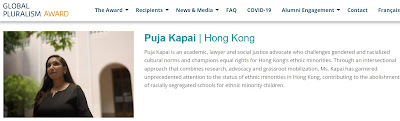
Congratulations to Puja Kapai who has won the prestigious 2021 Global Pluralism Award from the Global Centre for Pluralism, an international research and education centre in Canada. The Award celebrates exemplary achievements in building more inclusive societies where diversity is protected. This year 500 nominations spanning 70 countries were received and Puja received the award for her research, advocacy, and mobilization in the advancement of the equal rights of Hong Kong’s ethnic minorities, women and children. Another 2 awardees are a school project promoting Jewish-Arab education in Israel and an organization in Kenya helping the historically excluded communities to access even the most basic services.  Click here to view the Virtual Ceremony that was held with remarks from the Right Hon. Joe Clark who was chair of the international jury for the award.
     “I am most humbled to receive the Global Pluralism Award,” Puja Kapai said. “By honouring my work in advancing social justice in relation to race, gender and minority rights, the Award renders visible the lived realities of all those who are routinely marginalised and experience systemic exclusion and discrimination in nearly every sphere of life. The Award also signals the responsibilities we each carry to begin the journey of inclusion, acceptance and pluralism at home.”
     Puja Kapai is an academic, lawyer and social justice advocate who challenges gendered and racialised cultural norms. An HKU alum who grew up in Hong Kong, she is also Convenor of the HKU Women’s Studies Research Centre, which advocates around issues of gender, sexuality and diversity as well as Director of the Faculty’s Social Justice Summer Internship program which partners with students and NGOs working on gender-based violence, human trafficking and migration, ethnic minorities, children’s rights and COVID-19 related inequalities to conduct research and develop related recommendations to drive policy change. Growing up as an ethnic minority child in racially homogenous Hong Kong, Kapai faced barriers to education from an early age; these experiences inspired her to break these barriers as an advocate, attorney, and legal scholar.

Tuesday, January 14, 2020

Puja Kapai Speaks at the UN Forum on Minority Issues

Puja Kapai joined a panel of experts on the issue of minority language education and its impact on equal access to education and the implementation of SDG4. The Forum was a two-day event held in Geneva at the United Nations on 28 and 29 November 2019. 
     As part of the proceedings chaired by Anastasia Crickley, former Chair of the UN Committee on the Convention for the Elimination of Racial Discrimination and Astrid Thors, former OSCE High Commissioner on National Minorities, Kapai presented on the issue of minority language learning and its impact and implications for women and girls in attaining equal access to quality education in diverse societies. Building on my work on equality issues in education and disparate impact of particular policies on minority groups, Kapai drew on research data to demonstrate the indispensability of an intersectional framework to understand the impact of language education policies on minority women and girls. Kapai highlighted how the use of this analytical framework in understanding and evaluating language policies in the education system brings into view the hidden barriers which disproportionately impact minority girls in terms of their access to education, their drop-out rates and their prospects for academic achievements on par with others. More information is available on the WSRC website

Puja Kapai Awarded Women of Influence Award 2019

Conferring WOI Professional of Year Award 2019
Congratulations to Puja Kapai on receiving the American Chamber of Commerce Women of Influence (WoI) Professional of the Year Award 2019! The WoI Conference is one of the most established women’s symposiums in the Asia Pacific region. The theme of the Conference this year was on perseverance, risk-taking, and leadership from outside the confines of the corporate world. In keeping with the theme, the awards conferred accolades on individuals and organisations that "made exceptional achievements" and demonstrated "a steadfast commitment to supporting female leadership in business."
    When presenting the Award, Abbi DeLessio, Co-Chair of the WoI Judging Committee and Senior Consultant at Triangle Associates, said that, “In making their decision, the judges noted Puja’s commitment to going beyond leaning in and dedicating her expertise to pushing boundaries and breaking through traditional barriers. Her journey that continues to inspire many, her students and women in minority communities… her work is so well-aligned with what is happening globally.” DeLessio shared that one judge said, “Puja’s work is gaining traction not only in Hong Kong but she is poised to make a huge difference. Her work is timely, relevant and important and will have a lasting impact.
      Puja spoke about the value of her work and the award in her acceptance speech:
People within my community sometimes ask me whether my work makes any difference? Were the sacrifices I have made worth it? I think about this, too. As minority women, we often fall through the cracks due to intersectional dimensions of our identity which are inadequately captured by narratives of racism or sexism on their own. But we are more than just the sum of our parts. These experiences unmask how powerful people and powerful systems invisibilise women of colour by glossing over the structural barriers we face and by ignoring our agency and voice. This negative narrative diminishes our agency, constructs us as vulnerable and invites many ‘saviours’ or naysayers who counsel us to stay in our lanes. This Award helps rewrite this script on minority women to enable people like me to be seen as empowered agents for change in our own right, both within and outside our communities. And my hope is for this to encourage and inspire many others out there who dream to make an impact.
 Puja is Convenor of HKU's Women's Studies Research Centre and Associate Professor in HKU Law.

Thursday, November 28, 2019

New Study on Unconscious Bias and Implications for Equality in Hong Kong and Asia (WSRC & CCPL)

Puja Kapai
Women’s Studies Research Centre (WSRC) & Comparative and Public Law (CCPL)
September 2019
Description: In a project funded by the Equal Opportunities Commission, Puja Kapai conducted a study into the levels of unconscious bias on the grounds of gender and race in Hong Kong.  She examined who harboured which types of unconscious biases, whether such biases serve as predictors of discriminatory behaviour and whether it is possible to ameliorate these unconscious biases.  Summary of the results in conclusion: The results of this research study provide groundbreaking insights into the prevalence, nature and extent of unconscious bias among different social groups as well as the variables which influence such biases negatively or positively in the context of Hong Kong. Furthermore, the study demonstrates the effectiveness of specifically designed interventions in terms of reducing particular biases, while outlining the more challenging categories of unconscious bias which require more complex intervention models to address concretely. The key research findings of the 180-page report are: 
(1) Unconscious gender and racial biases are widespread in Hong Kong across diverse social groups.
(2) Unconscious bias tends to be stronger in the case of racial biases compared with gender biases. 
(3) The level of racial bias also varies depending on target group with South Asians being more susceptible to higher levels of bias relative to Mainland Chinese for the most part.  
(4) The level of gender bias in relation to sciences is significantly higher when compared to gender-role stereotypes pertaining to career.  
(5) The IAT itself has the effect of mitigating against certain types of unconscious bias but may have the opposite effect in respect of deeply entrenched biases.
(6) Interventions can and do work. However, the effectiveness of interventions varies depending on the type of bias, targets of discrimination, social groups targeted by the intervention, their social networks and exposure to outgroups.
(7) Some biases (racial biases) are more entrenched than others (gender-based biases) in the Hong Kong context and interventions have limited or little impact in reducing them.
(8) One-size-fits-all solutions do not work. There is a clear and potent need for intervention tools to be well-tailored to different groups and contexts and fine-tuned for different types and manifestations of biases. 
     Importantly, this study is the first of its kind to examine the manifestation of unconscious bias as embedded in an Asian context. The findings demonstrate that unconscious bias clearly exists and is prevalent in our society. However, in Hong Kong, it presents in specific ways judging from the distinct findings pertaining to certain racial categories and gender stereotypes in relation to career and sciences. Moreover, it reveals the significance of social context, networks and the particular background factors on bias levels. While intervention by way of raising awareness about the existence of different types of unconscious bias is found to mitigate biases, it is not sufficient in and of itself to reduce these in concrete terms or in the longer-term. Furthermore, if delivered carelessly without due consideration of the environmental context in which 109 participants are engaged and their background or networks, or a failure to debrief participants properly in terms of what the scores mean relative to prejudice levels, the intervention can have a detrimental effect, in turn, exacerbating biases. 
     These findings bear important implications for future of research and design considerations pertaining to unconscious bias and the implementation of interventions in Hong Kong in across different sectors, most notably, corporate, high school and higher education sectors.

Thursday, September 26, 2019

Puja Kapai on Undue Influence and Unconscionability in Comparative Common Law: Delivering Contextualized Justice for Minority Sureties (J of Transnational Law & Contemporary Problems)

Puja Kapai
Journal of Transnational Law and Contemporary Problems
Spring 2019, Vol. 28, Issue 2, pp 361-448
Abstract: Legal transplantation through colonization, mass migration, and—more recently—globalization has long been under the microscope of scholars, anthropologists, and lawyers, among others, who have sought to better understand the workings of the law in contexts foreign to its place of origin. This quest for understanding the relevance and operationalization of law in different contexts is part of the broader discourse of legal pluralism, which encompasses the study of the role of formal and informal normative values and institutions and the interaction between them as alternative, overlapping, or conflicting systems of relational ordering in diverse socio-political contexts. The law’s effectiveness as a tool for responsive justice is brought into sharp focus due to implicit biases which result from the law’s grounding in a dominant cultural framework which leaves minorities outside its legal lens. When the legal order delivers differential justice by overlooking or distorting the lived realities of those who fall outside law’s original frame of reference, it befits a critical inquiry about the law’s commitment to equality and non-discrimination in a plural legal order. The increasing convergence of legal systems cannot, on its own, be taken as determinative of an on-the-ground shift in values among all populations, communities, and peoples. Without an accompanying shift at the societal level, the law risks marginalizing and excluding minorities from an accessible framework for justice. Indeed, equality scholars have long argued that justice requires more than equal treatment and warrants a review of the substantive law itself as much as issues of procedural propriety in its application in demonstrating law’s fairness in terms of outcomes under the law. Despite the open-ended presentation of the common law as an apparatus with sufficient flexibility to achieve substantively just outcomes (and prevent miscarriages of justice) through the use of equitable principles where necessary, limitations inherent in the law’s institutional structure, how its content is populated, its reliance on agents for its dispensation, and its value-laden interpretive and analytical methodologies carve out an underclass of claimants for whom substantive equal justice remains unachievable. Law’s capacity to fulfill its function to deliver meaningful justice rests on its capacity to recognize the full range of complex legal subjects that may present themselves before it and to assess, understand, and interpret their claims and actions meaningfully by acknowledging the impact of the varied contexts within which human activity occurs. This paper critiques law’s purported neutrality in the field of contract law. It uses the doctrine of undue influence as a vehicle for investigating and understanding the implications of law’s entrenchment in a particular cultural context. Reviewing courts’ analyses of the factors grounding a successful claim of undue influence in guarantee contracts involving individuals of minority background, this paper examines the law’s capacity to identify and incorporate broader contextual factors to protect minority claimants against unfairly procured contractual liabilities in a range of jurisdictions. The paper’s critique of the courts’ analyses and framing of cultural factors in relation to the doctrine presents the imperative for a critical re-examination of modern jurisprudence developing judicial doctrine and its capacity for dispensing justice for subjects situated within plural normative orders. In doing so, the Article breaks ground with traditional rule of law analyses which ground conversations about law’s impartiality on law’s principled commitment to equality or, alternatively, seek an essentialized brand of justice. Instead, it avoid essentialism while placing burdens for due diligence where they are likely to be met. Building on this model, the Article offers arguments for incorporating considerations informed by a variety of social and human conditions in efforts to deliver substantive justice for all people regardless of their race, color, religion, or other background. This proposal bears notable implications for devising bespoke analytical tools which may well be specific to a legal field to ensure that legal understandings are rooted in the lived realities of those seeking law’s justice. Such an approach has the potential for development and application in a range of other areas of law such as violence against women and children’s rights. Click here to read the full text.

Saturday, February 16, 2019

New Book: "The Flow of Change: Celebrating Twenty Years of the Hochelaga Lectures" (HKU Law)

"The Flow of Change: Celebrating Twenty Years of the Hochelaga Lectures"
2018, Faculty of Law, the University of Hong Kong
Editors: Puja Kapai and Hughes Tang
Introduction: The Hochelaga Lectures were established in 1999 in memory of the benefactor's deceased father. Hochelaga was an Iroquois village in what is now Montreal. It was also the name which the deceased used for his company. 
     The initial intention was for the lecture series to reflect the deceased's commercial background as well as his fondess (albeit as an immigrant) for North American and Quebecois life and history. It was thus hoped to invite prominent jurists to the University of Hong Kong to lecture and deliver seminars on the following matters:- 
  • some aspect of United States or Canadian (especially Quebec) private law of interest to common lawyers worldwide 
  • some aspect of civil (as opposed to common) law, especially from a comparative perspective; or 
  • some aspect of the history of private law (not necessarily Western private law), especially from a comparative perspective. 
     But the university early on suggested that the series should not be confined to what had been envisaged. Flexibility would allow the university to invite speakers to lecture on topics of pressing concern to the Hong Kong community at any given time.
     The series has its motto Heraclitus' maxim (as quoted in Plato's Cratylus) that "everything is in flux and nothing remains the same". By its motto, the series stresses that in any rigorous inquiry nothing can be taken for granted. Mature future development requires that past certainties be constantly re-evaluated (however lonely the task) in light of a rapidly changing present.
     To mark the series' 5th anniversary, 2 contemporary artists were commissioned to carve seals bearing the Chinese character "ho" (river). The character was chosen for several reasons. It echoes the opening syllable of "Hochelaga". It alludes to the St. Lawrence River along which Hochelaga (and later Montreal) flourished. Most importantly, it reflects the metaphor of flow in the lecture series' motto.    
Table of Content
The Hochelaga Lectures: an Introduction -------------------------------------------------------------------iv

Chronology of Hochelaga Lectures ---------------------------------------------------------------------------v

The Handling of Parental Responsibility Disputes by the 
Australian Family Court following a Decade of Reform---------------------------------------------------1
The Honorable Justice Victoria Jane Bennett

Legislation and Adjudication of Juvenile Crimes in Mainland China ----------------------------------76
The Honorable Justice Huang Yong-wei

Challenges in the Development of International Family Law: 
Reflections by the Chief Justice of the Family Court of Australia --------------------------------------97
The Honorable Justice Diana Bryant AO QC

Values in Law: How they Influence and Shape Rules and the Application of Law------------------143
The Honorable Chief Justice James Allsop

Investment Treaty Arbitration Claims over Tobacco Packaging
Regulation: Running Out of Puff ---------------------------------------------------------------------------159
Luke Nottage and Jarrod Hepburn

Illegality and Statute in Hong Kong------------------------------------------------------------------------183
The Honorable Justice William Gummow

The Aftermath of the Fukushima Dai-ichi Nuclear Accident:
The Question  of Damages ----------------------------------------------------------------------------------197
Masato Dogauchi

Copies of this text are available at the HKU Law Library.

Friday, January 4, 2019

Puja Kapai Delivers Keynote Speech at Plan for Every Child 2018 (India)

Puja Kapai, Associate Professor and Convenor of the Women's Studies Research Centre, was invited to deliver a special keynote address by Plan International India and the Government of India's Ministry of Social Justice and Empowerment at the Plan for Every Child 2018: Girls Get Equal Conference​ held in New Delhi at the India Habitat Centre from 5 to 7 December, 2018. Other speakers included Mr Justice Lokur, Justice of the Supreme Court of India, Ms Mikiko Otani, member of the UN Committee on the Rights of the Child, magistrates, government ministers, the police, academics, civil society leaders, media representatives, as well as children themselves. It was a multidisciplinary and interactive event which engaged thousands of stakeholders working with children across India, focusing in particular on the girl child, those at risk of trafficking and sexual and domestic abuse, street children, and juveniles in the criminal justice system.
   Puja’s keynote, ‘Pathways to Gender Justice: A Critical Intersectional Framework’, focused on the need for legal and social justice advocates to adopt an intersectional framework to address specific vulnerabilities which children who sit at the intersection of multiple sites of oppression experience. Drawing on gender as the focal lens, she presented specific examples of how such a lens enables an enriched understanding of the nexus of pull and push factors which impoverish the girl child’s access to a range of human rights, including education, freedom from violence, and access to justice. Puja also presented an intersectional assessment framework integrated with the Child Rights Impact Assessment (CRIA) framework which she launched earlier this year with Plan International Hong Kong at the Conference on Safeguarding Children’s Best Interests . This serves as a shared tool for frontline responders, encouraging them to adopt a common language and framework for the identification and management of relevant and responsive interventions.
     Excerpt from the speech:
Critical intersectional inquiry urges the mapping of the various axes of inequity, oppression, discrimination or exclusion onto a framework. It then enables us to critically examine not only the prevalence of multiple vectors in the equation but more importantly, their inter-relationship and how they intersect to create the conditions which entrench individual children in a particular context to a life of deprivation. Using this framing and critical lens then, organisations and frontline responders working with children can build their capacities for more effective identification of specific environmental, substantive as well as structural challenges which warrant targeted interventions to formulate strategies to deliver responsive, accessible and meaningful justice. In essence, it means building up an entire ecosystem for the actualization of a unique model of justice which responds to intersecting axes of marginality in particular children or groups of children.
When we can accurately problematize issues, we render visible the invisible – the unseen, hidden, yet embedded – realities. We are able to capture within our analytical lens the aggressions, power, oppression or structurally entrenched constructs and relationships between issues. This knowledge presenting a fuller picture with all its layers of complexity enhances the prospects of justice, in particular, gender justice.

Friday, December 14, 2018

New CCPL Survey on Future Directions in Hong Kong’s Governance

Former CCPL Director, Puja Kapai, recently published Future Directions in Hong Kong’s Governance, findings from a public opinion survey conducted between August and September 2017 with a sample of 500 randomly selected respondents aged 18 or above living in Hong Kong. The household surveys were administered through face-to-face interviews. The study sought to understand Hong Kong people’s priorities and life satisfaction levels as well as their attitudes towards and expectations of politics and governance in Hong Kong. Specifically, the survey included items on public trust towards political parties, institutions, the government, and individuals of diverse backgrounds as well as the public’s prioritisation between economic and livelihood issues and democratic governance. In synthesising the data, the study also mapped the correlation between various demographic factors such as gender, age, education, and income levels and attitudes towards politics, governance, priorities, and life satisfaction.
      The project’s underlying objectives are timely and of significance at this juncture in Hong Kong’s political journey. The findings are distinct from other public opinion polls carried out to date in that they are obtained from face-to-face rather than telephone interviews. They also shed light on the underlying variables which appear to be determinative of public opinion on specific challenges facing Hong Kong at this time.
     Offering data-driven recommendations to guide the agenda of political parties, their leaders, and most importantly, the incumbent administration, the project seeks to underscore the importance of creating conditions and prioritising areas that are conducive to the effective engagement and governance of Hong Kong people going forward.
    The findings have been summarised and presented in two segments to distinguish the overall outcomes of the study from the distinct voices of Hong Kong’s youth, who portrayed a significantly different perspective on a range of issues, warranting a separate and focused analysis. Therefore, in addition to the Report presenting the Core Findings of the research, a dedicated report on Youth Perspectives has also been produced, offering a focused review of youth voices in Hong Kong, which are vital to any conversation on the future of governance in Hong Kong given the role of the youth in shaping Hong Kong’s future.
      Between May and June 2018, these Reports and the recommendations therein were presented to Mr Matthew Cheung, Chief Secretary for the Administration of the HKSAR, members of the Hong Kong Legislative Council, a range of consular representatives from different countries in Hong Kong, and youth groups. The presentations were conducted in small groups and generated much discussion and reflection on the part of all stakeholders engaged.  The full reports can be accessed here.

Thursday, September 20, 2018

Puja Kapai on Child Protection and Children’s Rights in Hong Kong (RTHK Radio)

Presenters: Hugh Chiverton and Jim Gould
Backchat, RTHK Radio 3
13 September 2018
Description: A report by the Social Welfare Department indicates that child abuse is on the increase, particularly where very young children are involved. In the first six months of this year there were 554 newly reported cases of abuse, compared with 947 for the whole of 2017. Those figures, and several widely reported cases before the courts in the past few months have led to calls for stronger penalties and an overhaul of child protection laws. So how could child abuse be prevented, and how could children's rights be better safeguarded?   Panelists: Puja Kapai, Priscilla Lui, Azan Marwah, and Dennis Ho. Click here to listen to the programme.  Kapai co-organised the Centre for Comparative and Public Law's Conference on Safeguarding Children's Best Interests at HKU on 8 September 2018.

Tuesday, July 24, 2018

Puja Kapai Interviewed on Failure of Anti-discrimination Laws to Prevent School Segregation (HKFP)

Jennifer Creery
17 July 2018
Hong Kong’s anti-discrimination law has failed to prevent the segregation of ethnic minority students at schools, a Legislative Council public consultation heard on Monday. NGOs and members of the public said that separate classes for those who learn Chinese as a second language delayed learning and ostracised pupils from the wider community.
     A panel tasked with examining racial discrimination policies heard calls for tighter laws to tackle what minority groups say is a failure to allow them to integrate into society.
...
     Puja Kapai, Associate Professor of Law at the University of Hong Kong, who also spoke at the hearing said that the panel was receptive to her suggestions to introduce data to gauge progress on racial equality. But she also said that the three-minute time limit for presenting ideas was restrictive.
     “The new rules of procedure provide a very limited time for engagement, unfortunately, because three minutes is really challenging for everyone to make their presentations and for lawmakers to raise questions,” Kapai told HKFP. ... Click here to read the full text.

Thursday, May 31, 2018

KE Story on Speaking Up for Women and Ethnic Minorities (Puja Kapai)

Puja Kapai (third from left) at UN Human Rights Committee
meeting in March 2013
HKU KE Newsletter
April 2018, Issue 14
Fair and equal treatment of women and ethnic minorities is too frequently unrealised in Hong Kong, but work by Associate Professor Puja Kapai Paryani in the Faculty of Law is helping to shed light on some of the ways in which society can redress the balance.
     Since 2012, Ms Paryani has compiled strong evidence on the extent of discrimination, unconscious bias and unfair practices in Hong Kong, which she has presented to the government and international organisations. She has also conducted training sessions for non-governmental organisations, corporations and the Equal Opportunities Commission on these issues, and brought together a wide range of stakeholders for roundtable discussions on the plight of domestic workers, ethnic minority children and the victims of sexual violence.
     These efforts have produced tangible improvements, such as a pledge by the government to officially disband the designated schools policy, improve school admission policies, and provide additional resources for Chinese language education for ethnic minorities after Ms Paryani’s research showed they were marginalised in education at every stage and effectively segregated from ethnic Chinese students in public schools; and a decision by the Department of Justice to install screens in court from behind which victims of sexual violence can testify, following lobbying by Ms Paryani and RainLily, a centre for victims.
...
     Her oral submissions contributed to the remarks made in the Concluding Observations, issued by the United NationsHuman Rights Committee and Committee on the Rights of the Child in 2013 on Hong Kong’s international human rights obligations.
     “People talk about gender-based discrimination or violence, or racial discrimination, but what my work highlights is that people are more than just a single identity holder. We inhabit multiple identities and when you locate and recognise the multifaceted identities all together in one person, that creates distinct vulnerability and disadvantage, which needs to be understood. We cannot develop effective laws or policies unless we can understand the populations we serve. I want to raise awareness about this across the societal, professional, governmental and non-governmental sectors,” she said.
     Ms Paryani has also encouraged sensitivity training for social workers, NGOs, healthcare workers and the police so they can deal more sensitively with situations involving ethnic minorities and women – for instance, by highlighting the importance of making use of translation services, which are often bypassed to save time. She also played an instrumental role in helping HKU identify more gender-friendly policies in her work as Chair of the Equal Opportunity Unit’s Working Group on Race, Family Status and Gender Identity.
     “I’m gratified that there has been a change in culture,” she said. “The government moved from saying there was no race discrimination problem in Hong Kong, to allocating resources to remedy what they now acknowledge as unacceptable patterns of racial marginalisation. NGOs are also now inspired to do their own research in this neglected area, monitor policies and call on the government to do better.”  Click here to read the full text.

Monday, March 19, 2018

Puja Kapai on Workplace Sexual Harassment in Asia (Nikkei Asian Review)

"Time to confront workplace sexual harassment in Asia"
Puja Kapai
Nikkei Asian Review
15 March 2018
The #MeToo movement against sexual harassment that kicked off in the U.S. is starting to gain momentum in Asia. Actresses in Hong Kong, a prosecutor in South Korea, a journalist in Japan and even factory workers in China have spoken out about their experiences with workplace sexual harassment, putting to rest any notion the problem is not a concern in Asia.
     A study in 2009 by D.K. Srivastava, the former pro vice chancellor of O.P. Jindal Global University, in India, found that 80% of working women in China had experienced sexual harassment at least once in their careers. Some 70% of female factory workers participating in a more recent survey conducted in the city of Guangzhou by the Sunflower Women Workers Center reported encountering sexual harassment. Similarly, 84% of female Chinese journalists polled by reporter Sophia Huang Xueqin said they suffered from workplace sexual harassment. Some 20% reported at least five such experiences, but only 3.5% had reported any incidents to senior managers. ...
     How can we transform Asian workspaces to tackle sexual harassment effectively? ...
    First, companies must revisit their anti-sexual harassment policies and complaint mechanisms and critically examine any barriers victims face...
     Second, victim support is essential...
     Third, building the capacity for and practicing effective interventions to address harmful attitudes and actions will be key to institutionalizing a cultural shift toward dismantling systemic privilege and power and responding forcefully to sexual harassment...
     Likewise, staff training can dispel patriarchal, misogynistic values and myths about women and victims of sexual harassment and violence which can lead to blame, shame or silence... Institutional change also requires that bystander intervention training be introduced, from the bottom to the top of the pecking order to ensure that inappropriate conduct is checked not only through complaints but also informally...This serves an important educational function ...
     Finally, Asia must commit to rehabilitating perpetrators instead of just passing the problem on to the next employer. This requires accountability and a program for rehabilitation with professional assistance. Only a multipronged approach can address the myriad issues which undermine effective strategies to address sexual harassment given its roots in deeply entrenched patriarchal value systems.  Click here to read the full text.

Tuesday, January 23, 2018

Puja Kapai Interviewed on Gender Pay Inequality in Hong Kong (SCMP)

Yupina Ng 
South China Morning Post 
21 January 2018 
There was quite a commotion in Hollywood when it was revealed that Michelle ­Williams was paid less than 1 per cent of what her male co-star received for ­reshooting scenes of crime thriller All the Money in the World...
     Although the Sex Discrimination Ordinance, which came into force in 1996, prohibits discrimination against either men or women on the basis of sex, marital status and pregnancy in seven public domains including employment, a lack of transparency in some companies’ pay scales has made it extremely difficult for complainants to establish their claims, according to Puja Kapai, an associate professor of law at the University of Hong Kong.
     “The legislation itself provides the scope for this kind of claim, but it’s about the practical implementation,” she says. “You really need a lot of transparency to be able to confidently say that any difference in pay is purely on the basis of gender.”
     Kapai adds that the legislation’s requirement of attempting reconciliation poses challenges. “It puts a lot of claimants in a very difficult position because oftentimes they don’t necessarily want to confront their very powerful employers.”...

Sunday, December 3, 2017

Puja Kapai Interviewed on Sexual Harassment in Hong Kong Sports (SCMP)

Su Xingqi, Raymond Yeung
South China Morning Post
2 December 2017
Hong Kong’s equality watchdog on Friday urged sports leaders to cooperate with a new sexual abuse survey it will conduct, and take it more seriously than a similar probe in 2015, after hurdling champion Vera Lui Lai-yiu revealed she had been sexually victimised by her coach.
     An Equal Opportunities Commission (EOC) spokesman criticised the sector for not taking a previous study seriously, even as more sexual abuse victims came forward to call hotlines to talk about how they were assaulted...
     Puja Kapai, an associate law professor specialised in women’s studies and anti-discrimination, said whether more people would come forward openly in the wake of Lui’s action depended on how much society could react in a supportive way instead of questioning and blaming the victims... Click here to read the full article.

Monday, November 27, 2017

Puja Kapai Speaks on Sexual Harassment in the Workplace (RTHK)

"Court should be option in sex harassment cases"
RTHK Radio 3
27 Nov 2017
Summary: Legal expert Puja Kapai on Monday urged the government to give the equality watchdog more leeway to take sexual harassment cases straight to court, without necessarily going through a mandatory conciliation process first.  Speaking during a forum on sexual harassment in the workplace, the University of Hong Kong professor noted that at present, the Equal Opportunities Commission (EOC) can only offer legal assistance to alleged victims and represent them in court after conciliation efforts fail.
     While this is beneficial in some cases where the complainants don’t necessarily want to take their employers to court, Kapai warned that this approach can in certain cases be detrimental to the victim, saying the conciliation process could become another form of trauma.
     "Many of the victims in, particularly serious forms of sexual harassment, would not want to confront their perpetrators in context where they have no legal representation and they feel they already lack power," she said.
     “So rather than push them to go through the reconciliation process which inevitably is likely to fail or be settled prematurely or maybe settled at a very unfavourable amount, it’s probably better to recognize that this is not a suitable case and then to move on to other possibilities like having the EOC support them in bringing a claim in court”, Kapai added.  Click here to listen to the interview.

Friday, November 17, 2017

Youth Civic Engagement in Hong Kong (new book chapter co-authored by Puja Kapai)

"Youth Civic Engagement in Hong Kong: A Glimpse into Two Systems Under One China"
Liz Jackson, Puja Kapai, Shiru Wang, and Ching Yin Leung
Citizenship Education in Comparative Perspective (Palgrave Macmillan US), ch 4
Introduction: This chapter examines youth perceptions regarding civic engagement during a tumultuous time in Hong Kong.  We begin by examining the historical context of Hong Kong, tracing changes in its political status and educational system in relation to civil attitudes and behaviors of its population over time, particularly as Hong Kong shifted from a colony of the British Empire to a Special Administrative Region (SAR) of the People's Republic of China towards the end of the twentieth century.  Next, the chapter discusses the findings of a study of Hong Kong youth perceptions of civic engagement, comparing the views of youth with two distinct prior experiences of civic education: university students in Hong Kong who were previously educated in Hong Kong or Mainland China.  The study reveals significant differences between these groups, with important implications for reforming civic education in Hong Kong. 

Monday, October 23, 2017

Puja Kapai Discusses Sexual Harassment in Hong Kong on Backchat (RTHK)

"Sexual Harassment in Asia"
Presenters: Hugh Chiverton and Danny Gittings
Backchat, RTHK Radio 3
20 October 2017
Description: On Friday's Backchat, sexual harassment. After the revelations about Hollywood Mogul Harvey Weinstein, many actors, sports stars and others, as well as hundreds of thousands of others through twitter are stating that they have suffered sexual harassment and assault. If people are aware of the scale of the problem will it change attitudes? Why did people like Harvey Weinstein get away with it, when so many were aware of the problem? How can women without power fight back? Do women in Chinese societies suffer less harassment than in the West?  Panelists: Puja Kapai, Raees Baig, Susanne Choi, Sylvia Martin and Gina Marchetti. Click here to listen to the programme.

Sunday, September 17, 2017

HKU Law Faculty Success in CPU's Public Policy Research Funding Scheme 2017-18 (Third Round)

Congratulations to Emily Lee who was awarded a Public Policy Research Grant in the 2017-18 (Third Round) by the Central Policy Unit. The project, titled "Financial Inclusion and Bank Account Opening: Deploying Financial Technology and Regulatory Technology for Improving Banking Services Accessibility Inside Hong Kong’s Anti-Money Laundering Law", was awarded $295,550 in funding over 18 months.  
     In addition, Puja Kapai is Co-Investigator in another successful Public Policy Research grant awarded to Professor Karen Laidler of the Department of Sociology. The project, titled "Opening Doors, Creating Pathways - A Qualitative Study of Social Harms and Service Access of Young People from Ethnic Minority Backgrounds in Hong Kong", was awarded $400,000 over 14 months.  

Thursday, September 14, 2017

Need for More Sensitivity When Reporting on Domestic Violence in Hong Kong (Puja Kapai)

Puja Kapai, Yenni Kwok, Linda To, Shirley Kong
Hong Kong Free Press
14 September 2017
A murder-suicide case shocked Hong Kong last week. Last Monday, a man allegedly killed his wife at a luxury apartment building in Yau Ma Tei before taking his own life. The police said the husband had moved out of their home on Friday after the wife discovered he had been cheating and demanded a divorce.
     Domestic violence in the city remains one of Hong Kong’s most neglected problems and unfortunately, also its most hidden. Yet, the media coverage of the murder-suicide case highlights a critical lack of understanding about the issue. As the horrific news about the young couple, who were both civil servants, gripped the city, reports speculated that the act of violence was the inevitable consequence of the wife earning a higher salary than the husband.
     The front-page story of Headline Daily on Tuesday, 5 September 2017, was titled: “Wife’s salary is more than double her husband’s. Wife in a higher position is a recipe for a tragedy.” News website HK01.com also linked the murder-suicide to the wife’s high salary. In a story published on 4 September, it quoted Szeto Hon-ming, a senior social worker, who said a wife shouldn’t “injure the pride” of the husband. He also advised wives who earned more than their husband not to use “terms that may undermine men’s self-esteem.”
     Media ethics exact a higher standard of reporting than what is sadly on display from the headlines and stories which have emerged over the course of the week. The reports have irresponsibly showcased and perpetuated a sexist narrative which blames the victim.
     Although the homicide rate in Hong Kong remains comparatively low given the size of our population, the number of domestic murder-suicides among homicides features prominently. This is no cause for comfort but rather, calls for targeted approaches for prevention by frontline personnel who need to understand that such incidents are often the breaking point in a relationship likely to have been peppered by escalating violence earlier on. The majority of the victims are women, and the perpetrators are usually their partners or former partners. Hong Kong — along with Japan — has the highest rate of female homicide victims in the world: women comprise 52.9 per cent of the total homicide victims in these two jurisdictions, followed by South Korea at 52.5 per cent... Click here to read the full article.