Showing posts with label globalisation. Show all posts

Monday, December 29, 2025

Congratulations to Puja Kapai honoured as one of “Women of Power” 2025

Congratulations to Professor Puja Kapai Paryani, who are honoured as one of “Women of Power” 2025. The Scheme is an initiative by Prestige magazine that identifies, celebrates, and builds a community of influential women in various fields across Asia, such as Hong Kong, Singapore, and Malaysia. It aims to inspire other women, particularly the next generation, through summits and annual lists, and foster a supportive network where members can collaborate and create positive social impact.

This is not the first time Puja is recognized; her commitment to pluralism and equity earned her the International Women of Courage Award in 2015 and the 2021 Global Pluralism Award. And we are proud that her pioneering work in human rights, inclusion, diversity and social justice, is well acknowledged and appreciated.

Wednesday, May 25, 2022

Eric Ip and Daisy Cheung on Mapping the Legal Foundations of Planetary Mental Health (Global Mental Health)

"Mapping the legal foundations of planetary mental health"
Eric Ip and Daisy Cheung
Global Mental Health, First View , pp. 1 - 5
Abstract: Human health, including mental health, hinges on the integrity of the planetary biophysical environment and local ecosystems. Legal principles relevant to planetary mental health are currently scattered across the discrete bodies of human rights, health, and climate law, each of which go some way in creating twofold state obligations to take climate action for the purpose of attaining health and thereby mental health, and address mental morbidities resulting from the climate crisis. We argue that a ‘planetary mental health law’ already exists, albeit in preliminary form, and in great need of being developed into a clearer and more coherent regime. Prior to proposing fundamental changes to the international system, it appears to us that soft law should be resorted to as a complement to existing international obligations, whereas states should bolster their level of national commitment to defend the right to mental health on a healthier planet. Time is not on our side and the law must act now.

Sunday, April 24, 2022

Weixia Gu & Jacky Tam on the Global Rise of International Commercial Courts: Typology and Power Dynamics (Chicago J Int'l L)

Weixia Gu & Jacky Tam
Chicago Journal of International Law, 
Volume 22, Issue 2, pp. 444-493
Published in 2022
Abstract: Over the past decade, there has been a proliferation of International Commercial Courts (ICCs) across the globe. ICCs are specialized tribunals within the domestic court hierarchy tailored for the adjudication of complicated cross-border commercial disputes. Most ICCs share similar features, such as a set of flexible procedural rules comparable to those in international arbitration, multilingual court proceedings, and the recruitment of overseas judges or foreign legal experts.
     The global phenomenon calls for a systematic comparative study of the different generations of ICCs and their power dynamics. This Article will offer a unique typological framework to study the evolution of ICCs. In particular, emphasis will be placed on the power dynamics among the ICCs such as horizontal power dynamics among the ICCs inter se, and diagonal power dynamics between the ICCs and international arbitration. This Article argues that the most apt characterization of the two dimensions of power dynamics is “co-opetition,” a combination of “cooperation/collaboration/complementarity” and “competition.” While a race for cases and foreign litigants is inevitable, we argue that there is significant room for inter-regional cooperation and coordination to allow for and capitalize on different ICC niches and specialties.

Sunday, March 6, 2022

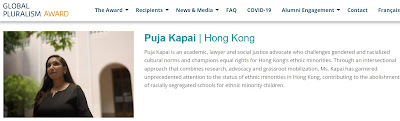
Congratulations to Puja Kapai, the recipient of 2021 Global Pluralism Award!

Congratulations to Puja Kapai who has won the prestigious 2021 Global Pluralism Award from the Global Centre for Pluralism, an international research and education centre in Canada. The Award celebrates exemplary achievements in building more inclusive societies where diversity is protected. This year 500 nominations spanning 70 countries were received and Puja received the award for her research, advocacy, and mobilization in the advancement of the equal rights of Hong Kong’s ethnic minorities, women and children. Another 2 awardees are a school project promoting Jewish-Arab education in Israel and an organization in Kenya helping the historically excluded communities to access even the most basic services.  Click here to view the Virtual Ceremony that was held with remarks from the Right Hon. Joe Clark who was chair of the international jury for the award.
     “I am most humbled to receive the Global Pluralism Award,” Puja Kapai said. “By honouring my work in advancing social justice in relation to race, gender and minority rights, the Award renders visible the lived realities of all those who are routinely marginalised and experience systemic exclusion and discrimination in nearly every sphere of life. The Award also signals the responsibilities we each carry to begin the journey of inclusion, acceptance and pluralism at home.”
     Puja Kapai is an academic, lawyer and social justice advocate who challenges gendered and racialised cultural norms. An HKU alum who grew up in Hong Kong, she is also Convenor of the HKU Women’s Studies Research Centre, which advocates around issues of gender, sexuality and diversity as well as Director of the Faculty’s Social Justice Summer Internship program which partners with students and NGOs working on gender-based violence, human trafficking and migration, ethnic minorities, children’s rights and COVID-19 related inequalities to conduct research and develop related recommendations to drive policy change. Growing up as an ethnic minority child in racially homogenous Hong Kong, Kapai faced barriers to education from an early age; these experiences inspired her to break these barriers as an advocate, attorney, and legal scholar.

Friday, April 16, 2021

Weixia Gu on Multi-Tier Approaches and Global Dispute Resolution (Japanese Yearbook of International Law)

"Multi-Tier Approaches and Global Dispute Resolution"
Weixia Gu
Japanese Yearbook of International Law
Published in 2020, Volume 63, pp. 147-166
Introduction: There are many ways disputes in the commercial world can arise, and as many ways they can be resolved.   Just as different methods of alternative dispute methods have attracted more and more attention.
     The Queen Mary University of London and White & Case LLP 2018 International Arbitration Survey ("QMUL Survey 2018") findings reveal that "there has been a significant increase in the combination of arbitration with ADR.   Nearly half of the participants to the 2018 survey preferred the hybrid approach, as compared to just 35 percent in the 2015 survey findings.   This is unsurprising in view of the benefits of using mediation as a prerequisite to starting arbitration.   The mediation step allows for a "cooling off" period for parties, thereby avoiding the escalation of disputes for adversarial resolution as an immediate recourse.   It also has a filtering effect: only the "truly" contentious issues in dispute proceed for resolution by arbitration.   Overall, thus, the mediation prerequisite increases the prospects of preserving the parties' commercial relationship.  Indeed, the QMUL Survey 2018 findings support the general dispute-avoidance mentality of business parties.  Within the in-house counsel sub-group, it is reported that there is "a clear preference" for the twinning of international arbitration and ADR (60 percent) over international arbitration as a stand-alone mechanism.
        As the 2018 Pound Conference Report further reveals, there is now a global interest in using mixed mode of dispute resolution.  Hybrid dispute resolution usually features a combination of mediation and arbitration into a dispute resolution framework with multiple stages.  These multi-layered modes of dispute resolution can thus be called "multi-tier dispute resolution" ("MDR").  However, despite its widespread popularity, the development of MDR has followed different pathways around the world.  This essay aims to provide a global survey of the development of MDR.  The essay comes in four parts.  Part I would first introduce the concept and procedure of MDR.  Part II then explores how MDR is developed around the world from a regulatory perspective.   Afterwards, Part III would turn to examine the specific situation in some of the world's most prominent legal jurisdictions in the East and West.  Last but not the least, Part IV provides some comparative observations on the trend in the global future of MDR.   

Monday, August 20, 2018

Stacy Douglas & Dan Matthews on Sovereignty, Affect and Being-Bound (new book chapter)

Stacy Douglas &  Daniel Matthews
in Daniel Matthews & Scott Veitch (eds), Law, Obligation, Community (Routledge, June 2018), Chapter 7, 22 pages
Introduction: If ever it left us, sovereignty has returned. The protectionist and nativist instincts that helped propel Donald Trump into office have been felt throughout the Western world as new nationalisms have forced themselves into the political mainstream. The promise of post-national identities, global flows of people and capital, and the weakening of the ‘bright lines’ of state control have been met by a forceful resistance that foregrounds local interests and concerns, often depends on ethnically defined notions of identity and clings fervently to nationalistic histories and modes of belonging. Whilst we might dismiss some of these movements as being motivated by atavistic fears of difference, there is a powerful sense that the events of 2016 represent the high watermark for the form of turbo-charged globalisation let loose as the Berlin Wall fell and the ‘new world order’ took hold in the early 1990s. As Kyle McGee argues, the West is suffering from a loss of both ‘place’ and ‘land’ as the dual forces of globalisation and global warming put extant forms of attachment to locale and community under erasure (McGee 2017). In such conditions, the allure of sovereignty with its promise to ‘take back control’, as the Brexit campaign had it, is quite understandable. If ‘waning sovereignty’ (Brown 2014) has accompanied these ‘twin vertigoes of placelessness and landlessness’ (McGee 2017, p. 128), its recent revival offers – some would believe – a line of defence against the forces of globalisation and the increasing precarity this brings. Against this background we engage with the theme of obligation in two ways.
     First, we explore the ways in which juridically enforceable obligations installed and defended by modern constitutional sovereignty are crucial to giving shape to the affective life of a community. We approach sovereignty through the sentiments that it produces – or claims to produce – and the particular effect that it has in enframing the world and giving scope to a sense of our political attachments and modes of belonging. We dwell on the sensibilities associated with sovereignty and on how the mobilisation of the rights and duties associated with the protection of sovereignty affectively enframes the way a political community attaches to place, past and an imagined future. 
     Second, continuing our emphasis on the register of affect, we explore a sense of ‘being-bound’ that both precedes and exceeds juridically defined obligations. The binding quality of obligations – evidenced in the root word ligare, which we find in ligature, ligament, allegiance and religion – limited notion of an obligation at law. It is this more expansive sense of ‘being-bound’ that we explore in what follows, underscoring the affective, political and existential dimensions to the bonds that give form to collective life. Ultimately, we are interested in unsettling the affective life of sovereignty, in revealing and attuning our selves to a sense of ‘being-bound’ that challenges sovereignty’s power to recentre an autonomous legal subject, and its attendant national community, within an anthropocentric horizon. Such a horizon is today increasingly compromised. In particular, the ‘twin vertigoes’ of globalisation and climatic change ought to attune us to a set of relations that transcend the assumed bifurcation between human and non-human life, ushering in a sensitivity to the bonds that sustain habitability beyond the limited set of relations honoured by modern sovereignty. 
     We find possibilities for such an unsettling of sovereignty’s affective force in artistic practices coming out of South Africa, namely in the work of J. M. Coetzee and Nandipha Mntambo, and explore the implications of their work for rethinking what it means to ‘be-bound’ beyond the juridical proscriptions associated with sovereignty. The complex challenges associated with the constitutional settlement in South Africa is not our central concern. Rather, by attending to the practices of two artists working within this context we hope to shed light on a broader problematic. The oldest questions of legal and political theory – the nature of the body politic, the territorial limits of political power and the aspirations of the common good – are today being reposed with a renewed urgency. It is our contention that turning to art and literature helps unseat the predominant affective disposition installed by contemporary juridico-political techniques. We think that the South African case, as it has been tumultuously unfolding for the past nearly 25 years, can offer some important insights here, especially as it demonstrates how the affective force of sovereignty reaffirms a deeply held anthropocentricism that we must today begin to challenge if we are to avoid an eternal return of well-worn scripts that equate constitutional sovereignty with justice. We begin by unpacking our approach to affect before moving to discuss sovereignty, South Africa, Coetzee and Mntambo.

Monday, September 26, 2016

Scott Veitch Comments on Hans Lindahl's Fault Lines of Globalization (Jurisprudence)

"A comment on Hans Lindahl, Fault Lines of Globalization: Legal Order and the Politics of A-Legality"
Scott Veitch
Jurisprudence
2016, Vol. 7, Issue 2, pp 409-418
In his book about ‘Who owns Scotland and how they got it’, Andy Wightman tells the story of a miner walking home one night with a couple of pheasants in his jacket when he gets stopped by the landowner. ‘This is my land’, the laird tells him, ‘and my pheasants, so hand them back’. The miner says, ‘Your land—how did you get it?’ ‘I inherited it from my father’, says the laird. ‘And who did he get it from?’ ‘From his father; this land has been in our family for four hundred years.’ ‘And how did they get it then, four hundred years ago?’ ‘Well’, says the laird, ‘they fought for it’. ‘Fine’, replies the miner. ‘Take your jacket off and I’ll fight you for it now.’
     Sometimes situations or events rupture the routine expectations we have and which we behave in accordance with. In doing so they can expose the grounds on which these expectations rest, and they may force us to consider in a new light what has been extensively taken for granted. In responding to such an experience it is sometimes a matter of re-adjusting, of shifting the cognitive framework, of re-interpreting. Other times, the jolt is more serious and cannot be readily assimilated. In the shock it produces, there is a sense of unease, a sense of strangeness—which is sometimes registered in uneasy laughter—that will not easily go away. The story of the miner and the landowner might work in this way. Landholding is not something we take our jackets off and fight for. It is regulated by the laws of property, inheritance, title registration and the like. Except, that at some point it isn’t, or wasn’t. That property in land is gained, at some time in the past, by violence or theft is not likely to be disputed; but it does commonly have to be forgotten. This goes as much for continents—Australia in 1788, for example—as it does for landed estates (and the birds that just happen to live on them). To be too-reminded of this however provokes a sense of disorientation. And precisely because of this, it feels like something must be done about it by way of response. But what exactly? Even that greatest of philosophers of consistency, Immanuel Kant, in noting the same problem about theft and property, was forced to respond in a most unphilosophical way: ‘Best not to dwell on it’, he said, ‘just start from where we are and what we’ve got now’. (Perhaps someone should have asked Mr Kant to take his jacket off … )
     Where exactly the boundary between property and theft is drawn—between what is a legal gain and what an illegal one—seems to have a degree of contingency to it. But that there is such a boundary, which must be established if we are to have settled—or ordered—ways of acting with respect to each other and things in our society, appears however, to be necessary. Yet this very necessity seems, in turn, to have something of the contingent about it—in the origins of landed property, a taking, say, that is, from the perspective of the order it brings into being, itself neither legal nor illegal: in Australia, a non-justiciable act of sovereignty that ‘founds’ the nation and its law; or in the case of the laird’s ancestor, the founding of right on the basis of might...

Wednesday, September 21, 2016

Farzana Aslam on Balancing Global Concerns with Local Issues (SCMP)

South China Morning Post
19 September 2016
With six “localists” among winners of the Legislative Council election in Hong Kong, following on the heels of Brexit, the nomination of Donald Trump as the Republican candidate for US president, and the rise of populist politics across Europe, it is tempting to think that the era of globalisation is coming to an end, or is at least facing an alarming backlash.
     Hong Kong “localists” are outspoken over the question of autonomy, but the political platform upon which they have garnered support is a protest against the establishment and its failure to address the pressing social issues that affect Hong Kong as a community – namely, rising inequality, the lack of affordable housing and the public’s perception that government is serving the interests of big business at the expense of the increasing ranks of the poor. It is a common thread that runs through all political shifts occurring around the globe.
      Outside of Hong Kong, the rhetoric has been squarely directed against globalisation, specifically international trade and open borders allowing the free flow of capital and people. This, however, is to equate the forces of globalisation with the forces that drive inequality, the stagnation of real incomes, the erosion of job security and of welfare services provided by the state.
      Politicians worldwide have been too ready to invoke globalisation as the cause of their domestic woes, when the reality is that the decline in the prosperity and social well-being of the average citizen of these nations has been the result of deliberate domestic policies promoted under the banner of globalisation... Click here to read the full article.

Thursday, February 18, 2016

Johannes Chan on Legal Education in Hong Kong

"Legal Education in the Global Context: The Case of Hong Kong"
in Christopher Gane and Robin Hui Huang (eds), Legal Education in the Global Context: Opportunities and Challenges (Ashgate 2015) 
Overview: The Impact of Globalization
      Partly as a result of globalization, a few recent trends in legal education are noticeable. Firstly, the pace of changes in the modern era is unprecedented. On the one hand, knowledge has a much shorter life-span these days and factual knowledge becomes outdated much more quickly than before. On the other hand, many new problems have emerged that require innovative solutions within a very short period of time. The advance of modern technology and means of communication, which present a new virtual world with novel and complex legal relationships is a prime example. Secondly, advances in technology mean that a huge amount of information is available on any topic. It also greatly shortens the distance between different legal systems and legal cultures. Very few legal systems can be insulated from external influences these days, and there is an increasing need for knowledge and familiarity of legal systems other than that of our own. Thirdly, legal issues have become increasingly multi-disciplinary in nature. Climate change, town planning, trade relations and so on are just some obvious examples. Fourthly, it is rare these days that graduates will stay in one career throughout their life. Instead, we have seen university graduates, and not just law graduates, have become or have to become increasingly versatile. It is also an increasingly popular phenomenon that law graduates, by their own choice, decide not to stay in, or even enter into legal field. 
     As legal education has become increasingly globalized and competitive, more and more legal education institutions are adopting an outward looking attitude. This has enhanced academic collaboration and exchange, to the benefit of both students and teachers. The other side of the coin is that tertiary institutions are increasingly concerned about international ranking. Education is to be quantified so that they can be compared and ranked. Factors that are more difficult to measure such as quality of teaching or impact on students tend to be ignored, or worse, twisted for the sake of quantification... Contact the author for a copy.