Showing posts with label Article 23. Show all posts

Wednesday, February 28, 2024

HKU Law Scholars Make Submissions on the 2024 Article 23 Bill and Consultation Paper

In January 2024, the Security Bureau of the HKSAR Government released its long-awaited Public Consultation Document on Basic Law Article 23 national security law proposals (“Safeguarding National Security: Basic Law Article 23 Legislation”). On 8 March 2024, the Safeguarding National Security Bill was presented to the Legislative Council for first and second reading.  Scholars in the Faculty of Law have prepared written submissions (and articles) on the proposals contained in the consultation paper and bill. This commentary can be accessed below.

Albert Chen: Ming Pao 1, Ming Pao 2
Simon NM Young: Submission on the Bill (Chinese Translation on HK01), Submission on the Consultation Paper (Chinese Translation on HK01).  In anticipation of the passage of the Safeguarding National Security Ordinance, Professor Young shared these comments on the new law with various media outlets:
"The Safeguarding National Security Ordinance is plainly intended to deter people from taking any step that might put national security at risk. It achieves this with tough sanctions and special restrictive procedures if one gets caught up in the system. It completes the national security ecosystem which began with the 2020 National Security Law making the system now intensely robust. Once the law is passed, the Central Government will rest assured that there are comprehensive and suitable measures in place in Hong Kong to suppress any threats, whether they be external or internal, to the stability and safety of the country.

For most Hong Kong people, the new law will have little relevance and impact on their daily lives. There are four categories of persons who are likely to be impacted and will need to take more care and be familiar with the requirements and contours of the new law. They are as follows: (a) public officers; (b) government contractors; (c) those who have regular dealings with external forces; and (d) those already within the system or within the radar of the national security authorities.
For categories (a) and (b), the new provisions on state secrets and espionage will need to be closely studied. Category (c) could include a wide range of persons and companies, including academics and journalists. For the most part, the cooperation that tends to happen with external forces already will not lead to any liability under the new law. But if the cooperation tends towards advocating for policy or legal changes in Hong Kong or is simply critical of the Hong Kong or Central governments, then the new offences of espionage and external interference may well be applicable.
As for (d), there would be different sub-categories of persons depending on how far one is within the system. If one is already serving a sentence for a national security offence, unfortunately the time they need to serve will effectively be extended unless they can demonstrate no risk to national security if released with remission. For those facing charges, there will no longer be the option of a suspended sentence of imprisonment. Those who are arrested for a national security offence will also face a more restrictive set of procedures in relation to pre-charge detention, restrictions on accessing a lawyer, a greater hurdle in obtaining bail, and restrictions on movement if granted bail.

As for the legislative process, the Administration invested much effort and labour at the front-end of the exercise in preparing both the Consultation Paper and Bill. There was a dedicated team in Government, including the Secretary for Justice and Secretary for Security, who dutifully attended the long and intensive meetings held in LegCo. The Bills Committee members asked questions about all aspects of the Bill and replies were given. The questions tended towards having the Bill clarified or loopholes closed. The Government agreed with some of these comments and came up with proposed amendments. I would not say it was a rubber-stamping exercise. But fewer comments from legislators were directed to making the law less restrictive; hence we do not see any proposed amendments to this effect. In the past, LegCo Bills Committee meetings, on politically sensitive topics, would be much more fractious, with filibustering and other obstructions to the proceedings. Hence proceedings would have been much longer. Sadly some of the antics in the past would have drown out the more constructive yet critical comments that more moderate opposition legislators were making. In the past, the Bills Committee might also have called for deputations from experts in the community including from the legal profession and law schools. It is regrettable that this was not done on this occasion. I believe legislators would have benefited from such expert input given that the issues involve technical and complex questions/implications of criminal law, procedure and evidence."

Sunday, May 31, 2020

Johannes Chan Comments on the National Security Law (RTHK English News)

'Naive to think new law will target a small group'
28 May 2020
Legal scholar Johannes Chan said on Thursday that it is naive to think the national security law that Beijing is planning to impose in Hong Kong will affect only a small group of people, saying what constitutes 'national security' has never been defined.
     “In China they never really define what exactly is 'national security'. So the law could change according to political expediency or political necessity,” he said.
     "We don't know if it will be more clearly defined in the coming law but in accordance with their tradition and the current scope, it could be exceedingly wide," Chan said, adding it is naive to think the law will only apply to only a small group of people.
     The legal scholar also said he doubts if the central government will accept unfavourable rulings by Hong Kong courts linked to the new security law.
     “If some of the law's scope is too wide and the Hong Kong courts said it is in violation of the Basic Law, human rights protection, or the Bill of Rights and strike it down, and if that happens what will the central government do? Will they just clap their hands and say ‘well done’ or are they going to interfere?” he asked.
     Chan said the plan to impose national security legislation will put Hong Kong's courts in a difficult position.
     He said he fears the scope of jurisdiction will be substantially limited by the laws to be drafted by the National People's Congress Standing Committee, as it has the ultimate power to interpret them.

Thursday, March 19, 2020

Danny Gittings on Unpalatable Realities and Hard Choices - Hong Kong's Article 23 (new book chapter)

"Unpalatable Realities and Hard Choices"
Danny Gittings (PhD candidate)
Chapter 16, pp. 297-306
Introduction: The unmistakable message running through the chapters in Part III of this book is that any fresh attempt to enact comprehensive Article 23 legislation is virtually certain to pose far greater challenges to Hong Kong's rule of law and freedoms than its 2003 predecessor. While that, ultimately abandoned, legislative effort was rightly seen as posing significant challenges at the time, for all its flaws many of the offences proposed during that earlier exercise were confined to conduct that means, with the latter defined by reference to anti-terrorism legislation. Then Chief Executive Tung Chee-hwa's administration was careful to stress that the 'mere expression of views' would not have been outlawed under the National Security (Legislative Provisions) Bill 2003, unless this incited others to use either force or serious criminal means...

Thursday, March 5, 2020

New Book: China's National Security: Endangering Hong Kong's Rule of Law? (Cora Chan & Fiona de Londras)

China's National Security: Endangering Hong Kong's Rule of Law?
Editors: Cora Chan & Fiona de Londras
Hart Publishing
March 2020, 356 pp.
Description: All states are challenged by the need to protect national security while maintaining the rule of law, but the issue is particularly complex in the China–Hong Kong context. This timely and important book explores how China conceives of its national security and the position of Hong Kong. It considers the risks of introducing national security legislation in Hong Kong, and Hong Kong's sources of resilience against encroachments on its rule of law that may come under the guise of national security. It points to what may be needed to maintain Hong Kong's rule of law once China's 50-year commitment to its autonomy ends in 2047.
   The contributors to this book include world-renowned scholars in comparative public law and national security law. The collection covers a variety of disciplines and jurisdictions, and both scholarly and practical perspectives to present a forward-looking analysis on the rule of law in Hong Kong. It illustrates how Hong Kong may succeed in resisting pressure to advance China's security interests through repressive law. Given China's growing international stature, the book's reflections on China's approach to security have much to tell us about its potential impact on the global political, security, and economic order.
     This book is the output of a collaborative project based in the Centre for Comparative and Public Law.  Faculty contributors included Cora Chan, Albert Chen, Hualing Fu, Simon Young, Johannes Chan, Danny Gittings (PhD candidate) and Yash Ghai.

Albert Chen on the Project of 'One Country, Two Systems' and the Question of National Security (new book chapter)

"Hong Kong in China: the Project of 'One Country, Two Systems' and the Question of National Security"
Introduction: In July 2017, Hong Kong celebrated the 20th anniversary of the establishment of the Hong Kong Special Administrative Region (HKSAR) of the People's Republic of China (PRC). In October 2017, the 19th National Congress of the Chinese Communist Party was convened, at which General Secretary Xi Jinping outlined a grand vision for China's strategic development all the way up to the middle of the twenty-first century. The vision was termed 'socialism with Chinese characteristics for the new age. It consists of 14 policy components, and the 'one country, two systems' policy is one of them. What was this policy originally and how has it been implemented in the case of Hong Kong? What is the status of Hong Kong as a special administrative region (SAR) of the PRC? What is the nature of Hong Kong's 'high degree of autonomy' - a term used in both the Sino-British Joint Declaration on the Question of Hong Kong (1984) and the Basic Law of the HKSAR of the PRC (1990)? How does the Basic Law seek to protect China's national security and limit Hong Kong's autonomy for this purpose? This chapter explores these questions. 
     Although the HKSAR is our focus, it should be borned in mind that Hong Kong is one of the two SARs of the PRC, and the other SAR is Macau. Following the reunification of Hong Kong and Macau with China in 1997 and 1999 respectively, the structure of the PRC consists of a national or central government, and at the level directly below it, 27 provincial governments (including the governments of five autonomous regions but excluding Taiwan), four governments of municipalities directly under the Central Government, and two governments of the SARS (Hong Kong and Macau).
     Chinese scholars have always stressed that PRC is a unitary state. It is not a federal system; there is nothing in the PRC Constitution that provides for a formal division of power between the national Government and the provincial, municipal, and SAR governments. That is, there is no constitutional limitation on the capacity of the national Government to exercise power with regard to any matter within any province, city or SAR pf the PRC. However, since the enactment of the Basic Laws of the HKSARs of Hong Kong and Macau, the powers that the Central Government may exercise with regard to the SARs have been constrained by the Basic Laws. It can be argued that the concept of an SAR within the PRC with a high degree of autonomy, and the related policy of 'one country, two systems' represent a substantial modification of the original model of a highly centralized unitary state...

Simon Young on Old Law in New Bottles: Reintroducing National Security Legislation in Hong Kong (new book chapter)

"Old Law in New Bottles: Reintroducing National Security Legislation in Hong Kong"
Introduction: It is unthinkable that any future legislative exercise to reintroduce national security legislation in Hong Kong would start from a clean slate. To do so would be to ignore the considerable amount of intellectual work and public debate that went into the 2003 proposals. Those proposals had imperfections, but they also had some merit in proposing to modernise existing offences and abolish laws that, if used, would impinge on fundamental rights protected in the Basic Law. However, just as it would be foolhardy to disregard the 2003 proposals, it would be equally so to believe those proposals could be reintroduced without change; they are now old bottles for old wine. Important developments since 2003 in the legal and political contexts of China, Hong Kong and Macau need to be taken into account in any future exercise. Relevant international developments in anti-terrorism laws should also inform law-making deliberations.
     This chapter considers the shape of new bottles for the old law of national security in Hong Kong. It identifies important local and international developments relevant to any future Article 23 legislative exercise, particularly two of the controversial proposals of 2003 concerning the offence of secession and the proscription mechanism for foreign political organisations. It will be argued there is no justification for reintroducing the proscription mechanism and its accompanying criminal offence. As for the secession offence, the 2003 proposal can be made legitimate by drafting the terms more clearly and keeping the scope within tighter limits. It is further argued that notwithstanding the rise in pro-independence sentiments amongst a small number of people in Hong Kong, introducing an additional offence criminalising the advocacy of secession would be unjustified and highly problematic.
     The chapter begins with a review of significant legal developments since 2003. First there is the case law of the Court of Final Appeal (CFA), from which can be derived a set of legislative guidelines for drafting national security offences. Next there are the legislative developments in mainland China and Macau related to national security. Finally, the consequences and experience of post-9/11 antiterrorism legislation may shed light on the merits of adopting similar procedural mechanisms. Following this review, proposals for the secession offence, required by Article 23, and a proscription mechanism for individuals and bodies on national security grounds are discussed having regard to the developments since 2003 particularly the legislative guidelines proposed in this chapter...

Cora Chan and Fiona de Londras on Building Rule of Law Resilience Through Institutions; A Proposed Institutional Infrastructure for National Security Legislation (new book chapter)

"Building Rule of Law Resilience Through Institutions; A Proposed Institutional Infrastructure for National Security Legislation"
Cora Chan and Fiona de Londras
Introduction: Institutions can help to embed and protect the rule of law, even in the face of seemingly oppressive and worrying legislative moves to 'protect' security. Of course, many of those institutions - courts, the legal profession, the international human rimight infrastructure - have already been canvassed in this collection as possible bulwarks against the encroachment of China's national security on Hong Kong's rule of law. However, in this chapter we wish to propose the construction of a new institutional architecture that is designed systematically to build rights-based and rule of law concerns into the context in which an Article 23 law or similar legislation would operate and China's national security imperatives might 'leak' (formally or informally) into the law, politics and practice of governance in Hong Kong. As is well-known, Article 23 of the Basic Law provides that Hong Kong shall enact law on its own to prohibit any act of treason, secession, sedition, subversion, against the Central People's Government, or theft of state secrets, to prohibit foreign political organizations or bodies of the Region from establishing ties with foreign political organizations or bodies. This is widely understood as an obligation to introduce national security law in Hong Kong, although that obligation has not yet been fulfilled. 
     In undertaking our task in this chapter, we recognize that institutions alone are not sufficient to reorient process of law, policy and operation that have at their heart an oppressive approach to protecting national security that suppresses, among other things, political dissent and organizing. However, neither is the text of a law itself, so that even if - as has been widely proposed - an Article 23 law is drafted in a way that minimizes its potential disruption to the ordinary criminal law and the rule of law, institutions will still be important as it is through them that the law will be interpreted, applied, reviewed, revised, resisted and realised. Institutions are the places where everything happens; state power flows through institutions (such as police forces, intelligence agencies and executive bodies), is formally constrained through institutions (such as courts and political institutions), and is called to account also through informal institutions (such as civil society and the electorate). Thus, we start from the institution that institutions founded on sound principles, effectively constructed, and independent in their operations - that is, institutions that are 'strong' in the language of the Sustainable Development Goals - have the capacity at the very least to inculcate participatory, reflexive, right-based modes of working that in turn may temper the operation of repressive security laws and policies. 
     We start this chapter by considering the role of institutions in a system that is committed to sustainable security, and then consider the existing institutional infrastructure in Hong Kong in the light of this. That consideration reveals system concerns that, we argue, must be addressed if there is to be any chance of Article 23 legislation or the like being something less than a license for oppressive governance by Beijing in Hong Kong. Some of those difficulties are reflections of broader challenges of constitutional infrastructure between Hong Kong and Beijing which take on a particular urgency and challenge in the context of security, while others are subject specific, focused on the particular dynamics and anxieties of security as a rhetoric and a mode of governance. Having mapped the challenge around institutional infrastructure in these first two parts, we then go on to propose a new institutional architecture within which national security laws in Hong Kong might operate, arguing that it should be designed to achieve four key aims: effectiveness, accountability, transparency and participation.
     In this exercise we are purposefully not constrained by concerns of what is politically likely or feasible; instead, we aim to map out an institutional model to which, we argue, Hong Kong should aspire if the 'one country, two systems' model of constitutional pluralism and accommodation that underpins the relationship with China is to sustain in the security context. However, this is not to suggest that we assume a benign or governance-oriented disposition on the part of Beijing to institutions within which a national security law might operate, we recognize that, to a government so inclined, 'strong' institutions might mean institutions that bolster its power and approach to security. As clearly outlined by Hualing Fu in this collection, China's approach to national security is one in which many of the fundamental elements of politicisation, resistance, dissent, and protest that attempt to discipline state security power in other contexts are, themselves, susceptible to being seen as security risks that require suppression. In other words, we know that institutions have capacity to compound oppressive and repressive regimes. They do not, in and of themselves, guarantee or even provide forms of transparency, accountability, reflection and participation that we will argue are the hallmark of the kinds of institutions that might provide resilience to the rule of law of Hong Kong, or, indeed, elsewhere. Nor do they 'have minds of their own.' Instead, institutions (just like laws and all other elements of governance) are deeply dependent on political commitment to their effective deployment towards the goal of maintaining security while respecting (and strengthening) the rule of law. We are acutely aware that such commitment cannot be assumed in the context of the China - Hong Kong relationship...

Yash Ghai and Jill Cottrell on Security, Economy, Politics: The Chinese Agenda (new book chapter)

"Conclusion: Security, Economy, Politics: The Chinese Agenda"
Yash Ghai and Jill Cottrell Ghai
Chapter 17, pp 307-332
Introduction: The story of Article 23 of the Basic Law governing, in part, the relationship between China and Hong Kong, is largely a reflection of the changes in China's perception of its standing at home and abroad. At first China accepted the Basic Law as governing its relationship with Hong Kong and largely adhered to the commitment to ensure Hong Kong's autonomy for 50 years. The Chinese authorities had been greatly disturbed by the impact of the student rebellion in Tiananmen Square, and put it down with great violence including considerable loss of life. Seeing Hong Kong people's strong condemnation of the crackdown, China worried that Hong Kong might become a base for subversion, and hence strengthened the wording of Article 23 of the Basic Law with an aim to desist foreign interventions. The situation is now somewhat different. China, on the whole, welcomes intimate relations with leaders of foreign states and enjoys greater international standing than it did in the 1990s. It also seems less inclined to treat itself as bound by the Joint Declaration and the guarantee of Hong Kong autonomy, and as other chapters in this collection have shown, seems quite wiling to intervene in Hong Kong affairs, including through interpretations of the Basic Law.
     In this concluding contribution to the collection, we discuss the impact of China's economic and global policies on the development of close relationships with foreign states, in spite of the scepticism of citizens in those states as well as in Hong Kong.  In particular, we will argue that China's global economic and investment approach - and especially the Belt and Road Initiative (BRI) - is strengthening its relative international position and as a result, that the people of Hong Kong may find themselves less able to call on international solidarity to ensure that China respects and gives effect to Hong Kong's autonomy, with potential negative implications for the Rule of Law.  The discussion in this chapter reveals that China is coherent in its domestic and global policies through which it aims to extend control in political, security and economic terms (echoing the Chines regime's priority on advancing 'sovereignty, security, and development interests').  China's treatment of Hong Kong therefore makes for interesting comparisons with, and shed lights on, China's activities in the international political, security and economic order...
        

Thursday, March 1, 2018

Reviving Article 23: Two-Part Story on Hong Kong's National Security Debate (Hong Kong Free Press)

Elson Tong (JD candidate)
17 Feb 2018
Hong Kong Free Press
“As long as we work on the basis of ‘loving the country and loving Hong Kong’, there will always be hope,” said the city’s outgoing Secretary for Security at a dinner in Wanchai’s Grand Hyatt, organised by various pro-Beijing trade unions. “But sometimes I see an unhealthy wind blowing across society. People mix up what is right and what is wrong, what is black and what is white. I even sense a Cultural Revolution-era mentality and language in some of the media.” The speech was not delivered in 2017 - but in the pivotal year of 2003...
     With these existing laws in mind, scholars such as Hong Kong University professor Johannes Chan are sceptical as to whether – by asking Hong Kong to “enact laws” – Article 23 really means that the government has to table a fresh bill.
     “We shouldn’t say that Hong Kong has failed to fulfil its constitutional duty under Article 23. We should ask whether existing laws already do so,” Chan told a conference last March...
     At the time, Regina Ip and Elsie Leung respectively led the Security Bureau and the Department of Justice. But Hong Kong University professor and prosecutor Simon Young told HKFP that colonial-era British officials, like solicitor-general Robert Allcock, were more involved as hands-on drafters for the bill. ... Click here to view the full article.

"Reviving Article 23 (Part II): Old wine in new bottles for Hong Kong’s national security debate"
Elson Tong (JD candidate)
18 Feb 2018
Hong Kong Free Press
In December 2017, Hong Kong’s pro-democracy lawmakers – who were six members short after some were ousted by the courts – fought a lost cause to prevent their pro-Beijing colleagues from changing the legislature’s house rules. Henceforth it would become much harder to filibuster controversial bills. ...
     Hong Kong University law professor Eric Cheung speculated that the motive for this document was to strip Hong Kong courts of their oversight of the arrangement. He added that Beijing may do the same thing to stop future Article 23 national security laws from being judged unconstitutional for any violations of protected rights and freedoms...
     Mainland constitutional law professor Fu Hualing told attendees that in pushing for a national security law, Beijing’s aim is now to suppress Hong Kong’s pro-independence movement.
     “The Falun Gong, for example, disappeared entirely from the field of debate,” he told HKFP. “I think Hong Kong will continue to be a foundation for activities within mainland China… like civil society development, working with NGOs.”...
     A national security bill only requires the support of a simple majority in the legislature to be voted into law. The pro-Beijing camp has always obtained over half of the seats. Therefore, few legislative obstacles exist to the passing of a law that would criminalise mere speech.
     However, Hong Kong University criminal law professor Simon Young told HKFP that the courts can refuse to enforce vague or otherwise unconstitutional laws.
    “The courts could say that the provision is so vague that it violates the principle of legal certainty… because it gives no indication to anyone what the law is, and you can’t regulate your conduct accordingly… But that rarely happens.”
    “The second thing that they can do is [to say] that there are provisions or aspects of the law that violate specific constitutional rights, whether it’s the freedom of expression or the presumption of innocence.” A judge would then either strike down the provision, or employ more lenient legal tests favouring the accused...
     His colleague Albert Chen told attendees at the December conference that under Article 17 of the Basic Law, the National People’s Congress Standing Committee (NPCSC) might invalidate a Hong Kong security law and ask for new legislation if it deems the provisions unsatisfactory...
     Click here to view the full article. 

Thursday, April 6, 2017

Proceedings of CCPL's Article 23 Roundtable (Aug 2016) Now Available

In August 2016, the Centre for Comparative and Public Law of the Faculty of Law of The University of Hong Kong organised a closed-door academic roundtable on Article 23 of Hong Kong’s Basic Law, the provision that requires the Hong Kong Government to enact national security legislation. This roundtable is one of the few major academic events on the subject since the Government’s failed attempt to implement the provision in 2003.
     The written proceedings, video recording, participants’ brief, and written submissions are now available here.  The speakers included:
Ms Amy Barrow, The Chinese University of Hong Kong
Ms Cora Chan, The University of Hong Kong
Professor Albert Chen, The University of Hong Kong
Mr Eric Cheung, The University of Hong Kong
Ms Surabhi Chopra, The Chinese University of Hong Kong
Professor Michael Davis, Centre for Comparative and Public Law, The University of Hong Kong
Professor Fiona de Londras, University of Birmingham
Professor Fu Hualing, The University of Hong Kong
Mr Danny Gittings, HKU School of Professional and Continuing Education
Dr Denis Halis, University of Macau
Dr Eric Ip, University of Hong Kong
Dr Huang Mingtao, Wuhan University
Dr Margaret Ng, Barrister-at-Law, Hong Kong
Mr Malik Imtiaz Sarwar, Malik Imtiaz Sarwar Advocates & Solicitors, Malaysia
Ms Puja Kapai, The University of Hong Kong
Professor Lin Feng, City University of Hong Kong
Dr Lo Pui Yin, Barrister-at-Law, Hong Kong
Professor Carole Petersen, University of Hawaii
Mr Benny Tai, The University of Hong Kong
Ms Doreen Weisenhaus, The University of Hong Kong
Professor Simon Young, The University of Hong Kong

Sunday, March 15, 2015

Guide to Basic Law Article 23: Hong Kong's Unresolved National Security Issue

HKU Press 2005
The year 2015 has seen the re-emergence of Hong Kong's Article 23 issue. It has been almost 12 years since the Hong Kong government withdrew its national security bill after a massive protest.  Those events in 2003 were a defining moment in Hong Kong's post-1997 history and have contributed in significant ways to who and what we are now as a special administrative region of China.
     The February 2009 passage of Macau's Article 23 legislation under very different conditions has added to the pressure on Hong Kong to re-introduce proposals. National security concerns were explicitly mentioned in the restrictive political reform decision of 31 August 2014 by the Standing Committee of the National People's Congress. In January 2015, a Hong Kong deputy to the National People's Congress, Mr Stanley Ng, advocated the application of China's national security law to Hong Kong pending the enactment of local legislation.  Despite the obvious constitutional difficulties with such a proposal, it reflected a growing frustration in some quarters over the issue, especially after the Occupy Central protests in 2014.  Rumours circulated that the next Chief Executive elected in 2017, whether by universal suffrage or not, will have the unenviable job of implementation.  
     The terms of Article 23 provide as follows (numbers added only to highlight the seven requirements):
The general view in government is that Article 23 is a political hot potato that gets many people angry and can destroy ministerial careers.  Many in the public see the issue as a serious threat to civil liberties imposed by the Chinese Communist Party and should be avoided as long as possible if not forever.  In this article, to mark the 10th anniversary our edited collection on Article 23 published by HKU Press, I present a different view, that implementing Article 23 is an opportunity for legislators (especially pan-democrat ones) and the Hong Kong and central governments to rebuild mutual trust that has been badly damaged as a result of the universal suffrage reform debate.  People forget how close we were to passing the legislation in 2003 after the government made its major concessions at the final hour.  Those concessions removed the most objectionable aspects of the proposals.  The passage of time has also demonstrated the absence of need for some of the proposals, such as the proscription mechanism against local organisations.  In the review below, I reconsider each of the Government's proposals for the seven requirements of Article 23, discuss their criticisms, and identify constructive steps forward.  (Note: references are to pages in the HKU Press book.)

1. Treason
a. What law exists now?
Reflecting its English law origins, Part I of the Crimes Ordinance (Cap. 200) criminalises the offence of treason (s. 2) and other related offences, including treasonable offences (s. 3) and offences against the person of the sovereign (s. 5).  There are also common law offences of misprision of treason and compounding treason.
b. What was proposed in 2003?
The Government proposed to repeal all treasonable offences (s. 3), abolish the two common law offences, and replace the existing s. 2 treason offences with the following new provision shown below.  It was notable that the new offence would only apply to Chinese nationals, but secondary parties to the offence could be non-Chinese nationals. 
c. What did commentators think of the proposals?
The proposal was mostly well received, for it significantly narrowed the net of criminal liability from that cast by the existing offences, and it phrased the offence in modern language appropriate to the 'one country, two systems' constitutional framework.  References: Chen, pp 97-9; Roach, pp. 124-5; Choy & Cullen, pp. 166-77.
d. Where do we go from here?
Probably not much more needs to be done.  The reform should be welcomed as it is rights-friendly and does away with archaic legislative language and offence definitions that were potentially very broad.  For example, under the current law, one commits a treasonable offence by publishing writing that manifests an intention to depose the Central People's Government, an offence punishable by life imprisonment (s. 3(1)(a)).  Such act of publication alone would not be an offence under the proposed offence, which requires proof of actual membership in foreign armed forces at war with China, instigation of an invasion by such forces, or assistance to a public enemy at war with China.

2. Subversion
a. What law exists now?
There is no offence under Hong Kong law known as subversion.  Much of what would be expected from the Chinese law notion of subversion as a criminal offence is probably covered by the existing treason offences.
b. What was proposed in 2003?
The Government proposed the following new offence:
HKU Conference - Nov 2002
c. What did commentators think of the proposals?
There were three main criticisms of the proposal.  The external elements of the offence ("disestablishing the basic system of the PRC", "overthrowing the CPG", and "intimidating the CPG") were too vague and uncertain.  What precise acts or circumstances would constitute overthrowing the CPG? Who's to say when the CPG has been "intimidated"?  The second criticism was directed at the broad definition of "serious criminal means", which included in sub-paragraphs (iv) and (v) non-violent means.  After 2014's Occupy Central protests, people will be very concerned if peaceful civil disobedience falls afoul serious national security laws rather than only minor public order offences.  The third criticism was directed at the vague notion of the criminal means "seriously endangering the stability of the PRC".  What form of stability, e.g. economic, political, social, etc.?  And at what point would there be "serious endangerment" of such stability?  References: Fu, p. 90; Chen, pp 98-102; Roach, pp. 132, 135-9; Choy & Cullen, pp. 178-85; Weisenhaus, pp. 287-8.
d. Where do we go from here?
Government needs to go back to the drawing board.  A clearer description of the prohibited de-stabilising circumstances needs to be provided.  Macau's National Security Law (Art. 3(1)) does not have the "disestablish" limb but has the "overthrow" limb and another limb ("prevent or restrict its functions") that is potentially problematic.  Two approaches are possible to addressing the "serious criminal means" problem.  One is to drop sub-paragraphs (iv) and (v) or restrict them only to circumstances involving violence or threats to the safety of a person.  The other approach, as advocated by Kent Roach, is to provide an exception for acts done "in the course of any advocacy, protest, dissent or industrial action" (see the exception in the definition of terrorist act in the United Nations (Anti-Terrorism Measures) Ordinance (Cap. 575), s. 2(1)).  References: Roach, pp. 138-9.
  
3. Secession
a. What law exists now?
There is no offence under Hong Kong law known as secession.
b. What was proposed in 2003?
The Government proposed the following new offence:
c. What did commentators think of the proposals?
The problems with "serious criminal means" and "seriously endangers" seen with the subversion offence are also present in this proposal.  The critical element of withdrawing a part of the PRC from its sovereignty is also vague.  One withdraws money from a bank account or withdraws oneself from a particular place but it is more difficult to imagine what it takes to withdraw a part of a country from its sovereignty.  Another problem was with the meaning of the external element of "using force" as an alternative to "serious criminal means" - the full expression is "using force that seriously endangers the territorial integrity of the PRC".  After Occupy, one will ask whether protesters barricading a main road preventing vehicle passage and inhibiting police enforcement action over several months will satisfy this element.  Surely the purpose of the conduct will be determinative, yet the proposal is silent as whether the mens rea is one of intention to secede or mere recklessness as to the prohibited acts/consequences.  References: Chen, pp. 98-102; Roach, pp. 129-131; Loper, pp. 205, 209-212, 216; Weisenhaus, p. 288.
d. Where do we go from here?
As with subversion, this is another proposal that needs further thought, clarification and perhaps elaboration.  If "serious criminal means" is restricted to violence related activities or subject to an advocacy or protest exception then question whether it is still necessary to have the "using force" alternative.  Given the potential punishment of life imprisonment, the offence needs to include the greater moral culpability requirement of 'intention to secede' from the PRC.  The withdrawal element should be defined more clearly - perhaps by reference to conduct that precludes or frustrates the ability of the government to exercise its complete authority over a part of its territory.  Reference can be made to Macau's National Security Law (Art. 2(1)) which refers to "acts to try to separate territory from the state or subject it to the sovereignty of another state".

4.  Sedition
a. What law exists now?
Part II of the Crimes Ordinance (Cap. 200) provides for offences, procedures and police powers in relation to sedition.  Section 9(1) provides a broad definition of "seditious intention"; s. 10 provides for offences based on acts done with a seditious intention including uttering seditious words and publishing seditious publications; s. 14 confers warrantless police powers to remove seditious publications; ss. 15 to 17 provides for offences in relation to unlawful oaths.
b. What was proposed in 2003?
Existing offences were to be replaced with more narrowly defined sedition offences and offences of handling seditious publications.  Mere possession of seditious publications would not be an offence. The police power to remove seditious publications, the statutory definition of seditious intention, and the three provisions related to unlawful oaths were to be repealed.  
     The sedition offence would take two possible forms (s. 9A(1) - see below).  The first was as an offence of inciting treason, subversion or secession, punishable up to life imprisonment.  It would replace the common law offence of incitement in relation to those three crimes (s. 2D).  It would be narrower than the common law offence because of the "likely to be induced" nexus requirement proposed in s. 9A(1A), reflecting principle six of the Johannesburg Principles on National Security, Freedom of Expression and Access to Information (1996).  The double inchoate offence of inciting sedition could not be charged (s. 9B).  The second form was inciting others to engage in "violet public disorder that would seriously endanger the stability" of the PRC.  The same "likely to be induced" nexus requirement applied.  This offence was punishable up to seven years imprisonment.
The offences of handling seditious publications proposed in s. 9C (see below) were narrower than the existing offences because of the "likely to induce" nexus requirement and the express "intent to incite" mental element. However, the maximum punishment was to increase from three to seven years imprisonment and the limitation period for prosecution was extended from six months to two years.
Proposed s. 9D (see below) provided defences to the new sedition offences (ss. 9A & 9C) for legitimate expression providing constructive criticism of government practices and laws. These defences already exist under the current law (s. 9(2)).

c. What did commentators think of the proposals?
The repeal of the old law was welcome, but there were still concerns with the new proposals.  The late concession to include the "likely to be induced" requirement was able to address some concerns. However, the second form of the sedition offence suffered from the problem seen earlier with the vague expression "seriously endanger the stability" of the PRC.  People will wonder if the protests and clashes seen during the 2014 Occupy events constitute "violent public disorder"?  Even if so, most would say that it was not violent public disorder "that would seriously endanger the stability" of the PRC.  But at point would it so endanger?  Questions come back to this vague expression.  Many also wanted to see the proposal for the seditious publication offences withdrawn, for fear that it could chill the publication and dissemination of legitimate political expression.  References: Petersen, p. 45; Chen, pp. 104-6; Roach, pp. 127-9, 140-4; Loper, pp. 214-5; Fu, pp. 243-9; Weisenhaus, pp. 284-7.
d. Where do we go from here?
While the first proposed form of sedition is fine, serious consideration needs to be given to whether the second form of sedition is necessary.  Incitement is a common law offence that can be charged in relation to most other violence related offence, so the ordinary criminal law will still be available.  If it is kept, the element of "seriously endanger the stability" will need to be clarified. The Macau National Security Law (Art. 4(1)) does not have the second form; it has the added requirement that a person must "publicly and directly incite" treason, subversion or secession - this is a safeguard worth considering.
     With seditious publications, existing offences and police powers are wide and fortunately have not been used to impact press freedom. With the narrower proposed offence that has safeguards in the express mental element of "intent to incite others" and the defences in s. 9D, the proposal on balance is probably justifiable. But note that the Macau National Security Law did not include an offence related to seditious publications.

5. Theft of State Secrets
a. What law exists now?
The Official Secrets Ordinance (Cap. 521) currently provides for several offences in relation to espionage (Part I) and protects a wide range of government information from unlawful disclosure (Part II).
b. What was proposed in 2003?
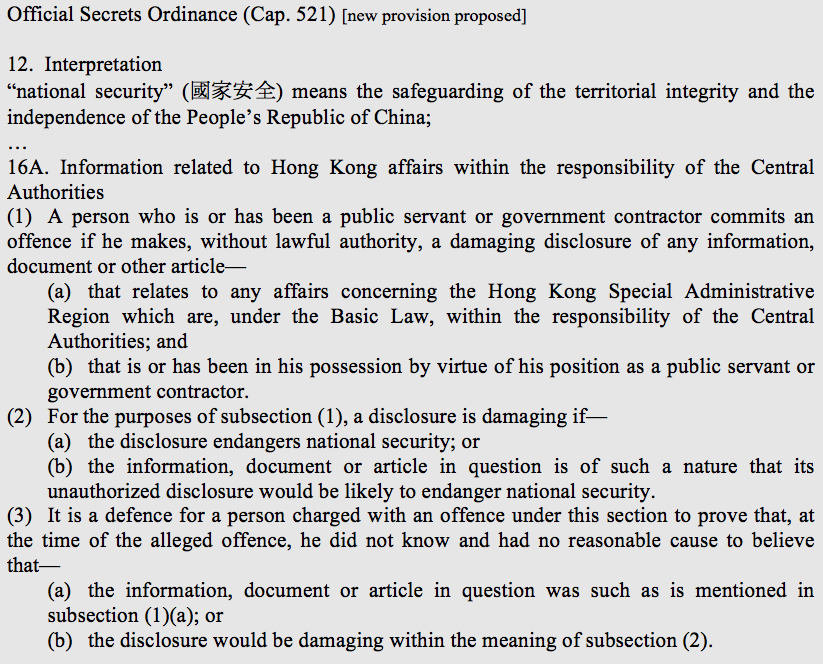
It was felt that there were two gaps in the existing legislative framework that needed to be filled.  The first was the potential disclosure of information related to Hong Kong affairs within the responsibility of the Central Authorities (s. 16A - see below).
The second perceived gap was in relation to disclosing protected information obtained by specified illegal access, e.g. computer hacking, theft, bribery, burglary and bribery (s. 18 - see below).  In the Post-Snowden era, close attention needs to be paid to the terms of this proposal.
In July 2003, a late concession was made to provide for a "public interest" defence to only the illegal access offence provision (s. 18(5B)).
HKU Conference - June 2003
c. What did commentators think of the proposals?
Criticisms were directed at a number of points.  In relation to the proposed s. 16A offence, the scope of "affairs concerning the HKSAR which are, under the Basic Law, within the responsibility of the Central Authorities" was unclear.  Did it refer only to matters of defence and foreign affairs or all matters relating to the Central Authorities under the Basic Law?  It was said that "national security" was unclear in referring to "safeguarding the independence" of the PRC.  The mental element was also problematic because a person could be convicted even if he genuinely did not know that he was making a damaging disclosure of protected information.  Constitutional review of the reverse onus provision in s. 16A(3) would likely read it down to an evidential burden.
     As for the s. 18 offence based on illegal access, there was a similar concern with basing liability on "having reasonable cause to believe" as it was still possible to convict someone who did not genuinely believe.  Was it an anomaly that the new public interest defence was only to apply to the s. 18 offence and to none of the other offences of damaging disclosure?  There were also criticisms of the narrow scope of the public interest defence.  For example, it probably would not cover Edward Snowden's disclosures about the PRISM surveillance programme. Finally a prior publication defence was advocated.  References: Petersen, p. 39; Chen, pp. 109-111; Roach, pp. 132-4; Loper, pp. 212-4; Chan, pp. 258-276; Weisenhaus, pp. 290-7.
d. Where do we go from here?
A enumerated list of the affairs within the responsibility of the Central Authorities should be provided.  Consider also limiting the category of information to items that should be kept confidential (see s. 16(5)).  The Macau National Security Law defines state secrets as information "that must be kept secret and are classified as such" (Art. 5(5)).  The definition of "damaging disclosure" in s. 16A needs more thought.  Reference to the more concrete ways in which this expression is defined in other sections may provide guidance (e.g. "disclosure causes damage to the work of...the security or intelligence services" (s. 14(2)(a)), "disclosure damages the capability of, or any part of, the armed forces to carry out their tasks" (s. 15(2)(a)), "endangers the safety of British nationals or Hong Kong permanent residents elsewhere" (s. 16(2)(a))).  While "endangering the territorial integrity of the PRC" is probably fine but something more tangible than "endangering the independence of the PRC" is needed in drafting a workable concept of "national security".  Attention needs to be paid to the fault element in both offences and whether having a subjective standard of recklessness (in place of the objective standards) will be sufficient, and without reversing the burden of proof.  Finally, thorough consideration needs to be given to the scope and broader applicability of the public interest defence.

6.  Prohibiting Foreign Political Organizations or Bodies from Conducting Political Activities in the Region &
7. Prohibiting Political Organizations or Bodies of the Region from Establishing Ties with Foreign Political Organizations or Bodies
a. What law exists now?
The Government conceded that the Societies Ordinance (Cap. 151), especially after its amendments in 1997, had already implemented the last two Article 23 requirements against foreign political organizations conducting political activities in Hong Kong and establishing ties with local political organizations (see ss. 5, 5A, 5D, 8; Consultation Document, p. 44).
b. What was proposed in 2003?
But, given the potential seriousness of national security risks, the Government felt it was necessary to have additional measures to deal with organizations that pose a risk to national security. It proposed a new executive proscription mechanism to blacklist certain local organizations (s. 8A).  There were to be basic procedural requirements for proscription (s. 8B) and a right of appeal to the Court of First Instance (s. 8D).  Originally, it was proposed that a local organization could be proscribed on three grounds: (1) it has an objective of engaging in treason, subversion, secession, sedition or spying; (2) it has committed or is attempting to commit treason, subversion, secession, sedition or spying; (3) it is subordinate to a mainland organization which has been prohibited on security grounds by the PRC.  As a late concession, the third ground for proscription was withdrawn.  What remained of the proposed proscription power is shown below:
There were to be new offences for participating in or aiding a proscribed organization (s. 8C) and existing offences relating to unlawful societies (ss. 21, 22, 23) were to be extended to proscribed organizations.  The defences seen in s. 8C(1A) were included as a late concession.
c. What did commentators think of the proposals?
The greatest concern was with the third ground for proscription as it was seen as a "connecting door" (p 309) allowing mainland authorities to silence undesirable groups and individuals in Hong Kong.  Even with the withdrawal of this controversial ground, there were still concerns with the potential criminal liability of persons involved or engaging with proscribed organisations.  The defences in s. 8C(2) & (3) reversed the burden of proof on the defendant and thus were constitutionally liable to be read down as evidential burdens.  They also required defendants to meet objective standards of ignorance and prevention.  There were also concerns with ensuring fairness in the proscription appeal mechanism.  References: Petersen, p. 26; Chen, pp. 111-115; Harris, Ma & Fung, pp. 305-330; Feng, pp. 331-61.
d. Where do we go from here?
With the withdrawal of the third ground for proscription, it must seriously be considered whether the proscription mechanism is still needed and should be proposed.  There are a number of reasons now for not adopting this controversial mechanism that impinges upon freedoms of association, expression and commerce.  First, it is not required for implementation of Article 23.  Second, the Macau National Security Law did not include it, which Godinho said was the "most positive aspect" of the Macau bill (p. 18).  Third, the idea only arose because it was used in anti-terrorism legislation which had been enacted in 2002 in response to UN Security Council requirements after 11 September 2001 (from work done by the same policy team). Experience has now shown that blacklisting terrorists and terrorist groups has many difficulties, e.g. problematic legal issues, interference with individual rights, and detrimental impact on peace-building (see 2015 report by the International State Crime Initiative, Queen Mary School of Law).  Fourth, the blacklisting mechanism available under the United Nations (Anti-Terrorism Measures) Ordinance (Cap. 525) will likely to be able to cover most if not all of the cases for which resort to the proposed proscription mechanism would be needed.  Fifth, no groups have appeared or formed that would lead the public to call for their proscription on national security grounds. 

Conclusion
In this review I assume that in any future Article 23 exercise the government would not seek to advance anything more controversial than their final set of proposals in 2003.  Looking only at the substance of those proposals, the disagreement was not great.  The proposals on treason and sedition were already near consensus.  They are the least controversial, and bearing in mind the existing laws that stand to be repealed, the proposals should generally be welcomed.  Dropping the seditious publication offence proposal (consistent with the Macau law) would surely leverage more support from the press and media community.  If Government can forgo the proscription mechanism, then this will settle (more or less) four of the seven Article 23 requirements.  It leaves subversion, secession and state secrets.  The difficulties here are more to do with legislative drafting than with differences in policy or principle.  Building on the work done so far, a working group of relevant legal and policy experts should be able to construct a set of carefully balanced proposals (informed by comparative law and international standards, such as the Johannesburg Principles) that are likely to be acceptable by all parties.  
     I draw the conclusion that a consensus on the details of implementing Article 23 is possible if the stakeholders are prepared to put politics aside.  Indeed reaching such a consensus would be a sign of a new plateau of trust from which further progress could be made, such as on matters of political reform. Rather than fearing and loathing the Article 23 issue, Hong Kong legislators should see it as an opportunity for rebuilding trust with the Hong Kong and mainland governments.   Written by Simon NM Young.

Further Reading
Buddle, Cliff, "Hong Kong's Article 23 obligations are already in our legal armoury", South China Morning Post, 29 January 2015.

Cheung, Alvin YH, A Spectre Resurfaces: Chinese National Security Legislation and Hong Kong, Int’l J. Const. L. Blog, 11 February 2015.

Chung, Francis HC, "Navigation between Autonomy and Authority: Some Suggestions on the Future Legislation under Article 23" (2013) 7 Hong Kong Journal of Legal Studies 1.

Fu Hualing, Carole J Petersen and Simon NM Young (eds), National Security and Fundamental Freedoms: Hong Kong's Article 23 Under Scrutiny (HKU Press 2005).

Fu Hualing & Richard Cullen, "National Security" in J Chan & CL Lim (eds), Law of the Hong Kong Constitution (Sweet & Maxwell 2011) ch 6.


Hu, Bob, "The Future of Article 23" (2011) 41 Hong Kong Law Journal 431.

Kellogg, Tom, "Legislating Rights: Basic Law Article 23, National Security, and Human Rights in Hong Kong" (2004) 17 Columbia Journal of Asian Law 307.

Lo, PY, The Hong Kong Basic Law (LexisNexis 2011) ch II.

Young, Simon NM, "Security Laws for Hong Kong" in VV Ramraj, M Hor, K Roach & G Williams (eds), Global Anti-Terrorism Law and Policy, 2nd ed (Cambridge University Press, 2012) ch 15.