Showing posts with label criminal justice. Show all posts

Thursday, October 2, 2025

International Criminal Justice in the Contemporary Asia-Pacific Region


    The University of Hong Kong (HKU)’s Faculty of Law and Centre for Comparative and Public Law (CCPL) held a workshop entitled “International Criminal Justice in the Contemporary Asia-Pacific Region” on 12 and 13 September 2025. The Workshop was conceived and overseen by Dr Suhong Yang and Professor Simon Young. As a key activity celebrating the 30th anniversary of CCPL, it was organised with the support of the Hong Kong International Legal Talents Training Academy (HKILTTA). After the welcome remarks by Professor Young and HKILTTA Director Dr Ling Yang, Judge Daqun Liu (China, UN International Residual Mechanism for Criminal Tribunals), Judge Raul Cano Pangalangan (Philippines, International Criminal Court (ICC)), and Judge Chang-ho Chung (South Korea, ICC) delivered their keynote speeches. The workshop featured prominent scholars and practitioners across Asia, Australia, Europe, and America, including Judge Nina HB Jørgensen (Norway, Kosovo Specialist Chambers), Judge Margaret M deGuzman (United States, UN International Residual Mechanism for Criminal Tribunals), Dr James Ding (HKSAR Department of Justice), Professor Sarah Williams (University of New South Wales), and many more. The High Court of Hong Kong also hosted a visit for the workshop participants, during which participants observed part of a criminal jury trial.

    The event was a great success with brilliant papers presented by speakers and insightful comments from assigned discussants. The workshop included six panels, addressing the following areas: domestic prosecutions and universal jurisdiction, ICC and Asia Pacific States, perspectives in China and Hong Kong SAR, hybrid courts and alternative justice, international criminal justice and public international law, and responsibilities and punishment. A detailed programme can be found here. The organisers and participants plan to publish the papers in an edited collection by a leading international publisher. This workshop not only advances the research on international criminal justice and the Asia-Pacific Region, but also serves to reinforce Hong Kong’s profile as an international legal hub.

Monday, March 31, 2025

Shilun Zhou on Analysis of whether restorative justice and criminal justice are incompatible justice paradigms (CJR)

"Analysis of whether restorative justice and criminal justice are incompatible justice paradigms"
Shilun Zhou (PhD Candidate)
Contemporary Justice Review
Published online: February 2025

Abstract: This essay contends that restorative justice and criminal justice are not entirely incompatible, and that their compatibility at various stages of criminal justice in the Anglo-American legal system hinges upon the extent to which either the rights of the accused or the public interest are compromised at each stage. We argue that these paradigms are incompatible at the trial stage, compatible in the post-trial phase, and conditionally compatible in the pre-trial stage. This essay is divided into three sections. First, we describe the divergence between restorative and criminal justice, highlighting the incompatibility of restorative justice during the trial stage, as it contravenes the principle of defendant protection. Second, we analyse the pre-trial stage, arguing that restorative justice measures should be applied conditionally to balance the rights of the accused with those of the victim. Finally, we posit that restorative justice can be compatible with criminal justice, but cannot wholly replace criminal justice sanctions in the post-trial phase, in order to safeguard the public interest.

Monday, October 14, 2024

Kemal Bokhary on Crime and Punishment – The Birth of Justice? (HKLJ)

"Crime and Punishment – The Birth of Justice?"
Kemal Bokhary
Hong Kong Law Journal, Vol. 54, Part 2 of 2024, pp.307 - 313

Abstract: Even more than they treasure justice, people abhor injustice. There is substance in the proposition that crime and punishment is the birthplace of judicial justice, for historically leaders paid more attention to suppressing offences than to resolving private disputes. The quality of criminal justice was a measure of the leader. Self-help between subjects was not frowned upon. But the taking of revenge by the victims of crime was always prohibited, for the taking of such revenge puts the law out of office. And it would lead to anarchy. The administration of criminal justice stood sorely in need of improvement. Much improvement has been made. But much more remains to be made. Two of the improvements made were surprisingly long in coming. One of these is an accused person’s right to counsel. If defence counsel’s incompetence deprives the accused of a fair trial, that is a ground for quashing a conviction. Prosecutors’ duty is to prosecute but they must do so fairly. Their failure to do so can lead to the quashing of a conviction. The other improvement that was surprisingly late in coming is the conferring of the right of criminal appeal. Exonerating the innocent and calling the guilty to account is the objective of the criminal justice system. Convicting the innocent and letting the guilty go free are both abominations. But the former is the worse. The presumption of innocence and the prosecution’s burden of proving guilt beyond reasonable doubt are directed to avoiding it. Sentencing involves bearing in mind various different interests and sentiments. The reformation of offenders is the main, but no sole, objective of punishment. Comparing Dudley and Stephen’ case with the Conjoined Twins’s case as thought-provoking. Stimulating thought is one of the best ways way of teaching.

Tuesday, July 16, 2024

HKU Law Welcomes Prof. Florence Lee

Welcome to Prof. Florence Lee, who joins the Faculty of Law as an Assistant Professor. Florence completed her DPhil at the St Antony’s College, University of Oxford. Prior to her DPhil, Florence obtained her MSc in Criminology and Criminal Justice (with Distinction) at the Worcester College, University of Oxford and her BA from Fitzwilliam College, University of Cambridge, graduating with double first class honours.

Florence teaches and conducts research in criminal law and criminal justice issues. She is interested in theoretical criminal law, criminal justice, sentencing as well as questions around risk, security and justice. She has published in journals including the Criminal Law Review and Sentencing News, and she has contributed a chapter to Precursor Crimes of Terrorism: The Criminalisation of Terrorism Risk in Comparative Perspective (Edward Elgar Publishing). She is a certified mediator and was called to the English Bar as a member of the Honourable Society of Lincoln’s Inn in 2020.

Thursday, June 15, 2023

Miguel Manero de Lemos and Simon NM Young on Regional Judicial Cooperation in Criminal Matters: Mainland China, Hong Kong and Macau (new book chapter)

"Regional Judicial Cooperation in Criminal Matters: Mainland China, Hong Kong and Macau"
Miguel Manero de Lemos and Simon NM Young
in Elgar Encyclopedia of Crime and Criminal Justice
Edward Elgar Publishing
Published online in Dec 2022 

I. Introduction

This entry outlines the law and practice of regional judicial cooperation in criminal matters within the larger People’s Republic of China (PRC). The current account is one of cooperation between three territorial parts of the PRC, namely Mainland China (Mainland) and the two special administrative regions of the PRC, the Hong Kong Special Administrative Region (HKSAR or Hong Kong) and the Macau Special Administrative Region (MSAR or Macau). But prior to 1997 and 1999, the years in which the PRC respectively resumed the exercise of sovereignty over Hong Kong and Macau, the account was one of cooperation between three sovereigns, namely the PRC, the United Kingdom ( England & Wales) and Portugal. Ironically, in the more than two decades after the resumption of Chinese sovereignty, there has been less formal cooperation between the three territories within one country than there was when cooperation was between three sovereign states. This is because the ‘one country, two systems’ model, which underpins the constitutional relationship between the Central People’s Government (CPG) and the Governments of Hong Kong and Macau, has been unable to bridge the differences in the laws and values of the criminal justice system in each of the three jurisdictions. The tensions that have arisen are described in this entry... 

Friday, January 7, 2022

Jane Richards on Discrimination against Defendants with Disabilities in the Hong Kong Criminal Justice System: Unfitness to Plead Rules, the Insanity Defence and Disposition Orders (HKLJ)

"Discrimination against Defendants with Disabilities in the Hong Kong Criminal Justice System: Unfitness to Plead Rules, the Insanity Defence and Disposition Orders"
Jane Richards (PhD candidate)
Hong Kong Law Journal, 
2021, Vol. 51, Part 3 of 2021, pp. 875-916
Abstract: In 1996 and 1997, in recognition of the inappropriate outcomes available for people who have mental disabilities and commit crimes, the Hong Kong Government introduced legislative reforms. These reforms aimed to ensure that people with mental disabilities would not be detained indefinitely without proof that they had committed the physical element of the crime and also sought to give judges broader discretion in the range of disposition orders available. This article analyses those legislative reforms and finds that they were largely successful in achieving their policy objectives. However, in light of Hong Kong’s obligations under the Convention on the Rights of Persons with Disabilities, the analysis also shows that Hong Kong’s legislative framework discriminates against persons with mental disabilities who are accused of criminal offences or who receive an insanity acquittal. The article concludes that further reform is needed; however, what this should look like is unclear.

Monday, December 28, 2020

Young, Hayward & Ip on Showing Arrested Youth Some Mercy, to begin the Healing Process in Hong Kong (SCMP)

Simon Young, William Hayward, and Paul Ip
2 December 2020 
The social unrest in Hong Kong since June 2019 has been heartbreaking. The scale of disruption and violence is unprecedented. People were harassed or attacked simply over the colour of their clothing. The verbal and emotional abuse arising from supporting the government or taking part in peaceful protest has been disturbing for all.
     The civil behaviour and good order that has characterised Hong Kong for generations seemed to disappear overnight. Road blocks, tear gas and confrontation between demonstrators and police became part of the lifestyle of the city during that period.
      There are many concerns in the community about the enactment of the national security law and its impact on many of Hong Kong’s freedoms. At least some of the violent confrontations have subsided for the moment, but the roots of the problems that led to them have not been addressed. Genuine reconciliation within society needs to occur, otherwise further social unrest might come back at any time.
      The local and central governments have a responsibility to lead in this process given their position of power. Such actions would be for the good of everyone in Hong Kong. One place to start is in resolving the status of those who were arrested... Click here to read the full text. 

Thursday, January 16, 2020

Dziedzic and Yam on Amnesties in Hong Kong (CCPL)

HKU’s Centre for Comparative and Public Law has released Amnesties in Hong Kong: Preliminary Discussion Paper. Authors Anna Dziedzic and Julius Yam argue that amnesty – in the form of pardons and/or immunity from prosecution – provide a way to address the ongoing civil conflict in Hong Kong. Amnesties have been used throughout Chinese history, in Hong Kong and all over the world as a way to bring conflicting parties to the negotiating table, cease hostilities, and to promote reconciliation.
     The Discussion Paper outlines the purpose and justifications for amnesty as well as discussing some of the common objections made to amnesty in Hong Kong. It explains how amnesty is not contrary to the rule of law, but rather, properly designed and implemented, amnesty can be consistent with Hong Kong’s existing legal framework and work to support amnesties can support peace, good governance, justice and the rule of law. 
     Global comparative experience offers a range of choices for the design of amnesty. The Discussion Paper suggests some options for design, tailored to meet the current needs of Hong Kong, covering questions such as: Whom should an amnesty cover? What offences should be included (or excluded)? What time period should the amnesty cover? What conditions might be attached to an amnesty? What procedure might be adopted for assessing and granting amnesty? The Discussion Paper also emphasises the importance of the design process: if amnesty is to work to defuse conflict, it is also important that all sides take ownership of the amnesty and work to make it effective and sustainable. 
     By explaining what amnesty is, why it is used, how it fits within Hong Kong law and the kinds of issues to consider in its design, the Discussion Paper provides a basis for informed discussion of the use of amnesty in Hong Kong and its potential to contribute to rebuilding trust and reconciliation. Click here to download the full Discussion Paper (in English) and Chinese translation.

Monday, December 2, 2019

Fu Hualing on the Power to Detain in a Dual State Structure (Made in China Journal)

"The Power to Detain in a Dual State Structure"
Fu Hualing
Made in China Journal
Vol. 4, Issue 3, Jul–Sept 2019, pp. 70-74
In liberal democracies, detention power tends to converge on three issues: first, differences in social/political status are no longer relevant, and common legal rules apply to all types of detention based on the fundamental right of personal freedom; second, political mechanisms and legal rules are in place to reduce state arbitrariness in depriving citizens of personal freedom; and finally, detention is subject to enhanced juridical control, with access to lawyers and judicial scrutiny serving as the litmus test for its legality. Indeed, the transition from a police-centric legal system to a court-centric one is often regarded as the hallmark of genuine democratisation, and the degree to which personal freedom is protected offers a meaningful index to measure the status of rule of law in a particular society. (Cao et al. 2014).
    After four decades of legal reform in China, what kind of progress has the country made in controlling the power to detain, reducing its arbitrariness, and making the repressive arm of the state legally accountable? Has the fear of police power, in particular the proverbial panic of a knock at the door in the middle of the night, been reduced or increased? A general answer to these questions is that there are changes and continuities, as the power to detain is largely defined and shaped by China’s regime type... Click here to read the full article.

Thursday, July 5, 2018

Richard Cullen on "Criminal justice system works, keep it that way" (China Daily)

"Criminal justice system works, keep it that way"
Richard Cullen
China Daily
14 June 2018
Since the sentences were announced there have been strong protests about the severity of the penalties imposed, especially on Leung who was the former spokesman for Hong Kong Indigenous - a localist group. Incidentally, none of those protesting has paused to note the courage of the out-numbered policemen who brought the riot under control using the minimum force required, at serious cost in terms of injuries for a number of them.
      The array of people thus protesting included the last governor of British Hong Kong. Chris Patten is quoted as saying: "It is disappointing to see that the legislation is now being used politically to place extreme sentences on 'pan-democrats' and other activists". The relevant legislation is the Public Order Ordinance, the most significant elements of which were passed by the British Hong Kong government to give additional powers to police during the riots in Hong Kong in the mid-1960s. Shortly before the 1997 handover, the powers the British enjoyed under the ordinance until 1995 were watered down. The Provisional Legislative Council reversed these 11th-hour amendments in 1997. ...
     Patten's accusation that the Hong Kong Special Administrative Region judiciary is now in the business of applying the law with plain political intentions is not new. This is a reiterated claim. Hong Kong's former director of public prosecutions Grenville Cross has responded to similar past claims and I cannot improve on his observations: "As he (Patten) should know, Hong Kong's judiciary is fiercely independent, is comprised of men and women of integrity and is well regarded throughout Asia and beyond. Once he has cooled down, Patten may wish to withdraw his slur, and to give the judiciary his unequivocal support, given its valiant work in upholding the rule of law in Hong Kong." I can only add that it is disappointing that Lord Patten (as he now is) has lately demonstrated a comprehensive failure to heed this robust, sensible advice. ...
     We are genuinely fortunate that Hong Kong's criminal justice system is not devitalized like that in Britain (which Patten would have us emulate, it would seem). Our system has both integrity and backbone. The judges in that system understand their key role in keeping Hong Kong one of the safest large cities in the world - without fear or favor.  Click here to read the full text. 

Tuesday, June 12, 2018

New Book: Paths of Justice (HKU Press) by Johannes Chan

Paths of Justice
Johannes Chan
HKU Press
June 2018, 264 pp
Description: In Paths of Justice, Johannes Chan illuminates fundamental themes and basic values in Hong Kong’s legal system by using his own experience and drawing on interesting and important cases. The book explains and demystifies some of the most frequently asked questions about the law: How does a lawyer defend someone who is guilty? Does the law favour the rich and the resourceful? Is there a duty to obey the law in all circumstances? How can human rights and national security coexist in balance if their goals conflict in certain situations? How can fairness be reconciled with administrative efficacy? Is an abuse of freedom a justification for denying it? He also casts light on legal profession and professionalism, arguing that the legal profession is honourable only because lawyers, by and large, do live up to a high ethical standard and are committed to the values of justice and fairness.
     These cases cover a wide range of legal discussion and span several decades of Chan’s professional practice, from when he was a young barrister to his years as Honorary Senior Counsel. Through the description of these real-life court cases, he gives readers not only a better understanding of how Hong Kong’s legal system works in practice, but also the essential tools to think deeply about legal institutions, the legal profession, the role of justice in a modern society, and the importance of the rule of law.
      Professor Chan was recently interviewed by the SCMP on 9 July 2018 and by Deutsche Welle on 29 June 2018.

Monday, September 19, 2016

New Issues: SSRN Legal Studies Research Paper Series (HKU)

Vol. 6, No. 4: 26 Aug 2016
Table of Contents

1. A Public Law Conception of Integrity in the Criminal Process
Simon N. M. Young, The University of Hong Kong - Faculty of Law

2. A Red Flag for Hong Kong Credit Ratings
Syren Johnstone, Faculty of Law, University of Hong Kong, Asian Institute of International Financial Law

3. Re-Examining Criminal Process Through the Lens of Integrity
Paul Roberts, University of Nottingham, University of New South Wales (UNSW) - Faculty of Law, China University of Political Science and Law
Jill Hunter, University of New South Wales (UNSW)
Simon N. M. Young, The University of Hong Kong - Faculty of Law
David Dixon, University of New South Wales (UNSW) - Faculty of Law

4. Voice and Exit as Accountability Mechanisms: Can Foot-Voting Be Made Safe for the Chinese Communist Party?
Roderick M. Hills, Jr., New York University School of Law
Shitong Qiao, University of Hong Kong Faculty of Law


Vol. 6, No. 3: 26 July 2016
Table of Contents

1. Bringing Politics Back In: Access to Justice and Labor Dispute Resolution in China
Fu Hualing, The University of Hong Kong - Faculty of Law

2. Interlocutory Injunction, Freedom of the Press and Public Interest: The University of Hong Kong v Hong Kong Commercial Broadcasting Co Ltd and ORS.
Anne S. Y. Cheung, The University of Hong Kong - Faculty of Law


Vol. 6, No. 2: 16 June 2016
Table of Contents

1. Live Migration in Emerging Cloud Paradigms
Massimo Ficco, Second University of Naples
Christian Esposito, University of Salerno
Henry Chang, The University of Hong Kong - Law and Technology Centre
Kim-Kwang Raymond Choo, The University of Texas at San Antonio

2. The Chinese Approach to Transfer Pricing: Problems Faced and Paths to Improvement
Jingyi Wang, The University of Hong Kong

3. Disproportionality in Asset Recovery: Recent Cases in the United Kingdom and Hong Kong
Simon N. M. Young, The University of Hong Kong - Faculty of Law

Wednesday, September 14, 2016

Eric Cheung and HKU Legal Clinic Helps to Free Police Informant (SCMP)

"Police informant incorrectly jailed for 33 months walks free"
Chris Lau
South China Morning Post
5 September 2016
“A” was a police informant and, more importantly, a free man before he was framed by the very person he was instructed to spy on by authorities. After serving 33 months behind bars for a crime he did not commit, A has finally been released thanks to the solicitor advocates’ scheme and the efforts of University of Hong Kong legal scholar Eric Cheung Tat-ming.
     A, whose identity could not be revealed for safety reasons, was arrested in 2012 for conspiring with Lam Hing to rob four people on various occasions in 2011. He was supposed to be spying on Lam for the police. But after Lam was arrested and pleaded guilty, the burglar then turned around and counter-accused A of being his accomplice.
     A was found guilty and received an eight-and-a-half-year jail term for his involvement in the crimes. Lam received five years. Cheung, a principal lecturer at HKU who obtained the higher rights of audience in 2013, said the inmate came to the university’s free legal advice scheme after failing to secure funds to appeal his case from the Legal Aid Department where he was turned down for a lack of merit.
      “But there is a huge non-disclosure problem,” Cheung said, recalling the moment he took the case. After changing the department’s mind, Cheung decided to represent the innocent man in the Court of Appeal last year... Click here to read the full article.

Tuesday, July 5, 2016

New Book: The Integrity of Criminal Process (Hart Publishing)

The Integrity of Criminal Process: From Theory into Practice
Editors: Jill Hunter, Paul Roberts, Simon NM Young, David Dixon
Hart Publishing
July 2016, 448 pp
Description: Criminal proceedings, it is often now said, ought to be conducted with integrity. But what, exactly, does it mean for criminal process to have, or to lack, 'integrity'? Is integrity in this sense merely an aspirational normative ideal, with possibly diffuse influence on conceptions of professional responsibility? Or is it also a juridical concept with robust institutional purchase and enforceable practical consequences in criminal litigation? The 16 new essays contained in this collection, written by prominent legal scholars and criminologists from Australia, Hong Kong, the UK and the USA, engage systematically with - and seek to generate further debate about - the theoretical and practical significance of 'integrity' at all stages of the criminal process. Reflecting the flexibility and scope of a putative 'integrity principle', the essays range widely over many of the most hotly contested issues in contemporary criminal justice theory, policy and practice, including: the ethics of police investigations, charging practice and discretionary enforcement; prosecutorial independence, policy and operational decision-making; plea bargaining; the perils of witness coaching and accomplice testimony; expert evidence; doctrines of admissibility and abuse of process; lay participation in criminal adjudication; the role of remorse in criminal trials; the ethics of appellate judgment writing; innocence projects; and state compensation for miscarriages of justice.

"Introduction: Re-examining Criminal Process Through the Lens of Integrity"
Paul Roberts, Jill Hunter, Simon NM Young and David Dixon
This book explores the relationship between integrity and criminal process. By ‘criminal process’ we mean, roughly speaking, the institutions, procedures and practices constituting official responses to suspected criminal wrongdoing, encompassing criminal investigations, prosecutions, trials, appeals and extraordinary post-conviction procedures. We do not extend our analysis to ‘the penal system’ and the treatment of convicted offenders, largely on pragmatic rather than theoretical grounds. The book’s central thesis is that ‘integrity’ offers a powerful conceptual lens through which the criminal process in its entirety, or selected phases or aspects of it, can be viewed and critically re-examined. Our general approach could in principle be extended to penality at large, but we had to stop somewhere to keep the volume within reasonable bounds, and adjudication marks a natural temporal break- point, distinguishing the participation of suspects, victims, witnesses and the accused in the investigative process and at trial from the treatment of convicted offenders in the penal system...

"A Public Law Conception of Integrity in the Criminal Process"
Integrity has become a prominent theme in current discourse on the criminal process. It is referred to in cases involving police or prosecutorial misconduct. Courts increasingly make reference to integrity as a ground for ordering relief against and for the government. Integrity lies at the heart of the entrapment and abuse of process doctrines. What more can be expected of the integrity principle will depend on a proper understanding of its scope and meaning. The principle is said to be ‘an influential but also a puzzling principle of criminal justice’. What is the relationship between integrity and human rights? And what is its relationship to notions such as public confidence in the administration of justice, disrepute, accountability and legitimacy? Does it mean anything more than having minimum standards of conduct (and if so, when and in what context), and again is this anything different from a rights-based approach to criminal process? Does it refer to having coherence in the system and if so, coherent by what underlying premises?...

"Integrity, Immunity and Accomplice Witness Testimony"
The use of immunised accomplice witnesses by the prosecution has long been a feature of criminal trials in England and those jurisdictions such as Hong Kong which adopted the English criminal justice system. This practice has been disparaged as ‘unsavoury’ and ‘distasteful’, even ‘unethical’, but ‘turning Queen’s evidence’ in return for immunity from prosecution has been regarded as a ‘necessary evil’ and legally sanctioned as an essential tool in the fight against serious crime. This is particularly true of those forms of criminal activity which normally take place in secrecy, such as trafficking in dangerous drugs, terrorism, fraud and—the subject of this chapter—corruption-related offences...

"Stays of Prosecution and Remedial Integrity"
It is well established in the United Kingdom, Australia and Hong Kong that where a court finds there has been an abuse of process by the prosecution it has an inherent power to order the criminal proceedings to be stayed permanently. A stay of proceedings may be permitted on two bases. An application may be made on the basis that a fair trial is not possible (for reasons such as pre-trial publicity or delay), or on the much rarer basis that whilst a fair trial is possible the application for a stay should be granted anyway as the criminal justice system would otherwise be affronted. This chapter focuses on the latter kind of stay...

"Excluding Integrity?  Revisiting Non-Consequential Justifications for Excluding Improperly Obtained Evidence in Criminal Trials"
This chapter revisits non-consequentialist justifications for excluding a piece of reliable evidence which is improperly obtained (say, through torture or an illegal search) in criminal proceedings. By non-consequentialist justifications, I refer to principles which claim that the improperly obtained evidence should be excluded even if by doing so we do not produce any further good contingent consequences such as deterrence of misconduct by investigatory agents. The two most prominent non-consequentialist justifications offered in the literature are the protective principle and the integrity principle...

Friday, February 12, 2016

Hualing Fu Interviewed on Punishment for Those Responsible for Chinese Wrongful Convictions (INYT)

Javier C Hernandez
International New York Times
3 February 2016
For two decades, Shang Aiyun waited for the day when the people responsible for convicting and executing her teenage son for a murder he did not commit would be held to account.
     But when the moment of reckoning came this week, Ms. Shang was outraged. The authorities in Inner Mongolia announced on Sunday that only one person would face a criminal investigation in the wrongful conviction of Ms. Shang’s son, Huugjilt, while 26 others would receive minor demerits.
     “These people don’t even have the courage to admit their mistakes and recognize their wrongdoing,” Ms. Shang said in an interview with Global Times, a state newspaper. “How can they handle legal cases impartially in the future?”
     Under President Xi Jinping, the Communist Party has made overturning cases of gross injustice a centerpiece of its efforts to overhaul the legal system, long troubled by corruption and abuse. But even as the party has moved to create a more equitable judicial system, it has resisted harsh punishments for officials involved in wrongful convictions, wary of creating instability...
     Fu Hualing, a professor of law at the University of Hong Kong, said it was possible that more severe punishments would be announced later, as the investigation progressed.
     “The problem is the institutional interests of the judges, the police officers and the prosecutors,” he said. “The question is whether the central authority has enough persuasion to really force the institution to be accountable.”... Click here to read the full article.

Tuesday, January 19, 2016

Latest Commentary on the Lee Bo Case in Hong Kong

Simon Young
South China Morning Post
20 January 2016
Many feel “one country, two systems” has suffered a serious blow from the mysterious circumstances of Lee Bo’s case, but it is too soon to conclude that the Basic Law has been violated.
     If Lee crossed the border voluntarily and on his own, there would be no Basic Law issue. If private individuals unconnected to the mainland government were involved in forcing or persuading Lee to cross the border then, again, it is difficult to see this as a constitutional crisis, even though such individuals may have committed ordinary crimes.
     There are a number of indications, however, that mainland officials were implicated in Lee’s entry. First there are Lee’s statements that he is “assisting an investigation” on the mainland. The nature of the books sold by Lee’s bookstore, coupled with the disappearances of his four associates, suggest a criminal investigation into offences of spreading rumours or slander to subvert state power or other national security offences.
     Then there was the entry itself without the usual immigration clearances, suggesting official intervention. Finally, there is the unexplained need for Lee and his associates to remain on the mainland indefinitely if the “investigation” relates only to their associate Gui Minhai’s alleged case of vehicle homicide.
     Even if mainland officials were involved, this does not necessarily mean the Basic Law was breached because there are grey areas when it comes to cross-border criminal investigations.
      Certainly an abduction and forced rendition by mainland officials would constitute a serious infringement of the “one country, two systems” principle, but there are multiple ways to cause someone to cross the border. A chat in acha chaan teng, a phone call or a text message may be all that is needed to incite a person to make the trip... Click here to read the full article.

Jeffie Lam and Eddie Lee
South China Morning Post
19 January 2016
A person on a suspended jail term on the mainland cannot leave the country without official permission and authorities would not only keep a close watch on anyone fleeing but make a real effort to track them down, say legal experts. Once the law caught up with the offender, he would have to serve his sentence in prison.
     This was why legal eagles and observers said they found it mystifying, and unconvincing, that Gui Minhai had eluded arrest for more than 12 years and decided to turn himself only now and – of all places – while in a foreign land.
     Gui – one of the five missing shareholders and staff of publishing house Mighty Current which is linked to Causeway Bay Books – disappeared in mid-October after he was last seen at his apartment in the seaside town of Pattaya in Thailand.
     On Sunday night, he appeared in a recorded interview broadcast by China Central Television, in which he said he had surrendered out of guilt for killing a 23-year-old student while drink-driving in Ningbo, Zhejiang province, in 2004. The confession contrasted starkly with the widely held suspicion that he was abducted by mainland law enforcement agencies in Thailand for selling books that are banned by China.
     Professor Fu Hualing, a legal expert on the mainland criminal justice system, said he found it “totally illogical” for Gui to turn himself in now, after being on the run for so long.
     “It is very shocking that after so many years Gui voluntarily went back,” said Fu. “A person, after so many years, suddenly finds his conscience and wants to return. What I can say is we have an official story but what else … is anybody’s guess.”
     Fu said the personal freedom of people on a suspended prison term would be curtailed and they could not leave the country lawfully without official permission. Should the person violate the condition, as in Gui’s alleged case, he or she would be placed on the wanted list immediately and would have to serve the original sentence in jail... Click here to read the full article.

"Hong Kong's Missing Booksellers Expose Publishing Underbelly"
David Tweed and Ting Shi
Bloomberg
20 January 2016
Sandwiched between a pharmacy and a discount clothing store in Hong Kong’s Causeway Bay neighborhood is a narrow staircase leading to a shuttered bookshop that has become a symbol of the fears of China’s encroachment in the former British colony.
     Causeway Bay Books is one of the city’s best known “upstairs bookshops,” which sell titles such as “Overseas Mistresses of the Chinese Communist Party,” and “Secrets of Wives of CCP Officials” to mainland tourists hungry for the salacious and often thinly sourced tales about the alleged peccadilloes of their leaders. Outside hangs a sign in Chinese warning would-be customers to “watch out for police.”
     The store, located in the shadows of one the world’s priciest shopping districts, has been shut since late December when its owner Lee Bo vanished from the city. With Hong Kong authorities pressing for information, Chinese police confirmed Jan. 18 that Lee was in the mainland, without explaining how the bookseller got across the border without the required travel permit or the knowledge of Hong Kong immigration.
     “A disappearance off the streets raises questions in ordinary people’s minds about the future of Hong Kong and whether its distinctive qualities with which most Hong Kong people identify will be maintained,” said Michael Davis, a Hong Kong University law professor... Click here to read the full article.


Sunday, December 13, 2015

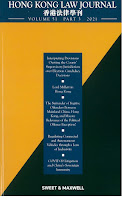
New Issue of Hong Kong Law Journal (Part 3 of 2015)

HONG KONG LAW JOURNAL
Vol. 45, Part 3 of 2015
Editor-in-Chief: Professor Rick Glofcheski
Associate Editor: Professor Albert Chen

Articles
Gay Marriage and the Common Law Conflict of Laws Rules: A Singapore Perspective KC Lye and Ervin Tan693
Fair Dealing Doctrine Caught between Parody and UGC Exceptions: Hong Kong’s 2014 Copyright Amendment and Beyond Wenwei Guan719
Non-Traditional Maritime Security and International Cooperation Jun Zhao743
Institutionalising Mediation in Hong Kong AKC Koo769
China Law
Electronic Recording of Custodial Interrogations with Chinese Characteristics: Tool for Transparency or Torture? Kuibin Zhu and David M. Siegel795
Emergence of a Dual Constitution in Transitional China  Shucheng Wang819
Toward a More Balanced Safe Harbour Protection System for Internet Service Providers in China Jia Wang851
Towards a Harmonised Definition of Terrorism in China: A Discussion Under “One-Country, Two Systems” Dr Li Zhe and Dr Sten Idris Verhoeven881
The Transformation of Chinese Law: Mark II Jianfu Chen911
What Happens to Embryos When the Would-Be Parents Die: The “Orphaned Embryos” Custody Dispute in China Ding Chunyan941
“Is Court Mediation Feasible?” Quantitative Research on the Attitudes of Legal Professionals in Southwest Grassroots Society of Chin Xiong Hao963
Why Does a Powerful Regulatory Regime Fail? An Examination of the Regulation of Prepaid Cards in China Pan Su987
Book Reviews
Confucian Perfectionism: A Political Philosophy for Modern Times, Joseph Chan Scott Veitch1023

Saturday, November 7, 2015

Dean Hor Interviewed by Innocence Project Singapore

Prior to his current appointment as Dean, Professor Hor was a Professor of Law at the National University of Singapore’s Faculty of Law where he taught, researched, and published extensively in the areas of Criminal Law, Criminal Procedure, Constitutional Law and Evidence Law.
     Professor Hor served as the Chief Editor of the Singapore Journal of Legal Studies and is a member of the editorial boards of the Singapore Academy of Law Journal and the Asian Journal of Comparative Law. He was also a consultant to the Ministry of Law and the Criminal Practice Committee of the Law Society of Singapore. Internationally, Professor Hor has also been appointed Distinguished Visitor at the University of Toronto’s Law Faculty and Visitor at Oxford Centre for Criminology.
     During this exclusive interview, Professor Hor candidly shared his views on the Innocence Projects in different jurisdictions, specific law reforms, and his experience serving as the Dean of the HKU’s Faculty of Law.

THE INNOCENCE PROJECT (SINGAPORE)
Q: What were your thoughts when the idea of setting up IP(SG) was mooted to you back then? What made you believe in this project?
A: This project was first conceived when a student, Audrey, who went to the United States for her undergraduate exchange programme came to know of the work of Innocence Projects (IPS) in the US. When she returned, she emailed a few Criminal Law Professors at NUS, including myself, to set up an Innocence Project in Singapore, known today as Innocence Project (SG). I was prepared to help but at the same time, I was also prepared to see the Project fail. There were concerns that setting up IP(SG) could potentially be construed as an insult to Singapore’s criminal justice system which prides herself to be reliable and trustworthy.
     However, the merits of this project could not be denied. In fact, which jurisdiction can say that there would be no merits to it? It can only be a good thing. The question, however, was whether this project is practically achievable within this political climate where we have a good and competent Government but any mistakes in convictions could be seen as an insult to that.
     As such, we tried to engage the Minister for Law and the Attorney-General Chambers from the outset. It took a few years and a few changes of IP(SG) heads as it was a potentially sensitive matter. It was a long process, but to-date it has since been set-up. Now, it is a question of pushing IP(SG) forward...

Q: Do you have plans to similarly bring the Innocence Project network into University of Hong Kong (“HKU”)?
A: First of all, it was the students who brought the Innocence Project to Singapore and I believe this is a very good initiative because students have more faith and idealism than practitioners and academics. I will personally support such a project if a student brings it up in HKU.

THE CRIMINAL JUSTICE SYSTEM IN SINGAPORE & HONG KONG
Q: In Veeramani Manikam v Public Prosecutor [2015] SGHC 201 (“Veeramani”), Chan Seng Onn J identified several lapses that happened at trial and the investigation process that led to the accused being wrongly convicted. These lapses include the Investigating Officers’ omission to investigate and verify the accused’s statements. The risk of wrongful convictions in Singapore is real. What are your views on Veeramani?
A: I remembered reading about this case in the Straits Times. Over the years, some judges do come up with judgments which are explicitly or implicitly critical of the way that law enforcement offices have behaved. For instance, in Muhammad bin Kadar and another v Public Prosecutor [2011] SGCA 32, V K Rajah JA (as he then was) was critical towards the investigations process as the police officer failed to comply with the rules. Such irregularities have been happening in Singapore, and it is necessary for judges, once in a while, to distance themselves away from law enforcement and demonstrate their neutral and independent stance in their judgments... Click here to read the full interview.

Saturday, October 17, 2015

Faculty Interviewed on the Ken Tsang Police Assault Case (SCMP)

Stuart Lau, Samuel Chan and Christy Leung
South China Morning Post
17 October 2015
A decision by prosecutors to synchronise actions against an Occupy protester charged with assaulting police and seven officers who allegedly beat him up means the order of their trials could affect witness credibility, lawyers said yesterday.
     A complicating element in the legal drama is the dual identity of Ken Tsang Kin-chiu, who is in one case a victim and potential prosecution witness while in the other a defendant. He is due to appear in Eastern Court on Monday, the same day the seven policemen are due to appear in the same court, in a move justice officials insist will ensure "fairness".
     Yesterday Tsang and his lawyers spent two hours inside police headquarters in Wan Chai but later declined to comment on the reason they were there.
     Tsang's case will be handled by magistrates while the officers' case will be taken up at a higher level in the District Court.
     Cases can proceed faster before magistrates than in the District Court, and timing could bear on the outcome of each case because the credibility of witnesses could be put into doubt. "If a defendant was convicted and had a criminal record, it might affect the judge's impression on the credibility of his evidence in another case," said Jeffrey Tam Chun-kit, a barrister who has handled criminal cases arising from protests.
     University of Hong Kong legal scholar Professor Simon Young said the result of one case could offer reference for the other. "At some point, the courts will need to address the order of trials. I would think that those advising Mr Tsang would want to see the trial of the seven officers handled first," Young said. "If there are convictions, it will provide the factual basis for pre-trial motions ahead of Tsang's trial. In particular, there will be a basis to argue for a stay of Tsang's proceedings on grounds of police brutality."
     Fellow HKU legal scholar Eric Cheung Tat-ming said the Department of Justice's statement on Thursday did not say whether any of the seven officers was involved in four further charges against Tsang of resisting arrest. If they were, they could appear in his case as witnesses... Click here to read the full article and for related post on this blog, click here.

Saturday, October 10, 2015

New Updates on Chinese Courts (Susan Finder)

"Judge Xi Xiaoming and his vanishing assets"
7 October 2015
Although Chinese judicial reforms include establishing a trial-centered judicial system that provides better protection for human rights (including property rights), under Party disciplinary regulations senior Party officials (such as former Supreme People’s Court Vice President Xi Xiaoming, subject of an earlier blogpost), often have property confiscated or other property punishments imposed at the conclusion of Party disciplinary proceedings. This means that confiscation of assets occurs before an official’s case is transferred to the procuracy and heard by the courts. According to the official statementon the disposition of Judge Xi’s case:
(He) was ordered to make restitution of certain amounts that were in violation of discipline;the issues related to his suspected crimes and related amounts are transferred to the judicial organs for handing.责令退赔违纪款;将其涉嫌犯罪问题及涉款物移送司法机关依法处理.
The wording is similar to official statements issued in relation to other senior officials investigated by the CCDI and the same language is to be found in reports on the dispositions of local Communist Party disciplinary investigations... Click here to read the full post.

3 October 2015
Buried in the depths of documents issued in the course of this year are the outlines of the way the Supreme People’s Court (Court) intends to create a corps of judges in which litigants, domestic and foreign, have faith will provide justice. The many measures set out in the 4th Five Year Judicial Reform Plan raise the competency bar for judges. A more litigious and rights conscious public, the increasingly complex economy and greater number of cross-border transactions and interaction, as well as smaller number of judges to hear more cases means that judicial training is an important part of of preparing Chinese judges for the new normal.
      The broad outlines of the Court’s plans for judicial training are set out in the following documents:
  • the Court’s latest 5 Year Training Plan, for 2015-2019, issued in June, the framework document;
  • the September 17, 2015 Communist Party Central Committee/State Council document on the open economy, calling for improving foreign-related competence in the judiciary; and
  • the September 25 White House press release, in which the United States and China commit to conduct high-level and expert discussions commencing in early 2016 to provide a forum to support and exchange views on judicial reform and identify and evaluate the challenges and strategies in implementing the rule of law.
Click here to read the full post.
     Susan Finder is a Visiting Fellow in the Centre for Chinese Law and an Adjunct Professor in the Faculty of Law in the fall semester 2015.  She recently spoke at the European China Law Studies Association's 10th Annual Conference held at the University of Cologne, Germany, on 26 September 2015.  She spoke on 'Assessing China's Court Reforms after One Year' in the panel on Chinese Courts and Recent Judicial Reforms.  She will also be speaking on the rule of law and criminal justice/fair trials at the one-day Symposium on Rule of Law and the Magna Carta on 16 October 2015, to be held at Guangzhou University, sponsored by the British Consulate.