Showing posts with label PhD. Show all posts

Friday, July 31, 2026

Benjamin Chen and Xinyu Xie on The Alignment Target Problem: Divergent Moral Judgments of Humans, AI Systems, and Their Designers (FAccT '26)

"The Alignment Target Problem: Divergent Moral Judgments of Humans, AI Systems, and Their Designers"
Benjamin ChenXinyu Xie (PhD Candidate)
ACM FAccT '26
Published online: June 2026

Abstract: The project of aligning machine behavior with human values raises a basic problem: whose moral expectations should guide AI decision-making? Much alignment research assumes that the appropriate benchmark is how humans themselves would act in a given situation. Studies of agent-type value forks challenge this assumption by showing that people do not always judge humans and AI systems identically. This paper extends that challenge by examining two further possibilities: first, that evaluations of AI behavior change when its human origins are made visible; and second, that people judge the humans who program AI systems differently from either the machines or the human actors they are compared against. An experiment with 1,002 U.S. adults measured moral judgments in a runaway mine train scenario, varying the subject of evaluation across four conditions: a repairman, a repair robot, a repair robot programmed by company engineers, and company engineers programming a repair robot. We find no significant difference in evaluations of the repairman and the robot. However, judgments shifted substantially when the robot's actions were described as the product of human design. Participants exhibited markedly more deontological, rule-based reasoning when evaluating either the programmed robot or the engineers who programmed it, suggesting that rendering human agency visible activates heightened moral constraints. These findings indicate that people may evaluate humans, AI systems acting in the same situation, and the humans who design them in meaningfully different ways. The fact that these evaluations do not necessarily converge gives rise to the alignment target problem: which normative target should guide the development of artificial moral agents in high-stakes domains, and whether these plural judgments can be reconciled within a coherent account of value alignment.

Wednesday, January 18, 2023

Shiling Xiao (RPg) & Yang Lin (RPg) on Judicial Review of Administrative Rules in China: Incremental Expansion of Judicial Power (The Journal of Comparative Law)

"Judicial Review of Administrative Rules in China: Incremental Expansion of Judicial Power"
Shiling Xiao  (RPg: currently postdoc) & Yang Lin (RPg: currently ARO) 
The Journal of Comparative Law, Special Part: Issues in Administrative Justice, Volume XVII, Issue 2, pp. 371-392
published in 2022
Abstract: Since 1989 when China adopted its first Administrative Litigation Law (ALL), it had long excluded administrative rulemaking from the court’s purview in administrative litigation, known as the Chinese judicial review of government actions. The courts were not expressly vested with the power to review administrative rules until the first amendment to the ALL in 2014. This article examines the evolution of the Chinese judicial review of administrative rulemaking and the court’s practice in the last seven years (2014-2021). It argues that whereas the judicial empowerment in 2014 is a symbolically significant step toward improving Chinese administrative rulemaking, public accountability, and the rule of law, China has merely established a weak-form judicial review of administrative rules, and the timid and deferential approach of the courts to this new empowerment seriously limits the judicial function of supervising government’s policy-making. This article underlines that judicial review of administrative rules in China is tied to limitations with regard to the scope, intensity and effect of the review. Only administrative normative documents that are at the bottom of the hierarchy of the Chinese legal system and have the lowest legal force are amenable to judicial review. The courts are not expected to scrutinise the reasonableness and proportionality of these documents, and they cannot even strike down invalid ones. They employ the report and record procedure to transfer the decision power to high courts. In practice, the courts declined pleas for reviewing administrative rules in most cases. Even when they accepted the review requests, they seldom closely and effectively scrutinised the substantive content and merits of administrative normative documents. During administrative litigation, they also consulted with the executive authorities and deferred to their opinion. 

Thursday, January 5, 2023

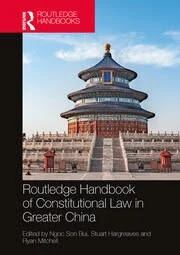
New Book: Routledge Handbook of Constitutional Law in Greater China, ed. by Ngoc Son Bui (PhD 2013), Stuart Hargreaves, and Ryan Mitchell (Routledge)

ed. by Ngoc Son Bui (PhD 2013), Stuart Hargreaves, and Ryan Mitchell
Routledge
Published on Dec 29 2022
392 pp.
Abstract: The Handbook of Constitutional Law in Greater China surveys important issues of constitutional law in Mainland China, Hong Kong, Macau, and Taiwan. It synthesizes existing scholarship, debates, and views on important constitutional issues in the four jurisdictions. Written by a range of scholars, it contributes to both national and comparative scholarship on constitutional law in these jurisdictions. The book includes four parts:

Part I: History. This part explores the constitutional movement of the Qing dynasty; constitutional projects in modern China; and aspects of the drafting and implementation history of the Hong Kong and Macau Basic Laws
Part II: Structure. This part discusses the relationship between the party-state and the Chinese constitutional order; Chinese constitutionalism; constitutional aspects of city development under the SAR concept; constitutional review in Mainland China; a history of Taiwan’s ‘Council of Grand Justices’; and judicial review in both Hong Kong and Macau
Part III: Rights, Society, and Economy. This part deals with Hong Kong’s National Security Law and its impact on the ‘one country, two systems model’; social movements and constitutionalism; LGBT rights advocacy; the integration of capitalist regions within socialist China; the constitutional relevance of labour reforms in Mainland China; healthcare rights in both the Mainland and the SARS; and foreign investment under Art. 18 of the PRC Constitution
Part IV: Transnational Engagement. This part surveys comparative writings on China’s constitution; the influence of international human rights treaties on China’s constitutional order; the international dimension of Hong Kong’s constitutional order; and the changing role of the ‘overseas judges’ in Hong Kong

     Exploring both historical and cutting-edge constitutional issues, this reference book is important reading for law researchers, lawyers, graduate students, undergraduates, and practitioners in the field of constitutional law and politics in Mainland China, Taiwan, Hong Kong, and Macau.