Showing posts with label book review. Show all posts

Monday, November 3, 2025

Book review of Tort Law and Practice in Hong Kong by Craig Purshouse (HKLJ)

"Bokhary, Witzleb and Srivastava (eds), Tort Law and Practice in Hong Kong"
Craig Purshouse
Hong Kong Law Journal, Vol. 55, Part 2 of 2025, pp.401 - 403

Introduction: For the latest edition of this leading reference work, the Honourable Mr Justice Kemal Bokhary NPJ remains as editor-in-chief and is joined by two new general editors: Prof Normann Witzleb of the Chinese University of Hong Kong and Dr Neerav Srivastava of Deakin University (replacing Mr Neville Sarony KC, SC and Prof Dhirendra Srivastava). This formidable team is to be congratulated for assembling a line-up of talented academics and practitioners to produce a comprehensive and erudite account of tort law in Hong Kong.

Wednesday, May 14, 2025

Book review of Allison Powers's Arbitrating Empire: United States Expansion and the Transformation of International Law by Jedidiah Kroncke

"Recovering an Erased Era of Early American Imperial Legal Experimentation"
Jedidiah Kroncke
Jotwell - The Journal of Things We Like (Lots)
Published online: March 2025

Book Review: Inherent in historical work is recovering aspects of the past lost to contemporary awareness. In her new book, Arbitrating Empire: United States Expansion and the Transformation of International Law, Allison Powers recovers one such aspect that has been more than passively forgotten—it was actively erased. Her target is a series of state-to-state arbitral claims commissions central to American international law during the country’s rise as a global power. Here Arbitrating Empire revises understandings of early international arbitration as an instrument of “civilized” non-violent dispute resolution by exposing its function as a legal technology of imperial power. Powers’s intervention is a powerful and persuasive addition to the rapidly expanding literature on the evolution of the legal forms used to project American power abroad while denying accountability for its violence. The initial history of American international arbitration, she shows, was governed by the imperative “to secure territory, wealth, and political power across the globe while disavowing charges of colonial aggression.” (P. 7.)

Arbitrating Empire centers on five different claims commissions......

(Please click here to view full text of the book review)

Wednesday, April 9, 2025

Book review of Anne Carter's Proportionality and Facts in Constitutional Adjudication by Cora Chan

"Anne Carter, Proportionality and Facts in Constitutional Adjudication"
Cora Chan
Hong Kong Law Journal, Vol. 54, Part 3 of 2024, pp.709 - 715

Introduction: In Proportionality and Facts in Constitutional Adjudication, Anne Carter examines how and why facts matter in the globally embraced multi-stage proportionality analysis that assesses whether a rights limitation pursues a legitimate aim and is rationally connected to the aim (“the suitability stage”), whether it is no more than necessary for achieving the aim (“the necessity stage”), and whether the harm to the right and benefit achieved by the limitation are fairly balanced (“the balancing stage”). Chapter 2, the first substantive chapter of the book, explains what questions of fact each stage of the proportionality test hinges on and how they relate to one another. Chapter 3 then goes on to categorise questions of fact, distinguishing the different kinds of factual issues that arise at the various stages. Next, Chapter 4 examines how the courts in Canada, Germany and South Africa treat questions of fact in constitutional adjudication, including whether they recognise such questions and how they find facts. Chapters 5 and 6 focus on Australian law. Chapter 5 examines the place of proportionality in Australian constitutional law, while Chapter 6 looks at how the Australian courts have treated questions of fact in proportionality analysis. The final substantive chapter, Chapter 7, fleshes out the procedural implications of taking facts seriously in proportionality analysis, highlighting unresolved questions in Australian law pertaining to the standard and burden of proof, the taking of judicial notice, and judicial deference. As well as suggesting directions for development, the chapter also examines the implications of facts changing over time for the issue of precedent.

Monday, September 30, 2024

Book review of Daniel F. Vukovich's After Autonomy: A Post-Mortem for Hong Kong’s first Handover, 1997-2019 by Simon Young

"After Autonomy: A Post-Mortem for Hong Kong’s first Handover, 1997-2019 by Daniel F. Vukovich. Singapore: Palgrave Macmillan, 2022. XIV, 175pp. US$109.99 (Paperback). ISBN: 9789811949852"
Simon Young
The China Review, Vol. 24, no. 3 (August 2024), 305 – 308
Published in August 2024

Book Review:  Hong Kong is dead, long live Hong Kong. That is one way of capturing the thesis of Daniel Vukovich’s new book, After Autonomy: A Post-Mortem for Hong Kong’s first Handover. For there must be a death to hold a post-mortem and life after autonomy. The autonomy he refers to is that of Hong Kong from Mainland China, as entrenched by the Basic Law. What comes next, he hopes, is the integration of Hong Kong and Mainland China in an egalitarian manner that is attentive to the needs of people on both sides of the border.

    Vukovich has written an important book about Hong Kong, at a critical time. It is recommended reading for all those who care about Hong Kong’s future. More than a commentary on the 2019 protests and unrest, the book reflects on the significance of 2019 along the historical trajectory of Hong Kong’s progress and evolution. Conscious of being labelled as belonging to either the “yellow” or “blue” camps – the superficial and divisive labels used in public discourse after the 2014 Occupy Central protests – Vukovich takes neither side. Instead, he writes a “green book” (p. 6), a mélange of yellow and blue...Please contact Prof. Young for a full copy of the review.

Monday, July 29, 2024

Book review of Diamant Neil's Useful Bullshit: Constitutions in Chinese Politics and Society by Hualing Fu

"DIAMANT, Neil J. 2022. Useful Bullshit: Constitutions in Chinese Politics and Society. Ithaca: Cornell University Press."
Hualing Fu
China Perspective (Issue 137, 2024)

Book Review: The book, despite its provocative title and tentative claims that the Chinese Communist Party (CCP) used the constitution to manipulate emotions, that is to induce “feelings of uncertainty, jealousy, apathy, helplessness, fear, frustration, and confusion” (p. 192), sheds new light on popular constitutionalism. Ironically, it offers a hopeful perspective on the constitutional future in China, arguing that citizens can envision the utility of a constitution beyond its original intent. Focusing on the public consultation of the 1954 draft Constitution organised by the Party, the book presents a diverse range of public opinions, including frank, open, and lively criticisms that are not typically associated with authoritarian states. These opinions come from individuals with various political and economic backgrounds, actively utilising the constitution to their advantage.

The book makes three significant contributions to the academic study of the Chinese Constitution......(Please click here to view full text of the book review.)

Monday, September 26, 2022

AJLS Book Discussion: Non-Governmental Orphan Relief in China: Law, Policy and Practice, by Anna High (Zheng Xu and Shahla Ali)

"Book Discussion: Non-Governmental Orphan Relief in China: Law, Policy and Practice, by Anna High: Comments by Zheng Xu and Shahla Ali"
Zheng Xu & Shahla Ali
Asian Journal of Law and Society
Published on 13 July 2022
Abstract: Anna High's masterful and thoughtful book, Non-Governmental Orphan Relief in China: Law, Policy and Practice, examines the interplay between non-governmental and governmental orphan relief efforts in Mainland China. Both specialist and non-specialist readers will appreciate the humanitarian value of this work, focusing as it does on issues of child rights in the context of China's most disadvantaged children — gu'er, otherwise known as "the lonely orphans."
     High's book is the result of in-depth socio-legal case-based research published by the Routledge Contemporary China Series focusing on the legal grey zone of non-state orga­nized gu'er relief in contemporary China. It draws on a multi-year process participant observation and semi-structured interviews with non-governmental organizations (NG0s) and private caregivers across rural and urban China to shed light on the ambiguous role of law in child welfare. The author's nearly decade-long longitudinal ethnographic fieldwork reflects recent developments in Chinese charity law, with particular reference to the silent, and at times invisible, uphill struggle of non-governmental gu'er welfare pro­viders in China.
     In the opening chapters of the book, High provides background on the condition of Chinese gu'er. Drawing on extensive fieldwork, High systematically depicts the causes of abandonment, the vulnerability of the orphan, and, importantly, the contri­bution of private caregivers. She illustrates individual stories through in-depth case-studies to provide context for the rapidly changing laws and policies in the private relief sector. Importantly, she highlights the political and ideological context sur­rounding the sensitive question of "who looks after our children" in the Chinese context ... 

Tuesday, January 11, 2022

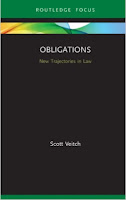
On Veitch's Obligations: Four Reponses and the Author's Reply (Critical Legal Thinking)

In December 2021, Critical Legal Thinking published four responses to the recent book authored by Professor Scott Veitch, who is Paul KC Chung Professor in Jurisprudence at HKU Law.  Professor Veitch then responded to the responses.  An excerpt from the first response is provided below with links to the other responses and Professor Veitch's reply.

"Rights, Obligations and Torture: On Veitch’s Obligations"
Julen Etxabe
Critical Legal Thinking 
Published on 14 December 2021
We continue our series on contemporary critical (legal) books with a series of responses to Scott Veitch’s, Obligations: New Trajectories in Law (Routledge, 2021). We will post four responses to Scott’s new work, each picking distinct themes which together testify to the richness of the book’s scholarship. Next week Scott will respond.
Those familiar with Scott Veitch’s earlier body of work will not be surprised by the wide-ranging, incisive and witty style of Obligations, his contribution for Routledge’s series New Trajectories in Law. This is not to diminish the accomplishment: Veitch’s impressive capacity of condensation, its intellectual and historical breadth, and the clinical precision with which he dissects the subject-matter deserve high praise. His “new trajectory” is at once a retrieval of an overlooked genealogy, a critical diagnosis of the times, and the groundwork for its renewal.
     The book is not a critique of rights per se, but of their dominant role as the defining, almost exclusive, language of our age. Not only are obligations historically prior, but they are substantially more robust and perform a “connective work” that rights simply do not. Above and beyond a primordial “right to have rights,” then, Veitch envisages an antecedent world of obligations that ground human relations and their political institutions, which make rights possible (34). However, he is too acute a thinker simply to suggest a reversal: “To expose and understand the fact of their [obligations’] priority must not therefore entail necessarily valorizing it: context matters” (18). ... Click here to read the full commentary, here to read the commentary by Matt Stone, here to read the commentary by Margaret Davies, here to read the commentary by Stacy Douglas, and here to read Professor Scott Veitch's reply.

Wednesday, July 28, 2021

Book Review of Henry Litton's The Dance of Folly: Or How Theatrics have Tarnished the Rule of Law by Richard Cullen

“LIKE MOTHS TO A FLAME” – A REVIEW OF: 

THE DANCE OF FOLLY:

OR HOW THEATRICS HAVE TARNISHED THE RULE OF LAW

by HENRY LITTON

((Kin Kwok, Hong Kong, 2021) 98 pages, HK$120) 

by Richard Cullen 

Published at Pearls and Irritations Website in Australia

A series of acute points are made by Henry Litton in his new book, The Dance of Folly. These typically pivot on his observations of how judges, across various courts in Hong Kong, have been drawn away – by lawyers - from what he argues is the essence of well-grounded, common law reasoning towards playing dubious games with legalized expressions and theory-based arguments. The result is that dangerous stress has increasingly been placed on the operation of the One Country Two Systems (OCTS) framework, which governs the relationship between Hong Kong and China.

Some will disagree with the central arguments made. But where they do, most will still find themselves thinking deeply about what is being argued in this robustly readable work.

As I read the book, it prompted significant reflection – and a particular memory

Over four decades ago, as I was completing my LLB at the University of Melbourne, I began attending various courtrooms to see the law actually being applied. Armed with my new legal-classroom understanding, I found I could follow what was going on. Rather like when one learns the rules of football; watching any game afterwards becomes far more engaging.

On one occasion I was fortunate enough to happen upon a murder trial, in the Victorian Supreme Court, where the facts were exceptionally lurid. The two accused, a wife and her lover (call them “X” and “Y”), were charged with murdering her husband (“A”). The evidence showed that all were no strangers to the professionally criminal way of life. Apart from myself, a number of X and Y family members were in court paying close attention.

The husband and wife, A and X, had a hilly countryside allotment in the well-timbered, modest mountains bordering Melbourne to the east. By arrangement, Y had arrived one damp day, to coordinate with X in order to murder A. Husband A was rendered unstable by a blow to the head and fell heavily. Mr. Y then ran over A with his motor vehicle more than once. Subsequently, X and Y, discovered that husband A was still drawing breath. A small calibre rifle was fetched and Y shot A, finally killing him.

After all this was established, the barrister for Y, asked to lodge a new defence to the charge of murder. To do this mid-trial is unusual. The judge agreed to a voir dire (a separate hearing within the trial) to allow the barrister to make his application. The jury was sent from the courtroom so they would not hear the argument unless the judge said it was admissible.

The barrister for Y then advised the judge that his client now wanted to plead self-defence. The judge asked the barrister what the basis for this argument could possibly be. The barrister explained that, although husband A was significantly injured prior to being shot, it must have been the case that he was also extremely angry with Y, by that stage, and thus, had he been able, he would certainly have been minded to kill Y and Y, thus, shot husband A dead in order to defend himself. The judge shook his head slightly in what looked like disbelief and smartly told the barrister that this argument was improper and would not be allowed to be put to the jury.

I had heard how lawyers could argue that black was white, but here I saw that sort of ability applied in real life for the first time.

The judgments in the cases analyzed by Henry Litton do not involve vividly lethal facts to compare with those just outlined but they do rely on putting legal arguments to work, unfittingly in Litton’s view, in ways which have adversely shaped the operation of the common law system in the Hong Kong Special Administrative Region (HKSAR).

Chapter 4 of this new book is entitled, “Do Judges Run Prisons?” Henry Litton provides a withering review of a case involving certain personal hygiene and appearance procedures applied within prisons in Hong Kong.

In March 2012, Leung, Kwok Hung was convicted of a criminal charge before a magistrate. Leung was, for an extended period, a Member of the Legislative Council (LegCo). He was widely known as “Long Hair” in recognition of the way he had worn his hair over many years. After exhausting the appeal process, he commenced his sentence of four weeks in 2014. His hair was cut short in accordance with long established prison regulations (page 39).

After some indecision about appealing against this hair-cutting decision because it was discriminatory – women prisoners in separate prisons are not ordered to have short haircuts in the same way – Leung lodged an appeal to the High Court, which was heard in April and May, 2015. A declaration was given in Leung’s favour in a 39 page judgment delivered 18 months later in late 2016. The Court of Appeal (CA) reversed this outcome in another prolonged judgment in April 2018. In November 2020, the Court of Final Appeal (CFA) overruled the CA and restored the original judgment, once more explaining why at length. The entire process took over five years. It transformed what Henry Litton powerfully argues was clearly (and justly) a matter best left to be decided (as it had been for many years) by the prison administration, into an immensely elongated discussion of equality rights, which now complicates custodial discipline measures (pages 39 – 49).

He finds the outcome absurd. He says the Judge at First Instance failed to accept his basic, judicial gate-keeping responsibility. The judge should have stopped the original case from proceeding in the interests (inter alia) of good governance. Subsequently, the disarray was compounded when the CFA failed in its leadership role by giving the procedural (access to judicial review) aspects of the case “not an ounce of thought”, simply following where it was led by counsel (page 50).

Litton concludes by observing that: “The judges, at all three levels of the courts, seem drawn to overseas case law as moths to a flame: apparently brushing aside the inconvenient truth that the common law system operates under the principle of One Country Two Systems. Such a mind-set spells disaster in the long run. It is not a formula for the long continuation of the common law in Hong Kong” (pages 50-51).

The book is conspicuously based on the penetrating analysis of a series of high profile cases – mostly cases seeking judicial review. These include (apart from the case above) the court-based review of: the election of the former Chief Executive C. Y Leung (2012); procedures under the Complaints Against Police Ordinance (CAPO) and police identification (2020); the Face-Covering Case (2020); and a bail-procedural case related to the new National Security Law (NSL) in 2020 (chapters 1 to 8).

Litton perceives – and documents in detail – the clear failure in many such judgments to come to terms with the substantive factual evidence as they each detour into “forensic games” typically played by discussing abstracted interpretations of the Basic Law and most recently, the NSL, both of which are nationally enacted fundamental laws applying in the HKSAR (chapters 1 to 8).

He repeatedly notes the failure to stop improperly based applications for judicial review (many of which are publicly funded by legal aid) proceeding at all.

The criticisms leveled are sharp but they are typically argued, step by step, with clarity. In his analysis of the Face Covering Case, Litton makes one perceptive point after another (chapter 3). At the outset he notes that judicial review is meant to aid those with a real grievance in the public law field and not “a mere agitator” (page 28).

Litton explains that all the applicants seeking a review of the new, emergency face-covering regulations (made under the Emergency Regulations Ordinance (ERO)) applied on October 5, 2019 by the HKSAR Government, were LegCo members, apart from one who was a former LegCo member. Litton asks the question which the court did not: were the applicants “legislators or agitators”. Why come to court – why not argue these matters within LegCo (which, as it happens, had largely been rendered non-functional by these same LegCo applicants). Litton goes on: “Were the applications made in good faith – or were [the applicants] just pursuing a political agenda?”(pages 28-29)

In an extraordinary judgment, the two High Court Judges hearing the case at first instance declared that the ERO was unconstitutional and they also struck down most of the regulations, themselves. This was a plainly dangerous on at least two levels. First, it badly handicapped the Hong Kong Police who were in the midst of managing the most difficult crisis they had faced in decades: trying to bring an end to the immensely violent and destructive multi-month insurrection which began in June 2019. Second, it openly challenged the fundamental constitutional role of the sovereign. Beijing explicitly reviewed the laws of British Hong in February, 1997 and then adopted most of those laws, in general. Next, a list was provided of particular laws which were not adopted because they contravened the Basic Law. The ERO was not on this list. The judgment also singularly failed to consider the vital nature of the public interest as an existential threat to the social and constitutional order of Hong Kong unfolded (see Cullen, Richard, “Ruling on mask ban a reminder of centrality of public interest”, China Daily, March 1, 2021).

The CA overturned the ERO declaration and restored most of the regulations. Finally, the CFA dismissed every ground relied on by the applicants – restoring all the regulations. By this time, the judgments, described in the book as a “carnival of words” ran to over 320 pages, in total. Litton trenchantly notes that: “It should have been blindingly obvious that counsel’s arguments that the [ERO] was unconstitutional verged on the absurd. Why was it given oxygen by the judges?” He summarizes the final outcome in these words: “After so much huffing and puffing, what has been achieved? The answer is zero, except to show how the law can be made ineffectual when the discipline is ignored” (page 32).

The book also includes a chapter that provides an overview of the new NSL (chapter 7). Litton first outlines the history of the failed attempt by the HKSAR to enact new a National Security Law in 2003 pursuant to the requirement to do this spelled out in Article 23 of the Basic Law. He then concisely summarizes the terrifying extent and impact of the lengthy 2019 insurgency and the paralyzing of LegCo. He also notes how this massive dispute in Hong Kong was used, inter alia, as a means to advance geopolitical interests aligned against China. In these circumstances, the need to upgrade national security protection became urgent (page 71).

In a paper written by Paul Harris, a leading Hong Kong Senior Counsel and now Chair of the Hong Kong Bar Association, it is said that NSL Article 43 (listing police powers), “goes far to create a police state”. Litton says that this claim is a “gross exaggeration”. He goes on to argue in detail and convincingly against this paper – and a related paper on the Joint Declaration by the same author (pages 77 – 85).

The concluding chapter deals with the “35 plus primaries” organized by the Pan-Democrat opposition in July 2020 (after the NSL was proclaimed) to prevent vote-splitting and to find the candidates most likely to be elected in the (then approaching) September, 2020 LegCo elections, who would use their LegCo powers to apply new constitutionally disruptive pressures on the HKSAR Government (chapter 9).

Litton argues that what was sinister about this scheme was that it was designed “to implement a wider plot called “ten steps to mutual destruction” which had been outlined in a pro-democrat newspaper, Apple Daily on 28 April, 2020”. He explains, convincingly, based on the outlined plan, that, if the 35 plus majority had been secured, the new legislators were committed to using their powers to create chaos (page94).

More recently, the author has written a related, influential article. Published in early July, 2021, it reflects on the first year of operation of the NSL in the HKSAR. It is entitled “A Close Run Thing” – drawing on a remark made by the Duke of Wellington after winning the Battle of Waterloo, against Napoleon, in 1815. Litton states, definitively, that in 2019, “What Hong Kong faced was an insurgency, the overthrow of government, nothing less:” another close run thing. In the conclusion to this article, he briskly notes how inadequately protected – compared to the NSL – potential defendants are under the measurably harsh text deployed within the US national security regime.

This sort of clear comparative analysis provides one foundation which shows how repeated Western claims of freedoms being stifled in the HKSAR under the NSL are starkly and purposefully detached from reality. Litton agrees with Mr C. H Tung that Hong Kong has been systematically used as a proxy within a wider power conflict.

The central message of this book can be summarized as follows:
  • Hong Kong is inalienably and fundamentally part of China;
  • As the HKSAR, it enjoys remarkable special, constitutional, political, economic and social privileges and opportunities within China under the OCTS framework;
  • But it also owes deep obligations to China, under OCTS, to protect national security within the HKSAR and within China;
  • This obligation has been singularly amplified by the increasingly hostile efforts by the US (and heavily-encouraged-allies) to confront and contain the rise of China, which threatens American superpower hegemony more seriously than at any time since the end of World War II;
  • The key to maintaining OCTS so that it operates to the best advantage of Hong Kong through until 2047 and beyond, is building and sustaining a level of fundamental trust between Hong Kong and Beijing;
  • The Judiciary in the HKSAR is uniquely placed and has a special responsibility both to maintain the essential principles of the common law and to maintain that trust;
  • There have now been too many instances, within the judiciary, of a “carnival of words” unfolding where there is a lack of “focus on the true issues [while] forensic games [are] played with a national law”;
  • This has led to an increase in mistrust of the HKSAR Judiciary in Beijing;
  • This is a grave current problem which needs to be addressed candidly and effectively.
Prior to the decision in the Face Covering Case, one might have argued that these concerns, though real, were rather strongly stated. After that decision, however, it is hard to disagree with the basic tenor of where Henry Litton says we now find ourselves, judicially, and why – and why this has led to a measurable undermining of cross-border trust. A central and difficult concern presents itself, which the judiciary in Hong Kong has to address.

Thursday, November 26, 2020

Review Essay of Henry Litton’s 'Is the Hong Kong Judiciary Sleepwalking to 2047?' (Richard Cullen)

A PROJECT WITH CONSEQUENCES: THE FUNDAMENTAL RENOVATION OF HONG KONG’S LEGAL SYSTEM[1]
Richard Cullen

During the British Hong Kong era, the Judicial Committee of the Privy Council (JCPC) in London acted as our paramount court (today replaced by the Court of Final Appeal (CFA)). In this role, the JCPC typically adhered to a society-based understanding of the operating context of the Common Law in Hong Kong.
     For around 150 years these were the essential guardrails within which the law worked in British Hong Kong. This was the Common Law system which was understood and spelled out for retention in the Joint Declaration, in 1984.[2]
     In 1991 we witnessed the enactment and application of the Hong Kong Bill of Rights Ordinance (BORO). This was one of the measures introduced by the British shortly prior to the 1997 handover, which aimed to build greater confidence within Hong Kong. The enactment of the BORO was the starting point of the fundamental reshaping of Hong Kong’s legal regime
     Henry Litton is a retired judge of the CFA, where he first became a Permanent Judge in 1997. He published a book in 2019 entitled, Is the Hong Kong Judiciary Sleepwalking to 2047?[3] This is a very important book because of its intense, highly informed observations on the reformatting of our legal system.
     Henry Litton has been a central legal figure in Hong Kong for many decades. He co-founded the Hong Kong Law Journal 50 years ago and had a successful career at the Bar (where he chaired the Bar Association seven times) before joining the Judiciary and rising to its highest levels. It is hard to think of someone better placed to comment, in depth, on the operation of the Hong Kong Judiciary. Apart from this seminal book, he is a regular, authoritative commentator on a range of legal and political topics of central concern in Hong Kong.
     Litton addresses contentious issues and takes robust positions. He has attracted a number of strong critics from the US and within Hong Kong. Most censorious are practitioners who applaud the way the role of the Judiciary in Hong Kong has been transformed over the last 30 years as it has increasingly deployed its power to run an elaborate human rights ruler over a widening range of aspects of governance and ordinances. Judicial activism is acclaimed. Some critics believe, for example, that as the HKSAR Judiciary ought to have the legal right to strike down various provisions in the new National Security Law it follows that it surely must have this legal power.[4]
     The lucid gist of Litton’s arguments is arresting. A bedrock position advanced is that the Common Law we have is the Common Law of Hong Kong. In each place, the law is developed by applying long-established legal principles and understanding to concrete, fact-based disputes, which arise in and are resolved within the broad context of any given Common Law jurisdiction. Influences may be taken into account from other jurisdictions - but there is no such thing as International Common Law. 
     For around 150 years, prior to its enactment, the British took the view no such law as the BORO was needed in Hong Kong. Today the BORO is recognized within the Basic Law where it pairs with the rights protected in Chapter 3 of the Basic Law.
     In 1992, in the Sin Yau Ming case,[5] the pronounced impact of the BORO on the previous mode of case-based decision making was signaled. In 1993, in the Lee Kwong Kut case,[6] Lord Woolf, speaking for the JCPC, foreshadowed the dangers inherent in this change, with its powerful emphasis on making the Government justify certain laws according to a complex series of judge-made proportionality tests drawn from Canadian case law. Briefly, Lord Woolf warned that the BORO could cause disputes to get out of hand and become a source of injustice if it were imposed inflexibly. He advocated that in most cases the courts should continue, essentially as before, to strike a balance between individual rights and the public interest.[7]
     This penetrating warning was roundly criticized by those favouring enhanced judicial activism and the application of a paramount level of proportionality testing.[8] The critics won and their approach has gathered impressive momentum over the last several decades. These developments have assisted the project to reshape the estimable concept of judicial independence into a form of lawyer-energized, judicial supremacy. It is key aspects of this development which have drawn the most trenchant criticism from Mr Litton.
     In his book, Litton has documented the erosion, in stark dismaying detail, of the previous, definitive adherence to common sense, fact-based decision-making in Hong Kong courts. This original approach, he says, has given way to massively over-argued, theory-based (not least and confusingly from the European Union) overlong legal decision-making, which, at great (usually public) cost, regularly fails to deliver fitting decisions. Much of this involves Judicial Review applications funded by Legal Aid. Lawyers lead and the judges follow, when, in fact, the judges should be saying, time and again, that there is no proper case to argue. By allowing themselves to be led, Litton contends, judges are surrendering their own judicial independence, step by step, to the lawyers arguing before them.[9] Compounding the calamity is the fact that so many of these judgments fail the translatability test – into Chinese.[10]
      Moreover, judgments are regularly emerging from this process which test Beijing’s predisposition to use – or not to use - the interpretation power in Article 158 of the Basic Law.[11]
      Another question implied by the analysis in this book, briefly stated, is: what has gone wrong with universalism? That is, how has it come to pass that the global project of employing highly legalized means to protect human rights (according to the doctrine of universal rights) has produced regular adverse outcomes? 
     I am not devaluing the importance of protecting rights. But I do wish to highlight the consequences of using very powerful, universalized legal means to secure them. No matter how well intentioned this mission may be, we need to face the reality that this project can produce significant and enduring, undesirable consequences when employed ardently, based on claimed universal norms superimposed on a material local context.
      Those who strongly favour the maximum protection of universal individual rights by legal means, would say no such thing has happened and that this maximum protection will always work to secure the greater public good: individual rights are paramount and they trump other concerns in order to create a better society for all. 
      We can see, however, with the unfolding of the COVID pandemic, for example, that this argument does not stand up – universally. In such a medical emergency, those determined to exercise and protect their individual rights (to mingle as they wish without any mask) amplify a too often deadly health risk for the entire community. The United States, with around 13 million cases and over 260,000 deaths – and both figures rising – plainly shows how grim such adverse outcomes can swiftly become.[12]
     But how truly universal is this doctrine in the first place? The modern, legalized calibration and enforcement of individual human rights is a comparatively recent formulation which was crafted, in detail, after World War II. It was purposefully labelled (by Western-focussed jurists) as a universal solution, which could – and should – be applied globally, the better to strengthen its power and legitimacy.
     However, this was a Western solution to an existential crisis in Western Civilization which had developed over many centuries. The Western Roman Empire made Christianity, headquartered in Rome, the official State Religion in 380 AD. After that empire broke up about 100 years later, Europe steadily separated into an outsized number of feudal Kingdoms which regularly spent much time at war with one another. This level of warfare intensified immensely after the profound 16th century split in the Roman Catholic Church at the time of the Protestant Reformation (subsequent to Europe’s intellectual Renaissance). The blood-letting which followed was staggering in scope and savagery.[13]
     The warfare continued as the Age of European Discovery and Imperialism began, with both discovery and warfare spurred on by remarkable breakthroughs in scientific and general understanding, as the Reformation gave way to the Enlightenment and then to the Industrial Revolution.[14]
     The crisis at the heart of Western Civilization truly came to head, however, in the 20th century: first with World War I and then, most horrifically, with World War II. The Nazi German regime systematically murdered over 6 million people for being Jewish or otherwise sub-human according to contemptible Nazi precepts.[15]
     How could Western Civilization, which had produced such extraordinary, world-changing art, literature, science and technology and the Enlightenment, descend to such a hideous level of mass human depravity? And what could be done to stop this ever happening again? A number of commendable measures were advanced to address this crisis, including the creation of the United Nations - and the formation of the modern doctrine of international human rights. 
     It is true that the US had long had a system of legalized rights protection in its constitutional Bill of Rights, since its ratification in 1791. The impact of that Bill was, until after World War II, very limited, however. The US had, for example, maintained a system, endorsed by the US Supreme Court, of highly discriminatory and often cruel segregation for Black Americans for around 100 years after the Civil War ended slavery in America: the Bill of Rights offered scant protection to these Americans.[16]
     The authoritative impact of the US Bill of Rights did, however, lift conspicuously by the 1960s as the Civil Rights movement gained robust political leverage.[17] And its legalized framework, - allowing for judicial enforcement of widely binding superior court decisions - provided the model for new, substantially legalized rights protection regimes in, for example, Canada, Western Europe, the UK, New Zealand – and, from 1991, Hong Kong. All these systems speak of universal rights which, according to leading practitioners, must be shaped in their definition and enforcement by international human rights law, drawn from Civil Law and Common Law jurisdictions, worldwide.[18]
      The English political philosopher, John Gray in his book Black Mass (2007) argues, with great force, that US-led, Missionary Liberalism insists that human rights are both universal – and must be universally respected.[19] They override the claims of Sovereign States. Gray, relying on a comprehensive historical-philosophical analysis, argues, in brief, that what he calls Liberal Imperialism has profound roots - along with far more savage, revolutionary movements like Nazism - in Western Enlightenment beliefs in the human capacity to guide and remake society, which in turn derive from earlier Judeo-Christian beliefs in apocalyptic (end of the world) cleansing and remaking or less drastic, early religious theories of utopian, societal recreation. Gray quotes George Santayana, the Spanish-American philosopher, who acutely noted how “Arrogance, fanaticism, meddlesomeness, and imperialism may masquerade as philanthropy.”[20]
      Apart from these deep concerns about the downside influence of doctrinaire, utopian social reformation theories sourced from within Enlightenment thinking and the particular, extended, very bloody, Western history underpinning the origins of the modern human rights doctrine, practical concerns also arise. A crucial operational flaw in the doctrine of international rights (recognized by Lord Woolf) is that, while it insists on an internationalized measure of acceptable legalization and protection, it provides very poor articulation of what to do when the exercise of certain rights by some has a grave impact on the rights of others, as regularly happens. This was a problem grimly encountered in Hong Kong in 2019. As an American academic recently noted, freedom from fear is the most basic of all freedoms. [21] This freedom, massively displaced in 2019, had been a singular hallmark of life in Hong Kong for decades before then.[22]
     Next there is the problem that, once a highly developed legalized human rights regime puts down serious roots in a given (especially Common Law) jurisdiction, one can expect lawyers to briskly put this regime to work. The prominent Canadian legal scholar, Michael Mandel, sharply noted the dangers arising from the “legalization of politics” in his principal book on the Canadian Charter of Rights. He characterized that document as “a dripping roast for lawyers”.[23]
     Hong Kong today provides measurable confirmation of Mandel’s insights. In short, Henry Litton makes a compelling case that the re-shaping of how the Common Law operates is bad for the HKSAR at two crucial levels. First, the practical, fact-based functionality of the law has been seriously compromised. Litton concludes his book by arguing that abstract principles of law derived from foreign jurisprudence have crushed the simple logic of the Common Law in Hong Kong.[24]
     Secondly, and more importantly, this Hong Kong incubated, adverse development of the law, shepherded by the Judiciary, poses a visible threat to the prospects of retaining the full essence of Hong Kong’s remarkable Common Law heritage over the long-term, well beyond 2047. Litton argues that collectively these vicissitudes spell “disaster as June 2047 gets ever closer.”[25]
     The way in which these profound changes in the operation of the Hong Kong legal system have been animated by the global project to advance the deployment of vigorously legalized, international human rights regimes is also plain to see.
     Henry Litton poses a crucial question in the title of his book: is the judiciary sleepwalking to 2047? He also introduces a pivotal question in the first chapter of his book: “The Basic Law gives effect to the ‘One Country Two Systems’ policy of the PRC which has held good for over twenty years: until the Hong Kong Judiciary itself, bit by bit, surrenders part of Hong Kong’s autonomy. Is this an exercise of judicial independence, or is it the betrayal of a constitutional trust?”[26]
     Hong Kong needs, today, to pay careful attention to both these questions – not least as the US pursues a policy of intensifying confrontation with China. This broader, grim geopolitical context cannot be ignored.[27] It may be time (notwithstanding George Bernard Shaw’s caveat[28]) for the application of some brute sanity.

Notes:
[1] A short, earlier version of this review-article, entitled, “Is Hong Kong Judiciary sleepwalking to 2047 and beyond?”, was published in the China Daily, November 4, 2020.
[2] Joint Declaration of the Government of the United Kingdom of Great Britain and Northern Ireland and the Government of the People’s Republic of China on the Question of Hong Kong – signed December 19, 1984.
[3] Litton, Henry, Is the Hong Kong Judiciary Sleepwalking to 2047? (Sherriff Books, Hong Kong, 2019) (hereinafter, Sleepwalking).
[4] See, for example, Cohen, Jerry, “Henry Litton’s Attack on Hong Kong Courts”, October 9, 2020, available at: http://www.jeromecohen.net/jerrys-blog/2020/10/9/henry-littons-attack-on-hk-courts
[5] R v Sin Yau Ming [1992] 1 HKCLR, 127.
[6] Attorney-General of Hong Kong v Lee Kwong Kut (1993) AC 951.
[7] Ibid. The essence of what Lord Woolf said was that,, while the Hong Kong judiciary should be zealous in upholding an individual’s rights, it was also necessary that disputes as to the effect of the BORO not be allowed to get out of hand. He added that, in order to maintain the balance between the rights of the individual and the public interest, rigid and inflexible standards should not be imposed on attempts to resolve the difficult and intransigent problems with which society is faced when dealing with serious crime. He also stressed the importance of local context and cautioned against using the complex proportionality test borrowed from Canada – which so strongly emphasizes individual rights - in most cases.
[8] A leading, powerfully argued example, is, Ghai, Yash, “Sentinels of Liberty or Woolf in Sheep’s Clothing? Judicial Politics and the Hong Kong Bill of Rights” (!997) Modern Law Review 459.
[9] Sleepwalking, 45.
[10] Sleepwalking, 25.
[11] Cheung, Tony, Zheng, William and Cheung, Gary, “’No other authority has right to make judgments’: China slams Hong Kong court’s ruling on anti-mask law as unconstitutional”, South China Morning Post, November 19, 2019, available at: https://www.scmp.com/news/hong-kong/politics/article/3038325/hong-kong-judges-slammed-chinas-top-legislative-body.
[12] See, for example, Paz, Christian, “All the President’s Lies About the Coronavirus”, The Atlantic, November 2, 2020, available at https://www.theatlantic.com/politics/archive/2020/11/trumps-lies-about-coronavirus/608647/.
[13] Gray, John, Black Mass (Penguin, London, 2007) 261.
[14] Ibid., Chapter 1, The Death of Utopia.
[15] Ibid., 89 ff.
[16] In Plessy v Ferguson (1896) 163 US 537, the US Supreme Court, in a 7:1 decision, approved a Louisiana State segregation law on the basis of the court’s “separate but equal” doctrine. This was not overturned until 1954, in Brown v Board of Education (1954) 37 US 483.
[17] See Brown v Board of Education (1954) 37 US 483 and subsequent cases.
[18] See, for example, Diakonia International Humanitarian Law Centre, International Human Rights Law, available at: https://www.diakonia.se/en/IHL/The-Law/International-Law1/International-Human-Rights-Law/.
[19] Gray, John, Black Mass (Penguin, London, 2007) 228. A.S. Byatt calls this work, “wise, furious and informative.”
[20] Ibid.
[21] Tiezzi, Joanna, “Victoria Hui on Hong Kong’s Troubled Future”, The Diplomat, June 3, 2020, available at: https://thediplomat.com/2020/06/victoria-hui-on-hong-kongs-troubled-future/.
[22] Cullen, Richard, Hong Kong Constitutionalism: The British Legacy and the Chinese Future (Routledge, Abingdon, 2020, Chapter 7.
[23] Mandel, Michael, The Charter of Rights and the Legalization of Politics (Thompson Educational, Toronto, 1994).
[24] Sleepwalking, 212.
[25] Ibid.
[26] Sleepwalking, 69.
[27] See, for example: Editorial Board, “Stopping the descent into a new cold war”, Financial Times, October 9, 2020, available at: https://www.ft.com/content/7f3b6965-94fb-41df-9fa8-25ce655192fa; Trevelyan, Laura, “Is the world entering a new Cold War?” BBC News, September 22, 2020, available at: https://www.bbc.com/news/world-us-canada-54244011; and Klare, Michael, “The New Cold War Is a Lot More Dangerous Than the Old”, Foreign Policy in Focus, November 1, 2018, available at: https://fpif.org/the-new-cold-war-is-a-lot-more-dangerous-than-the-old/.
[28] Shaw observed that: “Reformers have the idea that change can be achieved by brute sanity”, available at: www.quoteslyfe.com.

Friday, March 31, 2017

Grenville Cross Reviews Gittings' Introduction to the Hong Kong Basic Law, 2nd Edition (Austr J Asian L)

"Book Review: Introduction to the Hong Kong Basic Law"
I Grenville Cross (Honorary Professor)
Australian Journal of Asian Law
2016, Vol. 17, No. 2, article 13
If, as Harold Wilson once said, ‘a week is a long time in politics’, three years in the life of the Basic Law of the Hong Kong Special Administrative Region must rank as an eternity. Much has happened since the publication of Danny Gittings’ acclaimed Introduction to the Hong Kong Basic Law in 2013, and the arrival of the second edition is welcome. As Hong Kong has become more polarised, so the search for answers has led people back to the Basic Law, with the mini-constitution being widely debated in legal and political circles, as well as within the wider population. This, of course, is no bad thing, provided the discussion is informed, which is where Gittings comes in. At the outset, Gittings indicates that, although his text is intended to help students, its reach is actually ‘far wider’. He has provided not only a helpful guide to the Basic Law but also an incisive analysis of the many issues it has generated. Anyone wishing to understand how Hong Kong operates these days would be well advised to consult it. Gittings comprehensively traverses legal, political and governmental questions, with nothing of relevance left untouched. It is a huge bonus that the text can also be readily understood by the man in the street and anyone unfamiliar with the subject... Click here to read the full review.