Showing posts with label National Security Law. Show all posts

Friday, February 21, 2025

Hualing Fu on Managed freedom in precarious times: Maintaining academic freedom in transitional Hong Kong (GlobCon)

"Managed freedom in precarious times: Maintaining academic freedom in transitional Hong Kong"
Hualing Fu
Global Constitutionalism
Published online: January 2025

Abstract: This article examines the status of academic freedom in Hong Kong in light of the increasing securitization of higher education since the implementation of the National Security Law (NSL) in 2020. It provides an analytical framework to comprehend the changing landscape of academic freedom in Hong Kong, highlighting the impact of the NSL and the conflict between the necessity of political control on securitized campuses and the demand for international, free, and high-quality universities to make Hong Kong a global hub for higher education. The article concludes by asserting that the NSL has reshaped and will continue to impact academic freedom and university autonomy concerning core security issues, but there is still a possibility to establish a defendable space for genuine academic freedom in classrooms.

Monday, July 22, 2024

Han Zhu on Macau and Hong Kong: Convergence or Divergence? An Analysis of the 2023 Macau National Security Law (HKLJ)

"Macau and Hong Kong: Convergence or Divergence? An Analysis of the 2023 Macau National Security Law"
Han Zhu
Hong Kong Law Journal, Vol. 54, Part 1 of 2024, pp.53 - 63

Abstract: On 18 May 2023, the Macau Legislative Assembly passed amendments to the Law on Safeguarding National Security (MANSL), drawing heavily on the 2020 Hong Kong National Security Law (HKNSL). This article examines the major modifications made to the MANSL in reference to the HKNSL, and demonstrates that the revised MANSL has deviated from its pro-liberal, narrowly defined precursor. The two distinct paradigms of national security legislation in Hong Kong and Macau reveal the increasingly muddled and complex constitutional relationship between the central authority and the two Special Administrative Regions.

Please click here to view the full article on SSRN.


Wednesday, February 28, 2024

HKU Law Scholars Make Submissions on the 2024 Article 23 Bill and Consultation Paper

In January 2024, the Security Bureau of the HKSAR Government released its long-awaited Public Consultation Document on Basic Law Article 23 national security law proposals (“Safeguarding National Security: Basic Law Article 23 Legislation”). On 8 March 2024, the Safeguarding National Security Bill was presented to the Legislative Council for first and second reading.  Scholars in the Faculty of Law have prepared written submissions (and articles) on the proposals contained in the consultation paper and bill. This commentary can be accessed below.

Albert Chen: Ming Pao 1, Ming Pao 2
Simon NM Young: Submission on the Bill (Chinese Translation on HK01), Submission on the Consultation Paper (Chinese Translation on HK01).  In anticipation of the passage of the Safeguarding National Security Ordinance, Professor Young shared these comments on the new law with various media outlets:
"The Safeguarding National Security Ordinance is plainly intended to deter people from taking any step that might put national security at risk. It achieves this with tough sanctions and special restrictive procedures if one gets caught up in the system. It completes the national security ecosystem which began with the 2020 National Security Law making the system now intensely robust. Once the law is passed, the Central Government will rest assured that there are comprehensive and suitable measures in place in Hong Kong to suppress any threats, whether they be external or internal, to the stability and safety of the country.

For most Hong Kong people, the new law will have little relevance and impact on their daily lives. There are four categories of persons who are likely to be impacted and will need to take more care and be familiar with the requirements and contours of the new law. They are as follows: (a) public officers; (b) government contractors; (c) those who have regular dealings with external forces; and (d) those already within the system or within the radar of the national security authorities.
For categories (a) and (b), the new provisions on state secrets and espionage will need to be closely studied. Category (c) could include a wide range of persons and companies, including academics and journalists. For the most part, the cooperation that tends to happen with external forces already will not lead to any liability under the new law. But if the cooperation tends towards advocating for policy or legal changes in Hong Kong or is simply critical of the Hong Kong or Central governments, then the new offences of espionage and external interference may well be applicable.
As for (d), there would be different sub-categories of persons depending on how far one is within the system. If one is already serving a sentence for a national security offence, unfortunately the time they need to serve will effectively be extended unless they can demonstrate no risk to national security if released with remission. For those facing charges, there will no longer be the option of a suspended sentence of imprisonment. Those who are arrested for a national security offence will also face a more restrictive set of procedures in relation to pre-charge detention, restrictions on accessing a lawyer, a greater hurdle in obtaining bail, and restrictions on movement if granted bail.

As for the legislative process, the Administration invested much effort and labour at the front-end of the exercise in preparing both the Consultation Paper and Bill. There was a dedicated team in Government, including the Secretary for Justice and Secretary for Security, who dutifully attended the long and intensive meetings held in LegCo. The Bills Committee members asked questions about all aspects of the Bill and replies were given. The questions tended towards having the Bill clarified or loopholes closed. The Government agreed with some of these comments and came up with proposed amendments. I would not say it was a rubber-stamping exercise. But fewer comments from legislators were directed to making the law less restrictive; hence we do not see any proposed amendments to this effect. In the past, LegCo Bills Committee meetings, on politically sensitive topics, would be much more fractious, with filibustering and other obstructions to the proceedings. Hence proceedings would have been much longer. Sadly some of the antics in the past would have drown out the more constructive yet critical comments that more moderate opposition legislators were making. In the past, the Bills Committee might also have called for deputations from experts in the community including from the legal profession and law schools. It is regrettable that this was not done on this occasion. I believe legislators would have benefited from such expert input given that the issues involve technical and complex questions/implications of criminal law, procedure and evidence."

Monday, January 29, 2024

Cora Chan on Scholarship in Times of Constitutional Transformation: A View from Hong Kong (Human Rights Law Review)

"Scholarship in Times of Constitutional Transformation: A View from Hong Kong"
Cora Chan
Human Rights Law Review, Volume 24, Issue 1
Published online: December 2023

Abstract: Hong Kong's constitutional order has been undergoing a momentous transformation since 2020. The introduction of the Hong Kong National Security Law and the use of a plethora of other security tools have pushed Hong Kong's largely liberal legal order in an increasingly authoritarian direction. This article examines the implications of these changes for academic freedom in the territory. Through the lens of Hong Kong, it examines the unique challenges facing constitutional law scholars in authoritarian or liberal backsliding contexts, as well as the distinct contributions they can make. It concludes with reflections on the relevance of arguments against `scholactivism' to authoritarian contexts. The analysis in this article will help us to understand what scholars should and can do in politically volatile environments more generally.

Wednesday, November 1, 2023

Ju Liu on The Ouster Clause and the Amendment to the Legal Practitioners Ordinance: an Analysis (HKLJ)

"The Ouster Clause and the Amendment to the Legal Practitioners Ordinance: an Analysis"
Ju Liu (PhD candidate)
Hong Kong Law Journal, Vol. 53, Part 2 of 2023, pp.451 - 467
Abstract: In late 2022, Beijing issued its first interpretation of the National Security Law of Hong Kong, concluding that the admission of overseas counsel to appear in national security-related cases would involve national security and thus a certificate issued by the Chief Executive would be required. In May 2023, the Legal Practitioners (Amendment) Ordinance 2023 passed all the legislative proceedings and was gazetted on 12 May. In accordance with Beijing’s interpretation, the Ordinance introduces a parallel criterion for admitting overseas counsel in national security cases. This article looks into s 27F of the amended Ordinance, an ouster clause excluding any judicial challenge against a Decision made by the Chief Executive concerning the admission of overseas counsel. First, this article identifies three types of ouster clauses operating in Hong Kong. It then contends that, even though art 47 of the National Security Law is intertwined with s 27F of the amended Ordinance, the former does not necessarily supply the latter with full precluding force, and the latter gains its ousting force independently. Finally, this article argues, by reference to the English legal jurisprudence, that the Hong Kong courts might still be able to judicially review the Chief Executive’s Decision, but the scope would be rather limited and of low intensity.

Wednesday, March 1, 2023

Hualing Fu & Xiaobo Zhai on The Return of High Policing in Hong Kong (new book chapter)

"The Return of High Policing in Hong Kong"
Hualing Fu & Xiaobo Zhai
in The National Security Law of Hong Kong: Restoration and Transformation,
Edited by Hualing Fu Michael Hor (Hong Kong University Press, July 2022),
Chapter 9, pp. 187-210
Introduction: "What a disgrace!" lamented Xia Baolong, Director of the Office for Hong Kong and Macau Affairs, the highest-ranking official in the Central People's Government (CPG) in charge of Hong Kong affairs in a particularly condescending outburst to condemn the 2019 protests in Hong Kong.  That's how Beijing, Hong Kong's sovereign, perceived what happened in Hong Kong in 2019.  For the CPG, what was presented as democratic protest by the international media was nothing short of systematic disorder and organized violence bordering on insurrection.  What was shocking and extremely displeasing for the CPG was not only the level of violence and vandalism that some Hong Kong people proved to be capable of, but also the degree of sympathy and support they received from the larger communities in Hong Kong and internationally, and the incompetence and indifference of the Hong Kong government.  In the CPG's eyes, Hong Kong has turned from an economic asset into a political liability.  More importantly, the CPG believed that the unrest in Hong Kong exposed China to hostile international forces and put China's national security at grave risk.
     The mass unrest creates the need - it also offers an opportunity - for the CPG to react forcefully and strongly to put violence to an end and to restore law and order.  Its sharp and drastic action has taken the form of legislative suppression - the passing of the Law of the People's Republic of China for Safeguarding National Security in the Hong Kong Special Administrative Region (NSL).  The law aims both at the immediate goals of "preventing, stopping and punishing" activities endangering national security and the long-term goal of changing the constitutional structure of Hong Kong.  The law creates a range of new criminal offences, often broadly defined to cast a wide net against offences potentially endangering national security, exceeding China's own criminal law for some of the offences in its breadth.  It establishes a web of national security agencies with interlocking jurisdictions and duties with Beijing sitting at a comfortable, commanding height.  The NSL expands police power and correspondingly either ousts or limits judicial authorities at multiple entry points, ranging from restricting bail, excluding juries and enhancing secrecy in judicial proceedings.  Beyond the immediate impact, the NSL attempts to tackle the root cause of the national security risks as China perceives them in Hong Kong - a vibrant and politically charged civil society comprising non-governmental sectors, such as education, the media, the internet, religion or NGOs that were against the government.  Through the NSL, high policing has returned to Hong Kong. 
     This chapter offers a preliminary study of the role and functions of the high policing, also called political or national security policing, which the NSL has introduced in Hong Kong and its initial and long-term impact on the rule of law and rights and freedoms in Hong Kong.  The role that the political policing plays in Hong Kong largely depends upon the ultimate political end of the NSL.  Beyond the immediate goal of ending violence, nipping the pro-independence movement in the bud, and stopping foreign political meddling in Hong Kong, to what degree does the CPG intend to reorient Hong Kong and to bring it into the Chinese orbit?  Clearly, China continues to insist on the One Country Two Systems doctrine (OCTS), although to be enforced in a "correct way" that privileges its one country element.  China, however, does not intend to turn it into just another Chinese city.  In one of his speeches in 2017, President Xi Jinping highlighted Hong Kong's "distinctive strengths", including its pluralist and cosmopolitan society and its status as a major international financial centre.  China clearly stopped far short from imposing its own National Security Law (2015) upon Hong Kong, nor did it transplant its own national security practice in its entirety to Hong Kong.  In enacting the NSL, China sent a clear signal that, while the excess in 2019 should not happen again, Hong Kong will remain a distinct Special Administrative Region (SAR) in the foreseeable future.  There is a long spectrum between the unrest in 2019 and the Chinese regime of national security: where would Hong Kong find itself in the post-NSL era?
      This chapter explores three connected issues: 1) the political circumstances for the creation of the national security policing in Hong Kong; 2) the major features of the high policing that the NSL has created in Hong Kong, which are demonstrated by means of an analysis of the NSL, and the immediate impact that the NSL may have on the rule of law and rights and freedoms in Hong Kong; and 3) a possible new equilibrium between the national security policing and Hong Kong's liberal rule of law under the OCTS doctrine.

Tuesday, February 28, 2023

Kelley Loper & Carole J. Petersen on Academic Freedom in the Shadow of Hong Kong's National Security Law (new book chapter)

"Academic Freedom in the Shadow of Hong Kong's National Security Law"
Kelley Loper & Carole J. Petersen
in The National Security Law of Hong Kong: Restoration and Transformation,
Edited by Hualing Fu Michael Hor (Hong Kong University Press, July 2022),
Chapter 12, pp. 255-278
Introduction: This chapter analyses the impact of the Law of the People's Republic of China on Safeguarding National Security in Hong Kong (NSL) on educational autonomy and academic freedom, two core values that the "One Country Two, Systems" (OCTS) model of autonomy is supposed to protect.  Due to space constraints, this chapter primarily focuses on academic freedom in tertiary education.  However, it will also address certain contentious issues which have arisen in primary and secondary schools.
     Following this introduction, Part I reviews the concept of academic freedom, its value to society, and the ways in which it can be undermined.  Part II then analyses the situation in the Hong Kong Special Administrative Region (SAR) prior to the enactment of the NSL.  Although academic freedom and educational autonomy are expressly protected in the Hong Kong Basic Law (BL), changes to university governance in the past two decades have made universities and individual academics more vulnerable to political pressures.
      Part III of the chapter analyses provisions in the NSL that could further inhibit academic freedom and educational autonomy.  The NSL obligates the local government to "promote national security education in schools and universities" and creates several new criminal offences, which also apply extraterritorially.  The NSL also created new security agencies and endowed them with extensive powers.  On the other hand, Article 4 provides that human rights shall continue to be protected, including the rights stated in the BL, the International Covenant on Civil and Political Rights (ICCPR) and the International Covenant on Economic, Social and Cultural Rights (ICESCR).  These two treaties have a special place in Hong Kong's legal framework due to Article 39 of the BL and the Bill of Rights Ordinance (Cap 383) (which duplicates most of the provisions of the ICCPR).  Thus, any policies adopted by Hong Kong's educational institutions should comply with both treaties.  When cases are litigated the local courts should use the ICCPR as a guide to interpret vague language in the NSL.  Thus, the views of the United Nations (UN)  Human Rights Committee, the expert body tasked with monitoring states parties' implementation of the ICCPR, are particularly relevant.  The UN Committee on Economic, Social and Cultural Rights, the monitoring body for the ICESCR, can also offer guidance, particularly in the context of the right to education.  These international standards and their direct incorporation into Hong Kong law allow room for the courts and others to support academic freedom.  At the same time, legal protection alone is unlikely to be sufficient.  Other non-legal strategies, such as the drafting and enforcement of robust academic freedom policies by tertiary institutions themselves, are needed to strengthen academic freedom in Hong Kong going forward.  Indeed,  we conclude that the academic community has an obligation to adopt such policies and that the Hong Kong government has a constitutional obligation to respect them.  Suggested language for a university policy on academic freedom is therefore included at the end of this chapter. 

Monday, February 27, 2023

Po Jen Yap on Judging Hong Kong's National Security Law (new book chapter)

"Judging Hong Kong's National Security Law"
Po Jen Yap
in The National Security Law of Hong Kong: Restoration and Transformation,
Edited by Hualing Fu Michael Hor (Hong Kong University Press, July 2022),
Chapter 7, pp. 149-166
Introduction: An hour before the twenty-third anniversary of the Hong Kong Special Administrative Region's (HKSAR) establishment, the Standing Committee of the National People's Congress (NPCSC) bequeathed a new National Security Law (NSL) to Hong Kong.  Presented as a "birthday gift", this offering was prepared behind closed doors - the details were not subject to any public consultation and the law as only unveiled before the awaiting population after it took effect.  Surprise!
     Secession, which includes independence advocacy, subversion of state power, which includes the use of unlawful means to seriously undermine the operations of "the body of central power of the People's Republic of China or the body of power of [the HKSAR]", and collusion with foreign governments, which includes the receipt of any funding or support from a foreign country to provoke by unlawful means hatred among Hong Kong residents towards the Central or Hong Kong Government are all national security penal offences now.  Terrorism has also been defined to include the sabotage of vehicular transport and traffic facilities for political ends.  For all four crimes, offenders face sentences of up to life imprisonment for grave violations.  Even non-Hong Kong residents based outside the jurisdiction are liable for prosecution if they commit any of these penal offences against Hong Kong.  A national security agency established by Beijing to gather intelligence can now operate legally in Hong Kong but must abide by local laws, though these mainland officials are not subject to local jurisdiction for acts performed in the course of duty.  The enforcement and prosecution decisions made under this NSL are entrusted to local officials and Hong Kong courts are also empowered to adjudicate the vast majority of cases brought under this law.  Most local criminal law procedures and human rights safeguards continue to apply.  But jury trial in individual cases can be replaced with a panel of three judges, and where state secrets are involved, all or part of the trial can be closed to the public, though the verdict must still be announced in open court.  In those rare serious cases where foreign governments are involved or the Hong Kong government is unable to enforce the law effectively, the Chinese procuratorate and courts are legally empowered to take over from local counterparts.  The law opens up the chilling possibility that for these exceptional cases, the offenders, if in Hong Kong, can be extradited to the Mainland to face trial.  Finally, the power of interpreting this national security law lies with the NPCSC, which expressly allows mainland officials to overrule the Hong Kong judiciary's interpretation of this NSL.
     As to be expected, responses to this NSL have been sharply divided.  Western media has largely portrayed the NSL as the "final nail in Hong Kong's coffin" and mourned the city's death.  On the other hand, Beijing loyalists fete the law as a "new social contract" that restores stability and recovers Hong Kong's "original aspiration of 'One Country, Two Systems."'
     In this chapter, I do not intend to engage with the histrionics or propaganda.  Neither do I seek to navel-gaze and portend the long-term impact - salubrious or deleterious - that the NSL would have on Hong Kong's economic and civic life.  My aim is more modest: I shall examine whether the NSL is constitutional and explore the options Hong Kong judges have in assessing its legality and interpreting its operative scope.
     In essence, my arguments are as follows.  First, it is defensible - as Albert Chen has argued - that the HKSAR's constitutional duty to enact national security laws "on its own" is subject to an implied requirement that this duty be fulfilled within a reasonable time, or the Central Government may intervene and legislate on the HKSAR's behalf.  But to be consistent, Beijing should also act unilaterally on another mothballed provision - Article 68 of the Basic Law (BL) - which guarantees the election of all members of the Legislative Council by universal suffrage.  Second, the insertion of the NSL into Annex III BL is problematic as the BL only authorises the inclusion of 全國性法律   - People's Republic of China (PRC) laws that have nation wide applications or effects.  Notably, the NSL only applies to Hong Kong and not to the Mainland.  Nevertheless, it will be a fool's errand for the Hong Kong courts to reject the NSL wholesale, or invalidate it in part, as Beijing can legally overrule the courts and oust those judges from future national security disputes.  Instead, Hong Kong judges should engage in a remedial interpretation of the NSL, such that the law's operative scope is read down and additional safeguards are judicially inserted into the legislation.  

Friday, February 24, 2023

Michael Hor on The New National Security Law: Exploring a Meaningful Comparison with Singapore (new book chapter)

"The New National Security Law: Exploring a Meaningful Comparison with Singapore"
Michael Hor
in The National Security Law of Hong Kong: Restoration and Transformation,
Edited by Hualing Fu Michael Hor (Hong Kong University Press, July 2022),
Chapter 16, pp. 358-376
Introduction: This chapter compares the National Security Law in Hong Kong and the Internal Security Act in Singapore from the angle of their capacity to cause persons or entities dealing with or observing these jurisdictions to fear unacceptable abridgement of human rights and liberties.  A technical analysis of the letter of the law reveals a potentially far more authoritarian executive detention without trial in Singapore, compared with even the modified criminal law embodied in the National Security Law of Hong Kong.  Yet, the contrasting rights trajectory of Singapore and Hong Kong and the more ominous current political context of the National Security Law, more than makes up for the initial favourable comparison.  The chapter ends with a brief thought, gleaned from the Singapore experience, of how those who still care about human rights in Hong Kong should respond. 

Thursday, February 23, 2023

Hualing Fu & Michael Hor on Introduction: Re-balancing Freedom and Security in Post-NSL Hong Kong (new book chapter)

"Introduction: Re-balancing Freedom and Security in Post-NSL Hong Kong"
Hualing Fu & Michael Hor 
in The National Security Law of Hong Kong: Restoration and Transformation,
Edited by Hualing Fu Michael Hor (Hong Kong University Press, July 2022),
Chapter 1, pp. 1-19
Introduction: This book offers a dialogic study of the Law of the People's Republic of China on Safeguarding National Security Law (NSL) in the Hong Kong Special Administrative Region (HKSAR).  It examines the text and the context of the NSL, what caused it and what it has caused, and highlights the changes - real, potential or merely imagined - that the NSL has brought and is likely to bring to Hong Kong.  Constitutional development is not brought about by isolated events but by a series of connected episodes that have taken place over a long duration with each act done in response to an earlier one and, in turn, generating future dialectical reactions in multiple fields, some contemplated and others unforeseen, or perhaps, still unforeseeable.  It is a complicated process and emotions may run high, but there is always a logic to be discovered and explained to make sense of what, at first sight, appear to be chaotic, random occurrences.  This book studies the political and constitutional roots of the NSL as well as its practical operation in Hong Kong.  The book also attempts to view the NSL in the larger Chinese, and comparative law, perspectives.  
         This introductory chapter first situates the enactment of the NSL in the context of Hong Kong's own constitutional context and in particular, the failed attempt to enact Hong Kong national security law in 2003 as required by the Basic Law (BL), and the tortuous path of democratic pursuit that Hong Kong had trodden.  The chapter then explores the constitutional and political roots of the NSL in the Chinese constitutional order.  Part Three addresses several key issues on the impact of the NSL on the legal system, academic freedom, business, and media among others.  Finally, part four assesses the future prospects of Hong Kong's one country two systems doctrine (OCTS) and Hong Kong's freedoms under rule of law in the post NSL era, assessed from a comparative perspective by referencing the development in national security law in mainland China, Singapore and liberal democracies.

Wednesday, February 22, 2023

Johannes Chan on National Security and Judicial Independence: A Clash of Fundamental Values (new book chapter)

"National Security and Judicial Independence: A Clash of Fundamental Values"
Johannes Chan
in The National Security Law of Hong Kong: Restoration and Transformation,
Edited by Hualing Fu Michael Hor (Hong Kong University Press, July 2022),
Chapter 6, pp. 119-148
Introduction: Drafted in Beijing without any meaningful local public consultation and promulgated only an hour before it came into force, the National Security Law (NSL) was imposed on the people of Hong Kong just before 1 July 2021.  In less than a year, it has dramatically changed the civil and political scene in Hong Kong.  One of the features of the NSL is the Central Government's distrust and determination to curb the power of the judiciary in Hong Kong.  An independent judiciary is the hallmark of the rule of law, the only thing that still distinguishes the two systems between the Hong Kong Special Administrative Region (HKSAR) and the Mainland.  Yet China has a very different conception of the judiciary, and an independent judiciary that could challenge the sovereign power is beyond tolerance.  How this ideological difference led to the enactment of the NSL will be outlined in Part I of this chapter.  Part II will examine the impact of the NSL on judicial independence.  Judicial responses to the NSL will be discussed in Part III.  Part IV explores the room for judicial creativity under the NSL in light of decided cases.  It argues that the worst fear indeed comes from within.  By adopting a differential attitude towards any exercise of sovereign power, the judiciary will inevitably become compliant and there are already signs that the judiciary is losing public confidence in its independence.  Sadly, while the judiciary at the moment is still robust and independent, there is little room for optimism for the future of judicial independence in the HKSAR.

Tuesday, February 21, 2023

Albert Chen on The National Security Law of the HKSAR: A Contextual and Legal Study (new book chapter)

"The National Security Law of the HKSAR: A Contextual and Legal Study"
Albert H. Y. Chen
 in The National Security Law of Hong Kong: Restoration and Transformation,
Edited by Hualing Fu Michael Hor (Hong Kong University Press, July 2022),
Chapter 2, pp. 20-48
Introduction: The adoption by the National People's Congress (NPC) in May 2020 of a Decision on Safeguarding National Security in the Hong Kong Special Administrative Region (HKSAR) and the enactment shortly thereafter by the Standing Committee of the National People's Congress (NPCSC) of the HKSAR National Security Law (NSL) were momentous events in the history of the HKSAR, marking a new era in the implementation of the "One Country, Two Systems" (OCTS) policy.  Critics have suggested that these acts by the government of the People's Republic of China (PRC) portend the end of OCTS.  On the other hand, defenders of the Chinese action argue that, given the riots and turmoil Hong Kong had experienced in 2019, the imposition of the NSL was necessary and was designed to and likely to ensure the continued operation of OCTS.
     This chapter attempts to understand the nature, significance, and implications of the NSL.  Part I situates the Chinese action within the relevant constitutional, legal, political and historical contexts.  Part II examines the NSL in the light of Chinese law relating to matters of national security.  Part III considers the impact of the NSL on Hong Kong's existing law.  Part IV concludes by reflecting on the significance and implications of the NSL in the context of the evolution of the OCTS policy and changing circumstances in Hong Kong.

Monday, February 20, 2023

Simon Young on Police Powers under the National Security Law: A Commentary (new book chapter)

"Police Powers under the National Security Law: A Commentary"
Simon N. M. Young
Edited by Hualing Fu Michael Hor (Hong Kong University Press, July 2022),
Chapter 8, pp. 167-186
Introduction: The chapter is a commentary on the police powers provided for in the National Security Law (NSL).  It addresses three broad questions.  First, how does the NSL extend the existing scope of duties and functions of police in Hong Kong? Second, how are existing police powers in Hong Kong extended? Third, how does the NSL alter the existing mechanisms of keeping police powers in check?  The first two questions are related because the distinct duties and functions of national security police are related to the powers these officers need to discharge their duties and functions.  The third question explores the methods and mechanisms of limiting these powers.
     In many ways, these questions are novel.  Before the promulgation of the NSL on 30 June 2020, police powers in Hong Kong were either found in the common law or created by Hong Kong legislation.  This is the first occasion for national law to be directly applied to confer powers on the Hong Kong police.  How this affects the equilibrium of police and resident relations in the context of law enforcement is the focus of this chapter.  

Friday, February 17, 2023

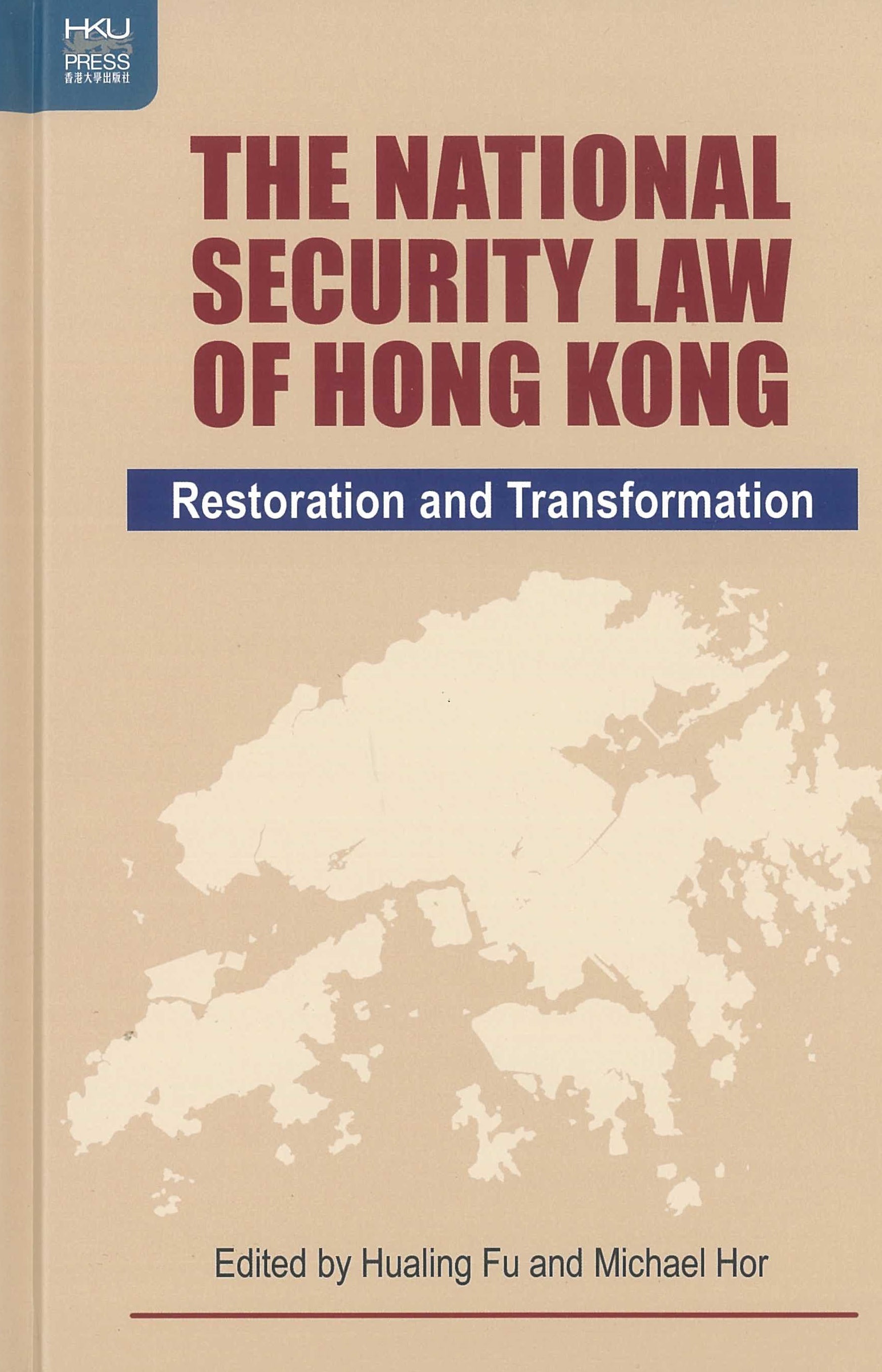
New Book edited by Hualing Fu & Michael Hor: The National Security Law of Hong Kong: Restoration and Transformation (HKU Press)

The National Security Law of Hong Kong: Restoration and Transformation
(香港國安法:社會重建與變革)
Edited by Hualing Fu & Michael Hor
Hong Kong University Press
Published in July 2022
396 pp.
Book Description: The Law of the People’s Republic of China on Safeguarding National Security in the Hong Kong SAR (the ‘NSL’) promises to be the most important legal development in Hong Kong since the advent of the Basic Law. Many wondered in the aftermath of the NSL how the foundations of Hong Kong’s system might be changed and in what way the freedoms valued by Hong Kong may be affected. Supporters view the law as essential for the preservation of public order and the national security of China and to support the fundamental well-being of “One Country, Two Systems”, an arrangement that has been in place since the return of Hong Kong to China. Critics fear an adverse impact on the spirit of “One Country, Two Systems”.
     From a discussion initiated by the University of Hong Kong’s Faculty of Law, this collection of essays brings together leading experts on Hong Kong and Chinese law to offer an exploratory study of the NSL and its impact on the legal system and the principle of the rule of law in Hong Kong.
     The book examines the ramifications of the law in relation to constitutional matters, protecting national security and sustaining “One Country, Two Systems”, policing, judicial independence, and extraterritoriality, as well as its wider implications in areas such as academic freedom and the business environment. It explores the interaction between Hong Kong and Chinese law occasioned by the NSL. Finally, the book offers a comparative perspective of the experience of other jurisdictions that have engaged with similar security legislation.
Review: 
“This collection addresses an important and timely issue, and provides an invaluable resource for all lawyers interested in Hong Kong as they grapple with the momentous changes in its legal landscape. The collection will surely serve as a reference point for further discussion and debate.”

—Victor V. Ramraj, University of Victoria, Canada

“This book covers the most important aspects of national security issues, including freedom and security that we have always been concerned about. This timely publication not only offers the latest research results for the academic community, but also provides important reference materials for the Hong Kong society to understand the important topics of national security.”

—Zhu Guobin, City University of Hong Kong

Monday, December 26, 2022

Henry Litton: Red Alert: Hong Kong Judicial Independence Under Existential Threat (Comment on the Admission of Owen KC)

Red Alert: Hong Kong Judicial Independence Under Existential Threat
The distressing tale of the admission of Owen KC to the Hong Kong Bar

Does the National Security Law (NSL) by itself render unlawful an act of a High Court judge plainly lawful under common law? If trust in the foundation of the legal system were sorely shaken, like an earthquake, it cannot be easily restored.

Introduction
The common law shares fundamental values right across the globe, but the practice and procedures of the courts often differ. Barristers play an important role in that process. An outside perspective has sometimes proved extremely valuable in throwing light on particularly complex issues.

The Court’s discretion in ad hoc admissions
Because there is a strong public interest in the proper administration of justice, s.27(4) of the Legal Practitioners Ordinance confers a broad discretion on the High Court to admit barristers from overseas to conduct particular cases in the local courts. This is referred to as ad hoc admissions, the judicial discretion to be exercised on a case by case basis.
     How to discharge the functions under s. 27(4) is a matter largely of value judgement, and there is no one better qualified to do that than a seasoned High Court judge. The criteria for that exercise are well established. Apart from personal qualifications and the nature of the case involved, there is the question whether the barrister concerned would add a significant dimension to the case.
      All this is covered by Article 94 of the Basic Law which provides as follows:
“On the basis of the system previously operating in Hong Kong, the Government of the Hong Kong Special Administrative Region may make provisions for local lawyers and lawyers from outside Hong Kong to work and practise in the Region”.
The focus of ad hoc admissions
As can be seen, the discretion to admit an overseas barrister under s.27(4) is narrowly focussed. It is concerned with case management. The public interest involved is the proper conduct of legal proceedings and the part to be played by the barrister in that process, in relation to the particular case for which he has been briefed.
     How this purely domestic matter has evolved to become one of international notoriety, fomenting a constitutional crisis in Hong Kong of gigantic proportions is, to say the least, surprising and disturbing. This distressing story is set out below.

The prosecution of Mr Lai Chee Ying for sedition
When Mr Jimmy Lai Chee Ying, founder of the newspaper Apple Daily, faced serious criminal charges, his solicitors engaged the services of Mr Timothy Owen KC from the United Kingdom to lead a team of local barristers.
      Mr Lai is charged with conspiracies with three others. The indictment falls under two broad headings: (1) conspiracies to publish and distribute seditious material contrary to sections 10, 159A and 159C of the Crimes Ordinance and (2) conspiracies to collude with a foreign country or external elements to endanger national security, contrary to Article 29(4) of the NSL.

Mr Owen KC’s ad hoc admission to the Hong Kong Bar
In order to render legal services in Hong Kong, Mr Owen KC applied for an ad hoc admission. His application was supported by a counsel’s certificate setting out matters that might arise at the trial (or before the trial as preliminary issues) including the scope and reach of NSL 29(4), the interface between that provision and the fundamental rights and freedoms under Chapter III of the Basic Law. The certificate also envisaged a challenge to the constitutionality of the provisions in the Crimes Ordinance under which Mr Lai was charged.
     No question arose regarding Mr Owen KC’s qualifications. He was described by the Court of Appeal as “a renowned specialist in criminal, public and human rights law, with substantial experience in cases concerning national security and freedom of speech. He has a wealth of experience in different jurisdictions and has appeared before the courts of Hong Kong in quite a few important cases”.
     He was not, of course, briefed to deal solely with the issues raised in counsel’s certificate. The trial was scheduled to last many weeks and his main responsibilities would be to deal with the evidence and other issues as the trial proceeds, leading the local team.
     As regards s.10 of the Crimes Ordinance under which Mr Lai was charged, this has been in the statute book since colonial times and Mr Owen KC would plainly have much to contribute to the constitutional issue said to be involved concerning that section, if indeed he should think such a challenge appropriate.
     As regards the interpretation and application of NSL 29(4), the Court of Final Appeal has, in an earlier case concerning Mr Lai’s bail application, embarked upon a detailed analysis of the compatibility between provisions in the NSL and those appearing in the Criminal Procedure Ordinance. The CFA, with great skill, navigated comfortably in those troubled waters; there is no reason to think that NSL 29(4) would pose insuperable problems in Mr Lai’s prosecution in a common law court, handled by a common law barrister of Mr Owen KC’s standing.
     Mr Owen KC’s application was dealt with by Poon CJHC on paper who, applying well-worn criteria, allowed the admission.

Court of Appeal
The Secretary for Justice was dissatisfied and took the matter on appeal to the Court of Appeal (Kwan VP, Chu VP and Au JA). That court found no basis to interfere with Poon CJHC’s exercise of judicial discretion and dismissed the appeal, adding that if they were to exercise the discretion afresh, they would have reached the same conclusion.
      They then made this caveat: 
“The forthcoming criminal trial is a high profile case attracting substantial publicity locally and abroad. It involves the resolution of legal issues of great general public importance that would impact substantially on the development of NSL jurisprudence and sedition offences. Public perception of fairness in the trial is of vital importance in the administration of justice. The court must adopt a flexible and sensible approach to arrive at a decision that would best suit the public interest in this application. It is clearly in the public interest to grant the application for admission on grounds of public perception as well as the other grounds that have been canvassed”.
     In dismissing the Secretary’s appeal, the court ordered the applicant’s legal costs to be paid by the government.

The Secretary’s application for leave to appeal to the CFA
On 15 November 2022 the Secretary for Justice lodged a Notice of Motion seeking leave to appeal to the CFA. This consisted of two dense pages of submissions, raising entirely new points for rejecting Mr Owen KC’s ad hoc admission, never mentioned before in the proceedings. Considering that the trial was due to start on 1 December, this must have been received by the Court of Appeal with a sense of shock. Because of the imminence of the trial, the Court of Appeal also dealt with the matter on paper.
     It is difficult to make sense of the new points advanced by counsel Mr Rimsky Yuen SC on the Secretary’s behalf. The Court of Appeal must have found the same difficulty. Instead of trying to summarise the points made (said to be of great and general importance) the entire text of the Notice of Motion was set out in the judgment.
     The first point was this: when, in respect of an NLS-related case, an application for ad hoc admission is made under s.27(4) of the Legal Practitioners Ordinance, the “public interest” to be considered must “arise” from the “uniqueness of NSL” which should “generally take precedence and/or override other public interest considerations”. That was because the NSL was a national law of the PRC which has a “continental legal system”.

Where this leads to is not clear
The second point was this: the ad hoc admission of overseas counsel in cases involving NSL was “incompatible with the overall objective and design of the NSL; the involvement of overseas barristers in national security cases would itself pose a national security risk”.
     In elaboration of this new point, counsel argued that overseas counsel might, in the course of conducting a case, come into possession of 'state secrets', and there was no effective means of enforcing confidentiality in regard to such secrets. This was rejected out of hand by the Court of Appeal: firstly, because factually the criminal trial involved no state secrets and secondly Mr Owen KC was bound by his own professional rules which apply wherever the courts might be and “whatever law they may be applying”.
     The truly startling thing is this: At every stage of the proceedings the Secretary was represented by senior counsel. The proposition now put forward is fundamental; there would have been no point in discussing the merits of Mr Owen KC’s ad hoc admission, however elevated, if Poon CJHC’s discretion under the Legal Practitioners Ordinance had been overridden by the NSL; Poon CJHC would, in effect, have exceeded his legal authority in admitting Mr Owen KC to the Hong Kong Bar under s. 27(4).
      But there was not a whisper of this in the lower courts. It wasn’t till the application for leave to appeal against the Court of Appeal’s judgment that the point was put forward in the Notice of Motion, when the Secretary was represented by a different counsel Mr Rimsky Yuen SC.
      What, then, were other leading counsel doing in the lower courts? Was Mr Yuen SC putting forward points of argument of his own invention, dreamt up for the first time, or was he acting under instructions from the Secretary for Justice? Had other counsel in the lower courts in fact considered those points and had them rejected as totally without merit?
       The overall purport of Mr Yuen SC’s submissions was that the judicial discretion in s.27(4), exercised by the First Instance judge in Mr Owen KC’s favour, was in some way fettered or eliminated by the provisions of the NSL; this required the judge to dismiss Mr Owen’s application.
      This was roundly rejected by the Court of Appeal. That court said that the discretion was 
“to be exercised in a judicial manner …..assisted by relevant principles and guidelines laid down in the authorities over time. If [ counsel’s ] contention is upheld, the court would no longer be required to carry out a balancing exercise of the relevant aspects of public interest in a flexible and sensible manner to arrive at a decision that best suits the public interest ….Its discretion could only be exercised in a particular way”.
       The Secretary’s application for leave to appeal was dismissed and, following the usual rule, the legal costs were awarded against the Secretary: in other words, the taxpayers had once more to foot the bill.

The Secretary’s application to the Appeal Committee of the CFA
The Secretary renewed his application for leave to appeal before the Appeal Committee of the CFA (Cheung CJ, Ribeiro PJ and Fok PJ), insisting that where an ad hoc admission involved cases under the NSL the normal criteria were no longer appropriate and a radically new approach had to be adopted. It was argued by counsel that there should in effect be a blanket ban on ad hoc admissions in NSL cases subject only to undefined “exceptional circumstances”. This would effectively mean that the court should be deprived of its statutory discretion.
     From what was a purely case management matter, it has been blown up into a cause celebre, with far-reaching consequences unforeseen.
      One of the matters put to the Appeal Committee by counsel for the Secretary was this: the admission of any overseas counsel (not simply Mr Owen KC) in NSL cases would tend to defeat the aim of countering “interference in the HKSAR’s affairs by foreign or external forces”. This is an alarmingly wide proposition with strong political flavours, destructive of the discipline of law. There was no scintilla of evidence in support of such submission.
     In refusing leave to appeal, the Appeal Committee was at pains to emphasise the importance of suppressing activity endangering national security, as required by NSL 3. But such issues must be properly raised, to enable the court to deal with them competently. Here the Secretary has, as the Committee said, “fundamentally changed his case only at the stage of seeking leave to appeal to this Court, raising undefined and unsubstantiated issues said to involve national security which were not mentioned or explored in the courts below. No appropriate basis has been made out for the grant of leave to appeal”.
     Applying the well-known Flywin principles (named after the CFA case Flywin Co Ltd v Strong & Associates Ltd where the court, in essence, determined it would not entertain points not raised in the courts below, unless there were exceptional circumstances) the Appeal Committee dismissed the Secretary’s application, with the usual order for legal costs awarded against the government.
      The Appeal Committee gave its determination with admirable promptness, on Monday, 28 November, leaving two clear days before the trial due to start on Thursday, 1 December. Mr Owen KC’s right of audience to represent Mr Lai at the trial was now firmly established and unchallengeable.

The trial postponed
The defendants have been detained in prison pending trial for a very long time. There was a strong public interest in having the trial brought on as soon as possible. That duty fell on the Secretary for Justice. Indeed, NSL 42 itself required him to ensure that cases concerning national security be handled in a “timely manner”.
      And yet, the trial has been postponed to an indefinite date next year. Why? Was this on the Secretary’s initiative? His professional duty was clear: to bring on the trial as soon as possible. So the question creeps in: was there political interference in his decision-making?
      He had “control of criminal prosecutions, free from interference”: Basic Law 63. Why did he not act as his duty clearly required, in a strong and resolute manner, and have the trial commence on Thursday, 1 December as arranged?
       This naturally has led to much speculation in the media. There are press reports suggesting that the Chief Executive has referred the matter to the Standing Committee of the National People's Congress (NPCSC) for an “interpretation” of the NSL, whatever that means.
      An article in The Australian (Australia’s leading national newspaper), 15 December 2022 edition, under the heading “Barrister row puts Lai trial on hold” reads:
“The trial of Jimmy Lai, the jailed Hong Kong publisher, on national security charges has been postponed for more than nine months while the Chinese authorities try to prevent a British barrister from defending him. Mr Lai, known for his outspokenness against Beijing … had instructed Tim Owen KC, from Matrix Chambers in London, to represent him on charges of colluding with foreign forces, causing a row over whether the barrister is eligible to do so. The Hong Kong government has appealed to Chinese officials in Beijing to decide on the matter, but without a quick answer, the territory’s High Court decided on Tuesday to adjourn the trial until September next year.... Mr Lai’s trial is seen as part of China’s attempts to stifle press freedom in Hong Kong in the wake of the 2019 pro-democracy protests in the former British colony... After Hong Kong’s highest court refused to hear a government appeal against the barrister’s case, John Lee, the territory’s chief executive, asked the standing committee of the National People’s Congress, the Chinese parliament, to give a ruling. The Hong Kong government argues the involvement of overseas lawyers in national security cases would itself pose a risk. The standing committee, which convenes this week, has not listed the item on its agenda”.

The NPCSC’s involvement?
If the facts stated in this article are accurate, it is difficult to see how the NPCSC could be involved in any way.  The sole matter before the court was Mr Owen’s ad hoc admission. The sole legal issue arising therefrom was Poon CJHC’s exercise of judicial discretion under s.27(4) of the Legal Practitioners Ordinance. He did so under clear common law principles, as Basic Law 8 so required.
      He was simply dealing with a matter of case management for the better conduct of the criminal trial. This could be of no possible concern to the NPCSC. What is more, it is now a fait accompli. Mr Owen has as full a right of audience at that trial as any other barrister. But the government seems to still insist that Mr Owen’s ad hoc admission is unlawful, seeking a radical change in the legal landscape.
       The matter having been escalated to such levels, it is difficult to see a happy outcome. If Mr Owen’s ad hoc admission to the Hong Kong Bar could become the subject of Beijing’s exercise of sovereign power, overturning Poon CJHC’s lawful discharge of judicial functions, the judiciary’s independence would have been torn to shreds, Hong Kong’s high degree of autonomy destroyed, with incalculable consequences to follow.
     Would the government thwart Mr Owen KC’s appearance in court by other means when the criminal trial at last begins perhaps next year? Say, to deny him an entry permit? That is now, alas, an open question.

Where does this lead?
In the life of nations, and of communities, a small mistake, an act of neglect, rashness, or unmindfulness could lead to disastrous consequences.

Public perception
The Court of Appeal, wisely and presciently, highlighted the importance of flexibility and common sense in the approach to this matter, saying that public perception of fairness in the trial is “of vital importance”, both locally and overseas.
     Here, the Secretary wore 'two hats'. He was both the prosecuting authority and 'the protector of public interest'. What role did he play when he first opposed Mr Owen KC’s ad hoc admission?
      Once Chief Judge Poon had ruled on the matter, why did the Secretary appeal that decision, repeating the same arguments in the Court of Appeal? When his primary responsibility was to ensure a fair trial as soon as possible, why did he persist in his attempt to exclude Mr Owen KC from acting for the defence? His then counsel Mr Benjamin Yu SC acknowledged that it was a pure matter of appeal against the exercise of judicial discretion and that the established principles applied to such an appeal. How could the Secretary have imagined that such an appeal had any chance of success?
      Was the Secretary not aware of the fact that the more he pursued that goal the stronger the perception that he was seeking an unfair advantage over the defence?
      The fact that the trial has been adjourned raises other troubling questions: what representations did the Secretary make to the trial court to cause it to postpone the trial? Why did the court order an adjournment, and a lengthy one at that, when public interest required adherence to the trial dates which had been set long in advance?

Conclusion
If the matter causing this sequence of events is 'state secrets', the source must come in the first place from the State: that is to say, the prosecuting authorities.
      It is a fact that no state secrets are involved in this case. But take the hypothetical situation where 'state secrets' become an important ingredient in the prosecution case. The government has a choice: to use it evidentially, thereby it ceases to be secret, or not to use it. In the latter case, if it contains material relevant to the defence, it must be disclosed as “unused material” under common law rules. Counsel for the prosecution would surely then seek the judge’s ruling, in camera, whether this duty of disclosure must be discharged. The responsibility then passes to the judge. The common law is well-equipped to deal with such a situation.
       This is all predicated on the basis that counsel for the prosecution can be trusted to safeguard state secrets, come what may.  Assume that a local senior counsel leads the prosecution team. Will this call for an inquiry into his background before he can be briefed? What is his record while a student? Does he have a foreign passport, dual nationality? Does he have a second home overseas? Does he have close family ties overseas?
      Mr Owen KC was not briefed for the prosecution. He was briefed for the defence: one frame removed, as it were, from the prosecution as regards state secrets. If he cannot be trusted to act professionally, what about senior counsel in Hong Kong who have foreign passports, dual nationality, second homes, close family ties overseas? Can they be trusted?
      This involves counsel, but what about judges? Can they be trusted to be true to their oaths of office if they have foreign passports, dual nationality, second homes, close family ties overseas?

Where will such mistrust ultimately lead?
Did this lead to Mr Rimsky Yuen SC putting forward the propositions that the discretionary power in s.27(4) of the Legal Practitioners Ordinance was “incompatible with the overall objective and design of the NSL” and that “the involvement of overseas barristers in national security cases would itself pose a national security risk”?
      It is like an earthquake. Once trust in the foundations of the legal system is sorely shaken, stability cannot be easily restored. The legal landscape would have changed forever. The rule of law, as it exists today, will be gone.

Tuesday, October 26, 2021

Scott Veitch's Observations on Hong Kong (Critical Legal Thinking)


Observations on Hong Kong
by
19 October 2021

It has been said that a poem is never finished, just abandoned. Academic writing has a touch of that too. The visions and revisions it has taken to get a text into decent shape could always do with one more run through, one more update, one more check for meaning and style. It is true also of research. It could be – it is – endless, but one must just stop somewhere otherwise the writing will never get done. If one is doing research on contemporary issues, a decision must be made about what to include and when to end the period for analysis. The process of selection and exclusion is one of the skills of judgement in research and writing one seeks to learn, test out, pass on, but always facing it afresh with each new project. For as Borges illustrates so well with Funes the Memorious – who remembers every detail but knows nothing of meaning, which only comes with generalization – without selection and exclusion, no sense will be possible. And if this is a concern that applies to research on current issues, it applies even more to historical research, since in addition to the question of when to stop, there is the much more challenging question of when to start. Each event, each effect, has a range of causes, and each of them in turn a further range. And so selection and exclusion – methodology – become key to making any sense, contested as that will always be. In the end perhaps, all you might say about your research and writing is that there are better and worse ways of abandoning it; and that what is offered in the text is the best you are able to do for now. ...Click here to read the full article.

Wednesday, July 28, 2021

Professor Richard Cullen presented at Hong Kong National Security Law 1st Anniversary Legal Forum by DOJ - "Comparative National Security Law: Australia and Singapore"


Professor Richard Cullen was honored to make a presentation at the Conference run by the DOJ to mark the first anniversary of the National Security Law.  

                          Hong Kong National Security Law 1st Anniversary Legal Forum

COMPARATIVE NATIONAL SECURITY LAW: AUSTRALIA AND SINGAPORE

by 

Richard Cullen 

_________________________________ 

INTRODUCTION

Good afternoon distinguished guests and friends

Thank you, Professor Zhu, for the introduction. And thank you to the Department of Justice for asking me to speak at this forum.

In an ideal world, there would be no need for National Security Laws. We live in a wonderful world – but it is far from ideal. We received a stunning reminder of this certainty in Hong Kong in 2019. The insurrection, which grew out of a series of major protest marches, had established traction by early June in that year and it grimly continued for many subsequent months.

In the normal, real world, National Security Laws have been applied in various forms for centuries. The Treason Act, for example, codified the Common Law offence of treason in England in 1351 during the reign of the Plantagenet King, Edward III.

National Security Laws have grown significantly more detailed and complex over time. Context matters. After the 911 attacks in 2001 in America, there was a major lift in National Security legislating around the world – led by the US (though, until last year, there was no such lift in Hong Kong).

Consequently, the scope of the matters to be discussed today is wide. Accordingly, I plan to use my time:

· To summarize key aspects of the Australian National Security Framework;.

· To discuss, briefly, the National Security Framework in Singapore; and

· To consider two relevant case studies illustrating the impact of these National Security regimes.

Click here for more details of the forum.


Sunday, July 25, 2021

New Book: Hong Kong in China—Rethinking the Hong Kong–Mainland Relationship (in Chinese) (香港在中國—重新思考內地與香港關係) by Christine Loh and Richard Cullen

"Hong Kong in China—Rethinking the Hong Kong–Mainland Relationship (in Chinese)"
<<香港在中國—重新思考內地與香港關係>>
Author / Editor
著 陸恭蕙 (Ms Christine Loh) 高禮文 (Professor Richard Cullen) , 譯 魏磊傑
City University of Hong Kong Press
Published in August 2021
98 pp.
Overview: It is over 20 years since British Hong Kong became the Hong Kong Special Administrative Region (HKSAR) of the People’s Republic of China (PRC). Much has happened that is positive since 1997. At the same time there have been recurring political incidents and stand-offs which have produced a series of severe policy log-jams and bred anxiety among the people of Hong Kong. There is a belief that Hong Kong is “stuck” and unable to advance.
     Can the HKSAR see a positive future within China? We recently published a short book, with Abbreviated Press in Hong Kong, entitled, No Third Person: Rewriting the Hong Kong Story, to address this question (see: http://www.abbrv.press/nothirdperson.html. Available from the Book Depository: https://www.bookdepository.com/No-Third-Person-Christine-Loh/9789881662965). We felt there remained a need for a further, more thorough discussion about Hong Kong’s future. We have now published an extended online review of this key question entitled, Hong Kong in China with the IPP Review in Singapore (see: https://ippreview.com/index.php/Index/company/name/about.html). This translated version of Hong Kong in China is enabled by the generous agreement of Abbreviated Press and the IPP Review. (Sections within Hong Kong in China repeat text and arguments found in No Third Party.)
      The last British Governor of Hong Kong, Chris Patten noted, in 1996, that "The world should want China to succeed as it continues its brave economic revolution." We agreed with that view then and we agree with it today. In this work, serialized in three parts in the IPP Review, we explain why Hong Kong remains exceptionally well placed to continue to shape its own positive future, within China, just as it has done, with such remarkable success, in the past.
     Part 1 of Hong Kong in China provides a general introduction of the historical background of Hong Kong seen from British and Chinese perspectives over the last two centuries. It also explains the constitutional and legal structure of Hong Kong’s reversion to Chinese sovereignty and considers how this regime has operated when placed under stress. Part 2 sets out Hong Kong’s economic fundamentals and also reviews the geo-political stresses affecting the Hong Kong – mainland relationship. Part 3 investigates how Hong Kong can get unstuck and – building on this – how Hong Kong can construct its new narrative – the story of Hong Kong in China.
      We owe thanks to a range of people who have advised and commented on this work. These include, Professor Albert Chen and Professor Fu, Hualing from The University of Hong Kong and Professor Harry Glasbeek, Emeritus Professor, Osgoode Hall Law School, Toronto, Canada. We owe special thanks to Professor Wei Leijie and his team from Xiamen University in China who have undertaken this translation. The authors, alone, are responsible for all that is argued in this book and for any errors and omissions.

Preface by Professor Albert Chen.

Introduction of Preface: A "Post-National Security Law Era" Narrative for Hong Kong

What is "one country, two systems"? How should we understand the relationship between the "high degree of autonomy" of the Hong Kong Special Administrative Region (HKSAR), state sovereignty and the central authorities’ “comprehensive jurisdiction” over the HKSAR? What should be the identity of Hong Kong people? What kind of discourse or narrative should there be about the "Hong Kong Story"?  How should Hong Kong’s past be understood? What kind of future will Hong Kong have?  How could the path of "one country, two systems" proceed?

     In the "post-National Security Law era", this series of issues is more urgent than at any other time in history, and they are causing anxiety among many Hong Kong people. Although this book was written before the enactment of the HKSAR National Security Law, it has fleshed out these issues and provided preliminary answers to them.

      In fact, I believe that in the "post-National Security Law era", this book is more meaningful, valuable and enlightening to us than it was at the time of its writing.  The authors are Christine Loh and Richard Cullen.  Loh is a public figure in Hong Kong, having served as a member of the Hong Kong Legislative Council before and after reunification, and as Undersecretary for the Environment of the HKSAR Government.  Loh is also a scholar and has written many books. Cullen, from Australia, has taught at the School of Law of City University of Hong Kong for many years, and in recent years at the Faculty of Law of The University of Hong Kong. Both authors are intellectuals who have long lived in Hong Kong, served Hong Kong and love Hong Kong. This book is the culmination of years of their reflections on Hong Kong's situation under "one country, two systems", and on the "Hong Kong story". 

Praise from the Dean Professor Fu Hualing (in Chinese):

「這本書提醒讀者香港憲制的史是世界史和中國史的一個小插曲。近二十年來有關一國兩制的爭論和衝突只有放在中國和世界的視野下才會有真正的意義它們主要是世界格局的變化在香港引發的陣痛。應對速變是香港的宿命,而香港從來都能把握好危機中的機會。本書正是告訴讀者香港的將來在中國、中國的將來在世界。把握好這個機遇,香港依然是中國走向世界的橋樑。」
    傅華伶
    香港大學 法律學院教授,院長