Showing posts with label Asian law. Show all posts

Monday, October 7, 2024

New book by Anupama Sharma: Implementation of Rights for Crime Victims in Theory and Practice Lessons from India

Implementation of Rights for Crime Victims in Theory and Practice Lessons from India
Anupama Sharma (PhD graduate)
Routledge
Published in September 2024
224 pp.

Description: There are many different ways in which victims’ rights can be implemented. The implementation pattern may vary depending on the type of rights a jurisdiction offers and the purposes it seeks to achieve via these rights. However, there are a few basic aspects that remain common to the variation in the implementation patterns across jurisdictions. This book provides a theoretical and practical overview of such implementation patterns, their features and underlying differences. It presents theoretical models capturing the different types of implementations of victims’ rights and the purposes that they can achieve. The book also offers a framework comprising the essential aspects involved in implementation of rights such as drafting and presentation, their visibility and accessibility to victims, enforcement of rights in case of breach, and assessment and evaluation of rights to ensure constant monitoring and improvement in implementation. The framework is tested by a sample case study in New Delhi, India, which showcases how the framework can be molded and applied to assess the existing implementation of victims’ rights and the scope for reform. The book will be of interest to those working in the areas of criminal justice, criminal procedure, victimology and human rights.

Thursday, March 30, 2023

New Book by Sida Liu et al: The Asian Law and Society Reader (Cambridge University Press)

The Asian Law and Society Reader
Lynette J. ChuaDavid M. Engel, and Sida Liu
Cambridge University Press
Published in March 2023
400 pp.
DOI: https://doi.org/10.1017/9781108864824
Book Description: The first reader on Asian law and society scholarship, this book features reading selections from a wide range of Asian countries – East, South, Southeast and Central Asia – along with original commentaries by the three editors on the theoretical debates and research methods pertinent to the discipline. Organized by themes and topical areas, the reader enables scholars and students to break out of country-specific silos to make theoretical connections across national borders. It meets a growing demand for law and society materials in institutions and universities in Asia and around the world. It is written at a level accessible to advanced undergraduate students and graduate students as well as experienced researchers, and serves as a valuable teaching tool for courses focused on Asian law and society in law schools, area studies, history, religion, and social science fields such as sociology, anthropology, politics, government, and criminal justice.
Reviews: 

‘This is just the volume that sociolegal scholars have been waiting for! The Asian Law and Society Reader is an elegantly organized, comprehensive, and accessible text, analyzing contemporary substantive topics within enduring legacies of colonialism and rapid legal and social transformation. The text illuminates the significance of this innovative and rich body of research for all law and society scholars today - wherever one works in the world.’

Eve Darian-Smith - Professor and Chair of Global and International Studies, University of California, Irvine, and coeditor of the Routledge Handbook of Law and Society (2021)

‘This book is a treasure trove of law and society research, spanning a massive diversity of societies and an equally broad array of issues. There is no scholar of the region who will fail to learn from it, and it will be of great use for teaching and research.’

Tom Ginsburg - Leo Spitz Professor of International Law, Ludwig and Hilde Wolf Research Scholar, and Professor of Political Science, University of Chicago

‘This intelligently curated collection brings together a new generation of Asian law and society research. It is exactly the right starting point for getting up to speed on the diversity of the field, or for anyone who wants to learn more about Asian politics and society through the lens of law.’

Rachel Stern - Professor of Law and Political Science and Pamela P. Fong and Family Distinguished Chair in China Studies, School of Law, University of California, Berkeley

‘In the twenty-first century, Asia will surely become another center for law and society scholarship. The inherent diversity of Asia will be further developed and conducive to future-oriented institutional experiments and knowledge innovation. From this point of view, the publication of The Asian Law and Society Reader is of great significance. I believe that it is the best introductory guide for Asian law and society research at this stage, and is also an indispensable reference for carrying out law and society education in Asian countries.’

Weidong Ji - University Professor of Humanities and Social Sciences, Shanghai Jiao Tong University, and President, China Institute for Socio-Legal Studies

‘This book examines the meaning and action of law in diverse Asian societies through a detailed examination of a wide range of issues. Readers will gain in-depth knowledge of various topics and will be able to read the universal significance of law and society studies in Asia.’

Yoshitaka Wada - Professor of Law, Faculty of Law, Waseda University, Tokyo

‘Grounded in rich empirical research, this volume extends the epistemological and methodological imagination of law and society. Intellectual conversations between empirical essays and insightful commentary reveal intellectual journeys of scholars and the field itself, achieving both a bird’s-eye view of the field and insights into the lives of ordinary people as they negotiate socio-legal realities on the ground.’

Yukiko Koga - Associate Professor of Anthropology, Yale University

Tuesday, May 31, 2022

HKU Law Collaborates with INTERPOL on the Use of Digital Evidence in Prosecutions in Asia (Report and Training)

The Use of Digital Evidence in Prosecutions in Asia
INTERPOL
February 2022
Executive Summary
Digital evidence has become an essential element of criminal investigations and prosecutions for all types of crimes. This research report by The University of Hong Kong, commissioned by the International Criminal Police Organisation, is a study of the laws governing the use of digital evidence in criminal cases in nine beneficiary countries in Asia, namely the People’s Republic of Bangladesh, the Kingdom of Bhutan, Brunei Darussalam, the Kingdom of Cambodia, the Republic of Maldives, Mongolia, the Federal Democratic Republic of Nepal, the Democratic Socialist Republic of Sri Lanka, and the Socialist Republic of Vietnam. The report also studies the existing legal arrangements that enable these countries to request and obtain digital evidence from abroad in cross-border cases.
      All nine countries are members of the Asia/Pacific Group on Money Laundering, five are members of the South Asian Association for Regional Cooperation (SAARC), four are members of The Commonwealth, and three are members of the Association of Southeast Asian Nations (ASEAN). Six of the countries have mixed common law legal systems, while the other three have civil law systems. The evidence laws of four of the mixed common law jurisdictions are based on or influenced by the Indian Evidence Act of 1872.
     This study has found that the laws and practices in all nine countries generally favour the admissibility and use of digital evidence in criminal cases. No instance was found of a court rejecting digital evidence merely on the grounds that the evidence was in a digital form... Click here to download the full summary.  Professor Simon Young led the HKU research team responsible for preparing the research report.  In May 2022, Professor Young and his team helped to organise the training of prosecutors and police across nine Asian countries in INTERPOL's e-Evidence Programme for Prosecution (Module 2: Legal framework on e-Evidence admissbility).

Sunday, January 2, 2022

New Book by Anna Dziedzic: Foreign Judges in the Pacific (Hart Publishing)

Foreign Judges in the Pacific
Anna Dziedzic (Global Academic Fellow)
Hart Publishing
Published in 2021
Book Description: This book explores the use of foreign judges on courts of constitutional jurisdiction in 9 Pacific states: Fiji, Kiribati, Nauru, Papua New Guinea, Samoa, Solomon Islands, Tonga, Tuvalu and Vanuatu. We often assume that the judges sitting on domestic courts will be citizens. However across the island states of the Pacific, over three-quarters of all judges are foreign judges who regularly hear cases of constitutional, legal and social importance. This has implications for constitutional adjudication, judicial independence and the representative qualities of judges and judiciaries. Drawing together detailed empirical research, legal analysis and constitutional theory, it traces how foreign judges bring different dimensions of knowledge to bear on adjudication, face distinctive burdens on their independence, and hold only an attenuated connection to the state and its people. It shows how foreign judges have come to be understood as representatives of a transnational profession, with its own transferrable judicial skills and values. Foreign Judges in the Pacific sheds light on the widespread but often unarticulated assumptions about the significance of nationality to the functions and qualities of constitutional judges. It shows how the nationality of judges matters, not only for the legitimacy and effectiveness of the Pacific courts that use foreign judges, but for legal and theoretical scholarship on courts and judging.

Friday, December 31, 2021

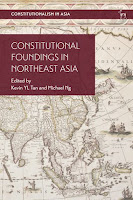
New Edited Book by Kevin Tan & Michael Ng: Constitutional Foundings in Northeast Asia (Hart Publishing)

Constitutional Foundings in Northeast Asia
Editors: Kevin Tan & Michael Ng
Hart Publishing
Published in December 2021
Book Description: This new book in the Constitutionalism in Asia series considers the idea of origins, and of change and continuity in terms of 'constitution-making', which is an on-going process in the Northeast Asian states. The book examines the drafting, nature, core values, and roles of the first modern constitutions during the founding of the 8 modern states/territories in Northeast Asia: China (1949), Taiwan (1947), Hong Kong SAR (1997), Macau SAR (1999), Japan (1889), North Korea (1948 and 1972), South Korea (1948), and Mongolia (1924). The collection provides:
  • an exploratory description of the process and substantive inputs in the making of the first constitutions of these nations/territories;
  • analysis of the internal and external (including intra-regional) forces surrounding the making of these constitutions; and
  • theoretical construction of models to conceptualise the nature and role of the first constitutions (including constituent documents) in the founding of the modern nation-states/territories and their subsequent impact on state-building in the region.

HKU contributors to the collection include Dr Humphrey Ko (ch 2), Professor Albert Chen (ch 3) and Dr Michael Ng (Ch 3).

New Issue of Asia-Pacific Journal on Human Rights and the Law (Volume 22, Issue 2, Dec 2021)


Editors-in-Chief: Simon NM Young and Kelley Loper
Publisher: Brill, Leiden

Table of Contents

Protecting the Identity of Juveniles in Criminal Proceedings in Viet Nam and Victoria
Open Trials and Restricted Publication
Authors: Le Huynh Tan Duy and Marilyn McMahon
Pages: 115–149
Online Publication Date: 31 May 2021

Procedural Rights Supporting Expeditious Trials for Juveniles (Open Access)
Effective Remedies and Legal Representation
Author: Aekje Teeuwen
Pages: 150–185
Online Publication Date: 29 Nov 2021

Development and Economy in Mongolia through a Human Rights Law Lens
Author: Juan Pablo Bohoslavsky
Pages: 86–221
Online Publication Date: 29 Nov 2021

Climate Change and the Challenges for Developing Countries in the Implementation of the Human Right to a Healthy Environment: Case of Vietnam
Authors: Nguyen Thi Hong Yen and Nguyen Phuong Dung
Pages: 222–254
Online Publication Date: 29 Nov 2021

Legal Pluralism, Human Rights and the Right to Vote: The Case of the Noken System in Papua
Author: Ignatius Yordan Nugraha
Pages: 255–286
Online Publication Date: 29 Nov 2021

We are pleased to announce that publication of APJHRL will expand to three issues per year starting in 2022.

Thursday, December 9, 2021

New Book by Po Jen Yap & Chien-Chih Lin: Constitutional Convergence in East Asia (CUP)

Po Jen Yap and Chien-Chih Lin
Published: December 2021
Description: This comparative study of the constitutional jurisprudence of three East Asian jurisdictions investigates how the rulings of the Constitutional Court of Taiwan, the Constitutional Court of Korea and the Hong Kong Court of Final Appeal have converged. The unique political contexts of all three jurisdictions have led to strong courts using the structured proportionality doctrine and innovative constitutional remedies to address human rights issues. Hong Kong, Taiwan, and South Korea have the only courts in Asia that regularly use a structured four-stage Proportionality Analysis to invalidate laws, and routinely apply innovative constitutional remedies such as Suspension Orders and Remedial Interpretation to rectify constitutionally flawed legislation. This volume explores how judges in these areas are affected by politics within their different constitutional systems. The latest developments in Asian constitutional law are covered, with detailed analysis of key cases.
  • Explains why and how the apex courts in Hong Kong, Taiwan and South Korea have converged on constitutional law
  • Enhances understanding of how politics shape judicial behaviour
  • Identifies and analyses the key constitutional case-law in Hong Kong, Taiwan and South Korea

Sunday, October 24, 2021

New Book by Anselmo Reyes and Wilson Lui: Direct Jurisdiction: Asian Perspectives (Hart Publishing)

edited by Anselmo Reyes and Wilson Lui (BA&LLB 2019)
Hart Publishing
Publication Date: August 2021
440 pp
Description: The second thematic volume in the series Studies in Private International Law – Asia looks into direct jurisdiction, that is, the situations in which the courts of 15 key Asian jurisdictions (Mainland China, Hong Kong, Taiwan, Japan, South Korea, Malaysia, Singapore, Thailand, Vietnam, Cambodia, Myanmar, the Philippines, Indonesia, Sri Lanka, and India) are prepared to hear a case involving cross-border elements. For instance, where parties are habitually resident abroad and a dispute has only some, little or no connection with an Asian state, will the courts of that state accept jurisdiction and hear the case and (if so) on what conditions? More specifically, the book's chapters explore the circumstances in which different Asian states assume or decline jurisdiction not just in commercial matters, but also in other types of action (such as family, consumer and employment disputes).
     The Introduction defines terminology and identifies similarities in the approaches to direct jurisdiction taken by the 15 Asian jurisdictions in civil and commercial litigation. Taking its cue from this, the Conclusion assesses whether there should be a multilateral convention or soft law instrument articulating principles of direct jurisdiction for Asia. The Conclusion also discusses possible trajectories that Asian jurisdictions may be taking in respect of direct jurisdiction in light of the COVID-19 pandemic and the political tensions currently besetting the world. The book suggests that enacting suitable rules of direct jurisdiction requires an Asian jurisidction to strike a delicate balance between affording certainty and protecting its nationals. At heart, direct jurisdiction involves sometimes difficult policy considerations and is not just about drawing up lists of jurisdictional grounds and exceptions to them.

Friday, July 23, 2021

New Book by Shahla Ali: Forming Transnational Dispute Settlement Norms: Soft Law and the Role of UNCITRAL's Regional Centre for Asia and the Pacific (Edward Elgar Publishing)

Forming Transnational Dispute Settlement Norms:
Soft Law and the Role of UNCITRAL's Regional Centre for Asia and the Pacific
(Asian Commercial, Financial and Economic Law and Policy series)
Shahla Ali
Edward Elgar Publishing
Published on 25 May 2021
288 pp.
Description: This thought-provoking book examines whether regional centres associated with global legal institutions facilitate expanded citizen engagement in global soft law making. Through an analysis of empirical research into the role of decentralized soft law making in the East Asian region, it investigates the influence of such regional centres in overcoming representational deficits in the design of cross-border dispute settlement norms.

Review: 

'Shahla Ali provides a richly detailed case study that illuminates how soft law is actually created and becomes effective. In doing so, she also shows how transnational dispute resolution norms are developed and how they become a form of legal regulation even in the absence of coercive enforcement power. Thus, this book is a must for scholars of global legal pluralism, practitioners of transnational dispute resolution, and all those interested in understanding in granular detail how international law is created and develops power over time.'

– Paul Schiff Berman, The George Washington University, US

'Shahla Ali's excellent new book on the role of UNCITRAL's Regional Centre for Asia and the Pacific in soft law-making shows the importance of rigorous, in-depth empirical analysis to test and support theoretical arguments calling for direct citizen participation to confirm the legitimacy of global norms.'

- Steven Wheatley, Lancaster University Law School, UK

'International commercial arbitration has long been subject to criticism for unequal access to and participation in shaping the rules and practices of this transnational legal order. Professor Ali's book breaks new ground on this key issue for the legitimacy of commercial arbitration by persuasively documenting a success story in broadening and deepening Asian state participation. The book shows that the success of UNCITRAL's International Trade Law Regional Centre for Asia and the Pacific may provide a model for other regions.'

- Bryant Garth, UCI Law, US and author of Dealing in Virtue

'This book leverages original data and novel methods to show convincingly how a regional soft lawmaking institution can overcome deliberative deficits, asymmetries in lawmaking influence, and failures to appropriate national and local creativity in global trade lawmaking. By imaginatively ''mapping the middle,'' Shahla Ali persuasively demonstrates the integral ways that a regional body can consolidate responsive transnational legal orders (TLOs) by harnessing state and non-state innovation and adaptations to diverse economic and legal contexts. In so doing Ali discovers new variants of TLOs and opens up exciting frontiers for research and theory.'

- Terence Halliday, American Bar Foundation, and co-author of Global Lawmakers: International Organizations in the Crafting of World Markets

'This study of the growing role of Asia-Pacific countries in the governance of international dispute resolution combines sophisticated treatments of the relevant legal instruments and theoretical literature with rigorous empirical analyses. It is impossible to ignore this evidence of decentralized transnational legal ordering and how it might be fostered by regional institutions.'

- Kevin E. Davis, NYU School of Law, US

'It is rare to have 5 years of our work performance scrutinized academically, and peer-reviewed. I cannot escape a sense of relief after reading this remarkable work by Professor Shahla Ali. Her work shows the importance of having more Regional Offices, not only of UNCITRAL, but, I dare to say, also of the HCCH and UNIDROIT. This book demonstrates how they are key enablers of legal reforms and relevant platforms to ensure equal access to legal knowledge. One of the possible conclusions reading this book, is that such work reduces non-tariff (sometimes invisible) trade barriers, and has tremendous side effects like levelling the playing field for practitioners and legal educators from parts of the world often meriting less attention and resources. For example, without such work, we would have never seen DPR Korea or Laos adopting the CISG and its core value: party autonomy. This book is indispensable for any one engaged with legal reforms based on international cooperation.'

- João Ribeiro-Bidaoui, Permanent Bureau of the Hague Conference on Private International Law (HCCH) and UNCITRAL Regional Centre for Asia and the Pacific (2013-2018)

Tuesday, July 6, 2021

Po Jen Yap & Rehan Abeyratne on Judicial Self-Dealing and Unconstitutional Constitutional Amendments in South Asia (Int'l J Const Law)

Published in January 2021
Abstract: Courts around the world today are empowered to strike down unconstitutional constitutional amendments. But can a court strike down amendments that restore parts of the original constitution? The Appellate Division of the Bangladesh Supreme Court did precisely this in Bangladesh v. Asaduzzaman Siddiqui (2017), holding unconstitutional an amendment that restored the judicial removal provision that existed in the original 1972 Constitution. This article analyzes Siddiqui within the comparative constitutional amendment literature and the broader South Asian context. Despite the apparent incongruity of applying the basic structure doctrine to an original constitutional provision, we argue that Siddiqui is defensible on both theoretical and pragmatic grounds. The amendment that was invalidated in this case represented an unconstitutional departure from the judicial removal practice that had existed for several decades and was entrenched by a previous amendment, which “dismembered” the original constitution and safeguarded constitutional democracy in Bangladesh. At a regional level, Siddiqui is similar to recent judgments in India and Pakistan in which apex courts assert their control and limit political influence in judicial appointment and removal proceedings. Such judicial self-dealing, we argue, is more justified in Bangladesh and Pakistan than in India due to their checkered histories with democracy and political interference with judicial functions.

Monday, March 15, 2021

New Book co-edited by Shahla Ali: New Frontiers in Asia-Pacific International Arbitration and Dispute Resolution (Wolters Kluwer)

Edited by Luke Nottage, Shahla Ali, Bruno Jetin and Nobumichi Teramura
Wolters Kluwer
Published in November 2020
Description: An invaluable book that challenges the existing procedures and frameworks for cross-border dispute resolution in commercial and treaty arbitration. The eastward shift in international dispute resolution has already involved initiatives not only to improve support for international commercial arbitration (ICA) and investor-state dispute settlement (ISDS) but also to develop alternatives, such as international commercial courts and mediation. This remarkable book focuses on these initiatives and their accompanying case law and trends in the Asia-Pacific region.
     What’s in this book: An outstanding team of experienced and insightful arbitrators and scholars describes the following pertinent developments:
  • ICA and ISDS in the context of China’s Belt and Road Initiative;
  • the Singapore Convention on Mediation;
  • the shift to virtual hearings and other challenges from the COVID-19 pandemic;
  • mistrust of the application of the rule of law in certain East Asian jurisdictions;
  • growing public concern over ISDS arbitration;
  • tensions between confidentiality and transparency; and
  • potential regional harmonisation of the public policy exception to arbitral enforcement.
Evolving practices and high-profile cases have been charted out by the contributors to make informed observations about where changes are needed and educated guesses about the pros and cons of reforms. The leading jurisdictions covered are China, Hong Kong, Japan, Malaysia, India, Australia and Singapore.
     How this will help you: Being a pioneer in-depth study of recent trends in dispute resolution practice related to business in the Asia-Pacific region, the book’s practical analysis of new resources for dealing with the increasing competition among countries to become credible regional dispute resolution hubs will prove to be of great value to specialists in the international business law sector. Lawyers will make informed decisions on the venue and dispute resolution methods that are the most suitable for any specific dispute in the region, and policymakers will confidently assess emerging trends in international dispute resolution policy development and treaty-making.
     Professor Ali authors chapter 6 titled "New Frontiers in Hong Kong's Resolution of 'One Belt One Road' International Commercial and Investor-State Disputes" and co-authors the concluding chapter with Nobumichi Teramura and Anselmo Reyes.

Saturday, March 13, 2021

Dr Ngoc Son Bui (PhD 2013) Appointed Associate Professor of Asian Laws at Oxford University

Congratulations to Dr Ngoc Son Bui, a 2013 graduate of our PhD programme, who will be the first Associate Professor of Asian Laws at Oxford University, when he takes up the appointment in July 2021. He will also be a Fellow of St Hugh’s College.  Dr Bui was a graduate of Vietnam National University-Hanoi (LLB; LLM) before he began his graduate studies at HKU Law under the supervision of Professor Albert Chen, Cheng Chan Lan Yue Professor in Constitutional Law. His dissertation was on Confucianism and Constitutionalism in Vietnam.  After graduation, he published his book titled Confucian Constitutionalism in East Asia (Routledge 2016) which was based on his doctoral work.  Before assuming his current tenure track position at CUHK Law, he held research positions at the National University of Singapore, Harvard Law School, Melbourne Law School and the University of Tsinghua. He is completing a new book on legal reform in the contemporary socialist world and co-editing a four-volume collection on Asian comparative constitutional law.  

Tuesday, January 5, 2021

Anupama Sharma on South Asian Perspectives of Gender Neutrality in Sexual Violence Laws (J Indian L & Soc)

"Addressing the Roadblocks to Gender Neutrality in Sexual And Domestic Violence Laws: A South Asian Perspective"
Anupama Sharma (PhD candidate)
Journal of Indian Law and Society
Winter 2020, Vol 11, Issue 2
pp 79-106
Abstract: Sexual and domestic violence laws across several countries in South Asia are gendered in nature. These legislation brand men as the perpetrator and women as the victim due to the wide prevalence of violence against women. In this paper, the author argues that gendered laws fail to accommodate abuse against men and other genders, as well as reinforce the one-dimensional image of women as a victim. In making this claim, the author addresses various counter-arguments made against gender neutrality and draws lessons from Bhutan, which has gender-neutral laws and also shares historical and social contextual similarity with other South Asian countries.  Click here to download the full article.

Tuesday, November 3, 2020

Xu Qian on Phoenix from the Ashes: CPTPP Meaning for Asia-Pacific (and Global) Investment (AJWH)

"Phoenix from the Ashes: CPTPP Meaning for Asia-Pacific (and Global) Investment"
Xu Qian
Asian Journal of WTO Law and Health Policy, Volume 15.2
Published in October 2020
Abstract: Formerly known as the Trans-Pacific Partnership (hereinafter “TPP”), the Comprehensive and Progressive Agreement for TransPacific Partnership (hereinafter “CPTPP”) is a multilateral Free Trade Agreement (hereinafter “FTA”) signed by eleven Asia-Pacific Countries on March 8, 2018. The aim of the CPTPP is to boost international trade and investment in the Asia-Pacific region. Prior to the entry into force of the CPTPP, the U.S. withdrew from the TPP agreement in early 2017. In spite of this, the CPTPP nevertheless portrays a critical advance toward deeper trade and investment linkages in the Asia-Pacific region and also projects new and exclusive features for regional trade. This article provides a detailed and comprehensive analysis of the new pact and demonstrates how the CPTPP codifies many changes and clarifications made to investment law over the last years. Importantly, the normative quality and geographic scope of the CPTPP places the agreement amongst the most detailed and important investment treaties. In fact, the CPTPP may be read as a strengthening (or a de facto renegotiation) of North American Free Trade Agreement (hereinafter “NAFTA”) and many other agreements such as the 2010 ASEAN-Australia-New Zealand (AANZ) FTA. Last but not least, the TPP truly displays a systemic importance because it has the potential to become a multilateral treaty as the membership is open to new members willing to sign up to its terms.

Tuesday, October 27, 2020

Interview with Yun Zhao, the New Representative of the Hague Conference on Private International Law Asia Pacific Regional Office

Congratulations to Professor Yun Zhao on his appointment as the Representative of the Asia Pacific Regional Office of the Hague Conference on Private International Law! The Faculty of Law's KE Unit is honoured to have the opportunity to interview Professor Zhao on his new role and the challenges ahead for private international law co-operation.

1. What is the Hague Conference on Private International Law?
The Hague Conference on Private International Law (HCCH) is a global intergovernmental organization with the purpose to work for the progressive unification of the rules of private international law ranging from commercial law and banking law to international civil procedure and from child protection to matters of marriage and personal status. It also fosters international judicial and administrative cooperation in the area of private law, especially in the fields of protection of the family and children, of civil procedure and commercial law. It does so by developing multilateral treaties (HCCH Conventions) and other legal instruments. 

2. When was the Regional Office for Asia and the Pacific opened in Hong Kong and what is its mission? 
The Regional Office for Asia and the Pacific (ROAP), representing the HCCH in the Asia-Pacific Region, was opened in 2012 with the mission to act as a bridge to enhance communications and understanding between the Permanent Bureau of the HCCH in the Hague and States in the Asia-Pacific Region. The ROAP promotes the HCCH and the HCCH Conventions by conducting events, developing projects and a variety of activities across the Asia-Pacific Region. Our former colleague, Professor Anselmo Reyes was the representative of the ROAP from 2013 to 2017.

3. What are the duties of the Representative of the Regional Office for Asia and the Pacific? 
The ROAP Representative shall promote the HCCH and its Conventions and build networks within the Asia Pacific Region; develop deeper understanding of the Hague Conventions and facilitate good practice and consistent implementation of these conventions; conduct or participate regional workshops, lectures, conferences, seminars or webinars; report on regional activities regularly to the Permanent Bureau. 

4. As the new Representative of the Regional Office for Asia and the Pacific, what do you hope to achieve in your term of appointment? 
I hope to strengthen the existing HCCH networks throughout the Asia Pacific Region and encourage non-member States in the region to join the HCCH and the Hague Conventions, enhance contacts with government officials, academic institutions and professional bodies in the region, and provide appropriate technical assistance to Member States in the Region.

Thank you Professor Zhao and all the best to you in your new role.

Sunday, October 18, 2020

New Book by Po Jen Yap: Proportionality in Asia (CUP)

Proportionality in Asia
Edited by Po Jen Yap
Published in August 2020, 300 pp.
Description: This is the first book that focusses on how proportionality analysis – a legal transplant from the West – is applied by courts around Asia, and it explores how a country's commitment to democracy and the rule of law is fundamental to the success of the doctrine's judicial enforcement. This book will appeal to lawyers, political scientists, and students of law and political science who seek to understand how proportionality analysis is blossoming and, in some cases, flourishing in Asia.
'This exciting new collection brings together scholars from across Asia to reflect on the use, and non-use, of doctrines of proportionality in the process of constitutional adjudication in nine Asian jurisdictions. It is insightful and compelling.'
Rosalind Dixon - Professor, University of New South Wales Faculty of Law

'An authoritative account of the growth and limits of proportionality analysis in Asia. This important volume combines masterful country-studies with insightful introductory and concluding chapter overviews to identify and address key issues about the various modes of constitutional influence, the impact of political context on courts, and the contrast between proportionality and its alternatives.'
Stephen Gardbaum - MacArthur Foundation Professor of International Justice and Human Rights, UCLA School of Law

'This volume is an invaluable contribution to the global literature on proportionality analysis. Its chapters offer grounded, empirically informed and sometimes skeptical views of the role of proportionality analysis in the jurisprudence of Asian courts.'
Hoi Kong - The Rt. Hon. Beverley McLachlin, P.C., UBC Professor in Constitutional Law, The University of British Columbia

'Proportionality in Asia is a major contribution to the field of comparative constitutional law. Admirably, contributors address cross-national differences in how Asian judges use proportionality, with what impact on the evolution of their respective legal systems. Required reading for anyone doing comparative research on rights protection, proportionality, or Asian law and politics.'
Alec Stone Sweet - Saw Swee Hock Centennial Professor in Law, National University of Singapore

Tuesday, October 6, 2020

Holning Lau & Kelley Loper on The European Union as Promoter of Equality in Asia: Beyond Economic Tools of Influence (new book chapter)

Holning Lau & Kelley Loper
in Thomas Giegerich (ed), The European Union as Protector and Promoter of Equality (Springer 2020) pp 487-502
Published online in July 2020
Abstract: The European Union’s (EU’s) foreign policy objectives include promoting equality rights around the world. Commentary on such efforts in Asia has focused on the EU’s application of economic pressure to influence Asian states. This chapter seeks to shift the focus to a range of non-economic tools that the EU uses to promote equality rights in Asia. These “soft power” options include, but are not limited to, conducting official “human rights dialogues” with Asian leaders, providing technical assistance to government and civil society actors, developing social media campaigns, and setting positive examples through progressive law reforms in the EU. This chapter first explains why it is important for the EU to support equality rights through the exercise of soft power. It then specifically considers the EU’s highest court, the European Court of Justice (ECJ), as a source of soft power. Some Asian courts cite the ECJ as persuasive authority. The ECJ thus indirectly promotes equality rights in Asia by setting examples. It is problematic, however, that Asian courts learn from the ECJ while the ECJ and other EU institutions fail to reciprocate by learning from rights-protective Asian courts. This unidirectional flow of information reflects and reinforces neocolonial dynamics. The EU could allay concerns about neocolonialism, and perhaps increase its influence in Asia, by engaging Asian courts in a two-way dialogue on equality rights.

Thursday, May 28, 2020

Syren Johnstone on Fintech Regulation in Asia (new book chapter)

"Fintech regulation in Asia"
in Cian, M. and Sandei, C (eds),  Dritto del Fintech (Kluwer, 2020) Part IV, pp. 699-714
Introduction: All major jurisdictions within the Asia region, as with other regions globally, have recognized the importance of Fintech to the development of its financial markets. Earlier chapters of this book have well recited the advantages of Fintech, and the associated risks, and these are also common to the Asian context and need not be repeated here. The approach to regulation in Asia has been diverse owing to different political, legal and cultural considerations in each jurisdiction. By way of broad characterization, while the efficiencies that Fintech solutions bring to traditional financial services have been a primary objective of regulatory facilitation throughout Asia, the emergence of digital assets and the primary and secondary markets that have evolved around them has been an object of concern and caution. Accordingly, the region has been active in developing specific laws and regulations related to e-money payment systems and financial services, while adopting a conservative risk-based approach to financing activities that tap the public capital market via digital assets. As to the latter, the larger capital markets of North Asia have been of interest to watch as developments have ranged from more permissive industry-regulator partnering to develop more granular regulation (Japan), to cautious approaches that tend to follow the United States model of openly permitting industry development while applying existing laws where possible (Hong Kong), to banning specific classes of activity while also promoting technology including blockchain (Mainland China).

Friday, May 15, 2020

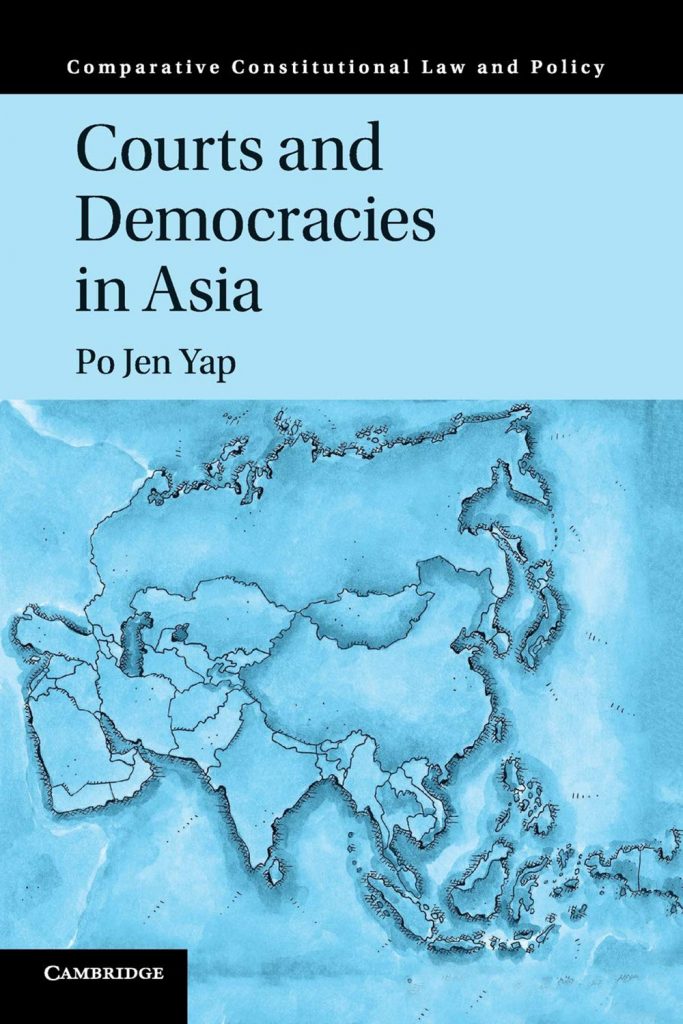
"Democracy and Judicial Behaviour in Asia" (Po Jen Yap Profiled in HKU's The Bulletin)

Book cover

"Democracy and Judicial Behaviour in Asia"
The Bulletin, May 2020
Judiciaries can shape – and are shaped by – the political systems they operate within, for better or worse. Professor Yap Po-jen of the Faculty of Law has been investigating this interplay between law and politics in Asia.
Democracies come in different forms. Some are effectively ruled by a dominant party that has muted most opposition. Some are dynamic, with two or more parties that have taken turns in power. Others are more fragile, with a strong military that may seize power if there is a vacuum. Each system shapes judicial behaviour in different ways, according to Professor Yap Po-jen.
     Professor Yap has studied the political factors that strengthen or constrain judiciaries in Asia. He has also been looking at how some of these judicial systems are converging by intentionally adopting constitutional practices from the West. 
     “Judges today no longer simply interpret the law, they also make law that binds their governments and citizens. The level of democratisation in a political system can impact judicial behaviour, and judicial behaviour can also facilitate the democratisation of a system,” he said. 
      His first major study on the topic, the monograph Courts and Democracies in Asia published in 2017, examined nine Asian democracies – three dominant-party (Hong Kong, Singapore and Malaysia), three dynamic (Taiwan, South Korea and India) and three fragile (Pakistan, Thailand and Bangladesh).

Protecting independence
The dominant democracies are practically ruled by one coalition or its proxies (in Hong Kong, the pro-Beijing forces) and their judiciaries can be easily overruled by the political branches of government. 
     Nevertheless, the courts in these places can still assert some autonomy within bounds – for instance, Hong Kong courts have ruled against the government on multiple occasions on issues relating to social welfare and gay rights. Where the courts cross the tolerance threshold of the government, they will be punished or overridden, as seen in Singapore and Malaysia.
     “All dominant parties will eventually fade away with time, even if this may take a long while. In the meantime, the role of their courts is to do what they can, while protecting their institutional independence. If they rule too aggressively, the dominant party will clip their wings,” Professor Yap said...  Click here to read the full text.

Gu Weixia on the Key Ingredients for Successful Reform of International Commercial Arbitration in the Asia (new book chapter)

"Reflections on the Key Ingredients for Successful Reform of International Commercial Arbitration in the Asia"
Gu Weixia
in Lei Chen & André Janssen (eds), Dispute Resolution in China, Europe and World (Springer 2020), pp.131-152
Abstract: Many states have recognized the economic importance of being 'arbitration-friendly', and many have naturally advertised themselves as such. Beyond the catch phrase lie these questions: What arbitration regimes are sufficiently 'arbitration-friendly'? Looking into the past, is there a standard pathway of arbitration reform in the Asia Pacific? Or are there divergent modes of development? To what degree have political, legal, social, cultural and other factors influenced a jurisdiction's ability to replicate successful reform patterns? This chapter looks into the development of arbitration regimes across the Asia Pacific, and aims to reflect on key ingredients for successful arbitration reform in the East. Among the Asia Pacific jurisdictions, some have reached greater success and have attracted many more commercial disputes within and outside the region. Others have been less successful, even with efforts to substantially reform the arbitration laws and institutions. To examine arbitration reforms and outcomes of Asia Pacific jurisdictions, this chapter relies on a hypothetical model of arbitration reform. This model is then tested again the reform pathways undertaken by 12 Asia Pacific jurisdictions for accuracy as a 'formula' for arbitration reform in the region.