Showing posts with label proceeds of crime. Show all posts

Friday, January 7, 2022

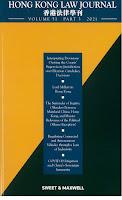
Shiling Xiao on Chinese Special Confiscation Procedure: Rules, Implementation and Problems (HKLJ)

Shiling Xiao (PhD candidate)
Hong Kong Law Journal, 
2021, Vol. 51, Part 3 of 2021, pp. 1041-1074
Abstract: China adopted a special confiscation procedure as an alternative measure for confiscating crime-tainted properties in 2013 and significantly amended this procedure in 2017. This article examines the substantive rules of this special confiscation regime and its implementation between 2013 and 2019. The examination reveals three problems of this regime with regard to its law-making and law-enforcement. First, the law-making process is unconstitutional. This regime comprises mainly judicial interpretations issued by the Supreme People’s Court and the Supreme People’s Procuratorate. These interpretations fundamentally amended the law promulgated by the legislature in excess of judicial interpretation power. Second, the prosecutors and courts have abused the special confiscation procedure. They applied it to property involved in offences falling outside the statutory scope of applicable offences. Third, some confiscations appear grossly disproportionate. The courts have neither acknowledged nor established an approach to proportionality in the confiscation procedure. They neglect the relationship between property and offences and confiscate property once they ascertain that the property belongs to or is under the control of the suspect.

Wednesday, June 13, 2018

Simon Young on Disproportionality in Asset Recovery (new book chapter)

Simon NM Young
in Colin King, Clive Walker & Jimmy Gurule (eds), The Palgrave Handbook of Criminal and Terrorism Financing Law, vol 1 (Palgrave Macmillan, May 2018) pp 469-489
Abstract: Proceeds of crime laws are designed to interfere with persons’ property rights and interests for good reasons, but human rights laws prohibit interferences that are disproportionate. Courts in the UK and Hong Kong are starting to develop a body of law to provide guidance in this area. While the UK courts are more advanced than the Hong Kong courts, the guidance that has emerged is still preliminary and judges are far from unanimous on both methodological and substantive points. The chapter argues that judges should adopt a two-step methodological approach that applies the broad and natural meaning of the legislative scheme at the first step and invokes proportionality only at the second stage to address disproportionate outcomes on a case-by-case basis. It further argues that courts should adopt an individualised approach to proportionality based on the application of three principles. Disproportionality in restraint or confiscation cases will normally be seen if the legal measure in question is unable to serve its objective, exceeds its objective in a systemic and detrimental manner, or has effects that are grossly out of proportion to its objective. Courts will be able to achieve a greater degree of coherence if these three principles are properly adapted and followed.  Contact snmyoung@hku.hk for a copy of the chapter.

Wednesday, February 22, 2017

Africa Journal of Comparative Constitutional Law and the Recovery of Corruption Proceeds in Kenya

Congratulations to Dr Tom Kabau (PhD 2013) and his two fellow co-editors on the publication of the inaugural issue of the Africa Journal of Comparative Constitutional Law published by Juta Law of South Africa.  News of this inaugural issue was published on the I-CONnect Blog.  Members of the international advisory board include Shahla Ali and Yash Ghai.  Dr Kabau contributed an article on the recovery of corruption assets in Kenya, in which he drew upon the experiences of Hong Kong and Hong Kong's anti-corruption agency the Independent Commission Against Corruption.  The details of his article are as follows:

"Constitutional dilemmas in the recovery of corruptly acquired assets in Kenya: Strengthening judicial assault on corruption"
Tom Kabau
2016, Issue 1, pp 23-57
Abstract: Despite widespread incidences of corruption in Kenya, obtaining evidence for the prosecution of offences relating to the vice is highly problematic. As a response to such challenges, the possession of unexplained assets, which is categorised as illicit enrichment in international legal instruments, creates a presumption of corrupt conduct by virtue of section 55 of the Anti-Corruption and Economic Crimes Act (ACECA). On that basis, ACECA shifts the burden of proof to the subject person, requiring him to demonstrate that the property was obtained lawfully. Whilst section 55 of ACECA provides that such court proceedings are of a civil nature, their linkage with criminal prosecution is extremely high, a fact that Kenyan courts seem to take into account while interpreting the scope of the right to a fair trial in such cases. 
     Unexplained assets recovery proceedings are often challenged in court on allegations of violation of the constitutional right to a fair trial, especially the presumption of innocence, and the right against self-incrimination, which are categorised as absolute entitlement under the Constitution. However, widespread corruption erodes accountability, undermines the rule of law and, therefore, establishes conditions in which even the right to a fair trial cannot be realised. It is on that basis that the article posits the view that courts should interpret the reversal of burden of proof in unexplained assets recovery proceedings, and the utilisation of the evidence obtained in subsequent criminal prosecution for corruption, as operating within the parameters of the right to a fair trial. Such an interpretative approach may facilitate institutionalisation of accountability in public institutions, including in the Judiciary, and therefore guarantee all Kenyans the right to a fair trial.

Monday, September 19, 2016

New Issues: SSRN Legal Studies Research Paper Series (HKU)

Vol. 6, No. 4: 26 Aug 2016
Table of Contents

1. A Public Law Conception of Integrity in the Criminal Process
Simon N. M. Young, The University of Hong Kong - Faculty of Law

2. A Red Flag for Hong Kong Credit Ratings
Syren Johnstone, Faculty of Law, University of Hong Kong, Asian Institute of International Financial Law

3. Re-Examining Criminal Process Through the Lens of Integrity
Paul Roberts, University of Nottingham, University of New South Wales (UNSW) - Faculty of Law, China University of Political Science and Law
Jill Hunter, University of New South Wales (UNSW)
Simon N. M. Young, The University of Hong Kong - Faculty of Law
David Dixon, University of New South Wales (UNSW) - Faculty of Law

4. Voice and Exit as Accountability Mechanisms: Can Foot-Voting Be Made Safe for the Chinese Communist Party?
Roderick M. Hills, Jr., New York University School of Law
Shitong Qiao, University of Hong Kong Faculty of Law


Vol. 6, No. 3: 26 July 2016
Table of Contents

1. Bringing Politics Back In: Access to Justice and Labor Dispute Resolution in China
Fu Hualing, The University of Hong Kong - Faculty of Law

2. Interlocutory Injunction, Freedom of the Press and Public Interest: The University of Hong Kong v Hong Kong Commercial Broadcasting Co Ltd and ORS.
Anne S. Y. Cheung, The University of Hong Kong - Faculty of Law


Vol. 6, No. 2: 16 June 2016
Table of Contents

1. Live Migration in Emerging Cloud Paradigms
Massimo Ficco, Second University of Naples
Christian Esposito, University of Salerno
Henry Chang, The University of Hong Kong - Law and Technology Centre
Kim-Kwang Raymond Choo, The University of Texas at San Antonio

2. The Chinese Approach to Transfer Pricing: Problems Faced and Paths to Improvement
Jingyi Wang, The University of Hong Kong

3. Disproportionality in Asset Recovery: Recent Cases in the United Kingdom and Hong Kong
Simon N. M. Young, The University of Hong Kong - Faculty of Law