Showing posts with label Clement Chen. Show all posts

Tuesday, January 25, 2022

New Issue: HKU Law's SSRN Legal Studies Research Paper Series (Jan 2022)


Vol. 12, No. 1: Jan 10, 2022

A Principles-based Approach tothe Governance of BigFintechs

Douglas W. Arner, The University of Hong Kong - Faculty of Law, University of Hong Kong
Ross P. Buckley, University of New South Wales (UNSW) - Faculty of Law
Kuzi Charamba, University of Hong Kong
Dirk A. Zetzsche, Universite du Luxembourg - Faculty of Law, Economics and Finance, Heinrich Heine University Dusseldorf - Center for Business & Corporate Law (CBC), European Banking Institute
Artem Sergeev, The University of Hong Kong - Faculty of Law


Land-related Restrictive Covenants in Restraint of Trade

Kelvin Hiu Fai Kwok, The University of Hong Kong - Faculty of Law


National Security Law in Hong Kong: One Year On

Johannes M M Chan, The University of Hong Kong - Faculty of Law


From Datafication to Data State: Making Sense of China’s Social Credit System and Its Implications

Anne S. Y. Cheung, The University of Hong Kong - Faculty of Law
Yongxi Chen, The University of Hong Kong - Faculty of Law

Monday, January 3, 2022

Semantic Search and Summarization of Judgments Using Topic Modeling - Case Study of HKLII (new book chapter)

"Semantic Search and Summarization of Judgments Using Topic Modeling"
Tien-Hsuan Wu, Ben Kao, Felix Chan, Anne SY Cheung, Michael MK Cheung, Guowen Yuan, Yongxi Chen
in Erich Schweighofer (ed), Legal Knowledge and Information Systems (IOS Press Ebooks 2021) pp 100-106
Abstract: Online legal document libraries, such as WorldLII, are indispensable tools for legal professionals to conduct legal research. We study how topic modeling techniques can be applied to such platforms to facilitate searching of court judgments. Specifically, we improve search effectiveness by matching judgments to queries at semantics level rather than at keyword level. Also, we design a system that summarizes a retrieved judgment by highlighting a small number of paragraphs that are semantically most relevant to the user query. This summary serves two purposes: (1) It explains to the user why the machine finds the retrieved judgment relevant to the user’s query, and (2) it helps the user quickly grasp the most salient points of the judgment, which significantly reduces the amount of time needed by the user to go through the returned search results. We further enhance our system by integrating domain knowledge provided by legal experts. The knowledge includes the features and aspects that are most important for a given category of judgments. Users can then view a judgement’s summary focusing on particular aspects only. We illustrate the effectiveness of our techniques with a user evaluation experiment on the HKLII platform. The results show that our methods are highly effective.  The chapter is open access and can be accessed here.

Friday, October 2, 2020

HKU Law Begins 2020/21 with $12 Million in New Competitive Research Funding

Congratulations to our 8 colleagues who were successful in their research funding applications this year in competitive exercises conducted by external funding bodies.

RGC Senior Research Fellowship 2020/21
Professor Douglas Arner was awarded an inaugural RGC Senior Research Fellowship by the Research Grants Council.  This fellowship in the amount of $7,798,380 enables Professor Arner to deepen his research on "Digital Finance, Financial Inclusion and Sustainability: Building Better Financial Systems" over the next five years.  This fellowship builds on the RGC Research Impact Fund award Professor Arner obtained in the 2018/19 exercise.

Public Policy Research Funding Scheme 2020/21
Ms Amanda Whitfort was awarded a Public Policy Research (PPR) grant from the Policy Innovation and Co-ordination Office in the amount of $462,019.  She will conduct "An Empirical Study of the Nature of Animal Abuse Cases in Hong Kong from 2013-2019" over the next 12 months.  Ms Whitfort's 2008 PPR project, "Review of animal welfare legislation in Hong Kong", produced an influential policy report that improved the welfare of pets and animals in Hong Kong by triggering impactful legislative and policy reforms.

RGC General Research Fund 2020/21
Six colleagues were awarded General Research Fund (GRF) grants by the Research Grants Council in the 2020/21 round. The GRF success rate was 40%, compared to last year's 31%. The projects cover a range of legal topics of importance to Hong Kong, China and beyond. The details of the new funded projects are as follows:
Dr Clement Chen, Accountability in Algorithm-assisted Sanctions: Public Law Scrutiny of China’s Social Credit System, $705,920

Prof Frank He Xin, The Personal Safety Protection Order against Domestic Violence in China, $924,000

Prof Lusina Ho, A Comprehensive Examination of Judicial Practice on the Chinese Trust Law, $650,064

Ms Rebecca Lee, Rebuilding Trust and Legitimacy for Charities in Hong Kong, $375,000

Dr Michael Ng, Liberating Hong Kong: The awakening of freedom of expression and the rule of law in British Hong Kong (1978-1997), $591,400

Dr Marco Wan, The Construction of Sexual Minority Identities in Legal and Political Discourse in Hong Kong, $585,080

Friday, May 15, 2020

"The Paradox of Information Control in China" (Clement Chen Profiled in HKU's The Bulletin)

"The Paradox of Information Control in China"
The Bulletin
Published in May 2020
Chinese law allows access to information on the one hand but restricts it on the other, which has a troubling impact on everything from virus outbreak controls to the country’s new social credit system.
The COVID-19 coronavirus outbreak that started in Wuhan this past winter triggered deep questions about the flow of information in Mainland China, as officials played down the threat until it became too big to ignore. To those who experienced SARS in 2003, the situation was depressingly familiar. 
     Dr Clement Chen Yongxi of the Faculty of Law was an MPhil student during SARS. In 2002, he had witnessed the drafting of a new freedom of information regulation for Guangzhou – the first of its kind in China – and he was dismayed that it failed to make the municipal government more transparent about the SARS outbreak. 
     The situation prompted his research interest in the gap between law on paper and law in action, and to observe: “What happened with SARS is closely related to what is happening now.” 
     As in Guangzhou, the central government had ostensibly improved freedom of information with the 2007 introduction of the Regulation on Open Government Information (ROGI) which, ironically, was partly motivated by SARS and other cover-ups. But this failed to ensure prompt reporting about COVID-19. Whistleblowing doctors in Wuhan felt compelled to go to social media about the threat rather than official channels such as news agencies, and they were summoned and disciplined by the police for their efforts. 
     So why haven’t the lessons been learned? Dr Chen’s research over the past 12 years sheds light on the flaws – and progress – of information control on the Mainland.
No right to monitor government 
Dr Chen said the ROGI was initially considered a positive step because for the first time in Chinese history, citizens had the right to demand information from their government. But two critical defects have limited its impact. One is that it conflicts with other laws which restrict disclosure of information and prevail over ROGI. The other is that it contains a wide scope of exemptions, including disallowing the disclosure of information that ‘endangers social stability’, which is not defined. This gives government agencies wide discretion to interpret things as they see fit. 
     The judicial response to the government’s denial of access to information has been cautious. Courts examine closely the motive of the applicant, but subject agency claims to various degrees of scrutiny. As a result, they support information requests relating to the applicant’s personal interests, such as their property rights, but refrain from enforcing ‘watchdog requests’ concerning government accountability or the common good. 
     “Some judges have even claimed that the right to information under ROGI does not amount to the right of monitoring the government. This is a bit ironic because the nature of freedom of information laws almost around the world is as an instrument to support democracy and allow citizens to monitor government operations,” he said. “This partly explains why, after 17 years, ROGI doesn’t prevent a public emergency similar to SARS from being covered up.”  Click here to read the full text. 

Monday, July 22, 2019

Clement Chen on China's Social Credit System and fajia (Legalism) (Verfassungsblog)

"A Déjà Vu? The Social Credit System and fajia (Legalism)"
Verfassungsblog
28 June 2019
With its resort to data technologies, powerful enforcement machinery, and proclaimed goal of morality enhancement, the Social Credit System (SCS) emerges as a novelty. It captures the imagination of algorithms and a refreshed fear, or hope, of social engineering. The SCS differs from China’s existing mode of governance that operates primarily through a formal legal system. Early investigations of the impact of the differences share a preoccupation with technology.1)The philosophical dimensions of those differences await exploration,2) which this series of online debate timely addresses. While it is certainly beneficial to contrast the SCS to emerging governance mechanisms in the West or principles of civil liberties, it is equally important to connect it to traditional Chinese thought which may have influenced the policy-makers. In view of the tendency of associating the SCS with Confucianism, this blog post concentrates on fajia (legalism), a traditional school of political and legal thought that had shaped the mode of governance in imperial China. Given the intricacy of Legalism, discussions here would be unsatisfactorily sketchy, leaving questions to elaborate in a full-length paper. It is nevertheless worth taking this inward and retrospective approach to highlight problems in the SCS that may be overlooked under a futuristic and de-contextualised perspective.
     Data technologies do not necessarily revolutionise the regulation of behaviours. They can also facilitate the realisation of aspirations for social control that are encapsulated by Legalism. As a major rival to Confucianism, Legalism advocates radical state control of the society and the primacy of criminal law as a means for upholding autocratic order. In addition to being the ideology in Qin (initially the strongest state in the Warring States period [cir. 500 – 221 BC] which became the first unitary dynasty [221 – 207 BC])), Legalism had guided and sustained the operation of legal systems throughout the two-thousand-year-old dynastic era,3) but also has remained a source of inspiration for revolutionists who wished to wield state powers to forge a social order in line with their respective ideals. Meanwhile, Legalism has been widely criticised in ancient and modern time because of the repressive and manipulative consequences of its measures. If ‘dystopian’ implies a categorical disregard of individuals’ core interests in pursuit of the ideals of a collectivity, Legalists can be regarded as embracing a dystopia, though their thoughts are indigenous. Insofar as there is a close affinity between core features of the SCS and Legalist tenets, as will be analysed below, the system is more like a déjà vu than a futuristic sue genesis... Click here to read the full post.

Wednesday, September 5, 2018

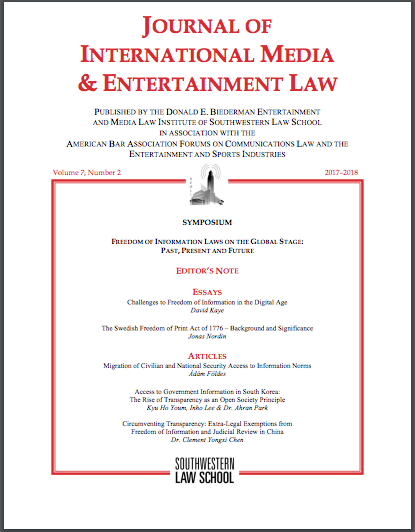
Yongxi Chen on Circumventing Transparency, Extra-Legal Exemptions from Freedom of Information and Judicial Review in China (J Int'l Media & Entertainment L)

Yongxi Chen
Journal of International Media & Entertainment Law
2018, Vol. 7, Issue 2, pp. 203-252

Abstract: This paper examines the relation between extra-legal regimes of information control and the right to information created by China’s Regulations on Open Government Information (ROGI) and discusses its implications for legal reforms in a party-state. It finds that the norms that preserve the traditional ways of information control under the socialist system have triumphed over the transparency requirements under the ROGI and inhibited the ROGI’s liberally oriented functions. It argues that the circumvention of transparency requirements is caused by not only the flaws in the ROGI, but also the dualist disposition of power in the party-state and the incomplete legal regulation of the exercise of power.
     Existing literature on China’s transparency reform focuses on the implementation and interpretation of the ROGI alone, largely overlooking the norms that are generated by the party-state authorities in parallel with, or in the place of, the ROGI to exempt information from disclosure. These secrecy norms can be called “extra-legal norms” because they are generally not considered sources of law under the Chinese legal system. Extra-legal norms are nevertheless widely adhered to in practice because of their political importance within the governance structure. It is important to note that freedom of information law is significant primarily because it seeks to establish disclosure as the rule and non-disclosure the exception. The ROGI’s effectiveness hence hinges on the extent to which the primacy of its disclosure requirements is guaranteed over secrecy norms. 
      The paper first identifies three major categories of extra-legal exemptions: (1) documents defining the specific scope of state secrets; (2) directives on the prior approval of information releases; and (3) ROGI implementation measures. It analyzes in depth the nature and validity of each. It then examines, based on a representative sample of cases, judicial review of extra-legal exemptions that fall within categories (1) and (3) but contradict either the ROGI or other laws. After elaborating the gaps in the formal hierarchy of law and the marginal, or even failing, judicial control of invalid norms, the paper further reflects on how its embeddedness in the party-state has impeded an otherwise promising legal reform in the direction of greater government accountability.

Tuesday, July 31, 2018

Yongxi Chen & Lingqiao Song on China and the Regulation of Cross-Border Genomic Data Sharing (Human Genetics)

Human Genetics
Yongxi Chen & Lingqiao Song
published online, 16 July 2018
Abstract: This paper reviews the major legal instruments and self-regulations that bear heavily on the cross-border sharing of genomic data in China. It first maps out three overlapping frameworks on genomic data and analyzes their underpinning policy goals. Subsequent sections examine the regulatory approaches with respect to five aspects of responsible use and sharing of genomic data, namely, consent, privacy, security, compatible processing, and oversight. It argues that substantial centralised control exerted by the state is, and would probably remain, the dominant feature of genomic data governance in China, though concerns of individual protection are gaining momentum. Rather than revolving around a simplistic antinomy between privacy preservation and open science, the regulatory landscape is mainly shaped by the tension between government desires for national security, state competitiveness, and public health benefits.

Tuesday, May 22, 2018

Clement Chen & Anne Cheung on The Transparent Self under Big Data Profiling: Privacy and Chinese Legislation on the Social Credit System (Journal of Comparative Law)

"The Transparent Self under Big Data Profiling: Privacy and Chinese Legislation on the Social Credit System"
Yongxi Chen & Anne Cheung
The Journal of Comparative Law
published in Feb 2018
Volume 12, Issue 2, pp. 356-378
Introduction: Big data is one of the buzz phrases of the 21st century, concerning not only the digitalisation of data on billions of individuals, but also what those in power are able to do with that data.  The defining characteristic of big data is the capacity to search, aggregate and cross-reference large datasets for analysis to identify previously undetectable patterns, as well as the power to profile individuals, calculate risks, and monitor and even predict behaviour.  When big data is harvested by governments, the worry is that the totality of individuals' lives will be captured, that citizens will be monitored and that the Orwellian state will become a reality.
     In China, such a worry seems far from unfounded given the Chinese Communist Party's (CCP) roll-out of its powerful Social Credit System (SCS).  Launched at the national level in 2014, the system's aim is to assess the trustworthiness of Chinese citizens in keeping their promises and complying with legal rules, moral norms, and professional and ethical standards.  It is essentially an all-encompassing, penetrative system of personal data processing, manifested by the comprehensive collection and expansive use of personal data with the explicit intention on the Chinese government's part of harnessing the ambition and power of big data technology.  The SCS rates both business entities and individuals.  According to its blueprint, the records that are collected can be extensively used by the authorities and business entities alike for a variety of purposes broadly related to 'encouraging trustworthiness and punishing untrustworthiness'.
     Whilst the use of big data analytics in the context of credit scoring and the rating of individuals is not unique to China, in other jurisdictions it is usually confined to the financial arena and regulated by law.  What differentiates China is the scale of the data collected, the scope of its use and, particularly important for the purposes of this article, the apparent lack of a comprehensive legal system to protect personal data.  Despite the introduction of the Cyber Security Law in 2016 in relation to online data, the extension of civil law protection to consumer data in 2013, and the criminalisation of the unlawful gathering, receipt and sale of personal data in 2009, personal data as a general subject has yet to be clearly defined and effectively protected under Chinese law.   The rights that data subjects are entitled to under a personal data protection regime are rarely mentioned in China and are, at best, provided for under scattered sector-specific laws.
     Given the inadequate protection afforded to personal data in China, the country is an ideal social laboratory for big data experimentation, data intelligence and mass surveillance.  Individuals risk being reduced to transparent selves before the state in this uneven battle.  They are uncertain about what contributes to their social credit scores, how those scores are combined with the state system and how their data is interpreted and used.  In short, the big data-driven SCS is confronting Chinese citizens with major challenges to their privacy and personal data.
     Although the State Council's Planning Outline for the Construction of the Social Credit System ('SCS Outline' hereafter) sketches out an ambitious blueprint, it is the pilot legislation implemented at the local level since 2014 that has institutionalised the collection and use of social credit-related data.  To analyse China's emerging SCS under existing international legal principles concerning personal data protection, this article identifies and compares typical examples of relevant legislation at the local level and discusses their implications for personal data protection.  It argues that existing legislation and proposed regulations require substantial revisions to mitigate the impact of the SCS on data privacy and other interests critical to individual citizens.
     The article begins by mapping out the background to the construction of China's big data social laboratory and the SCS.  The next section examines the system's social management aim and comprehensive sanction system, as well as its nature as a collaborate project between the authorities and the business sector.  The section which follows then summarises the legislative history and evolving concept of social credit and analyses the nature of individuals' rights to personal data protection under China's uncoordinated legal framework.  The article then reviews local social credit legislation with reference to the three cardinal principles of personal data protection most closely related to data subjects' control over the processing of their data: firstly, the data collection principle,;secondly, the data usage principle, and thirdly, data subjects' right to access and correct their own data.  The final section concludes that although local legislation provides nominal rights of access to, and a few restrictions on, the collection and use of data, it has largely failed to secure meaningful control over personal data for individuals.  These legislative defects relate to the very purpose of the SCS and to extra-legal restrictions inherited from the pre-reform party-state regime.

Clement Chen on Taming the Right to Information and the Public Interest Test under China's FOI-like Law (Journal of Comparative Law)

"Taming the Right to Information: Motive Screening and the Public Interest Test under China's FOI-like Law"
Yongxi Chen
The Journal of Comparative Law
published in Feb 2018
Volume 12, Issue 2, pp. 203-215
Introduction: Promoting government accountability to the public is a core value common to freedom of information (FOI) laws around the world.  FOI law is primarily understood as an empowering tool for the civil society, for it enables citizens to take over the initiative in making government information available, in particular information necessary for the public to judge government performance, participate in public policy-making, and call administrative agencies to account for violations of law, corruption or maladministration.  That value is often echoed by Chinese officials who push through transparency reforms, and emphasized by jurists who hail the introduction of the Regulations on Open Government Information (ROGI) 2007 as a landmark improvement of the government-citizen relation or a major advance in 'democratic politics' in China.  Persistent denials of access to information concerning abuse of power and policy-making affecting crucial public interests, however, casts serious doubt on the adherence to this value in the ROGI's implementation.
     It is usually through two principles that a FOI law entrench the public accountability value.  The first is the 'requester-blind' principle which grants all members of the public a universal right to information irrespective of their identities and motives in accessing the information.  It ensures that all requesters are treated equally without any bias against those whose motives may not be favoured by officials.  It is a corollary of the essence of FOI law, i.e. government information should be disclosed by default, and should not be withheld unless it falls within the limited and statutorily prescribed regime of exceptions.  The second principle is that of subjecting exceptions to the public interest test.  This intends to ensure reducing the areas of secrecy to minimum and releasing information whose disclosure serves the public interest, including in particular accountability enhancement, that overrides the secrecy interests protected under the exemptions.  Although the ROGI is compatible with these two fundamental principles, its wording creates ambiguities which have been employed by government agencies to the detriment of this legislation's function in making the government accountable to the public.  The General Office of the State Council (Guowuyuan Bangongting, 'SC General Office' here after) issued interpretations of the ROGI to introduce a test of the requesters' needs, which actually screens the motives for access.  Agencies also tend to ignore the public interest associated with disclosure and shirk the balancing test.
     Being the sole external review body that enforces the right to information, the Chinese courts have a pivotal role to play in scrutinizing government decisions concerning these two principles.  Effective judicial scrutiny is important for the full functioning of the ROGI and and successful outcomes of the transparency reform.  The public interest test pertaining to information disclosure best illustrates the courts' view on what the values of transparency are in a society and a polity, and how important such values are when compared to the secrecy interests in a given circumstance.
     This article investigates the extent to which the public accountability value has been fostered by the ROGI by illustrating and assessing the judicial approaches to the motives of access and to the public interest test.  The section which follows criticises the problematic judicial responses to the SC General Office's interpretations, and identifies the discriminative treatment of three major sets of motive in access to information. The subsequent section summarizes Chinese judges' unique understandings of the public interest test in the FOI context, and examines the major categories of public interest that the courts have identified under two exemptions respectively.  The final section generalizes from its finding of the convergent results of both tests that there is a prevailing judicial policy to uphold 'defensive transparency' which is attached to the requester's own rights of the person and property ('personal or property right' hereafter), but to refrain from supporting 'civic transparency' - that is, the transparency to be unconditionally enjoyed by every citizen in respect of public scrutiny of government performance.  The Chinese courts have largely failed to yield their review power to uphold the pro-accountability value embodied in the ROGI, but have cooperated with administrative agencies in taming an otherwise politically significant right to information into a mediocre instrument for private interest assertion.
     In basing the investigation on representative cases, this article continues to use the methodology developed by the author in previous studies of the right to information in China.  Cases are collected from three sources that complement each other.  The first source is case collections published by the Supreme People's Court ('Supreme Court' hereafter) or compiled under its supervision.  The cases reported in these collections, called 'referential cases', are widely considered by the Chinese legal community to reflect to varying extends the intentions of the Supreme Court and its departments in guiding local courts on the adjudication in a particular field of law.  The second source is mainstream legal databases, including China Judgment Online, the official portal designated by the Supreme Court to publish the judgments rendered by courts at all levels, and ChinaLawInfo, the country's most comprehensive commercial databank.  In consideration of the overrepresentation of certain regions in the databases and the post-2013 spiralling of number of judgments on open government information (OGI) litigation, the scope of search is restricted to the judgments of the second instance in eight provincial units.  The selected units are dispersed across the country with different levels of industrialization.  Appeal judgements often involve more detailed examination of important legal issues than judgments of the first instance, and are more suggestive of mainstream judicial approaches.  The third source is news reports in fifty-nine Chinese media outlets which enjoy either great popularity or an appreciation of their professional quality, plus the 'Transparent China Online', a portal dedicated to news on OGI.  It should be pointed out that OGI cases reported by the media ('media-reported cases' hereafter) are more representative than reports of adjudicative practice in two senses.  First, they encompass cases whose judgements are withheld from online publication by the courts for various discretionary  reasons, including for instance the political sensitivity or inconvenience of the case.  Second, they are more evenly distributed geographically than those retrieved from the databases and Supreme Court-managed collections.  Searches within the three sources have yielded 289 cases which were adjudicated before the end of 2015 and which concern the issues discussed in this study.

Tuesday, January 30, 2018

Anne Cheung and Clement Chen's Work on Big Data in China Profiled in HKU's Bulletin (Jan 2018)

Bulletin
Jan 2018, Vol 19, No 2
How can individuals be protected when their personal data is constantly being collected for uses that may not be apparent until some future date? And when it may not be obvious who is collecting that data?
     As giants like Google, Facebook, WeChat and Alibaba track their users every minute of the day, these questions are rising high on government agendas around the world. In little more than a decade, most people now share personal information in order to gain access to services – whether socialising, shopping, seeking entertainment, or checking up on their health. Even our whereabouts can be tracked at every moment if the location service on our phones is turned on.
     That goldmine of information is being used by both businesses and governments to make decisions about individuals and groups, such as how much to charge certain users for services, whether to deny them access and what trends are revealed by their data. And therein lie several problems.
    First, the story told by big data may not be an accurate one. Professor John Bacon-Shone of the Faculty of Social Sciences, a statistician with an interest in big data and privacy who also advises the Hong Kong Government on the issues, cites the example of the Google Flu Trends web service which aggregated search queries about flu to predict outbreaks. “The problem is, it’s just an association, not causation, and it doesn’t work well at prediction. If you have a different type of flu, the whole thing falls apart,” he said...
     Personal data protection laws typically require banks and other institutions to keep accurate up-to-date information and disclose how it will be used. But when the technology is changing rapidly, with new and unanticipated uses becoming possible, this may no longer be sufficient.
     Professor Anne SY Cheung of the Faculty of Law has been studying privacy and personal data protection and is co-editor of the 2015 book Privacy and Legal Issues in Cloud Computing. “Recent legal reforms and position papers from the European Union (EU), the UK and the US have raised concerns about the problem of profiling, predictive decisions and discrimination, and the harm that may result from that. This is because the use of big data is very different from our traditional understanding of how to regulate personal data.
     “The traditional approach is essentially one of notice and consent: the collection of personal data is allowed only for a specific and limited purpose. But in the age of big data, the more data one has, the more accurate and arguably useful one’s conclusions will be. So the collector tries to collect as much data as possible and only after they have it and have done their analysis, will they find correlations and identify the purpose,” she said...

China: Big data, big brother?
The use of big data in China is of an altogether different level of concern from commercial uses of personal information.  The central government is in the process of rolling out a social credit system that draws on big data to rate each individual's reputation based on their political leanings, purchase history, social interactions and other factors.  
     "China is like a big data laboratory," said Professor Cheung, who has been studying the situation there with colleague Dr Clement Chen.  "Arguably, there is 360-degree surveillance watching individuals and gathering data. They have real-name registration [for mobile and internet services] and close connections between the government and the banking system and internet companies"...  Click here to read the full article.

Thursday, August 17, 2017

Wednesday, January 25, 2017

Clement Chen on the Role of Chinese Courts in Upholding Freedom of Information (Tsinghua China LR)

Tsinghua China Law Review
2016, Vol. 9, No. 1, pp 79-138
Abstract: This paper explores the inconspicuous but increasingly important role of Chinese courts in handling the often conflicting goals of promoting government transparency and maintaining social stability within the Party-state context. The Regulation on Open Government Information created an unprecedented right of access to information with the potential for improving administrative accountability, but established a peculiar exemption of social stability. “Stability maintenance” has long been an overwhelming political task for Chinese state organs, and has profoundly affected legal practices, posing a challenge to judicial control of abuse of the aforementioned discretionary exemption. Added to the challenge is the obscurity in the standards for judicial review of discretion. 
     The paper reviews how the courts respond to this challenge by focusing on representative cases concerning government claims that disclosure would endanger social stability. It finds that in referential cases adopted in official publications, the courts have developed creative approaches to scrutiny. However, other sources indicate that meaningful review is largely absent from cases involving appropriations of private properties and those concerning large-scale maladministration. It argues that the judicial inaction can be attributed to two concerns underlying the common practice of the stability maintenance system, i.e. containing collective mobilization and inhibiting expression of public mistrust in governance. The courts demonstrate their ability in judicializing the political concept of social stability in the context of right to information, and thus assume more than a deferential role in the politics of stability maintenance. Nevetheless, they remain captive to the imperative of securing core regime interests. The liberalization implications of transparency reform are hence minimized through the judicial process.  Click here to read the full article.

Friday, January 22, 2016

Clement Chen on Privacy and Freedom of Information in China (European Data Protection Law Review)

"Privacy and Freedom of Information in China: Review through the Lens of Government Accountability"
Clement Chen Yongxi
European Data Protection Law Review
Vol. 1 (2015), Issue 4, pp. 265-276
Abstract: This article critically reviews how the Chinese legislation and courts handle the conflict between the right to privacy and freedom of information. It summarises inadequacies in the protection of privacy provided under an uncoordinated body of legislation, and highlights the gaps concerning the privacy exemption to disclosure of government information left to be filled by the courts. By analysing a representative sample of cases, it evaluates the judicial approaches to balancing privacy and public interest in transparency on several subject matters. The article finds that the courts have recognised a wider scope of privacy in the FOI context than what is usually recognised under the civil law doctrine, and have often undervalued or neglected the public interest in promoting government accountability through transparency. It argues that these approaches risk condoning the misuse of privacy to cover maladministration, and can hardly redress the weak legislative protection of privacy from government intrusion in the non-FOI context.

Wednesday, July 15, 2015

Clement Chen Interviewed on China's Draft Cyber Security Law (Tech in Asia)

"China to codify internet control measures"
Jennifer Zhang
Tech in Asia
12 July 2015
China has been eager to claim its “internet sovereignty” since the 18th party congress, with internet control naturally topping the central leadership’s agenda. The recently released cyber security law draft, while aiming to codify the previously scattered internet regulation policies and solidify Cyberspace Administration’s status as the leading internet governing body, has demonstrated the country’s determination to take a more effective and concentrated approach to make the cyberspace a “safe and harmonious” territory...
     The draft also duplicates the stringent requirements on the real identity registration system of the NPCSC’s 2012 Decision on Strengthening Network Information Protection, according to Clement Chen, a post-doctoral fellow at the Faculty of Law, HKU. Article 20 of the draft prescribes that network operators shall require users to provide real identity information when signing service agreements to ensure the traceability of the internet content. Where users do not provide real identify information, network operators must not provide them with relevant services. Chen adds that while the draft imposes obligations to protect privacy on the ISPs, it does not impose equally comprehensive obligations on public authorities in relation to their collection and processing of personal information within the broad scope of ‘internet security maintenance’...  Click here to read the full article.

Friday, March 6, 2015

Clement Chen on Freedom of Information in China

"Freedom of Information in China?  The Paradox of Access to Information in a Closed Regime"
Clement Chen
in John Mair & Tom Felle (eds), FOI Ten Years On: Freedom Fighting or Lazy Journalism (Abramis Academic Publishing 2015)
Abstract: As a result of the Regulations on Open Government Information (ROGI), Chinese journalists as well as other citizens enjoy, for the first time in history, a statutory right to access government information. While the ROGI has led to increased disclosure of non-sensitive information, it has yet to secure disclosure of information with democratic implications, i.e. enhancing government accountability and promoting civic engagement, as shown by data concerning request handling and judicial review. Under the law, journalists do not have a more privileged right of access to information than any other citizen; in practice, their rights are actually far less, as frequently a ‘needs test’ is applied by government agencies (news gathering has not been recognised as a valid need) in addition to other exemptions, in an effort to stymie information release, especially where such requests relate to accountability of public money; potential maladministration; or corruption. Journalists and other non-personal requests have an extremely limited right of appeal, as courts have been slow to overturn non-disclosure decisions, or even accept cases. Because of this combination of a weak legislative framework and a largely impotent judicial protection, watchdogs such as activists, NGOs and journalists find it increasingly difficult to use the ROGI to monitor and check on the workings of government, and its officials.

Thursday, February 26, 2015

$1.1M in New Small Project Research Funding

Congratulations to the Faculty members who were awarded HKU Small Project Research Grants up to $80,000 each. The projects cover a wide range of topics and are listed as follows (in no particular order):
1. Competition Law Enforcement against Abuses of Market Power in Hong Kong (36 months), Kelvin Kwok
2. Fiduciary Obligations: Justifying and Limiting Loyalty (24 months), Rebecca Lee
3. Reforming Anti-Dilution Law in China (24 months), Haochen Sun
4. Path Dependence and Interconnected Institutions: Implications for Legal Transplantation (24 months), Guanghua Yu
5. Implications of the New Round of Legal and Market Reform in China (30 months), Xian Chu Zhang
6. Eastern Values in International Arbitration: An Initial Exploration (36 months), Shahla Ali
7. Exercise of Legislative Power by the Executive (36 months), Jianlin Chen
8. A Comparative Legal Study on Tackling Cyberbullying and Protecting Children's Rights (24 months), Anne Cheung
9. Financial Planning for Mental Incapacity: A Tale of Two Confucian Cities (24 months), Lusina Ho
10. Survey of Public Opinion Toward Lesbian, Gay, Bisexual and Transgender People in Hong Kong (24 months), Kelley Loper
11. Minority Shareholder Remedes in Hong Kong: Evolving Dispute Resolution Approaches (24 months), Katherine Lynch
12. The Interrelation between Case Law and Legislation in Aspects of Commercial Law (36 months), Ji Lian Yap
13. A statistical study of Constitutional and Administrative Law judgments from 1997 - 2012 (24 months), Antonio Da Roza
14. The Tightening of Transparency Requirements in the International Tax Regime and its Impact on Mainland China and Hong Kong (15 months), Doreen Qiu
15. Freedom of information and privacy protection in China: resolving conflicts and promoting accountability (18 months), Clement Chen
16. The Delicate Art of Med-Arb and Its Future Institutionalisation in China (18 months), Weixia Gu.

Thursday, October 16, 2014

28 Nov 14: Symposium on Privacy in Greater China Conference

The Law and Technology Centre is organizing a Symposium on Privacy in Greater China Conference on 28 November 2014, 9am-5:30pm, 11/F, Cheng Yu Tung Tower, Faculty of Law, University of Hong Kong.  
Description: The one-day symposium focuses on the development of privacy and personal data protection in Hong Kong, Macao, Taiwan and mainland China, the four regions with close cultural ties and sharing similar impacts from advancing Internet and communication technologies. Local and international experts from the academics, industries, and regulatory authorities will gather to explore and reflect on the privacy challenges and legal responses in the four jurisdictions respectively, in particular on health data protection and consumer data handling. In addition, a special Roundtable discussion will be held, focusing on the controversial Right to be Forgotten.  Keynote Speaker: Allan Chiang (Privacy Commissioner).  Other Speakers: John Bacon-Shone, Anne Cheung, Yongxi Chen, Ding Chunyan, Henry Chan, Pancy Fung, Stuart Hargreaves, Chih-hsing Ho, Terry Kaan, Ching-Yi Liu, Lin Wei, Charles Mok, Carly Nyst, Marcelo Thompson, Ken Yang, Yan Meining, Zhao Yun.  Cost: Free for students, otherwise $150 registration fee.  Click here to register. 

Thursday, September 11, 2014

Congratulations to Dr Clement Chen Yongxi

Congratulations to our former PhD student Dr Clement Chen Yongxi, whose PhD thesis won two awards.  Dr Chen’s thesis, "An Empty Promise of Freedom of Information? Assessing the Legislative and Judicial Protection of the Right of Access to Government Information in China”, won the following two awards:
  1. Intersentia Prize for the Best PhD Thesis in Law 2013-2014
  2. HKU’s Award for Outstanding Research Postgraduate Student 2012-2013
Well done to Dr Chen’s supervisors: Professors Anne Cheung (Primary supervisor) and Fu Hualing (Co-supervisor).  Dr Chen will be joining the Faculty of Law this semester as a full-time Post-Doctoral Fellow in Privacy Law and Policy in China.