Showing posts with label private law. Show all posts

Monday, September 22, 2025

Kelvin Low on ‘Property’ as polyseme and its implications for trust ‘property’ (Journal of Equity)

"‘Property’ as polyseme and its implications for trust ‘property’"
Kelvin Low
Journal of Equity, Volume 18, Part 2, pp. 107 - 130
Published: February 2025

Abstract: The trust may be English law’s “greatest and most distinctive achievement … in the field of jurisprudence” but it is likely to also be its most confounding. A fierce debate - often cast in dualistic terms - has raged for more than a century over whether a beneficiary’s interest under a trust is proprietary or obligational. Upon closer examination, some of the disagreements are less substantive and more semantic. At the heart of this debate lies the ambiguity inherent in the meaning of the word “property” itself. Yet, although equitable “property” may not be identical to legal “property” (indeed, tangible legal “property” is fundamentally different from intangible legal “property”), this does not make it any less properly regarded as “property”. Rather than being a mere mimic or metaphor, equitable “property” simply secures exclusive control to a resource in a different, indirect, manner for equitable “owners”. “Property” is a polyseme, where a word has different meanings but those meanings are related so that even though it is different from legal “property”, it is no less truly “property”. The primary objective of this clarification is to serve as a via media to reconcile some of the apparently opposing views that have arisen in this debate. However, it also pushes back against certain revisionist reforms proposed for equitable “property” that fail to acknowledge the fundamentally different nature of equitable "property" to legal "property". The understanding of equitable “property” proposed also carries implications for the English Law Commission's conception of digital assets as third things that supposedly carry no rights until they are interfered with.

The paper is also available on SSRN, please click here

Wednesday, July 2, 2025

HKU Law Welcomes Prof. David Winterton

Welcome to Prof. David Winterton, who joins the Faculty of Law as an Associate Professor.

David is an Associate Professor at the University of Hong Kong, with a specialization in contract law, commercial remedies, restitution and private law theory. He has published in several leading academic journals, as well as a monograph based on his doctrinal dissertation, entitled Money Awards in Contract Law (Bloomsbury 2015), which was shortlisted for the St Petersburg International Legal Forum Private Law Prize in 2018. His work has also been cited in various judicial decisions, including in the ultimate appellate courts of Australia and Canada.

Prior to his arrival in Hong Kong, David was a Senior Lecturer at the University of Sydney, and prior to that a Lecturer at UNSW and a stipendiary lecturer at St Anne’s College, Oxford. He holds a BSc (Pure Mathematics) and an LLB from UNSW and a BCL (Dist), MPhil and DPhil from the University of Oxford. Additionally, David has spent some time in legal practice in both Sydney (commercial litigation) and New York (Bankruptcy & Restructuring). He is admitted as a legal practitioner in NSW (2006) and as an Attorney in New York (2012).

Monday, June 9, 2025

Lusina Ho and Hui Jing on The Dominance of Regulatory Oversight in Chinese Investment Trusts (Asia-Pacific Trusts Law, Volume 3)

"The Dominance of Regulatory Oversight in Chinese Investment Trusts"
Lusina Ho and Hui Jing
Asia-Pacific Trusts Law, Volume 3, Boundaries in Context, Part II, Chapter 10
Hart Publishing
Published online: May 2025

Abstract: A fundamental tenet in the relationship between regulations and private law is their functional dichotomy. Private law deals with the adjudication of bilateral rights and duties between individuals. Its main purpose is to protect the rights of individuals from infringement by others. In contrast, regulations primarily serve public interests, and are typically enforced by regulatory agencies through administrative sanctions or criminal liability. In this chapter, we argue that the Chinese legal regime for investment trusts departs from this paradigmatic dichotomy. Regulatory supervision not only addresses public interest concerns, but also frequently displaces private law in resolving disputes amongst trust parties, blurring the boundary between private law and regulations. We examine the unique circumstances in China that account for this regulatory dominance and argue that it can be justified only as a temporary measure.

Following this introduction, Part II discusses the main reason for regulatory dominance in China. We examine how the widespread use of investment trusts for shadow banking raises public interest concerns when private law rights are enforced in such trusts. In Part III, we explore the use and limitations of regulatory supervision to address both the public interest and private law concerns raised by trust (mal)practice. Part IV contends that whilst regulations can be an effective interim measure for addressing private law disputes, legislators should in the long term adopt a proactive approach and enact trust laws that clearly define the rights and responsibilities of the trust parties. Part V concludes.

Full text of this chapter is available on SSRN, please click here.

Monday, August 5, 2024

HKU Law Welcomes Prof. Kelvin F.K. Low

Welcome to Prof. Kelvin F.K. Low, who joins the Faculty of Law as a Professor. 

Kelvin read law at the National University of Singapore and Oxford University. Before his current appointment at the University of Hong Kong, he held previous appointments at National University of Singapore, Singapore Management University, and City University of Hong Kong. 

Kelvin's research interest spans the field of private law but with a particular interest in property, broadly defined. He has published internationally with leading journals such as the American Journal of Comparative Law, the International & Comparative Law Quarterly, Legal Studies, Lloyd’s Maritime and Commercial Law Quarterly, the Law Quarterly Review, the Melbourne University Law Review, and the Modern Law Review. He is a co-author (together with Michael Bridge, Louise Gullifer, and Gerard McMeel) of the 2nd and 3rd editions of The Law of Personal Property, and co-author (together with Tang Hang Wu) of the 3rd and 4th editions of Tan Sook Yee’s Principles of Singapore Land Law. His works have been cited by the courts in Australia, Canada, England and Wales, Hong Kong SAR, Malaysia, New Zealand, and Singapore as well as law commissions and law reform bodies in Australia, England and Wales, Ireland, New Zealand, Scotland, and Singapore.

Friday, May 27, 2022

Rebecca Lee: Towards a Unified Doctrine of Mistake (Trusts & Trustees)

"Towards a unified doctrine of mistake?"
 Rebecca Lee
Trusts & Trustees, 
https://doi.org/10.1093/tandt/ttac050
Published on 5 May 2022
Abstract: The concept of mistake permeates various areas of private law and performs a similar function in relieving errors in each. This article reviews the operation of the doctrine of mistake in different substantive areas of law, including contract, unjust enrichment and equity, and argues that the similarities in terms of the requirements for establishing a mistake and the role of assumption of risk in negating a mistake should not be overstated. It further argues that the distinction between gifts and bargains, as well as the proprietary consequences of equitable mistakes, makes it premature to postulate a unified doctrine of mistake.

Monday, March 14, 2022

Hualing Fu & Xianchu Zhang on Judging the Party: Public Law Wrongs and Private Law Remedies (Chinese J of Comp Law)

"Judging the Party: Public Law Wrongs and Private Law Remedies"
 Hualing Fu & Xianchu Zhang
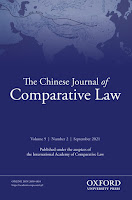
The Chinese Journal of Comparative Law
Published on 23 February 2022
Abstract: This article offers a case study of civil litigation in which the decision of a Party organ or the application of Party rules in a decision have allegedly infringed the private law rights of individuals. Party organs have always performed civil activities and engaged with a wide range of civil legal relations affecting the rights and interests of various individuals and entities, resulting in occasional legal disputes between a Party organ and the aggrieved individuals or entities. After failing to challenge a Party organ’s decision within the political system, the affected member brings a case to court to challenge the validity of the decision. In the court process, legal rules are used primarily to deal with issues involving insignificant players in employment disputes with Party organs. For matters involving the Party’s own officials and those matters regarded as internal, legal rules are largely limited, if not dispensed with entirely, confirming the prerogative state’s superior position in the hierarchy above the normative state. Freedom of contract is more relevant and recognized for claims by individuals at the lower end of the political ecosystem, while politics is reserved for the elites of society and for issues where the Party is determined to maintain direct, hands-on control.

Tuesday, August 11, 2020

Lusina Ho on Unjust Enrichment and Equity (new book chapter)

"Unjust Enrichment and Equity"
in  Elise Bant, Kit Barker, Simone Degeling (eds), Research Handbook on Unjust Enrichment and Restitution (Edward Elgar, July 2020), Chapter 7
Summary: The proper relationship between unjust enrichment and equity has long been the subject of spirited debates. At the theoretical level, there is debate as to whether the idea of conscience is better than unjust enrichment in explaining and categorising instances of restitutionary liability previously available under quasi-contract. At the doctrinal level, it has been argued that the equitable doctrines of knowing receipt and undue influence are better classified as claims to reverse unjust enrichment. Furthermore, where both common law and equitable rules are applicable to a claim in unjust enrichment, there are calls to assimilate the rules to achieve coherence and consistency. The present chapter explores all these issues.

Tuesday, August 22, 2017

Des Voeux Chambers Oxford-HKU Visiting Fellowship Public Lecture (7 Sept 2017)

Des Voeux Chambers Oxford-HKU Visiting Fellowship
Public Lecture

Chaired by The Honourable Mr Justice Jonathan Harris,
Judge of the Court of First Instance of the High Court

Date: 7 September 2017 (Thursday)
Time: 18:30 – 20:30 (Drinks reception will be held after the lecture)
Venue: Academic Conference Room, 11/F Cheng Yu Tung Tower, 
Centennial Campus, The University of Hong Kong

Humans as a Service? The Promise and Perils of Work in the Gig Economy 
Dr Jeremias Prassl
Uber, Didi, Deliveroo, Amazon’s MTurk, UpWork, TaskRabbit &co: On-demand work in the gig economy has had a profound impact on traditional conceptions of employment relationships. The completion of ‘tasks’, ‘gigs’ or ‘rides’ in the (digital) crowd fundamentally challenges our understanding of work in modern labour markets: gone are the stable employment relationships between firms and workers, replaced by a world in which everybody can be ‘their own boss’, enjoy the rewards – and face the risks – of independent businesses. Litigation between workers, customers, and platforms is on the rise all over the world, with many fundamental questions raised by gig economy work still lacking authoritative answers. 
     Dr Prassl’s talk will explore some of the key questions raised in his new book, Humans as a Service (Oxford University Press, forthcoming 2017): Is this the future of work? What are the benefits and challenges of working in the gig economy? And is platform work really fundamentally different from existing work arrangements, as many providers claim? Most importantly, how should the law respond and regulate on-demand economy work?
     Dr Jeremias Prassl is an Associate Professor in the Faculty of Law at the University of Oxford, a Fellow of Magdalen College, and Deputy Director of the Faculty’s Institute of European and Comparative Law. He read law at Oxford and Paris II (MA, DPhil) as well as Harvard Law School (LL.M.), and has held visiting positions at institutions including Columbia Law School, the Max Planck Institute Hamburg, UCL, WU Vienna, and Yale Law School. His principal research interests are in the fields of Employment Law, Corporate Law, and European Union Law (with a particular focus on Civil Aviation). 

Justifying Damages: Corrective Justice, Civil Recourse, or Something Else
Dr Sandy Steel
It has usually been thought that the breach of a primary tortious or contractual duty causing actionable harm gives rise immediately to a secondary duty to pay damages. Recently, this view has come under challenge: it has been argued that breach of such a primary duty gives rise only to a legal liability to pay damages. The liability view, as we can call it, is thought to pose a challenge to corrective justice theories of damages which claim that the justification of damages (sometimes) rests upon a secondary moral duty. In this lecture, Dr Steel offers some new arguments for the duty view, but suggests that, even if the legal liability view turns out to be correct, the moral duty of repair may still be crucial to justifying the existence of the liability. In doing so, Dr Steel suggests that the morality of self-defence helps to illuminate aspects of the law of damages.
     Dr Sandy Steel is an Associate Professor in the Faculty of Law at the University of Oxford, and also a Fellow of Wadham College. He read law (BA, PhD) at Corpus Christi College, Cambridge. From 2010-2014 he was a Lecturer in Law at King’s College London. He is interested in the English, French, and German law of obligations and in philosophical questions about that area of law. He has written mainly about torts. He also maintains an interest in general jurisprudence. 
     Click here to register online. Should you have any enquiries, please feel free to contact Kerry Ng by email at ngkerry@hku.hk.

Thursday, June 23, 2016

Ernest Lim Writes a Case Study on the Illegality Defence (J Business Law)

"Tensions in Private Law Judicial-Making: A Case Study on the Illegality Defence"
Ernest Lim
Journal of Business Law
2016, Issue 4, pp 325-334
Abstract: This article explores a recurring tension in judicial decision-making, thrown into sharp relief by recent jurisprudence—between the need for certainty and clarity in the law, and thus the need for clear articulation and enforcement of rules, with the equally important desire to achieve a fair and just result in each case, and thus the need to ensure that the rules are not uncritically applied—through the lens of illegality defence, a crucial, outstanding issue in private law.  Available on Westlaw or contact the author.

Monday, February 1, 2016

The Two Books from Obligations VII (Hart Publishing)

The Common Law of Obligations: Divergence and Unity
Andrew Robertson and Michael Tilbury (eds)
Hart Publishing
January 2016, 376 pp.
Description: The development of the law of obligations across the common law world has been, and continues to be, a story of unity and divergence. Its common origins continue to exert a powerful stabilising influence, carried forward by a methodology that places heavy weight on the historical foundations of legal principles. Divergence is, however, produced by numerous factors, including national and international human rights instruments, local statutory regimes, civil law influences, regional harmonisation, local circumstances and values and different political and legal cultures. The essays in this collection explore the forces that produce divergence, the countervailing forces that generate cohesion and consistency in the common law of obligations, and the influence that the major common law jurisdictions continue to exert over one another in this area of law. 
     The chapters in this book were originally presented at the Seventh Biennial Conference on the Law of Obligations held in Hong Kong in July 2014. A second collection, entitled Divergences in Private Law, will focus on particular departures from the common law mainstream, the causes and effects of those deviations, and the extent to which they undermine the idea of the common law as a single, transnational body of law.

Andrew Robertson and Michael Tilbury (eds)
Hart Publishing
January 2016, 392 pp.
Description: This book is a study of doctrinal and methodological divergence in the common law of obligations. It explores particular departures from the common law mainstream, the causes and effects of those departures, and the extent to which they undermine the idea of the common law as a single, transnational body of law. Some divergences can be justified on the basis of a need to adapt the common law of contract, torts, equity and restitution to local circumstances, or to bring them into conformity with local values. More commonly, however, doctrinal or methodological divergence simply reflects different approaches to common problems, or different views as to what justice or policy requires in particular circumstances. In some instances divergent methodologies lead to substantially the same results, while in others particular causes of action, defences, immunities or remedies recognised in one jurisdiction but not another undoubtedly produce different outcomes. Such cases raise interesting questions as to whether ultimate appellate courts should be slow to abandon principles that remain well accepted throughout the common law world, or cautious about taking a uniquely divergent path. 
     The chapters in this book were originally presented at the Seventh Biennial Conference on the Law of Obligations held in Hong Kong in July 2014. 

Sunday, January 10, 2016

Ernest Lim on Corporate Law, Private Law and Instrumentalism

"Corporate Law, Private Law and Instrumentalism"
Ernest Lim
[2015] Lloyd's Maritime and Commercial Law Quarterly 541-574
Abstract: This article seeks to enrich our understanding of corporate law and private law. Deploying insights from the rights-based analysis in private law, this article argues that corporate law, in its instrumentalist conception, is unable to properly account for a defining feature of private law disputes, its bipolar structure consisting of the correlative and personality elements. Through a critical examination of certain corporate law cases, this article shows that the rejection of instrumentalist considerations by the rights-based thesis is unwarranted; it demonstrates how judges in private law disputes can accommodate instrumentalist considerations in a structured, coherent and restrained fashion.  Click here to download the full article.

Friday, December 26, 2014

Michael Tilbury Interview on Post-Obligations VII

World leading private law scholars and jurists met at the HKU Law Faculty in mid-July 2014 for the Obligations VII conference.  The event was co-organised by the  law schools of Hong Kong University and Melbourne University.  The co-convenors were Michael Tilbury (HKU) and Andrew Robertson (Melbourne).  In the interview below, Professor Tilbury reflects on what was achieved and briefs us on subsequent developments.  
Profs Robertson and Tilbury (L-R)
1. What were you hoping to achieve when you were planning Obligations VII?  By way of background to my answer, it is important to stress that the biennial Obligations conferences, which originated at the University of Melbourne in 2002, are the leading forums that bring together scholars, judges and practitioners from around the common law world to discuss issues in private law. Each conference is organised around a common theme, and speakers are asked to address this theme in their presentations.
     Against this background, the overall objective of the Obligations VII conference was to bring together leading authorities in the common law world who could address the identified theme of the conference, namely divergence and convergence in the common law of obligations.
     The theme starts from the premise that, although the common law has its origins in English law, its development outside England has been subject to local influences (for example, local statutory regimes, including human rights instruments, or even local values) that have led to divergences in the common law. The conference was aimed at identifying the reasons for, and evaluating the utility (or otherwise) of, such divergences.
     In planning the conference we were keen to see a logical development of the theme of the conference throughout its three full days, and to devise individual sessions that were linked, as far as possible, by common topics.
Prof Burrows
2. Do you think the Hong Kong conference achieved those objectives?  The conference certainly achieved its objectives. Indeed, the conveners of the conference have received many messages commenting on its intellectual depth, and its overall coherence.  Specifically, and relating this to the objectives of the conference that I have already outlined, I note the following.
     First, leading authorities from throughout the common law world (both from the academy and from the judiciary), presented papers at, and generally participated in, the conference. The papers engaged the theme of the conference at sophisticated, often ground-breaking, levels, taking into account our current theoretical understandings of the common law of obligations and the practical and societal contexts of those understandings.
Prof Stevens
     Secondly, the conference theme was progressively developed throughout the conference both in plenary sessions and in the parallel sessions broadly classified into tort, contract, unjust enrichment and equity. For example, the plenary session on the first full day began with Professor Andrew Burrows addressing the general influence on the English law of obligations of leading Commonwealth authorities, and ended, on the final day, with Professor Robert Stevens (addressing the conference by video-link from Oxford) discussing the approach to particular aspects of remedies in two leading English and Australian cases. 
Fok PJ, Ma CJ, Ribeiro PJ (L-R)
3. What were some of the main highlights from the Hong Kong conference?  Undoubtedly, the major highlight was the intellectual engagement of the papers with the conference theme. Of course, beyond this, the answer runs the risk of being subjective, depending on the papers that had special personal appeal. 
     However, I think it is not unfair to single out the contributions of our plenary speakers to our understanding of divergence and convergence in the common law of obligations. I have already mentioned the papers of Professors Burrows and Stevens, both from Oxford. Justice Robert Ribeiro of the Hong Kong Court of Final Appeal spoke at the opening plenary session of the conference. His Lordship gave the conference a distinctly Hong Kong ‘feel’ by speaking about a decision of the Hong Kong Court of Final Appeal on defamation on the internet, comparing the decision to those in other common law jurisdictions. 
Dean Hor and Prof Worthington
      Sir Anthony Mason, also of the Hong Kong Court of Final Appeal and formerly Chief Justice of Australia, spoke about the influence of statute law on common law development. Professor Sarah Worthington from Cambridge addressed the issue of the extent to which party autonomy is essential to common law doctrine. Dame Sian Elias, the Chief Justice of New Zealand, spoke about public acts and private obligations. Unfortunately Professor Paul Finn, formerly of the Federal Court of Australia, was unable to attend the conference. 
Prof Smith, Sir Anthony Mason, Elias CJ
However, his written paper, which traced the emergence of diversities from English law particularly in Canada, Australia and New Zealand, formed the subject of a spirited plenary panel session, in which Professor Stephen Smith commented from a Canadian perspective; Sir Anthony Mason from an Australian perspective; Dame Sian Elias from a New Zealand perspective; Professor Anselmo Reyes from a Hong Kong perspective; and Professor Andrew Burrows from an English perspective.

Group photo before dinner cruise
     The other highlight of the conference that must be mentioned was its outstanding organisation, attributable to the quiet determination of the organising team at HKU, led by Priscilla Wong. The organising team ensured that everything ran to clockwork, including the widely enjoyed cruise dinner on Victoria Harbour and the conference dinner at the Bankers’ Club.
4. Will the papers from the conference be published?     Yes, Hart Publishing will publish two volumes of essays from the Conference in 2015. The first will be entitled The Common Law of Obligations: Divergence and Unity and the second Divergences in Common Law. The volumes will be stand-alone works, the first focusing on general topics relating to the conference theme, the second on particular divergences in contract, tort, unjust enrichment and equity. Update: The two books were published in January 2016.  Click here for more information.
5. What can you tell us about Obligations VIII?     Obligations VIII will be held at the University of Cambridge from 19-22 July 2016. The theme of the conference will be ‘Revolutions in Private Law’.  More photos from Obligations VII can be found here