Showing posts with label space law. Show all posts

Wednesday, October 29, 2025

Yun Zhao on International Regulatory Regime for MegaConstellations: A Path to Equitable Access to Outer Space (Air and Space Law)

"International Regulatory Regime for MegaConstellations: A Path to Equitable Access to Outer Space"
Yun Zhao
Air and Space Law, Volume 50, Special Issue (2025) pp. 591 – 600
Published online: September 2025

Abstract: The deployment of mega-constellations, as a significant advancement in space technology and commercialization in the twenty-first century, calls for a comprehensive regulatory framework. This article examines the existing legal and policy landscape, identifies regulatory gaps and puts forward suggestions on how to come up with a cohesive international regulatory regime for mega-constellations to ensure the long-term sustainability of space activities. Given the difficulty of achieving a binding legal regime, a pragmatic approach should be adopted at the current stage in enacting guiding principles or concrete guidelines for the responsible deployment and operation of mega-constellations in the interim, laying a solid practical foundation for a binding regime in the future.

Monday, October 13, 2025

Yun Zhao and Mingyan Nie on Creating a lunar-centric legal regime to preserve peaceful and sustainable uses of cislunar space: Proposing initial measures (Acta Astronautica)

"Creating a lunar-centric legal regime to preserve peaceful and sustainable uses of cislunar space: Proposing initial measures"
Mingyan Nie, Yun Zhao
Acta Astronautica, Volume 236, pp. 856 - 868
Published online: July 2025

Abstract: Cislunar space, the significant region beyond Earth geostationary orbit, has become a focal point for leading spacefaring nations like the United States and China, which are developing infrastructure to support their lunar missions. These nations are establishing national policies and strategies to advance their interests in cislunar space; however, existing international legal frameworks, designed primarily for Earth-orbit and near-Earth activities, are inadequate to address the complex challenges of preserving peaceful and sustainable operations in this region. The 1967 Outer Space Treaty, foundational to current space law, sets a ‘dual-track’ system for peaceful use of outer space and the Moon. Yet, the interconnected nature of cislunar and lunar activities complicates efforts to maintain peace in cislunar space. Additionally, while the Outer Space Treaty and related soft laws offer general principles to prevent harmful interference, they fall short in addressing the unique demands of cislunar space. In response to these emerging challenges, this paper advocates for the creation of a lunar-centric legal regime tailored to the specific conditions of cislunar space. Such a regime should incorporate stricter regulations that address new developments in cislunar and lunar activities and should build upon existing outer space laws. As initial steps, this paper proposes strengthening the ‘exclusively peaceful purposes’ principle, establishing clear implementation rules to safeguard exclusively peaceful uses, refining the ‘due regard’ principle, and creating cislunar-specific Traffic Management and space debris mitigation guidelines to enhance sustainability. Moreover, fostering cooperation between the U.S. and China is crucial. These nations must work together to develop a framework of mutually recognized rules to prevent escalating competition and potential conflicts, ensuring that cislunar space remains a peaceful and sustainable domain.

Tuesday, December 22, 2020

Legal Implications of China's Space and Moon Missions (Interview with Prof Yun Zhao)

China's Chang'e 5 space capsule returned to Earth on 16 December 2020, bringing back a sample of rocks and dust from the Moon all according to plan. HKU Legal Scholarship Blog asked our own resident space law expert, Dr Yun Zhao, who holds the Henry Cheng Professorship in Interational Law and serves as Head of the Department of Law, to explain some of the legal implications of the Chinese Lunar Exploration Programme.

(1) What are three basic principles of space law to help us understand the legal implications of China's recent space mission to the Moon?
Three basic principles defined in the 1967 Outer Space Treaty are: 1) The freedom of exploration and use of outer space (for the benefit and in the interests of all countries) (Art. I); 2) Non-appropriation principle (outer space is not subject to national appropriation) (Art. II); 3) peaceful uses of outer space (Art. VI).

Credit: Simona Young
(2) The Chang'e 5 returner brought back close to 2 kg of Moon rocks and dust ("Moon samples") for analysis. Who owns these Moon samples?
The non-appropriation principle prohibits national appropriation of outer space, including the Moon and other celestial bodies by claim of sovereignty, by means of use or occupation, or by any other means. The ownership issue has not been dealt with by any existing space treaties. However, it is helpful to make reference to the Moon Agreement (China and other major space-faring nations are not yet Members to this Agreement). Art 6.2 provides that 
“In carrying out scientific investigations and in furtherance of the provisions of this Agreement, the State Parties shall have the right to collect on and remove from the moon samples of its mineral and other substances. Such samples shall remain at the disposal of those State Parties which cause them to be collected and may be used by them for scientific purposes. States Parties shall have regard to the desirability of making a portion of such samples available to other interested States Parties and the international scientific community for scientific investigation. States Parties may in the course of scientific investigations also use mineral and other substances of the moon in quantities appropriate for the support of their missions.”

(3) At the press conference on 17 December 2020, it is reported the deputy director of the China National Space Administration said China would share the moon samples with scientists around the world. Is there any legal obligation on China to honour this promise to share the moon samples?
Article 6.2 of the Moon Agreement is the only legal source and no customary rules exist on this issue; the wording of this Article shows that sharing of the moon samples is not compulsory. It should also be borne in mind that China is not yet a State Party to the Moon Agreement.

(4) To what extent do patent laws apply to these moon samples? For example, what if scientists in Hong Kong develop new instruments or technologies to analyze these samples, can these new instruments and technologies be patented?
It is argued that patent laws do not apply to the moon samples per se. The moon samples, a kind of discovery, have nothing to do with invention/creation and thus do not fall within the scope for patent protection. But it is possible to patent new instruments or technologies (satisfying the element of creativity/originality) in accordance with national patent laws or international patent treaties. Scientists in Hong Kong developing new instruments or technologies may apply for patent protection in accordance with the Patents Ordinance (Cap 514). Relevant provisions include Part 1A, Division 1, Article 9A on patentable invention (if it is new, involves an inventive step; and is susceptible of industrial application).

(5) China is planning to establish an international research station on the moon by 2030. Are there any laws governing where it can set up this research station? Can China claim land rights on the area it has chosen to establish its research station?
The 1967 Outer Space Treaty is the most relevant document. In accordance with the non-appropriation principle, China cannot claim land rights on the space. Article XII of the Outer Space Treaty provides that 
“All stations, installations, equipment and space vehicles on the moon and other celestial bodies shall be open to representatives of other States Parties to the Treaty on a basis of reciprocity. Such representatives shall give reasonable advance notice of a projected visit, in order that appropriate consultations may be held and that maximum precautions may be taken to assure safety and to avoid interference with normal operations in the facility to be visited.”

(6) On previous missions, China has left various objects on the moon including the Yutu rover. Are these objects considered abandoned property which anyone can now claim on the basis of 'finders keepers'?
Such objects should not be considered abandoned property which anyone can claim. Article VIII of the Outer Space Treaty provides that 
“A State Party to the Treaty on whose registry an object launched into outer space is carried shall retain jurisdiction and control over such object, and over any personnel thereof, while in outer space or on a celestial body. Ownership of objects launched into outer space, including objects landed or constructed on a celestial body, and of their component parts, is not affected by their presence in outer space or on a celestial body or by their return to the Earth. Such objects or component parts found beyond the limits of the State Party to the Treaty on whose registry they are carried shall be returned to that State Party, which shall, upon request, furnish identifying data prior to their return.”

Credit: Simona Young
(7) Would the answers to the above questions be any different if a private enterprise was engaging in similar moon explorations? For example, would a private company have any stronger property interest claims over samples extracted from the Moon or to territory occupied?
The answer would be the same. Article VI of the Outer Space Treaty provides that States Parties shall bear international responsibility for national space activities, whether such activities are carried on by governmental agencies or by non-governmental entities, and for assuring that national activities are carried out in conformity with the provisions set forth in the treaty. This provision further requires authorization and continuing supervision of the space activities of non-governmental entities by the appropriate State Party. 

(8) To what extent do national laws apply to things that happen in space or on the Moon? For example, do you know of any countries' criminal laws or civil laws applying to conduct occurring in space or on the Moon?
National space law or space-related laws (such as telecommunications law, remote sensing laws) shall apply to things or activities that happen in outer space. There are possibilities of applying other general laws (such as criminal laws or civil laws) to things or activities in outer space. A State should normally have personal jurisdiction over its own nationals. Moreover, Article VIII of the Outer Space Treaty provides for the retention of jurisdiction and control over space object and personnel thereof. This implies the possibility of applying national laws to the things or activities happening within the specific space object. However, this quasi-territorial jurisdiction is not ostensibly pronounced in the field of space law. The only relevant document is the International Space Station Intergovernmental Agreement (IGA) (1998). Article 5 states that each Partner shall retain jurisdiction and control over the elements it registers and over personnel in or on the Space Station who are its nationals. Article 22 deals with criminal jurisdiction, that the Partner States may exercise criminal jurisdiction over personnel in or on any flight element who are their respective nationals; an affected Partner State may exercise criminal jurisdiction over the alleged perpetrator who is not its national subject to certain conditions. 

(9) Can a country enact a law to enable the country to claim or confer rights to things that exist on the Moon? For example, can country X pass a law that says nationals of country X may have property rights to anything which those nationals extract from the Moon? 
It is possible for a country to enable its own nationals (not the country per se) to claim rights to things that exist on the moon. After the United States adopted the U.S. Commercial Space Launch Competitiveness Act on 25 November 2015, the International Institute of Space Law (IISL) released a Position Paper in December 2015. The document emphasizes the importance of the non-appropriation principle; however, it acknowledges that there is no international agreement governing whether the right of “free use” includes the right to take and consume non-renewable natural resources in outer space. Accordingly, the United States has not violated its international legal obligations. The IISL questions whether this legal situation is satisfactory. Another country that has adopted a similar national law is Luxembourg.

(10) Would such a domestic law, as described in Q(9), violate international law? Does China have such laws?
As mentioned in A(9), there is no violation of international law. China does not have such laws.

Monday, July 8, 2019

Professor Yun Zhao Appointed Henry Cheng Professor in International Law (HKU)

Congratulations to Professor Yun Zhao, who was recently appointed to the Henry Cheng Professionship in Internationship Law.  He joins the other five endowed professors in the HKU Faculty of Law.  The appointment recognises Professor Zhao's expertise and scholarship in the area of space law.


From the website of HKU's Development and Alumni Affairs Office:  On October 4, 1957, the Soviet Union launched Sputnik 1, Earth’s first artificial satellite, and pushed the US into second place in the Space Race. This resulted in the United States Congress passing the Space Act that created the National Aeronautics and Space Administration (NASA). 
     Sputnik also had far-reaching legal implications and led to the creation of space law that governs human activity in outer space. With private companies leading a new commercial space race, space law faces many new challenges.
     Professor Zhao Yun is Head of the Department of Law at The University of Hong Kong. He was Director of the Centre for Chinese Law (2013-17) and is currently a Standing Council Member of the Chinese Society of International Law.
    He received his PhD from Erasmus University Rotterdam, having previously received an LLM from Leiden University and an LLM & LLB from China University of Political Science and Law. 
     The focus of Professor Zhao’s research is on space commercialisation and privatisation, including the liberalisation of telecommunications services within World Trade Organization frameworks, and national space legislation in China. He recently began work on international co-operation on space activities and space sustainability. And in view of the need of an appropriate legal regime for space mining, he put forward suggestions for an international space authority to govern space mining. 
    He has completed a project on commercialising the International Space Station, with particular reference to Hong Kong’s Future Participation, and is currently working on a multilateral regime for space resource mining and space sustainability.
    Professor Zhao is also researching dispute resolution, in particular online dispute resolution, to facilitate the dispute resolution process. He has argued on various occasions for the need to have an online dispute resolution mechanism and a set of online dispute resolution rules for the resolution of B2B disputes.
     He is listed as arbitrator in several international arbitration commissions. Professor Zhao is also a founding council member of Hong Kong Internet Forum, and a member of the International Institute of Space Law in Paris, the Asia Pacific Law Association, and the Beijing International Law Society. 
    He sits on the editorial teams of several Social Science Citation Index journals, including the Hong Kong Law Journal and the Journal of East Asia and International Law. He was the winner of the Prof.Dr. I.H.Ph. Diederiks-Verschoor Award 2006 from the International Institute of Space Law in France, the first winner of the Isa Diederiks-Verschoor Prize in the Netherlands, and also the first winner of the SATA Prize from the Foundation of Development of International Law in Asia. 
    He is published widely and his recent publications include Dispute Resolution in Electronic Commerce; Liberalization of Electronic Commerce and Law; Space Commercialization and the Development of Space Law; Mediation Practice and Skills; and National Space Legislation in China: An Overview of the Current Situation and Outlook for the Future.

Tuesday, December 11, 2018

Yun Zhao on The Role of Regional Space Cooperation in Procuring Space Security in the Asia-Pacific Region (CUP book chapter)

"The Role of Regional Space Cooperation in Procuring Space Security in the Asia-Pacific Region: Prospects for the Future"
Yun Zhao
in Yun Zhao (ed), International Governance and the Rule of Law in China under the Belt and Road Initiative (Cambridge University Press, September 2018), pp. 243-258
Introduction: Space security has become a hot topic in recent years, with space cooperation, regional space cooperation in particular, believed to be the major mechanism for realising and maintaining such security.   This chapter examines the role of regional cooperation in the Asia-Pacific region and discusses how such cooperation can contribute to the maintenance of space security.   Drawing on the successful experience of Europe, the chapter explores possible ways of furthering space cooperation in the Asia-Pacific region.  It also outlines the principles and guidelines that should be followed in pursuing future regional space cooperation in the Asia-Pacific.  The chapter concludes by arguing that regional space cooperation is crucial to furthering space security, and thus that the Asia-Pacific region needs to step up its efforts in the arena.  
     The development of space technologies has important implications for both state security and perceived military imperatives, particularly given the increasing number of space activities taking place worldwide.   The issue of space security has become a focus of interests in the space arena partly because of the inclusiveness of the term 'space security' itself and partly because of the challenges posed to international society with regard to the peaceful uses of space.  Since the start of the space era in 1957, international society has emphasised the importance of international cooperation in space activities.   Such cooperation results in mutual respect for and understanding of the space activities of various countries, consequently contributing to the peaceful uses of space.  International cooperation can take place in various forms and at various levels. 
      Regional cooperation, a subcategory of international cooperation, is particularly helpful in addressing concerns over space security.  We have already witnessed successful regional cooperation in the case of Europe.  However, cooperation within the Asia-Pacific region does not appear to have led to fruitful results as yet.  The launch of China's Belt and Road Initiative (BRI) provides an excellent opportunity to re-examine the current situation and future development of space cooperation in the Asia-Pacific region.  Under the auspices of the BRI, countries in the region can be encouraged to work more closely with one another to realise space security.
     Following this introduction, Section 1 of this chapter addresses the relationship between space security and space cooperation.  A proper understanding of the term 'space security' is vital to any further consideration of space cooperation.  Thus, this section of the chapter presents the various contemporary understandings of the term to set the stage for the discussion in the subsequent sections.  Section 2 then examines the current status of regional space cooperation in Asia-Pacific, showing it to be far from satisfactory at present.  In making suggestions for improved space cooperation within the region, Section 3 takes regional space cooperation in Europe as an example, demonstrating how successful such cooperation has been in helping Europe to realise space security.  With the successful European experience in mind, Section 4 then discusses possible ways of furthering space cooperation in the Asia-Pacific region and proposes principles and guidelines to follow in future. The chapter concludes by arguing in Section 5 that regional space cooperation is so vital to ensuring space security that the Asia-Pacific region would be well advised to step up its game in this arena... 

Wednesday, October 3, 2018

Yun Zhao on China's Perspective on Space and Sustainable Development (new book chapter)

"Emerging Approaches in Development Efforts: Chinese Perspective on Space and Sustainable Development"
Zhao Yun
in Al-Ekabi, Cenan, Ferretti, Stefano (eds.), Yearbook on Space Policy 2016
Space for Sustainable Development (Springer, 2018), Ch 15, pp. 265 - 280
Abstract: The issue of sustainable development came to the forefront in view of the increasingly serious concerns over space debris. However, this is only the vertical aspect of sustainable development in outer space: space sustainable needs to take into account the horizontal aspect of sustainable development, i.e. all the countries, irrespective of their economic, social and technological developmental levels, should be able to benefit from outer space and space activities.  This paper aims to examine new approaches and new perspectives in realizing space sustainability through international cooperation, with China as an example.  China's efforts in promoting space cooperation through overseas assistance program exemplify the importance of financial and non-financial assistance efforts in the realization of the horizontal aspect of space sustainability for both space-faring and non-space-faring nations.   Space sustainability cannot be achieved without taking into account the interests of developing countries.  The China-Brazil cooperation presents an excellent example that space cooperation can take place between and/or among developing countries.  While benefiting one state at one stage, space cooperation will bring benefits to cooperating countries in the long term: such benefits will not simply be restricted to these cooperating counties, with proper arrangement, other states can similarly benefit from such cooperation. The paper concludes that space sustainability, as an issue for both space-faring and non-space-faring nations, regardless of their level of economic and technological development.

Yun Zhao on Legal and Policy Aspects of Space Cooperation in the BRICS Region (new book chapter)

in Rostam J. Neuwirth, Alexandr Svetlicinii, Denis De Castro Halis (eds), The BRICS-Lawyers’ Guide to Global Cooperation (Cambridge University Press, 2017), Ch 14, pp. 309 - 332
Introduction: Since the launch of first satellite in 1957, international society has emphasized the importance of cooperation in space.  The United Nations has advocated the principle of international space cooperation on various occasions, to be demonstrated by the adoption of a series of documents elaborating on this principle.  The most recent achievement is the adoption by the UN General Assembly (UNGA) in 1996 of the Declaration on International Cooperation in the Exploration and Use of Outer Space for the Benefit and in the Interest of All States, Taking into Particular Account the Needs of Developing Countries. This document illustrates the means (formal requirements) and factors (substantive requirements) to be considered in applying the principle of international space cooperation.  It is to be noted that it elaborates this principle in the broadest sense, encouraging space cooperation to be carried out in various manners and approaches and at all levels. 
    While emphasizing the importance of space cooperation at the international level, one cannot disregard the special role that bilateral or regional cooperation can play in promoting the development of space activities and ensuring the realization of space security.  With more and more countries joining the space club, international space cooperation will face many challenges and difficulties in view of the diversified state interests in this strategic field, and bilateral and regional cooperation has proven to be a feasible and relative easy way for countries with similar history and culture to work together in the space field, ultimately leading to space cooperation at the international level. 
     The BRICS countries - Brazil, Russia, India, China and South Africa, all being developing countries,  grouped together and formed a flexible political and economic bloc in 2009.  This provides a platform for these five countries on which to coordinate and cooperate on various issues.   While space activities are not specifically mentioned in the area of cooperation, the open and flexible nature of the platform does allow for intra-BRICS space cooperation, of which bilateral cooperation is the main future.  This chapter then analyzes the reasons for the current situation and identifies the difficulties and barriers in carrying out multilateral cooperation among the BRICS members. It concludes that the widely accepted principle of space cooperation also applies to the BRICS and then that more efforts are needed to realize the wider scope of space cooperation among the members. 

Monday, July 23, 2018

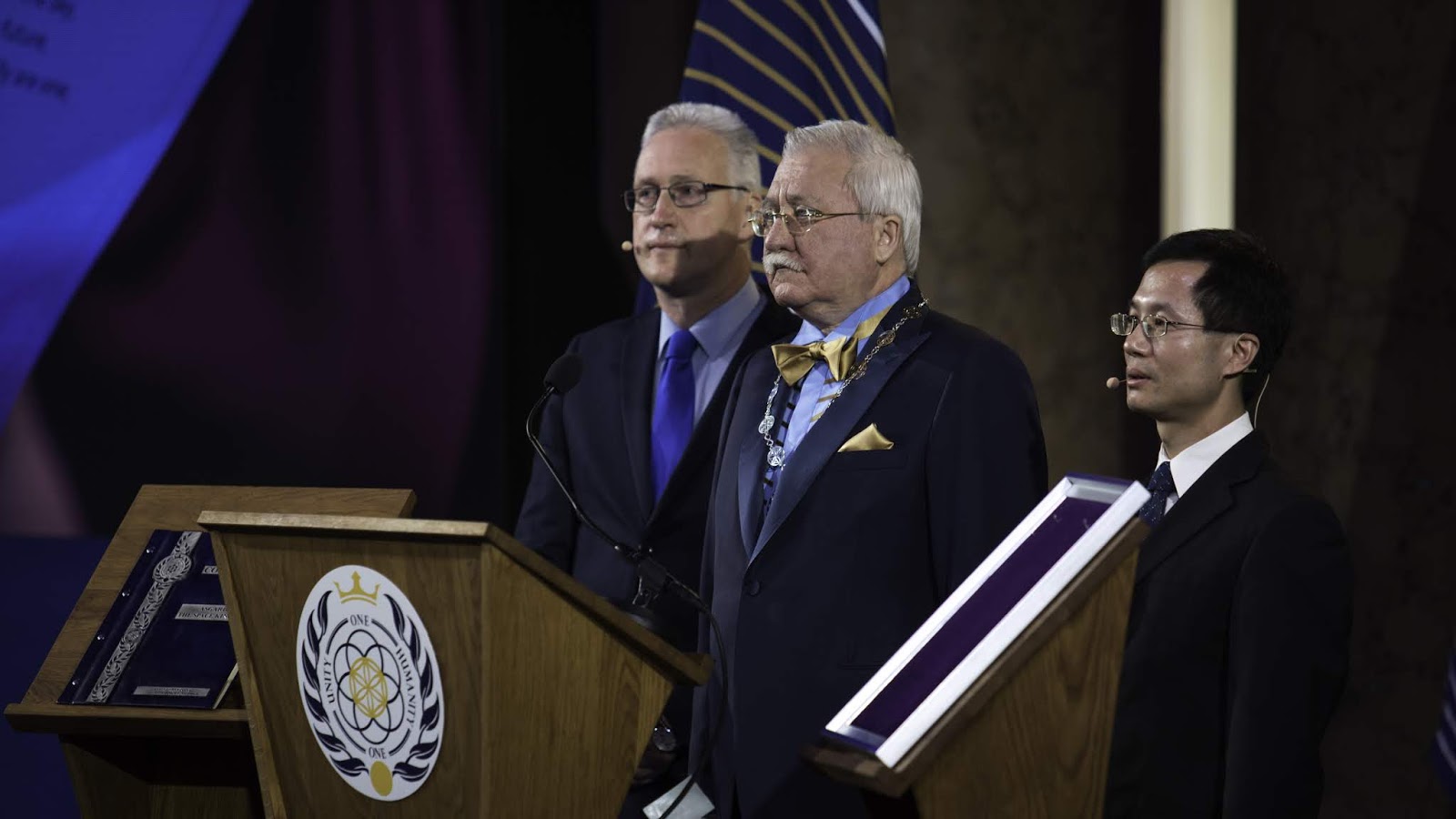
Interview with Yun Zhao, the first Supreme Justice of Asgardia

Source: Asgardia website
The space kingdom Asgardia held its first Parliamentary session on 24 June 2018 in Vienna.  The 108 members of Parliament adopted the first law on the Parliament of Asgardia.  The Head of Nation, Dr Igor Ashurbeyli, signed the law immediately after adoption.
      Decree No 19 appointed Professor Yun Zhao, HKU's head of the Department of Law, as the Supreme Justice of Asgardia in accordance with Article 35, item 3 of the Asgardian Constitution.  Mr Lembit Opik and Ms Ana Diaz were appointed Parliament Chairperson and Prime Minister, respectively.  Two laws, an Act on the Enactment of Legislative Acts of the Nation of Asgardia and the Citizenship Law, were debated and passed.
Source: Asgardia website
     On the following day, a ceremony was held at Hofburg Palace to mark the inauguration of Dr Igor Ashurbeyli as the Head of Nation.  In attendance were ambassadors of more than 10 countries and guests from over 40 nations.  The one hour, fifty-one minute video of the celebration can be viewed here.  Many major international news media organisations (The Standard, Reuters, The SunThe Daily Mail, covered the inauguration ceremony.
     Despite his extremely busy schedule, Professor Zhao kindly spared a few minutes of his time to participate in an e-interview by the HKU Legal Scholarship Blog.

1. What is Asgardia and how did you first get involved?
Asgardia is the first space nation, which was set up in 2016. I was invited to attend a press conference held in Hong Kong in 2017 when Asgardia announced future plans for the space nation.

Source: Asgardia website
2. How did you come to be appointed the head of Asgardia’s Court, a position known as Supreme Justice of Asgardia, and what responsibilities do you have in this new role?
Supreme Justice of the Court is an appointed position, not elected. Relevant factors include the professional qualifications and experience in the field. I will ensure the smooth operation of Asgardia's legal system, such as constitutionality, resolution of disputes that arise from Asgardia's laws.

3. Will other judges be appointed in the future?
Other judges will be appointed in the near future, targeting end of 2018. There are four panels for constitutional, civil, administrative and criminal proceedings.

4. Do you envisage Asgardia’s Court ever hearing a case and what kinds of issues would it likely have to address?
There is the possibility of court hearing, most probably cases arising from the new Citizenship' Law.

5. How has your scholarship on space law contributed to your involvement in Asgardia?
This appointment takes into account my professional qualifications and experience in the space law field, and recognition from the space law (and international law) circle. 

6. What opportunities are available for other legal academics and law students if they want to become involved in Asgardia?
At the moment Asgardia is making appointments of ministers in the Asgardia Government, committee chairmen (Deputy-Chairmen) of Parliament and judges. Those interested in Asgardia and outer space should consider applying for Asgardia citizenship and indicate their interest in these positions.
    A short video of Dr Zhao speaking about his new role as Supreme Justice can be viewed here.

Sunday, November 5, 2017

Rong Du on China's Approach to Space Sustainability: Legal and Policy Analysis (Space Policy)

"China's approach to space sustainability: Legal and policy analysis"
Rong Du (SJD 2017)
Space Policy
October 2017
Introduction: The concept “space sustainability” came to the landscape of international space community in response to the increasing concerns over the safety and security of outer space in recent years, especially the risk posed by long-lived space debris. By far, there is no agreed definition on space sustainability. It often appears in association with space safety and space security or encompasses the meaning of safety and security in outer space, with an emphasis on the long-term impact of current space activities and due considerations deserved by future generations.1 The threats to space assets may come from the collision risk posed by orbital debris and asteroid or interferences from hazardous space weather.2 Space debris is the most serious issue. States have been dealing with space debris from two perspectives, debris mitigation and removal, and monitoring space debris through space situational awareness (SSA) capability. China started to develop the space industry since the 1950s and has carried out various space programs. After efforts of several decades, it has become autonomous in the construction and launch of satellite. By far, it possesses almost 150 satellites in orbit. It also has made remarkable progress in the exploratory and scientific missions, such as human space flight and lunar exploration. It will continue to give a high priority to the space sector for the purpose of boosting economic growth and safeguarding national security. Yet, due to the lack of national space policy, there have always been concerns on how China will carry out space activities in a responsible and sustainable way. The previous researches discussed China's performance in tackling space debris from the legal perspective. But they overlooked the policy aspect and did not address the implications of the civil-military relationship for the space sector. Among the external observers, there are different understandings toward China's strategy in outer space. The 2007 anti-satellite (ASAT) test is often cited as an evidence of China's ignorance to the sustainability of outer space environment. Yet the underlying causes should be carefully studied, other than widely speculated. Meanwhile, China has become more proactive in the multilateral efforts aiming to create new norms for space sustainability. Its participation carries substantial weight in the conclusion of the agreements. These instruments, once adopted, will contribute to shape China's behaviors in outer space. This paper examines the parameters that are affecting China's approach to space sustainability and suggests how China could make systematic efforts toward space sustainability, with a major focus on the civil-military interaction. Part 2 reviews the space governance structure and the progress made by China by far. Part 3 examines the 2007 ASAT test from the perspectives of the civil-military gap, the US's responses, and the military sector's narratives on space strategy. Part 4 further discusses to what extent the newly created Central National Security Commission (CNSC) and the military reform will fill the civil-military gap and facilitate the deliberation of space policy. Part 5 draws the correlation between ASAT capability and the Treaty on Prevention of the Placement of Weapons in Outer Space and of the Threat or Use of Force against Outer Space Objects (PPWT) and discusses the political factors pertaining to the prospect of the PPWT. It also discusses how far China is from the International Code of Conduct for Outer Space Activities (ICoC), taking into account the interactions between the PPWT and the ICoC.

Saturday, September 30, 2017

Yun Zhao on Intellectual Property Protection in Outer Space (Queen Mary J of IP)

Queen Mary Journal of Intellectual Property
2017, v. 7, pp. 137-155
Abstract: The issue of intellectual property protection is receiving more and more attention from participants in space activities.  Outer space provides a special environment for scientific research and experiments. The increasing involvement of private entities provides another impetus calling for states to provide a favorable legal environment for intellectual property protection.  As such, it is important to examine whether the territorial nature of intellectual property can reconcile with non-territorial nature of outer space.  This article concludes that conflicting features of the two regimes are irreconcilable. Since the existing regime for intellectual property is relatively mature, a connected point can be created to link outer space with the current intellectual property regime.  As such, an optimum balance can be reached 'between the interests of the inventor, the State concerned, and those who improve space technology.'

Tuesday, September 27, 2016

Yun Zhao on China's Future Participation in the Space Protocol (new book chapter)

2016, Springer, pp 67-79
Abstract: After more than 10 years of work, the UNIDROIT finally adopted the Space Protocol to the Cape Town Convention in 2012. This protocol is meaningful in dealing with the issue of international interests in financing space assets. It is expected to create a predictable legal regime for the space financing industry. China, an important space power in the world, has great stake in the success of the space financing industry. China has been actively involved in the negotiation process for the Space Protocol and has already acceded to the Air Protocol to the Cape Town Convention. It would thus be necessary to examine possible impact of this third protocol on space financing industry in China. This article will further investigate the possibility of China’s accession to the protocol.

Sunday, April 17, 2016

Yun Zhao on International Space Cooperation Agreements (Space Policy)

Space Policy
March 2016, Vol. 35
Abstract: International cooperation has been successfully conducted in a wide range of areas in the space field. Over the past years, many bilateral and multilateral agreements have been concluded, providing solid legal basis for space cooperation. This article examines the important role of these agreements in the process of international space cooperation and put forward suggestions on how to further facilitate the conclusion of international agreements so that international space cooperation can be carried out more effectively. The article concludes that international agreements are important tools to realize international space cooperation and that we will need to further study possible means to promote international space cooperation in wider scope through the conclusion of international agreements.  Contact the author for a copy.

Monday, March 23, 2015

National Space Law in China (New Book)

National Space Law in China: An Overview of the Current Situation and Outlook for the Future
Author: Yun Zhao
Brill, 316 pp.
January 2015
Description: China has made rapid developments in space technologies and space activities in the last few years, however, it still lags behind in the legal arena. In order to provide guidelines for and promote further development of space activities, China should speed up its national space legislation process. In National Space Law in China, Yun Zhao offers a comprehensive study of national space laws, regulations and policies in China. It contains rich information and materials of China’s space law and practice. As the first English monograph on national legislation on space law in China, this book shall contribute to the understanding of China’s current legal regime for space activities and future national space legislation.