Congratulations to Prof. Hui Jing on his promotion to Associate Professor! Prof. Jing is a prolific researcher with an excellent publication record. He is a rare scholar of comparative trust law who can effectively cover both the Chinese and common law jurisdictions. He is one of the few experts worldwide capable of engaging deeply with both legal traditions. Prof. Jing is a valuable member of our Faculty, and this promotion is a well-deserved recognition of his contributions. To read more about Prof. Jing's research and publications, click here.
Follow the research activities and scholarship of the Faculty of Law, The University of Hong Kong
Showing posts with label land law. Show all posts
Friday, December 26, 2025
Monday, July 7, 2025
HKU Law Welcomes Prof. Valeria Vázquez Guevara
Welcome to Prof. Valeria Vázquez Guevara, who joins the Faculty of Law as an Assistant Professor.
Valeria researches and teaches across the areas of international law, law-and-humanities, and land/property law. Valeria’s research engages with law-and-humanities methodologies to address questions of international law, its institutions, contestations, and geopolitical implications, especially between North-South and South-South actors. The research builds on Valeria’s personal and professional experiences in international development and peacebuilding projects in El Salvador, Spain, the Basque Country, and South Africa.
Valeria is the author of Truth Commissions and International Law (Cambridge University Press, in press). The book examines how Truth Commissions deal with the plurality of (rival) accounts that exist across communities to establish an authoritative account of the past. It expands on her doctoral thesis at Melbourne Law School, which won the University of Melbourne Chancellor’s Prize for Excellence in the PhD Thesis and Melbourne Law School’s Harold Luntz Prize for Best Doctoral Thesis. Valeria’s next major research project focuses on the historical and contemporary relationship between ASEAN and international law, with a particular focus on land tenure issues.
Valeria serves as member of the executive committee of the Law, Literature and Humanities Association of Australasia, and as co-convener of the Critical Approaches to International Law Interest Group of the European Society of International Law (ESIL). Previously, Valeria has served as co-chair of the History and Theory of International Law Interest Group of the Australian and New Zealand Society of International Law (2022-2025), and as Managing Editor and Editorial Board member of the Australian Feminist Law Journal (2021-2023).
Valeria researches and teaches across the areas of international law, law-and-humanities, and land/property law. Valeria’s research engages with law-and-humanities methodologies to address questions of international law, its institutions, contestations, and geopolitical implications, especially between North-South and South-South actors. The research builds on Valeria’s personal and professional experiences in international development and peacebuilding projects in El Salvador, Spain, the Basque Country, and South Africa.
Valeria is the author of Truth Commissions and International Law (Cambridge University Press, in press). The book examines how Truth Commissions deal with the plurality of (rival) accounts that exist across communities to establish an authoritative account of the past. It expands on her doctoral thesis at Melbourne Law School, which won the University of Melbourne Chancellor’s Prize for Excellence in the PhD Thesis and Melbourne Law School’s Harold Luntz Prize for Best Doctoral Thesis. Valeria’s next major research project focuses on the historical and contemporary relationship between ASEAN and international law, with a particular focus on land tenure issues.
Valeria serves as member of the executive committee of the Law, Literature and Humanities Association of Australasia, and as co-convener of the Critical Approaches to International Law Interest Group of the European Society of International Law (ESIL). Previously, Valeria has served as co-chair of the History and Theory of International Law Interest Group of the Australian and New Zealand Society of International Law (2022-2025), and as Managing Editor and Editorial Board member of the Australian Feminist Law Journal (2021-2023).
Thursday, January 6, 2022
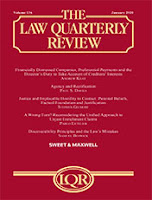
Kelvin Kwok on Land-related Restrictive Covenants in Restraint of Trade (Law Quarterly Review)
"Land-related Restrictive Covenants in Restraint of Trade"
Kelvin Kwok
Law Quarterly Review
Kelvin Kwok
Law Quarterly Review
2021, Vol 134, p 193
Abstract: Does a land-related restrictive covenant fall within the restraint of trade (RoT) doctrine such that the restrictions under the covenant must be justified as reasonable? This important question, which impacts upon a wide variety of land-related transactions, had long been answered according to the “pre-existing freedom” test prescribed by Lord Reid in the English House of Lords decision in Esso Petroleum Co Ltd v Harper’s Garage (Stourport) Ltd (1968). The question regarding the applicability of the RoT doctrine to land-related restrictive covenants came before the English Supreme Court most recently in Peninsula Securities Ltd v Dunnes Stores (Bangor) Ltd (2020). The Supreme Court took the monumental step of abolishing the long-established “pre-existing freedom” test, and preferred an alternative approach based on Lord Wilberforce’s “trading society” test in Esso. The purpose of this article is to critically examine the conflicting approaches under the "pre-existing freedom" and "trading society" tests. The article argues that neither of these tests constitutes the proper approach to the assessment of land-related restrictive covenants under the RoT doctrine. The test of applicability should instead consist of the simple question of whether the covenant restricts a person’s liberty to trade, a broad approach advocated by J.D. Heydon many years ago. This all-encompassing approach would represent a major policy improvement in the common law, albeit purchased at the expense of legal certainty.
Thursday, November 25, 2021
Low, Wan & Chan on Private Takings of Land for Urban Redevelopment: A Tale of Two Cities (Am J of Comp L)
Kelvin F K Low, Wai Yee Wan, Alwin Chan
Published on 8 November 2021
Abstract: In 1999, both Hong Kong and Singapore brought into force legislation that permitted a supermajority of apartment owners within a building development that met certain statutory criteria to force a minority of dissenters to sell the development as a whole. Both territories did so because, as land-scarce cities, it was considered that the redevelopment of aging buildings was an urgent imperative. In so doing, although they claimed to be following other jurisdictions, both Hong Kong and Singapore broke new ground in pioneering the private takings of land among common law jurisdictions. These developments have proven controversial in both territories, although the controversies have differed because of differences in implementation and historical background in both cities, despite their shared past as British colonies in Asia. This Article compares the two regimes to each other as well as to a more mature regime permitting private takings of shares in mergers and acquisitions law to highlight the lessons to be learned in order to prevent abuse.
Friday, April 16, 2021
Qiao & Hills on "Here’s How Transferable Development Rights Outweigh Lantau Reclamation Plan in Ending Hong Kong Housing Crisis" (SCMP Opinion)
Concrete Analysis by Qiao Shitong and Roderick Hills Jr.
31 March 2021
Housing in Hong Kong is among the least affordable in the world. And the problem is not lack of land, but lack of development. Three quarters of Hong Kong’s land is vacant, and much of this is reasonably buildable territory.
In particular, Hong Kong contains 1,414 hectares (3,494 acres) of brownfield sites and another 1,200 hectares of country development land reserved for indigenous villagers of the New Territories that is all suitable for high-density residential construction. Click here to read the full text.
Friday, February 19, 2021
Shitong Qiao & Roderick Hills Jr on Killing Two Birds with One Stone: How to End Rural Land Expropriation and Secure Tenure for Urban Property Owners (USALI Perspectives)
"Killing Two Birds with One Stone: How to end rural land expropriation and secure tenure for urban property owners at the same time"
Shitong Qiao & Roderick M Hills Jr
USALI Perspectives
21 January 2021
Consider two apparently distinct problems that currently vex Chinese land policy. First, what is going to happen when the seventy-year term of land use rights (LURs) for homeowners in Chinese cities expires? LURs are similar to ground leases in common law jurisdictions, except that the owner and lessor of all urban land is the government. Although shorter-lived LURs in some cities have already reached term and been renewed, and Premier Li Keqiang assured homeowners in 2017 that there was no need for worry, the continued absence of formal legal guidance is striking. The drafting of China’s new Civil Code, which replaces the Property Law among others, offered a good opportunity to solve the LUR puzzle, but the final draft approved in May 2020 failed to do so. As more and more LURs come to the end of their terms in coming decades, the question about whether and how such leases can be renewed has become increasingly pressing. To frame the issue in more radical terms, as Professor Robert Ellickson did in 2012: “[I]f current policies continue, the health of every private industrial, commercial, and residential enterprise in China will fade as its fixed-term land contract winds down.”... Click here to read the full text.
Wednesday, February 5, 2020
New Book by Malcolm Merry: The Unruly New Territories (HKU Press)
The Unruly New Territories: Small Houses, Ancestral Estates, Illegal Structures, and Other Customary Land Practices of Rural Hong Kong
Malcolm MerryHong Kong University Press
Published in January 2020, 300 pp.
Description: At the end of the nineteenth century a slice of imperial China was abruptly incorporated into the British Crown Colony of Hong Kong. It became known as the New Territories. The people of this remote and traditional corner of the Ching empire were not consulted about the annexation, initially resisted and long resented it. To placate them, the incoming authorities promised that little would alter and that their customs would be respected. The promise would not be fully kept but it became the source of the preservation of Chinese customary law in respect of rural land and the justification for privileges afforded to indigenous inhabitants. Their tenacious assertion of those rights and aversion to authority is detectible throughout the twentieth century and into the era of the Hong Kong Special Administrative Region; it permeates almost every aspect of policy and law relating to rural land.
The Unruly New Territories is an account of the annexed area and of its special place in Hong Kong history and law. It recounts the customs and privileges, how they preserved a China that was elsewhere disappearing and how they gave—and, despite enormous changes, continue to give—leverage to indigenous representatives in dealings with government as well as handsome profits to rural landowners.
Book Reviews:
‘This fascinating and impressive book is a must-read for all who want to know more about the New Territories. Malcolm Merry traces, with his usual clarity and insight, its unique land history that blends, not always harmoniously, Chinese custom with the advance of common law and this area’s dramatic development.’
—Sarah Nield, University of Southampton
‘The Unruly New Territories covers various aspects of land law and custom in the New Territories and the history of this region in a thoughtful and provocative combined thesis. A must-read for anyone studying the laws and customs affecting land in rural Hong Kong and interested in the history of the New Territories.’
—Steven Gallagher, The Chinese University of Hong Kong
Saturday, July 21, 2018
Interview with Dora Chan, Inventor of the “E-package of DIY Residential Tenancy Agreement” (CLIC)
The online Community Legal Information Centre (CLIC) recently uploaded an e-package of Do-It-Yourself (DIY) Residential Tenancy Agreement. The package includes a tenancy agreement template in English and Chinese which tenants and landlords can use to structure their legal relations. Principal Lecturer Dora Chan, Adjunct Associate Professor Edmund Cham, and their team of students/graduates developed the templates along with a set of guidance notes with the assistance of the HKU Knowledge Exchange Fund. HKU Legal Scholarship Blog caught up with Dora to find out more about her project.
1. What motivated this project and what is its aim?
Currently, if members of the public want to enter into a tenancy agreement on their own, the most common means is to buy a sample tenancy agreement from a stationery shop or to download a sample agreement from the internet. All these samples are not satisfactory as they are not prepared and reviewed by persons competent in tenancy law. In one of the stationery shop sample, one of the clause refers to legislation from 1952 which had been repealed and some of the terms used in samples are archaic. If the public use inappropriate samples for renting their residential homes, it may result in disputes and problems between the landlord and tenant which can have significant impact on their daily lives. In many cases, the public may not want to engage a lawyer to prepare a residential tenancy agreement as it can be costly and time consuming.
The aim of the E-package is to provide the public with a properly prepared residential tenancy agreement template. Members of the public can enter into a proper residential tenancy agreement using the E-package without the need and costs to engage a lawyer or an estate agent.
2. Who are the targeted beneficiaries?
Any member of the public who would like to enter into a residential tenancy agreement on his or her own.
3. Can this substitute for the assistance of a lawyer or only supplement?
Depending on the individual circumstances, if the transaction is a simple letting of a residential flat, the public can use the template tenancy agreement by filling in the essential details of name of parties, rent, term of tenancy and deposit and they can have a workable tenancy agreement. For complicated transactions, they may still need to engage a lawyer.
4. Is there a purpose to having a bilingual agreement?
It would give a choice to the public as to whether they want the tenancy agreement to be in Chinese or English.
5. Why should someone use this new “E-package of DIY Residential Tenancy Agreement”?
The public can have free online access to a residential tenancy agreement properly prepared and vetted by the students and staff of the Faculty of Law, HKU who have competent legal knowledge on HK tenancy law. The guidance notes also provide a comprehensive guide to the public on how to stamp and register timely a residential tenancy agreement to avoid incurring late fees and penalty.
6. How is this related to HKU's goals to promote knowledge exchange and experiential learning?
In the course of preparing the E-package, the law students in the E-package team gained the valuable experience in applying their legal knowledge and English and Chinese drafting skills in preparing the E-package which is beneficial and useful to the general public. The practical experience gained by the students in producing the E-package would be most advantageous to them as future lawyers and would also serve the worthy purpose of knowledge exchange between HKU and the society.
7. Why is this project unique?
As far as I am aware, the E-package is the first online website which provides a properly prepared residential tenancy agreement template and comprehensive guidelines on stamping and registering a residential tenancy agreement.
8. Who can access the free agreement package? And, where?
Any member of the public can have free access to the E-package from the HKU CLIC website. The URLs are as follows in the three languages (English, Traditional Chinese, Simplified Chinese):-
9. What if the users encounter problems when using the e-package? Who can they contact? What can they do?
The E-package is intended to be a self-explanatory document. If the public finds the E-package does not suit their specific needs, they would have to seek legal advice from a lawyer.
Labels:
CLIC,
DIY,
Dora Chan,
innovation,
KE,
land law,
landlord and tenant
Thursday, July 12, 2018
Special Symposium Issue on "Decentralization and Development" in Minnesota Law Review Co-Edited by Qiao & Epstein

The current issue of the Minnesota Law Review, issue 4 of volume 102, publishes papers from a special symposium on decentralisation and development held at the Faculty of Law, The University of Hong Kong on 14-15 March 2017. It is co-edited by Shitong Qiao (HKU Law) and Richard Epstein (NYU Law). A group of Asian and American scholars working in the areas of law, economics, and political science debated and discussed questions including what does decentralisation mean, how do we best measure decentralisation, is interjurisdictional competition a race to the bottom or a race to the top, is decentralization desirable in the context of China and other jurisdictions and so on. The symposium was co-sponsored by New York University's Classical Liberal Institute and HKU's Centre for Chinese Law. In addition to co-authoring the introduction with Professor Epstein, Dr Qiao also authored "Rights-Weakening Federalism" and co-authored "Binding Leviathan: Credible Commitment in an Authoritarian Regime" in this special issue. All articles are freely accessible here.
Shitong Qiao on "Rights-Weakening Federalism" (Minnesota L Rev)
Shitong Qiao
Minnesota Law Review
Apr 2018, Vol. 102 Issue 4, pp.1671-1702
Abstract: This Article examines whether federalism protects land rights in China from two dimensions. I first compare national law with local institutions of eminent domain, revealing that local governments take much more land than the national government approves, frequently violating, tweaking, and challenging national law. I next examine the impact of interjurisdictional competition on the development of local land institutions, demonstrating that local governments are weakening individual land rights for the benefits of mobile capital. Overall, Chinese federalism weakens rather than strengthens individual land rights and should be called rights-weakening federalism. This China case also has general theoretical implications. Leading property law scholars in the United States have debated whether federalism protects land rights for decades but have achieved no consensus. The existing debate centers around the immobility of land, however, this Article argues that land immobility is not an essential factor. The structure and power of local governance, the balance between land and capital in particular, matters much more. Hence, the better question to ask with respect to interjurisdictional competition is who benefits from the competition. This Article also poses a more fundamental challenge to the literature on interjurisdictional competition by adopting agglomeration economics, which poses the question of whether such competition constitutes sorting or agglomeration. All the existing literature on property rights and federalism presumes a market of sorting--that investors are indifferent to location, and are thus attracted by local governments offering the best price or strongest protection. However, urbanization and industrialization in China are actually a process of agglomeration, which determines that a few cities with a natural, or at least initial, advantage are taking over, and the local governments of the remainder will therefore eventually lose in the competition. The implication is that interjurisdictional competition is a race to the bottom for most local governments rather than a win-win game as the sorting literature suggests. Click here to download the full article.
Thursday, July 5, 2018
Richard Cullen on "Tight-fisted historical land policy had a point" (China Daily)
"Tight-fisted historical land policy had a point"
25 June 2018
In this article I do not wish to enter the thorny debate on how to alleviate this building land shortage. My aim is to examine one pivotal factor that has, since 1842, constrained the release of land for building in Hong Kong. As it happens, it is also a factor with an often overlooked, distinctive upside. ...
Robust and effective judicial, legal and policing systems are expensive to establish and maintain if they are going to serve all in a community with some level of steady fairness. Hong Kong's land revenue system soon proved itself up to the task of funding these foundational institutional developments. Operational deficiencies in these bodies were evident from the outset and some remain today. Comparatively, however, Hong Kong has built - and funded - an enviable rule of law system. ...
We are still confronted today with the awful accommodation shortfalls noted above. We should not forget, though, that the same exceptional land policy which has constrained land release in Hong Kong has left our high-density areas surrounded by nearby greenery. Still more importantly, it has bankrolled our rule of law achievements and some world-beating basic housing policies. These two successes have underpinned so much Hong Kong has accomplished. They are achievements we can rightly be proud of. Click here to read the full text.
Sunday, November 5, 2017
Shitong Qiao on Dealing with Illegal Housing: What Can New York City Learn from Shenzhen (Fordham Urban LJ)
2016, Vol. 43, Issue 3, pp. 743-769
Abstract: In New York City, owners violated zoning regulations and opened up their basements, garages, and other floors to rent to people (particularly low-income immigrants) priced out of the formal market. The more than 100,000 illegal dwelling units in New York City (NYC) were referred to as “granny units,” “illegal twos or threes,” or “accessory units.” Due to the safety and habitability considerations of “alter[ing] or modif[ying] of an existing building to create an additional housing unit without first obtaining approval from the New York City Department of Buildings (DOB),” the City government devoted a lot of resources to detecting and stopping such illegal conversion. Recently, however, Mayor Bill de Blasio proposed to legalize such illegal dwelling units to increase the City’s rent-regulated housing stock. The question remains as to whether crackdown or legalization is the right policy. Such illegal housing is not unique to NYC. Shenzhen, a city in south China that experienced a population explosion from 300,000 to over 10 million within three decades, faces the same problem as NYC: legal housing supply cannot catch up with the population growth, resulting in prevalent illegal housing supply. Almost half of Shenzhen’s buildings have been built illegally and now host over eight million migrant workers and low-income residents. In the past three decades, the Shenzhen city government has swung between legalization and crackdown of such illegal buildings, neither of which has resolved the problem. Due to the large number of illegal apartments, the “crackdown” option has proven to be impossible, while legalization has incurred huge information costs and encouraged more illegal constructions. In more recent years, though, the Shenzhen city government has discovered an effective policy: Keeping the city government’s zoning power intact while granting an option to owners of illegal housing to buy an exemption. The lesson from Shenzhen is that options matter at least as much as the allocation of initial entitlements. In the case of prevalent zoning violations, these options should be granted to parties that have the best information to make decisions — the numerous individual owners rather than the government. I propose that this optional zoning approach should be taken in dealing with illegal housing in New York City. Click here to download the full article.
Saturday, September 16, 2017
HKU Law Faculty Awarded Four KE Impact Project Awards 2017/18
The University of Hong Kong's Knowledge Exchange (KE) Funding Scheme for Impact Projects supports (A) projects that have the potential to create social, economic, environmental or cultural impacts for industry, business or the community by building on expertise or knowledge in the University; and (B) projects designed to collect evidence for corroboration and evaluation of impacts. Engagement projects that aim to benefit non-academic communities beyond Hong Kong are strongly encouraged.
The Faculty of Law was successful in obtaining four awards in the 2017/18 round of funding, each in the amount of HK$100,000. Congratulations to Dora Chan, Katherine Lynch, Anne Cheung and Richard Wu. The details of their projects are described below:
Ms Dora Chan
E-package of DIY Residential Tenancy Agreement
The proposed project aims to provide the public community with a template residential tenancy agreement and a set of useful guidelines (including stamping and registration procedures) on how to enter into a valid residential tenancy agreement. Members of the public can then use and adapt the template to independently enter into a tenancy agreement for their residential homes, an important document that has a significant impact on their daily lives, without the costs and trouble of engaging a lawyer. The main objective is to provide free legal support to the community and to encourage knowledge exchange on tenancy matters.
Ms Katherine Lynch
Evaluation of the Children’s Issues Forums & Legal Reform of Child and Family Law & Policy in Hong Kong
This project aims to collect evidence for corroboration and evaluation of impacts arising from the research and knowledge exchange project, “Children’s Issues Forums & Legal Reform of Child and Family Law in Hong Kong”, which created a multidisciplinary forum enhancing policy and legal reform for children’s issues in Hong Kong. The project will evaluate through quantitative and qualitative measures the impact of the project on increasing public awareness of children’s issues, changing legal policy on and creating pressure for law reform in Hong Kong’s child and family justice system.
Professor Anne Cheung
Hong Kong SAR Treaties e-Library
The proposed project aims to provide free access to legal information for the public in Hong Kong by building a one-stop comprehensive and electronically searchable database of treaties and international agreements applied to the Hong Kong SAR in Hong Kong Legal Information Institute (HKLII). The key objective is to support the community and engage in knowledge exchange.
E-package of DIY Residential Tenancy Agreement
The proposed project aims to provide the public community with a template residential tenancy agreement and a set of useful guidelines (including stamping and registration procedures) on how to enter into a valid residential tenancy agreement. Members of the public can then use and adapt the template to independently enter into a tenancy agreement for their residential homes, an important document that has a significant impact on their daily lives, without the costs and trouble of engaging a lawyer. The main objective is to provide free legal support to the community and to encourage knowledge exchange on tenancy matters.
Ms Katherine Lynch
Evaluation of the Children’s Issues Forums & Legal Reform of Child and Family Law & Policy in Hong Kong
This project aims to collect evidence for corroboration and evaluation of impacts arising from the research and knowledge exchange project, “Children’s Issues Forums & Legal Reform of Child and Family Law in Hong Kong”, which created a multidisciplinary forum enhancing policy and legal reform for children’s issues in Hong Kong. The project will evaluate through quantitative and qualitative measures the impact of the project on increasing public awareness of children’s issues, changing legal policy on and creating pressure for law reform in Hong Kong’s child and family justice system.
Professor Anne Cheung
Hong Kong SAR Treaties e-Library
The proposed project aims to provide free access to legal information for the public in Hong Kong by building a one-stop comprehensive and electronically searchable database of treaties and international agreements applied to the Hong Kong SAR in Hong Kong Legal Information Institute (HKLII). The key objective is to support the community and engage in knowledge exchange.
Dr Richard Wu
Engaging Local School Teachers with Common Law Concepts and Values Through Experiential Learning
This project is a pioneering interdisciplinary collaboration in common law education for local school teachers between academics from HKU Law and Social Science Faculties as well as academics from two other local universities. On basis of the project team members’ previous teaching and research projects on common law education for ‘non-law’ students and experiential learning in law, as well as teacher education, this project will engage local school teachers with common law concepts and values through experiential learning like case discussion, personal sharing by senior lawyers, and visual media . The project attempts to impact local school teachers by promoting their understanding of the common law system in Hong Kong and enhance their awareness of general common law concepts and specific common law values like justice and equality.
Engaging Local School Teachers with Common Law Concepts and Values Through Experiential Learning
This project is a pioneering interdisciplinary collaboration in common law education for local school teachers between academics from HKU Law and Social Science Faculties as well as academics from two other local universities. On basis of the project team members’ previous teaching and research projects on common law education for ‘non-law’ students and experiential learning in law, as well as teacher education, this project will engage local school teachers with common law concepts and values through experiential learning like case discussion, personal sharing by senior lawyers, and visual media . The project attempts to impact local school teachers by promoting their understanding of the common law system in Hong Kong and enhance their awareness of general common law concepts and specific common law values like justice and equality.
Sunday, September 18, 2016
Alice Lee on Land Registration in Hong Kong and Problems of Statutory Interpretation (HKLJ)
"Land Registration: Validity, Priority and Statutory Interpretation"
Alice Lee
Hong Kong Law Journal
2016, Vol. 46, Part 2, pp 415-444
Alice Lee
Hong Kong Law Journal
2016, Vol. 46, Part 2, pp 415-444
Abstract: The Land Registration Ordinance (Cap 128) was enacted at the inception of the Colony to provide for the registration of deeds as opposed to the registration of titles. The registration system that it has established is still operating well after all these years. Its success is attributable in no small part to the statutory incentives for registration. While s 3(1) provides that registered instruments shall have priority according to the order in which they are registered, s 3(2) imposes a severe penalty on those who fail to register — an unregistered instrument shall, as against any subsequent bona fide purchaser or mortgagee for valuable consideration, be absolutely null and void to all intents and purposes. Most of the time, the sub-sections are simply applied without much discussion on the meaning of “priority” or “null and void”. Yet some recent cases have triggered a debate on the interpretation of s 3(2) and whether its wording is consistent with the overall scheme of deeds registration, which is said to be concerned with priority rather than validity. It is time that we examined the Ordinance under the Bennion lens. This article seeks to demystify the key provisions of the Ordinance and reveals the intricacy of statutory interpretation.
Thursday, June 16, 2016
Johannes Chan Interviewed on the 2047 Question (INYT)
"Expiration Date on China's Promises Stokes Unease in Hong Kong Housing"
Didi Kirsten Tatlow
International New York Times
16 June 2016
Didi Kirsten Tatlow
International New York Times
16 June 2016
To buy a tiny but coveted apartment in the vertiginous towers of South Horizons, a middle-class housing development overlooking the South China Sea in the world’s most expensive real estate market, would cost a family about a million United States dollars.
These modest homes on Ap Lei Chau, Cantonese for Duck Tongue Island, are a reason that a seemingly far-off date — July 1, 2047 — is in fact pressingly close in Hong Kong. Under the Sino-British Joint Declaration governing the British colony’s return to Chinese rule on July 1, 1997, China agreed that Hong Kong would retain a high degree of autonomy, and its capitalist financial and legal system, for 50 years.
“The current social and economic systems in Hong Kong will remain unchanged, and so will the lifestyle,” the Joint Declaration said.
A simple calculation shows the problem: After July 1, 2017, a 30-year home mortgage cannot be paid off before July 1, 2047, when the declaration runs out and China’s promises expire along with it.
...
“History repeats itself,” said Johannes Chan, a law professor at the University of Hong Kong. “In the 1980s, the banks were a prime driver for a solution.”
That demand for financial certainty led to the Joint Declaration and the legal framework, known as the Basic Law, that Britain and China agreed to for post-handover Hong Kong, which described the city’s rights for 50 years after 1997.
The Joint Declaration was the basis for the recovery of China’s sovereignty, and “it clearly stated that the Chinese policy was to let things go on for 50 years,” Mr. Chan said. “There is no promise for beyond 50 years. Thereafter it will relapse, because sovereignty has already been resumed.”... Click here to read the full article.
Wednesday, June 1, 2016
Richard Cullen on Looking to Hong Kong for Lessons in Cooling Property Prices (SCMP)
Richard Cullen
South China Morning Post
1 June 2016
South China Morning Post
1 June 2016
In cities across the developed world, especially in jurisdictions popular with Chinese immigrants, there are deep concerns about rapid, residential property price inflation. It is argued that this is putting ownership beyond the reach of increasing numbers of local residents seeking to buy their first home.
The media in Melbourne and Sydney, in Australia, for example, carry almost daily stories on this theme. It would seem, though, that the global “leader” in this regard may be Vancouver, Canada. Early in May, it was reported that the benchmark price for a house in the Vancouver region was C$1.41 million (HK$8.4 million) – up 30.1 per cent in one year. (In fact, Vancouver’s problems with excess offshore-sourced demand date back over 30 years to the time of the first major, Hong Kong Chinese immigration wave.)
In all three cities just noted – and in most of the cities feeling this pressure (including Hong Kong) – there is a fundamental, underlying problem of demand exceeding supply. Limits on land supply, planning controls (and related complexities) and increases in building cost explain much of the supply-side problem. In all such cities, immigration is driving populations up, year after year, intensifying the demand. These cities are attractive in a number of ways, often in terms of providing good, comparatively lower-cost educational opportunities... Click here to read the full article.
Wednesday, April 27, 2016
Shitong Qiao on the Politics of Chinese Land (Columbia J Asian Law)
"The Politics of Chinese Land: Partial Reform, Vested Interests and Small Property"
Shitong Qiao
Columbia Journal of Asian Law
2016, Vol. 29, No. 1, pp. 70-113
Shitong Qiao
Columbia Journal of Asian Law
2016, Vol. 29, No. 1, pp. 70-113
Abstract: This paper investigates the evolution of the Chinese land regime in the past three decades and focus on one question: why has the land use reform succeeded in the urban area, but not in the rural area? Through asking this question, it presents a holistic view of Chinese land reform, rather than the conventional “rural land rights conflict” picture. This paper argues that the so-called rural land problem is the consequence of China’s partial land use reform. In 1988, the Chinese central government chose to conduct land use reform sequentially: first urban and then rural. It was a pragmatic move because it would provoke much less resistance. It also made local governments in China the biggest beneficiary and supporter of the partial reform. However, a beneficiary of partial reform does not necessarily support further reform because of the excessive rents available between the market of urban real estate and the government-controlled system of rural land development and transfer. On the other hand, Chinese farmers and other relevant groups have no voice or power in the political process of the reform, which makes it difficult for the central government to achieve an agenda that balances the interests of all relevant parties. Nevertheless, Chinese farmers have challenged the existing system by forming a huge small-property market to claim their interests in rural land, which counteracts the goals of the central and local governments and has led to adaptive policy changes. This case study of Chinese land reform provides a richer account of the political process of evolution of property rights. Click here to download the full paper.
Wednesday, November 25, 2015
New Edition: Land Law in Hong Kong, 4th edn (Say Goo and Alice Lee)
Land Law in Hong Kong, 4th edn
Say Goo and Alice Lee
Lexis Nexis
August 2015, 922 pp.
Say Goo and Alice Lee
Lexis Nexis
August 2015, 922 pp.
Description: Since the first edition, Land Law in Hong Kong has emerged as the leading work on the subject in Hong Kong. The text explains key concepts of property law and the conveyancing process. It covers all essential topics, including major forms of acquisition, the protection of ownership or interests in land, leases, licences, easements and mortgages.
This book contains extracts from numerous sources including judgments, academic writings and statutory provisions which focus on the core rationale behind the law and provide a convenient reference. The new edition takes into account recent important legislative changes and cases. Table of Contents: Chapter 1 Tenures, Estates, Land and Property, Chapter 2 Sale of Land, Chapter 3 Proprietary Estoppel, Chapter 4 Trusts, Chapter 5 Co-Ownership, Chapter 6 Limitation Ordinance and Adverse Possession, Chapter 7 Priority, Chapter 8 Enforcement of Restrictive Covenants and Deeds of Mutual Covenant, Chapter 9 Leases, Chapter 10 Leasehold Covenants, Chapter 11 Licences, Chapter 12 Easements, Chapter 13 Mortgages, Chapter 14 Successive Interests, Chapter 15 Rule Against Perpetuities, Chapter 16 Deeds of Mutual Covenant and Multi-storey Building Management.
Wednesday, August 19, 2015
Shitong Qiao and Frank Upham on Chinese Rural Law Reform (Iowa Law Review)
"The Evolution of Relational Property Rights: A Case of Chinese Rural Law Reform"
Shitong Qiao and Frank Upham
Iowa Law Review
August 2015, Vol. 100, pp 2479-2506
Shitong Qiao and Frank Upham
Iowa Law Review
August 2015, Vol. 100, pp 2479-2506
Abstract: The most notable, or at least the most noted, form of property evolution has been the transfer of exclusive rights from collectives to individuals and vice versa, such as the farm collectivization in Soviet Union and the establishment of the People’s Communes in Mao’s China and their reversals. Such radical moments, however, constitute only a small part of history. For the most part, property rights evolve quietly and incrementally, which is hard to explain if we take exclusive rights as the core of property, or, to put it more generally, if we are focusing solely on the question of who owns the things. To describe the evolution of property rights in China, we employ the concept of relational property. It is a concept that is heavily influenced by Joseph William Singer’s “social relations model” and Ian Macneil’s “relational contract” and, in particular, their emphasis on the determinative role of social relations in the construction of property and contract rights. The bundle of sticks metaphor is at the heart of relational property because it recognizes that property rights can be, and often are, disaggregated as they adapt to changing social, economic, and technological demands. As we show in the context of the reform of Chinese rural land, the combination of the metaphor of separable interests — the sticks in the bundle — and the dependence of property interests on social relationships can explain the evolution of property rights more accurately than a perspective that stresses a single central meaning of property. Click here to download the full article.
Saturday, July 25, 2015
New Issue: SSRN Legal Studies Research Paper Series (HKU)
Vol. 5, No. 6: 24 July 2015
Table of Contents
1. The Achievement of Constitutionalism in Asia: Moving Beyond 'Constitutions Without Constitutionalism'
Albert H. Y. Chen, The University of Hong Kong - Faculty of Law, University of Hong Kong - Faculty of Law
2. What Does Wukan Offer? Land-Taking, Law, and Dispute Resolution
Fu Hualing, The University of Hong Kong - Faculty of Law
3. The First Successful Climate Negligence Case: A Comment on Urgenda Foundation v. The State of the Netherlands
Jolene Lin, University of Hong Kong - Faculty of Law
4. Carbon Credits As EU Like It: Property, Immunity, TragiCO2medy?
Kelvin Low, Singapore Management University - School of Law
Jolene Lin, University of Hong Kong - Faculty of Law
Subscribe to:
Posts (Atom)