Showing posts with label UK law. Show all posts

Friday, January 9, 2026

Shilun Zhou on Whether chatbot-generated opinion can be trusted (International Journal of Evidence and Proof)

"Whether chatbot-generated opinion can be trusted: Application of the hearsay rule of the Criminal Justice Act 2003 and inspiration for China's evidence law reform"
Shilun Zhou (PhD Candidate)
International Journal of Evidence and Proof
Published online: December 2025

Abstract: As part of its criminal justice reform, the UK Ministry of Justice issued a policy paper on the use of software-generated evidence in criminal proceedings. In response, this article consistently uses the term “chatbot-generated opinion,” while employing “chatbot testimony” metaphorically to compare chatbot responses in court to human testimony given in answer to a judge's questions. The article explores whether chatbot-generated opinion evidence can be trusted, focusing on the hearsay rule under the UK Criminal Justice Act 2003 and its implications for reforming China's evidence law. Contrary to prevailing views that exclude such evidence due to the lack of cross-examination, the article argues that chatbot opinions should not be directly accepted as testimony. It further explains that virtue jurisprudence offers an appropriate framework for identifying indicators of justified belief. Since a chatbot is incapable of having a moral motivation, this prevents judges from justifiably believing a chatbot's statement qua testimony. Introducing such an evidence analysis approach in China is significant. China's Confucian ethics and virtue jurisprudence highlight moral responsibility and motivation, providing a valuable foundation for the ongoing reform of China's evidence law and overcoming the limitations of its predominant objectivist approach to proof.

Monday, November 17, 2025

Hilary So on Estoppel: adopting constructive trust to remedy an unhonoured promise (Trusts & Trustees)

"Estoppel: adopting constructive trust to remedy an unhonoured promise"
Hilary H W So (JD 2024, PCLL 2025)
Trusts & Trustees
Published online: October 2025

Abstract: This article examines the scope for England’s recognition of remedial constructive trusts (RCTs) after reviewing the respective legal positions across common law jurisdictions. Having regard to relevant doctrines, jurisprudence and policy concerns, this article proposes estoppel with the following elements as the proper basis for recognising RCTs under English law: (i) a clear and unequivocal assurance by the promisor, (ii) detrimental reliance by the promisee, (iii) justice in all circumstances, and (iv) an appropriate apportionment by the Court. It further suggests that legislative intervention and proper judicial assessment are appropriate solutions to the general concerns about RCT in insolvency contexts.

Friday, November 19, 2021

Alex Schwartz on The Changing Concepts of the Constitution (OJSL forthcoming)

"The Changing Concepts of the Constitution"
Alex Schwartz
Accepted for publication, forthcoming in Oxford Journal of Legal Studies
Date Written: October 29, 2021
Abstract: There have been several important formal changes to the United Kingdom’s constitution over the past few decades, including devolution to Northern Ireland, Scotland, and Wales; the incorporation of the European Convention on Human Rights in domestic law; and the creation of a new Supreme Court. This article is about the informal semantic changes that may have accompanied these formal changes. It focuses on several central concepts: parliamentary sovereignty, the rule of law, the separation of powers, devolution, and human rights. Using a recently developed machine learning method to analyse a massive corpus of parliamentary debate, the article gauges the extent to which these concepts have become more (or less) related to the meaning of the United Kingdom’s constitution in parliamentary discourse. Ultimately, the analysis supports some important theoretical expectations about the changing nature of the constitution, including the claim that parliamentary sovereignty is now a less significant concept for the meaning of the constitution than it once was.

Tuesday, November 16, 2021

Eric Ip on The Political Economy of Anglo-American Administrative Law (British Ass'n of Comparative Law)

“Judging Regulators: The Political Economy of Anglo-American Administrative Law”
Eric Ip
British Association of Comparative Law
November 5, 2021
We tend to think of administrative law as an external constraint on politics, regulation, and public administration, and forget the fact that administrative law actually rests upon political foundations and is part and parcel of the political system. The overall insight of Judging Regulators is that administrative law is not an exogenous determinant of administrative behaviour. Administrative law, as developed by common law courts, will evolve in response to broader changes in the polity, subject to constraints imposed by political actors and the scarcity of judicial resources. Such changes are not necessarily constitutional shifts, but more subtle changes in the partisan and ideological composition of the legislature in particular, and the electorate in general.
     Judging Regulators derives insights from political science and economics to solve the mystery of why administrative law in the United States and the United Kingdom – the world’s two most influential common law countries – fundamentally diverges from each other on questions of law, fact, and discretion. Divergence was not always the case. From the founding of the American Republic in the eighteenth century to the immediate years after the Second World War, administrative law in these two English-speaking countries showed remarkable similarities. Judicial review of administrative acts grew exponentially in both jurisdictions as their administrative states became larger and more powerful during the second half of the twentieth century... Click here to read the full post.

Thursday, October 15, 2020

New Book by Eric Ip: Judging Regulators: The Political Economy of Anglo-American Administrative Law (Edward Elgar)

Edward Elgar Publishing 
Published in October 2020, 192 pp.
Description: Drawing insights from economics and political science, Judging Regulators explains why the administrative law of the US and the UK has radically diverged from each other on questions of law, fact, and discretion.
    This book proposes an original interdisciplinary theory that integrates the concept of veto-gates into a strategic model of judicial review of administrative action. It argues that long-term changes in the number of effective veto-gates in the US and the UK are the key to understanding the antithesis that emerged between their administrative jurisprudence. It then forecasts the future of Anglo-American administrative law in light of recent destabilizing political developments, such as attempts by the US Congress to abolish Chevron deference and the UK Supreme Court’s interventionist decision in R (on the application of Miller) v. The Prime Minister.
    A crucial overview of the history and future of administrative law, this book is critical reading for scholars and students of public law and comparative law, particularly those focusing on comparative administrative law in common law contexts. Its theoretical insights will also be useful for political scientists and economists interested in judicial politics and regulation.
‘A wonderful example of interdisciplinary comparative scholarship and an extremely insightful analysis of the different trajectories of administrative law in the United States and the United Kingdom. This is a must-read for public law scholars of all kinds.’
   – Mila Versteeg, University of Virginia, School of Law, US
Contents: 1. Antithesis in Anglo-American Administrative Common Law 2. A Veto-gate Theory of Administrative Common Law 3. Law and the Regulatory State 4. Judicial Review of Administrative Statutory Interpretation 5. Judicial Review of Administrative Factfinding and Discretion 6. Closing Remarks

Friday, October 4, 2019

Alex Green on 'Our Constitution, Accountability and the Limits of the Power to Prorogue' (UK Const L Blog)

"Our Constitution, Accountability and the Limits of the Power to Prorogue"
Alex Green
UK Constitutional Law Blog
26 September 2019
Constitutions do many things. They distribute authority amongst public bodies, enshrine important points of substantive principle, and cement relationships between rulers and the ruled. However, in a more abstract and fundamental sense, constitutions also tell us something about ourselves as political collectives: they express the kind of polity we embody and the kind of people we have come to be.
     Whether written or unwritten, constitutions establish the contours of our political communities. To use Hannah Arendt’s metaphor – borrowed from the Ancient Greek understanding of law as nomos – constitutions are the walls that encircle, define, and defend the everyday aspects of our political lives. It is against this normative backdrop that I want to reflect upon one element of what is expressed by the recent judgement of the United Kingdom Supreme Court in the cases of R (on the application of Miller) v The Prime Minister and Cherry and others v Advocate General for Scotland. This element, which I contend is of fundamental importance to the overall justifiability of our constitutional order, is mentioned in paragraphs 46 and 47 of that judgement. It relates to the governmental accountability, and is expressed in the following terms... Click here to read the full blog post.

Thursday, July 11, 2019

Eric Ip on Anorexia Nervosa, Advance Directives and the Law (Bioethics)

View Table of Contents for Bioethics volume 33 issue 3
Bioethics
Early View: 29 April 2019
Abstract: This article will explore whether the law should allow people with anorexia nervosa to refuse nutrition and hydration with special reference to the English decision in Re E (Medical Treatment: Anorexia). It argues that the judge in that case made the correct decision in holding that the patient, who suffered from severe anorexia nervosa, lacked capacity to make valid advance directives under the Mental Capacity Act 2005 of the United Kingdom, and that medical procedures that are apparently against her wishes should be carried out for the sake of preserving her life. The law should generally not permit patients with anorexia nervosa to decline nutrition and hydration, precisely because their autonomous ability to make such decisions has been substantially circumscribed by this psychiatric condition.

Monday, May 15, 2017

Alice Lee's Comparative Study of Well-known Trade Marks and Dissimilar Goods (HKLJ)

"Well-known Trade Marks and Dissimilar Goods: HK, UK and EU Law"
Alice Lee
Hong Kong Law Journal
2017, Vol. 47, Issue 1, pp 89-114
Abstract: The escalating complaints of international brands about unauthorised use of their trade marks or resembling marks on non-competing goods or services have provoked rethinking of trade mark law. In Hong Kong, as in most other jurisdictions, there are specific statutory provisions for the protection of well-known trade marks. Comparing Hong Kong, UK and European authorities, this article examines the scope of ss 18(4) and 12(4) of the Trade Marks Ordinance (Cap 559), explains why they should be construed as limited to dissimilar goods and services and concludes that the Trade Marks Registry Work Manual is in desperate need of revision.

Monday, February 6, 2017

New Book: Media Law and Policy in the Internet Age (Hart)

Media Law and Policy in the Internet Age
Editors: Doreen Weisenhaus and Simon NM Young
Hart Publishing
2017, 280 pp.
Description: The Internet brings opportunity and peril for media freedom and freedom of expression. It enables new forms of publication and extends the reach of traditional publishers, but its power increases the potential damage of harmful speech and invites state regulation and censorship as well as manipulation by private and commercial interests.
     In jurisdictions around the world, courts, lawmakers and regulators grapple with these contradictions and challenges in different
ways with different goals in mind. The media law reforms they are adopting or considering contain crucial lessons for those forming their own responses or who seek to understand how technology is driving such rapid change in how information and opinion are distributed or restricted.
     In this book, many of the world’s leading authorities examine the emerging landscape of reform in nations with variable political and legal contexts. They analyse developments particularly through the prisms of defamation and media regulation, but also explore the impact of technology on privacy law and national security.
     Whether as jurists, lawmakers, legal practitioners or scholars, they are at the front lines of a story of epic change in how and why the Internet is changing the nature and raising the stakes of 21st century communication and expression. 

Thursday, April 14, 2016

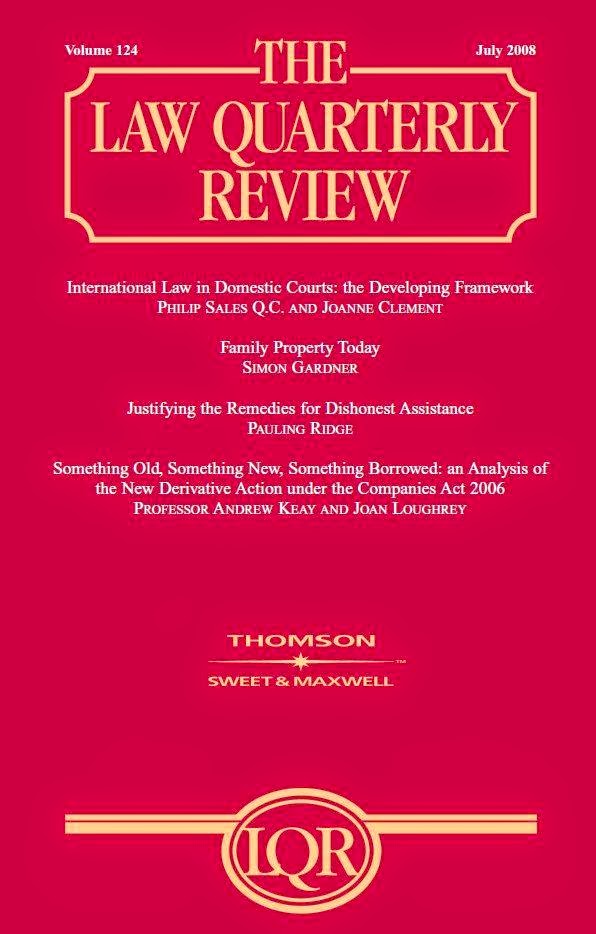
Kelvin Kwok on the UKSC's Passing-Off Decision in Starbucks (HK) v British Sky Broadcasting (LQR)

"Protection of a Reputable Foreign Trader's Legitimate Interests Under the Law of Passing-Off"
Kelvin Kwok
Law Quarterly Review
2016, Vol. 132, p 186
Abstract: Analyses the UK Supreme Court decision in Starbucks (HK) Ltd v British Sky Broadcasting Group Plc [2015] UKSC 31; [2015] 1 W.L.R. 2628. Argues that: (i) the Starbucks case represented a missed opportunity for the Supreme Court to develop the law further still by recognising that evidence of mere reputation in the UK, as opposed to goodwill due to the presence of local customers, can itself satisfy the first element of actionable passing-off, with reference to the development in Australia, Hong Kong and other common law jurisdictions; and (ii) a foreign claimant with mere reputation in the UK has at least two legitimate interests that should be protected under the law of passing-off: first, the claimant’s ability to use its name or mark as part of its future expansion of business into the UK market; and secondly, the claimant’s brand image developed through its supply of high quality products or services over the years.  Click here to download the article.

Tuesday, April 12, 2016

Simon Young on R v Jogee (Joint Criminal Enterprise) Implications for Hong Kong (SCMP)

Simon Young
South China Morning Post
12 April 2016
Let’s be clear on what this new United Kingdom Supreme Court decision (R v Jogee) on joint criminal enterprise might mean for Hong Kong. You and I plan to rob a 7-Eleven. You carry a wooden stick, and I know you’ll use it if you need to. I stand outside the store to keep watch. To my surprise, I hear a gun fired and see you running out of the store, one hand with a fistful of cash and the other holding a handgun. I run too. The cashier died from your gun shot to the head.
     Under the existing Hong Kong law, you would be guilty of murder, but I would be guilty of only robbery, as a secondary party, because it cannot be proven that I foresaw the use of the gun, a more lethal weapon than the stick. If our courts follow the UK decision, Jogee, I would be guilty of both robbery and manslaughter because I was party to an unlawful and dangerous enterprise that resulted in a person’s death. If it was proven that I intended that the cashier suffer really serious bodily harm by the stick, I would be guilty of murder. In this example, Jogee results in more serious criminal consequences for me than under the current law.
     Take a second example. You and I plan to rob the 7-Eleven, but this time, you are carrying your usual pocket knife, and though you say you will only use it to frighten the cashier, I know of your short temper and violent tendencies. As I stand outside, I hear a scream and see you running out with the cash and pocket knife stained with blood. You killed the cashier with intention to cause really serious harm and will be done for murder.
     Under the existing law, I will also be guilty of murder because I foresaw that you might use the knife to stab the cashier. If our courts follow Jogee, I would likely be guilty of manslaughter instead of murder because robbery of a 7-Eleven with a pocket knife is an unlawful and dangerous act – objectively carrying the risk of some harm to another – that resulted in death. By requiring proof of intention in place of foresight, Jogee narrows the net of criminal liability in this example.
     These examples show that Jogee is not a ‘get out of jail’ card for those involved in serious crimes of violence. Manslaughter instead of murder is more likely to be the verdict if intention cannot be proven. Jogee also closes the exception based on an inability to foresee the use of a more lethal weapon. The case should find support with both defence lawyers and prosecutors.
     To persuade the Court of Final Appeal to overrule itself will always require some effort. But where the reasons for extending the net of criminal liability of a common law offence have fallen away, the court would be justified to restore the law to its original form.