Showing posts with label equality. Show all posts

Monday, April 27, 2026

Ryan Whalen et al on The institutional dynamics of inequality for women inventors who break with conventional thinking (PNAS)

"The institutional dynamics of inequality for women inventors who break with conventional thinking"
Tara Sowrirajan, Ryan Whalen, and Brian Uzzi
Proceedings of the National Academy of Sciences (PNAS)
Published online: April 2026

Significance: The gender innovation gap—where women’s inventions are less likely to be patented or pursued—raises concerns about its potential to slow scientific progress. Our analysis of millions of patent applications reveals that the gender gap in patenting is not uniform across conventional and unconventional patents. Rather, it manifests for women inventors who attempt to patent unconventional inventions—innovations that combine knowledge in unfamiliar ways. We find the USPTO’s practices overassign women inventors to women examiners who are relatively inexperienced and more likely to reject unconventional inventions due to their inexperience, not due to gender stereotypes. By identifying these institutional barriers, we propose that organizational policies can complement gender bias explanations and may more immediately address the gender innovation gap.

Abstract: Though women comprise a growing share of the scientific workforce, the gender innovation gap in patenting between men and women inventors persists, potentially limiting innovation output and equity. We study millions of scientific and technological innovations and find that the innovation gap faced by women is not universal. No gap exists for highly conventional innovations, which combine ideas in familiar ways. Rather, it exists when women inventors attempt to patent unconventional inventions, which combine ideas in surprising ways and drive scientific advancements. Our data suggest that rather than deliberate bias, a confluence of institutional practices lower women inventor’s chances of patenting unconventional innovations. We find that women examiners relative to men have less of the on-the-job experience needed to appraise unconventional innovations. Additionally, women examiners are overassigned to women applicants, reducing their odds of successfully patenting unconventional inventions. Lastly, traditional explanations weakly account for this innovation gap because men examiners grant comparably more unconventional innovations to women inventors than do women examiners. These institutional barriers reveal new factors that slow innovation, but at the same time can be more directly addressed than deeply rooted gender norms.

Friday, February 6, 2026

Stefano Osella and Graziella Romeo on Something’s Wrong with Traditionalism: LGBTQI+ Rights in Comparative Perspective (AsJCL)

"Something’s Wrong with Traditionalism: LGBTQI+ Rights in Comparative Perspective"
Stefano Osella and Graziella Romeo
Asian Journal of Comparative Law
Published online: January 2026

Abstract: This article problematises traditionalist thinking in constitutional adjudication in relation to the rights of same-sex couples, especially those rights that are connected to family life. It identifies two approaches, represented respectively by the case law of the Italian Constitutional Court (ItCC) and the Court of Final Appeal (CFA) of the Hong Kong SAR of the People’s Republic of China. The ItCC has expressly stated that preserving traditional family forms is a reasonable objective per se for the legislature to pursue. The CFA, on the other hand, has challenged this approach to traditionalist thinking in relation to same-sex unions. Despite some contradictory signals within its case law, the CFA has stated that justifying differential treatment based on sexual orientation with reference to tradition is circular reasoning. Drawing on historical, anthropological, and philosophical sources, this article argues that invoking the preservation of tradition, despite its rhetorical force, is empirically and conceptually criticisable and, ultimately, unpersuasive.

Wednesday, March 12, 2025

Stefano Osella on A caring academia? Afterword to the Foreword by Gráinne de Búrca, Rosalind Dixon, and Marcela Prieto Rudolphy (ICON)

"A caring academia? Afterword to the Foreword by Gráinne de Búrca, Rosalind Dixon, and Marcela Prieto Rudolphy"
Stefano Osella
International Journal of Constitutional Law
Published online: January 2025

Abstract: This Afterword to the Foreword by Gráinne de Búrca, Rosalind Dixon, and Marcela Prieto Rudolphy aims to foster the debate on the recognition of care as a means to achieve gender equality in academia. Drawing inspiration from the ongoing revaluation of care across various disciplines, including constitutional law, the article emphasizes the importance of a cultural revaluation of care within academic institutions. It interrogates whether such a shift could favor a more equitable distribution of care-related tasks and foster a symbolic move toward values such as collegiality, reciprocal nurturing and support, and relationality. Finally, the Afterword asks whether such a transformation could be a crucial first step toward a more sustainable higher-education and research environment.

Friday, March 7, 2025

Cora Chan on Gender, democracy, and the legal academy: Afterword to the Foreword by Gráinne de Búrca, Rosalind Dixon, and Marcela Prieto Rudolphy (ICON)

"Gender, democracy, and the legal academy: Afterword to the Foreword by Gráinne de Búrca, Rosalind Dixon, and Marcela Prieto Rudolphy"
Cora Chan
International Journal of Constitutional Law
Published online: February 2025

Abstract: This Afterword reflects on the Foreword’s three key contributions—proof of a gender gap in the legal academy, revelation of the problem’s complexity, and an exploration of solutions—from the perspective of a woman scholar specializing in constitutional law in Hong Kong, a former British colony and now a special administrative region of China. While Hong Kong is an international financial center with a strong higher education sector, and its government is explicitly committed to gender equality, the territory is steeped in traditional Chinese values and culture and has undergone a sharp authoritarian turn since the protest movement in 2019. It therefore provides an interesting vantage point from which to assess issues of gender in the legal academy. In particular, this Afterword cites and provides data substantiating the existence of a gender gap in Hong Kong’s legal academy, highlights the intersectional challenges arising from authoritarianism, marketization, and gender as well as other forms of marginalization, and underscores the relationship between gender equality and democratic governance.

Saturday, April 20, 2024

Marco Wan comments on the case of Sham Tsz-kit v. Secretary for Justice on Deutsche Welle news

In a television interview with Deutsche Welle (DW) news, Marco Wan, shares the recent development of the legal framework for recognizing the existence and rights of same-sex couples in Hong Kong after the judgement of Sham Tsz-kit v. Secretary for Justice decided on 5 September 2023. He identifies and comments on the unique challenges on legalizing or offering legal recognition to same-sex marriage in Hong Kong. He also illustrates the major concerns from the LGBTQ+ Community on the degree of protection to same-sex couples in Hong Kong to be introduced by the Government's new framework. Click here to view the interview (in English) on YouTube.

Friday, September 29, 2023

New Issue of Asia-Pacific Journal on Human Rights and the Law (Volume 24, Issue 2, Special Issue: Contemporary Challenges in Comparative Equality Law, August 2023)


Editors-in-Chief: Simon NM Young and Kelley Loper

Publisher: Brill, Leiden

Table of Contents

Author: Kelley Loper
Pages: 155–159
Online Publication Date: 31 Aug 2023

Judicial Perspectives on Transforming Equality
Author: Geoffrey Ma
Pages: 160–164
Online Publication Date: 31 Aug 2023

Empathy, a Hallmark of Equality: Shaping Fearlessness Into Transformative Decision-Making and Teaching
Author: Naina Kapur
Pages: 165–185
Online Publication Date: 31 Aug 2023

Microverse, Mezzoverse, Macroverse: Protection Against Discrimination in an Artificialised World?
Author: Vitit Muntarbhorn
Pages: 186–197
Online Publication Date: 31 Aug 2023

Bangladesh’s Body Parts Trade: A Critical Analysis of Gaps in Justice
Pages: 198–229
Online Publication Date: 31 Aug 2023

A Human Rights-Based Approach to Combating Corruption in the Education Sector in Indonesia
Author: Ratna Juwita
Pages: 230–265
Online Publication Date: 31 Aug 2023

Tuesday, August 29, 2023

CCPL Survey finds A Growing Share of Hong Kong People Support Same-Sex Couples’ Rights 60 Percent Support Same-Sex Marriage

Press Release: A new report shows that Hong Kong public opinion on same-sex couples’ rights has changed markedly over the past ten years. Earlier this year, 60% of Hong Kong people said they supported same-sex marriage, while only 17% said they were not supportive, and 23% were neutral. In comparison, 50.4% supported same-sex marriage in 2017, and 38% did so in 2013.
    The new report is jointly issued by the Centre for Comparative and Public Law at the Faculty of Law, The University of Hong Kong; the Sexualities Research Programme at The Chinese University of Hong Kong; and the Human Rights Law Program at the University of North Carolina School of Law. The report is based on the longest running study to track public opinion in Hong Kong concerning same-sex marriage using representative samples. The research was led by Holning Lau from the University of North Carolina, Kelley Loper from the University of Hong Kong, and Yiu Tung Suen from the Chinese University of Hong Kong. The team conducted a telephone survey of Hong Kong residents in 2013, repeated the survey in 2017, and repeated it again earlier this year.
    The survey asked about other issues in addition to same-sex marriage. It found growth in support for gay men and lesbians and their rights across various domains. For example, 71% of people in 2023 said that Hong Kong should have a law to protect against sexual orientation discrimination, compared with 69% in 2017 and 58% in 2013. A remarkably small percentage of people in 2023—only 6%—disagreed with having such legislation. The share of Hong Kong people who said they were unaccepting of gay men and lesbians dropped nearly 20 percentage points between 2013 and 2023 (from 32% to 13%).
    “Our study shows that support for the rights of same-sex couples has grown quite considerably in the last decade,” said Suen. “The increase in support for same-sex marriage and the decrease in opposition to sexual orientation discrimination legislation are particularly striking.”
    Lau noted the legal and social backdrop to the survey.  “A lot has changed over the past ten years. Hong Kong courts have made headlines with rulings that protect same-sex couples. The list of jurisdictions around the world that have legalised same-sex marriage has grown rapidly. Representation of lesbians and gay men in local and global media has also grown. These are some of the factors that formed the backdrop to the shifts in public opinion that we found in our research.”
    Still, Loper highlighted persisting discrepancies between public opinion and law: “Although 71% of Hong Kong people said they favor having a law to protect against sexual orientation discrimination, and only a small proportion of people disagree, the government of Hong Kong has yet to enact such legislation. Same-sex couples also continue to be excluded from marriage, despite majority support.”
    The release of the report coincides with the International Day Against Homophobia, Biphobia and Transphobia (IDAHOBIT), which is observed annually on 17 May. For the full report see here.
   Professor Holning Lau (hslau@email.unc.edu) and Associate Professor Kelley Loper (kloper@hku.hk) are available for press inquiries in English by email. Associate Professor Yiu Tung Suen is available for press inquiries in Chinese and English by email (suenyiutung@cuhk.edu.hk) .

Thursday, June 29, 2023

Professor Marco Wan Speaks on Marriage Equality and Trans Rights at HSBC and Morgan Stanley

Professor Marco Wan spoke at HSBC and Morgan Stanley to mark the International Day Against Homophobia, Transphobia, and Biphobia (IDAHOBIT) and Pride Month. At HSBC, Professor Wan analyzed the key court cases and changing landscape of marriage equality in Hong Kong. At Morgan Stanley, he discussed the major developments and future trajectories of trans rights in the city.
     Professor Wan also serves as a curator for the Hong Kong Lesbian and Gay Film Festival. His latest article, ‘Law, Film, and Trans Identity in Hong Kong’, was recently published in the International Journal of Constitutional Law (I.CON) this summer.

Monday, February 13, 2023

Kelley Loper on Intersecting Crises and Exponential Inequalities: The View from Hong Kong (new book chapter)

"Intersecting Crises and Exponential Inequalities: The View from Hong Kong"
Kelley Loper
in Exponential Inequalities: Equality Law in Times of Crisis,
edited by Shreya Atrey and Sandra Fredman (Oxford University Press, 2023),
Chapter 6, pp.97-117
Introduction: This chapter considers the limits and the potential of equality law to address inequalities arising from intersecting crises, that is, when more than one crisis occurs simultaneously or in close succession. It examines the case of Hong Kong, a Special Administrative Region (SAR) of China, which has recently faced multiple crises, with different, but interrelated, root causes and effects. While concurrent crises may have distinct features, their impacts frequently overlap, and mutually reinforce each other. As other contributions to this volume illustrate, a single crisis on its own is often enough to exacerbate existing inequalities (or produce new forms of marginalization) in many societies. Indeed, unresolved inequality itself may be characterized as 'a crisis' in its own right, whatever else is happening. Additional traumas are all the more likely to amplify disadvantage. 

Wednesday, November 9, 2022

"Discrimination", Volume 22, Halsbury's Laws of Hong Kong (2nd Edition) edited by Patricia Ho et al

"133 - Discrimination"
Halsbury's Laws of Hong Kong (2nd Edition)
Volume 22, 2022 Reissue
Edited by Patricia Ho, Evelyn Tsao, and Crystal Charlie Yeung
(1) Introduction
[133.001] The scope of the title and its legislative frameworks
The Hong Kong Bill of Rights Ordinance (Cap 383) which entrenches the International Covenant on Civil and Political Rights (‘ICCPR’) prohibits any discrimination and guarantees to all persons equal and effective protection against discrimination on any ground such as race, colour, sex, language, religion, political or other opinion, national or social origin, property, birth or other status. In order to specifically and effectively provide recourse to persons facing discrimination, four pieces of legislation were enacted: (1) the Sex Discrimination Ordinance (Cap 480); (2) Race Discrimination Ordinance (Cap 602); (3) Disability Discrimination Ordinance (Cap 487); and Family Status Discrimination Ordinance (Cap 527). These legislations are implemented and enforced by the Equal Opportunities Commission...

Thursday, September 15, 2022

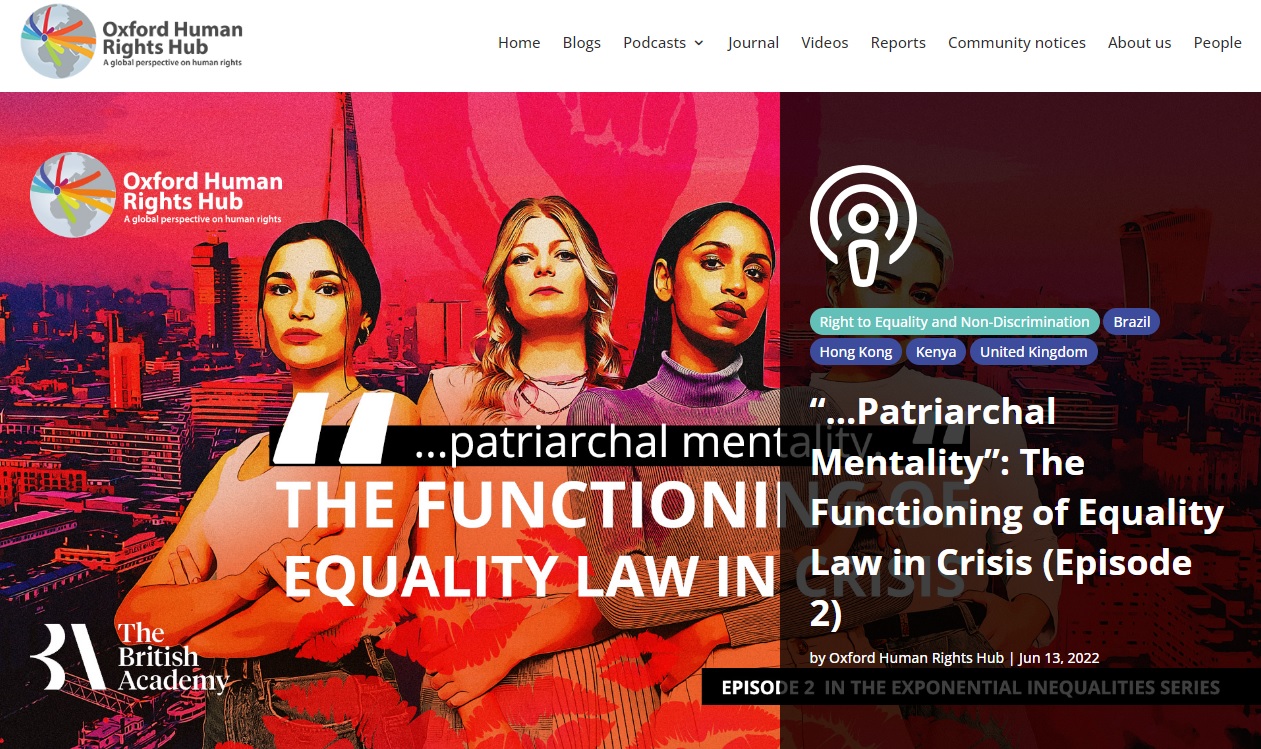
Kelley Loper in Podcast for the Oxford Human Rights Hub: Exponential Inequalities: Equality Law in Times of Crisis

A podcast for the Oxford Human Rights Hub: part of the Exponential Inequalities project led by Shreya Atrey which is also producing the book Exponential Inequalities: Equality Law in Times of Crisis, edited by Shreya Atrey and Sandra Fredman.  Kelley Loper has a chapter in that book on Hong Kong.
     Human rights experts help us determine whether equality law is set up to protect the most vulnerable in times of crisis.   This is Episode Two of a four-part series. The series takes a deep dive into whether equality law is cut out to protect the most vulnerable in times of crisis, and if not, then why not and what can we do about it?  This podcast series is part of the Exponential Inequalities project, led by Shreya Atrey as the Principal Investigator of the British Academy Leverhulme Small Research Grant on Equality Law in Times of Crisis.
    Transcript and show notes available on the Oxford Human Rights Hub website at ohrh.law.ox.ac.uk. Producer, Presenter, Sound Editor: Christy Callaway-Gale. Executive Producers: Shreya Atrey, Meghan Campbell, Sandra Fredman. Assistant Producers: Mónica Arango Olaya, Gauri Pillai, Natasha Holcroft-Emmess. Transcript and show notes: Sarah Dobbie
     EPISODE 2 is titled “…Patriarchal Mentality” : The Functioning of Equality Law in Crisis. It features Anna Lawson, Kelley Loper, Christy Callaway-Gale, Victoria Miyandazi, Aaron Reeves, Marta Machado, Helena Alviar García, and Beth Gaze.  To listen to the episode, click here.

Thursday, October 21, 2021

Marco Wan on Queer Temporalities and Transgender Rights: A Hong Kong Case Study (Social & Legal Studies)

First Published: 2020-8-27
Abstract: This article investigates how theoretical explorations of queer time can shed light on our understanding of law. Taking transgender rights in Hong Kong as a case study, it argues that legal judgments can entrench normative temporal structures and impose tropes such as linearity, futurity, and finality onto the life scripts of trans subjects. Through close readings of the Court of Final Appeal decision in W v. Registrar of Marriages and the recent judicial review challenges that have emerged in its aftermath, it demonstrates how the cases exclude transqueer individuals who do not fit into those temporal trajectories from the realm of rights protection. It also suggests ways of thinking about the temporalities of transgender issues differently. The analysis here stages an encounter between law and literary/cultural theory, and provides a new perspective on the current state of transgender rights in Hong Kong.

Wednesday, May 26, 2021

Jane Richards (PhD candidate) on An Incremental Approach to Filling Protection Gaps in Equality Rights for Persons with Disabilities (Human Rights Law Review)

"An Incremental Approach to Filling Protection Gaps in Equality Rights for Persons with Disabilities"
Jane Richards (PhD candidate)
Human Rights Law Review
Published on 15 May 2012
Abstract: The Convention on the Rights of Persons with Disabilities (CRPD) guarantees that persons with disabilities (‘PWD’) are to be equal before and under the law. There are almost identical equality guarantees in the Canadian Charter of Rights and Freedoms and Hong Kong's mini constitution – the Basic Law. Australia boasts similar legislative equality guarantees for PWD. The CRPD Committee has interpreted the right broadly, whereas constitutional courts have taken a proportionality approach, balancing the right to substantive equality against competing concerns. The tension between these methods of rights protection means the CRPD is being positioned as an alternative model of rights protection, but it is not an alternative mechanism for enforcement. This article calls on the Committee to modify its guidance to make suggestions to state parties as to how incremental advances in rights protection can be immediately implemented, even if in the short-term, these advances fall short of full inclusion.

Wednesday, March 17, 2021

CCL's Equality Rights Project and Chinese NGOs Submit Report to the UN Committee on the Elimination of Discrimination against Women

The Equality Rights Project (under the Centre for Chinese Law) and two other Chinese NGOs jointly submitted a parallel report to the United Nations Committee on the Elimination of Discrimination against Women ahead of the adoption of the list of issues for the ninth periodic report of China at its 80th Pre-Session (which will be held in this March). The report covers only Mainland China. It refer to the Ninth Periodic Report of the State Party (SP) and the CEDAW Committee’s Concluding Observation (CO). The List of Issues are ordered according to the articles in CEDAW, together with the two issues that are addressed in Concluding Observation of 2014. The report was published in February 2021. To view the report, click here.

Tuesday, December 8, 2020

Do Judges Run Prisons? (Henry Litton)

DO JUDGES RUN PRISONS? 
Henry Litton

The Scenario
In Hong Kong there are male prisons, and there are female prisons. There are no mixed prisons. The disciplinary regime in each is different, for obvious reasons.

The Disciplinary Rules
As regards hair style, this is what the Prison Rule says about male prisoners:
The hair of all male convicted prisoners will be kept cut sufficiently close, but not close cropped, for the purpose of health and cleanliness, unless the prisoner himself requests it”. 
But for female prisoners it is different. The rule says:
Upon request, female prisoners will have their hair cut especially before discharge or production in court. Except as recommended by MO [Medical Officer] a female prisoner’s hair shall not be cut shorter than the style on admission without her consent.” 
These two rules are set out in the Standing Orders for prisons, but grouped together in SO 41-05. However presented, they are clearly different rules.
      Another Prison Rule requires the Chief Officer to ensure that male prisoners’ clothing is kept in a good state of repair, and “their hair kept trimmed, and their washing, hair clipping and personal ablution attended to”. 
     Then Prison Rule 34, regarding general treatment of all prisoners, says:
Every prisoner shall obey such directions as regards washing, bathing, shaving and hair cutting as may from time to time be prescribed”. 
The “Long Hair” case
In March 2012 Leung Kwok Hung (also known as “Long Hair”) was convicted before a magistrate of criminal charges. In June 2014, after an appeal, he was required to serve a sentence of four weeks imprisonment. This he did at the Lai Chi Kok Reception Centre. On admission he objected to having his hair cut short and said he might apply for judicial review to challenge such requirement. After ascertaining that no application had been made, the Chief Officer authorized the hair-cutting to proceed. That was done. 
     Leung subsequently did apply for leave to start judicial review proceedings: Hence the case Leung Kwok Hung aka “Long Hair” v Commissioner for Correctional Services [HCAL 109/2014] heard by Au J in April and May 2015.
     In a 39-page judgment handed down 1.5 years later, he made the following orders:
(1) A declaration that the rule for male prisoners constituted “direct sex discrimination under s.5 of the Sex Discrimination Ordinance and was made unlawful under s.38(1) of the Ordinance; or alternatively the rule violated Article 25 of the Basic Law and was unlawful”. 
(2) An order to quash the Chief Officer’s decision to enforce the rule.
Statutory Offence 
The offence of sex discrimination is a pure creature of statute. The common law knew nothing of such offence.
     Before WWII, there was not a single female judge on the Bench anywhere in England. The common law gave no redress for sex discrimination. It was not the common law judges but legislators who, bit by bit, came to realize that this was an ethical issue.
     It follows, as night follows day, that the ingredients of such offence are to be found in the statute itself. Nowhere else.
     The Hong Kong Sex Discrimination Ordinance was first enacted in May 1996. Its long title says that it is an Ordinance to render unlawful “certain kinds of sex discrimination ….”. There then follows many different kinds of discrimination. For example:
  • Discrimination by way of victimization: s. 9
  • Discrimination by employers against contract workers: s. 13
  • Discrimination by barristers: s. 36.
  • Governmental discrimination: s.38(1).
Section 5(1)(a) 
Here, the judge held that the rule concerning male hair-style in prison was what he called “direct discrimination”, as defined in s.5(1)(a). That section, taken together with s. 6 and s.38(1) reads thus:
'The Commissioner discriminates against a man in any circumstances relevant for the purposes of any provision of this Ordinance if, on the ground of his sex, he treats him less favourably than he treats a woman' 
Note the words: “in any circumstances relevant for the purposes of any provision of this Ordinance”. 
     The statutory 'purpose' in this case is the prohibition in s.38(1) which makes it unlawful for the government, in the exercise of its functions, to discriminate against Leung Kwok Hung.
     But what were the relevant circumstances? They were those in a male prison. The prison regime relevant in a male prison does not apply in a female prison, for obvious reasons. And vice-versa. In judging whether s.5(1)(a) is engaged in a case concerning male prisoners, comparison with circumstances in a female prison is not relevant.
     If there be any doubt about this, it would be dispelled by s.10 which says:
A comparison of the cases of different sex under s. 5(1) ….shall be such that the relevant circumstances in the one case are the same, or not materially different, in the other.” 
     Any ordinary person, not learned in the law, would have found this a matter of plain common sense. In life, there is no ethical framework that transcends context. Ethical values are not free-standing. When someone says: 'This is sex discrimination', that statement has no meaning unless you know the context in which it is said.
     The Sex Discrimination Ordinance was simply not engaged in this case. End of story.

How Did the Judge Get To The Result He Did? 
The judge identified “three types of discrimination”: Direct, indirect and Thlimmenos discrimination. These are labels used in overseas case law. The term Thlimminos discrimination came from a case of that name decided in the European Court of Human Rights.  The expression “direct discrimination” identified the kind of discrimination set out in s. 5(1)(a). 
     Au J, instead of focussing on the words in the Hong Kong statute, got totally entangled in overseas case law concerning “direct discrimination”, as if this was a generic term detached from its statutory roots. He never focussed on the simple words in s.5(1)(a).
     Before Au J, the exercise in court seemed like a running dialogue between Bench and Bar, with case after case being dissected and discussed.
     For instance in para. 56 of his judgment one finds this sentence:
The Gillan Case therefore does not support Mr Pao’s submissions questioning the correctness of the Roma Case.” 
Mr Pao was counsel for the Commissioner. Why was he questioning the correctness of the Roma Case ? Right or wrong, what purpose did that serve? 
     The running dialogue on these two cases began in para.44 of the judgment where the facts of the Roma Case were set out. They involved immigration control at the Prague airport for those seeking entry into the UK. The Gillan Case concerned police powers of stop and search in the UK. How these cases elucidated the meaning of the Hong Kong statute on sex discrimination was not explained.
     After the conclusion on those two cases reached in para 56, one sees many more paragraphs in the judgment where other overseas cases were discussed, ending with para 98:
For all the above reasons, I reject the Commissioner’s arguments and conclude that SO 41-05 and the Decision amount to direct sex discrimination and are thus unlawful”.
The “above reasons” were set out in about 20 pages of fine print. Few can understand them, however elevated their level of English.

The Common Man’s Perspective 
Overseas case law would be a complete mystery to the ordinary citizen.  But if one simply focussed attention on the words “circumstances relevant for the purposes ….of this Ordinance”, that would have coincided with the way an ordinary person would have approached the matter. The question of discrimination would have been put in the right context: That is to say, custodial discipline in a male prison.
     The common man would have said: 'what is the fuss all about? Are you saying that the female rules should apply in a male prison ?' And he might even have added: 'Are the judges now going to run prisons as well?'
     Furthermore, the ordinary person would not have agonized over whether, under the rules, a male inmate was being treated “less favourably” than a female inmate. He would have realized that the matter was one of custodial discipline, within the Commissioner’s responsibilities; uniformity and conformity among inmates was important as part of the correctional process. But females were not the inmates under consideration.
     Adopting such an approach the judgment would not have been more than a couple of pages long and would have been easily understood by the ordinary citizen. 

Article 25 Basic Law
As regards whether the rule concerning prison hair-style offended Article 25 of the Basic Law, the ordinary man would have shaken his head in total disbelief at the judge’s conclusion.
     Article 25 simply says: “All Hong Kong residents shall be equal before the law”. Full stop.  The notion that, under the principle of One Country Two Systems, Article 25 of the Basic Law could be engaged in a case like this is alarming.
     The Basic Law is a constitutional document, setting out the general framework for the Region. It is not a civil code for regulating Hong Kong’s daily affairs: And certainly not for regulating the way prisons should be run.

The Court of Appeal 
The Commissioner appealed. The Court of Appeal gave judgment in April 2018.
      The Chief Judge did not write the leading judgment. This was left to Lam VP. But the Chief Judge did set the tone. He began his judgment by saying:
Discrimination is a huge subject that has generated a tremendous amount of literature and debate. It straddles many disciplines and law is just one of them.” 
With such an approach it was inevitable that the judgments amounted to pages and pages of fine print, totally unintelligible to the ordinary person.
     As it was, the Court of Appeal, after tripping through many of the same cases as the judge, came to the opposite conclusion: that Au J had erred on both counts: that is to say, the application of s.5(1)(a) to the facts of the case, and his reliance on Article 25 of the Basic Law.  Au J’s judgment was quashed.

Court of Final Appeal
Leung Kwok Hung in turn lodged an appeal. This was heard by the Court of Final Appeal ( CFA ) in October 2020. Its judgment handed down on 27 November 2020 must have shocked the community. It overturned the Court of Appeal’s judgment. Au J’s judgment was restored.
     The Chief Justice delivered the only judgment, with which the other four judges agreed.  He began his judgment by saying that a “4-step approach contained in the speech of Baroness Hale of Richmond in R (European Roma Rights v The Prague Immigration Office [2005 ] 2 AC 1 at para 73 is helpful”. 
     That immediately raises the question: “Helpful” as to what? Is the wording in s.5(1)(a) not clear enough? At any rate, these are the 4-steps.

“4-Step Approach” 
“15 (1) There must be a difference in treatment between one person ……and another person, real or hypothetical, from a different sex group, the compared person ( in our case, female prisoners ).

(2) The relevant circumstances between the complainant and the compared person are the same or at least not materially different.

(3) It must then be shown that the treatment given to the complainant is less favourable than that given to the compared person.

(4) The difference in treatment is on the basis of sex.”
      As to 15(1), the Chief Justice said that male prisoners did not “have the choice as regards hair-style that female prisoners had”, which of course is right.

The Relevant Circumstances” 
As to 15(2), the Chief Justice said: “…it is important to compare like with like and to view the matter in proper context”. That again is correct, and one would have expected the judgment then to examine the question: What is the proper context ? Is the court being asked to compare like with like ?
     But not at all. The judgment immediately moved on to 15(3): What constitutes “less favourable treatment”.

Less Favourable Treatment
There then followed 11 pages of text examining a whole range of overseas cases dealing with a variety of situations: Selection requirements for secondary schools Birmingham City Council v Equal Opportunities Commission; length of hair in schools Re McMillan; rub down searches in prisons R ( on the Application of James Dowell v Secretary of State for Justice and Conway v Canada; dress and appearance code in a supermarket Smith v Safeway; what constitutes presenting a clean and tidy appearance and to dress in a business-like way in a book shop Department for Works and Pensions v Thompson.
      Those eleven pages were under the heading “Less favourable treatment”. Whether someone has been treated “equally” or “less favourably” can only be examined in the actual context of the case. It is not an abstract exercise. A hundred citations of cases dealing with different situations will yield no answer.  What is more, “equality”, “less favourable treatment” are elusive concepts.
     One argument put up on the Commissioner’s behalf was this: the requirement imposed on Leung Kwok Hung was no more than the conventional hair-style of the majority of males in Hong Kong. That requirement was uniformly applied in a male prison: to de-emphasise individuality In the interests of custodial discipline. That is plain common sense.
     But, whilst accepting the need for custodial discipline, the Chief Justice, astonishingly, said this in para 52:
….no details are provided and no basis is given for saying that in our society, the conventional hairstyle for men is a short one whereas for women hair can be long or short. There must be sufficient evidence going to these matters; they cannot simply be asserted ….
Sadly, the court appears to dwell in a world of words, detached from reality on the ground.
     In the Chief Justice’s view, the “less favourable treatment” rested on the fact that a female prisoner, on admission, was allowed to keep her hairstyle even if it was long, whereas a male could not. But factually, the Chief Justice was not entirely correct. The female was also under some limitation. Her choice was not unrestrained. If the Medical Office required her hair to be cut, then under the Prison Rules she had to comply.
     In the two courts below, the judges looked at the concept of “less favourable treatment” through the lens of cases dealing with a diversity of situations and came to opposite conclusions. The reason why it is so difficult to nail down that concept is because the context in which it was being considered was missing. 
     The Commissioner was the respondent to these judicial review proceedings. Were he to be asked: 'what is this case all about', his reply would surely have been 'about custodial discipline in a male prison'.
     In this context, the problem of “less favourable treatment” disappears. The comparison with the female regime was simply not relevant.

Article 25 of the Basic Law 
In para 56 the judgment said this:
In view of the conclusion reached on the previous issue, it is unnecessary to deal with this issue. However, on the facts of the present case, the outcome would not be different under Article 25 of the Basic Law.
This seemingly throwaway line contains a most sinister seed.
     What the Chief Justice was saying, in effect, was this: Were the challenge to the prison rule to be judged, not by applying the Sex Discrimination Ordinance, but by applying Article 25 of the Basic Law, the result would have been the same.
     In other words, he would have interpreted Article 25 of the Basic Law as applicable to strike down the prison rule: raising, in effect, a purely local matter to the State level. This was an open invitation to lawyers to play games with the Basic Law, regardless of the consequences.

Transparency 
The Chief Justice, in answer to general criticisms of the Judiciary, issued a statement on 23 September in which he said (para 29):
The community is able to see for itself and verify whether fundamental principles are followed by the courts by observing court proceedings ………and reading the judgments of the courts at all levels to see precisely the reasons why a court has arrived at a determination …..Open justice and transparency enable the community to observe the judicial process in full, and to provide meaningful and informed comments and criticisms”. 
Unhappily, this judgment is anything but transparent.
     It deals essentially with an ethical issue, made into an offence by a local statute. Any judgment on such an issue should be understood by every educated person. Yet this judgment, and those in the courts below, are so dense with “law” that no-one can possibly understand them, however elevated their standard of English.

Limits of Courts’ Powers 
In a case such as this, which essentially concerns management of male prisons, a court should approach the matter with hesitancy and diffidence. The Commissioner has expertise which judges do not share. The standards of behaviour are set by the Commissioner. Such standards fall naturally within a broad spectrum. If judges expect the community to respect the norms and values set by them, they in turn must show respect for those set by other institutions of government. Judges have no monopoly on ethical standards set in society.

What has this judgment achieved? 
The undoubted effect of the CFA’s judgment is that discipline in male prisons must now be relaxed as regards hairstyle. There will be repercussions. What follow-on impact this might have on custodial discipline as a whole seems of no concern to the CFA.
      What Au J had before him was a mere application for leave to start proceedings for judicial review. Au J was in the position of a gate-keeper. Judicial review is brought in the interests of lawful administration, good governance. It is, at the end of the day, a discretionary remedy. 
      The application was made some time after Leung had served his sentence. It might even be the case that his hair had grown back to its full length by that time. Was it made in good faith ? What interests of his did it serve?  Did it help good administration in male prisons to have the hairstyle rule struck down by the court?

A Leadership Role?
Had the CFA been conscious of its leadership role in the community, these would have been matters of concern to the court. But the court gave the procedural aspects of the case not an ounce of thought. It simply played to the agenda laid down by counsel.

Eurocentric View 
And what is perhaps even more troubling is the Eurocentric leaning of the judgments. Instead of giving the words in a local statute their plain ordinary meaning and applying those words to the facts of the case in a robust straightforward way, the courts favoured the formulation of vague principles.
     The judges, at all three levels of the courts, seem drawn to overseas case law as moths to naked light: apparently brushing aside the inconvenient truth that the common law system operates under the principle of One Country Two Systems. Such mindset spells disaster in the long run. This is not a formula for the long continuation of the common law. 
 

Tuesday, October 6, 2020

Holning Lau & Kelley Loper on The European Union as Promoter of Equality in Asia: Beyond Economic Tools of Influence (new book chapter)

Holning Lau & Kelley Loper
in Thomas Giegerich (ed), The European Union as Protector and Promoter of Equality (Springer 2020) pp 487-502
Published online in July 2020
Abstract: The European Union’s (EU’s) foreign policy objectives include promoting equality rights around the world. Commentary on such efforts in Asia has focused on the EU’s application of economic pressure to influence Asian states. This chapter seeks to shift the focus to a range of non-economic tools that the EU uses to promote equality rights in Asia. These “soft power” options include, but are not limited to, conducting official “human rights dialogues” with Asian leaders, providing technical assistance to government and civil society actors, developing social media campaigns, and setting positive examples through progressive law reforms in the EU. This chapter first explains why it is important for the EU to support equality rights through the exercise of soft power. It then specifically considers the EU’s highest court, the European Court of Justice (ECJ), as a source of soft power. Some Asian courts cite the ECJ as persuasive authority. The ECJ thus indirectly promotes equality rights in Asia by setting examples. It is problematic, however, that Asian courts learn from the ECJ while the ECJ and other EU institutions fail to reciprocate by learning from rights-protective Asian courts. This unidirectional flow of information reflects and reinforces neocolonial dynamics. The EU could allay concerns about neocolonialism, and perhaps increase its influence in Asia, by engaging Asian courts in a two-way dialogue on equality rights.

Thursday, August 6, 2020

Marco Wan on Same-sex Marriage in the Context of Hong Kong (JP Morgan Webinar)

Marco Wan spoke on the timely and important issue of same-sex marriage at a recent webinar at the Hong Kong office of the US investment bank JP Morgan on 24 June 2020. His presentation gave an update of the recent cases in Hong Kong, including QT, Leung Chun KwongInfinger, and MK, and also explored international developments. The talk further explored Hong Kong's marriage history as a way of thinking about the twenty-first century debate about marriage equality; this part of the talk drew on his forthcoming article entitled "The Invention of Tradition: Same-sex Marriage and its Discontents in Hong Kong". The talk concluded by noting the need not only to focus on marriage, but on other issues central to sexual minority rights such as employment discrimination. 

Thursday, November 28, 2019

New Study on Unconscious Bias and Implications for Equality in Hong Kong and Asia (WSRC & CCPL)

Puja Kapai
Women’s Studies Research Centre (WSRC) & Comparative and Public Law (CCPL)
September 2019
Description: In a project funded by the Equal Opportunities Commission, Puja Kapai conducted a study into the levels of unconscious bias on the grounds of gender and race in Hong Kong.  She examined who harboured which types of unconscious biases, whether such biases serve as predictors of discriminatory behaviour and whether it is possible to ameliorate these unconscious biases.  Summary of the results in conclusion: The results of this research study provide groundbreaking insights into the prevalence, nature and extent of unconscious bias among different social groups as well as the variables which influence such biases negatively or positively in the context of Hong Kong. Furthermore, the study demonstrates the effectiveness of specifically designed interventions in terms of reducing particular biases, while outlining the more challenging categories of unconscious bias which require more complex intervention models to address concretely. The key research findings of the 180-page report are: 
(1) Unconscious gender and racial biases are widespread in Hong Kong across diverse social groups.
(2) Unconscious bias tends to be stronger in the case of racial biases compared with gender biases. 
(3) The level of racial bias also varies depending on target group with South Asians being more susceptible to higher levels of bias relative to Mainland Chinese for the most part.  
(4) The level of gender bias in relation to sciences is significantly higher when compared to gender-role stereotypes pertaining to career.  
(5) The IAT itself has the effect of mitigating against certain types of unconscious bias but may have the opposite effect in respect of deeply entrenched biases.
(6) Interventions can and do work. However, the effectiveness of interventions varies depending on the type of bias, targets of discrimination, social groups targeted by the intervention, their social networks and exposure to outgroups.
(7) Some biases (racial biases) are more entrenched than others (gender-based biases) in the Hong Kong context and interventions have limited or little impact in reducing them.
(8) One-size-fits-all solutions do not work. There is a clear and potent need for intervention tools to be well-tailored to different groups and contexts and fine-tuned for different types and manifestations of biases. 
     Importantly, this study is the first of its kind to examine the manifestation of unconscious bias as embedded in an Asian context. The findings demonstrate that unconscious bias clearly exists and is prevalent in our society. However, in Hong Kong, it presents in specific ways judging from the distinct findings pertaining to certain racial categories and gender stereotypes in relation to career and sciences. Moreover, it reveals the significance of social context, networks and the particular background factors on bias levels. While intervention by way of raising awareness about the existence of different types of unconscious bias is found to mitigate biases, it is not sufficient in and of itself to reduce these in concrete terms or in the longer-term. Furthermore, if delivered carelessly without due consideration of the environmental context in which 109 participants are engaged and their background or networks, or a failure to debrief participants properly in terms of what the scores mean relative to prejudice levels, the intervention can have a detrimental effect, in turn, exacerbating biases. 
     These findings bear important implications for future of research and design considerations pertaining to unconscious bias and the implementation of interventions in Hong Kong in across different sectors, most notably, corporate, high school and higher education sectors.

Thursday, October 10, 2019

Kelley Loper on Human Rights and Substantive Equality: Prospects for Same-Sex Relationship Recognition in Hong Kong (N Carolina J Int'l L)

Kelley Loper
Spring 2019, Volume 44, No. 2, Article 4
Introduction: This Article considers judicial approaches to the adjudication of the rights of Lesbian, Gay, Bisexual, and Transgender (LGBT) persons in the Hong Kong Special Administrative Region of the People’s Republic of China (Hong Kong). Hong Kong provides a notable case study of litigation strategies and court responses in a jurisdiction open to international human rights law. Sodomy was decriminalized in 1991 under the former British colonial regime, and, since 2006, Hong Kong courts have decided a number of cases concerning a range of issues including transgender marriage, different ages of consent for vaginal and anal intercourse, other discriminatory criminal provisions, restrictions on television broadcasts about relationships between gay men, the rights of incarcerated transgender persons, and the rights of same-sex couples. Other cases are still working their way through the system and future challenges are anticipated as advocates continue to pursue a persistent litigation strategy... Click here to read the full text. 

Thursday, July 18, 2019

Marco Wan on The Invention of Tradition: Same-Sex Marriage and Its Discontents in Hong Kong (Int'l J Const L)

International Journal of Constitutional Law
July 2020, Volume 18, Issue 2, pp 539-562
Abstract: In Leung Chun Kwong v. Secretary for the Civil Service, the Hong Kong Court of Final Appeal held that the government unlawfully discriminated against a gay civil servant by refusing to recognize his same-sex marriage—entered into abroad—when considering the granting of local spousal benefits and joint tax assessment. The year before, in QT v. Director of Immigration, the court had ruled against the government for denying the partner of a British lesbian a dependant visa on the basis of her sexual orientation. QT and Leung Chun Kwong are landmarks in the rapidly evolving jurisprudence on same-sex marriage in the territory. This article presents an analysis of the Hong Kong cases relating to gay rights and same-sex marriage. It contends that, even though the need to protect traditional marriage is cited as a reason against marriage equality in many jurisdictions, the claim is particularly problematic in Hong Kong, given the city’s unique marriage history. It draws on the historian Eric Hobsbawm’s notion of “the invention of tradition” to argue that the rhetoric of traditional marriage conjures up an imagined past that displaces a vast and varied set of long-standing marital practices. By exploring government reports and records pertaining to Chinese marriages in colonial Hong Kong, this article then examines these forgotten traditions and demonstrates their significance for understanding the marriage equality debate in the territory in our own time.