Showing posts with label Maisie Ooi. Show all posts

Tuesday, July 20, 2021

Maisie Ooi on Choice of Law in the Shifting Sands of Securities Trading (new book chapter)

"Choice of Law in the Shifting Sands of Securities Trading"
Maisie Ooi
in A Conflict of Laws Companioned. by Andrew Dickinson and Edwin Peel, (Oxford University Press, June 2021), Chapter 8
Abstract: The author examines how the conflict of laws has approached the task of determining the law applicable to issues relating to securities, and whether that approach is suitable for determining the law applicable to the proprietary aspects of securities created or traded through the use of distributed ledger technology (DLT), including cryptosecurities, and other new forms of securities holding and trading.

Sunday, February 21, 2021

Maisie Ooi on Re-enfranchising the Investor of Intermediated Securities (J of Private Int'l L)

"Re-enfranchising the investor of intermediated securities"
Maisie Ooi
Journal of Private International Law
April 2020, Vol 16, Issue 1, pp 69-111
Abstract: Efforts to devise a choice-of-law rule for intermediated securities in the last two decades have almost entirely been centred on issues of property and title. Intermediation of securities does not, however, give rise to issues of property alone, even as they are mostly represented as such. The Court of Appeal’s decision in Secure Capital SA v Credit Suisse AG (hereinafter referred to as “Secure Capital”) signals a possibly larger problem of the disenfranchisement of the investor of intermediated securities. Consideration of Secure Capital and its implications on choice-of-law have however been curiously sparse. This article seeks to bring the debate which still continues for issues of property to the issues of disenfranchisement, and to demonstrate why they are no less problematic, complex and in urgent need of a viable solution.

Thursday, February 27, 2020

Maisie Ooi on Rethinking the Characterisation of Issues Relating to Securities (J of Private Int'l L)

"Rethinking the characterisation of issues relating to securities"
Published online on 16 Dec 2019
Abstract: This article contends that there is a pressing need to rethink the characterisation of issues relating to securities, both complex and plain vanilla. It will demonstrate that the less than coherent choice-of-law process that exists for securities today is a consequence of courts utilising characterisation categories and rules that had not been designed with securities in mind and applying them in disregard of the new dimensions that securities and their transactions bring to characterisation. These have resulted in rules that do not provide certainty and predictability to participants in the securities and financial markets.
     The thesis that this article seeks to make is that a new characterisation category is required that is specific to securities which will encompass both directly held and intermediated securities (possibly also crypto-securities), and address issues of property, contract and corporations together. This will have its own choice-of-law rules which will be manifestations of the lex creationis, the law that created the relevant res or thing that is the subject-matter of the dispute. The convergence of issues traditionally dealt with by separate categories and rules will simplify and make for more coherent choice-of-law for securities.

Saturday, December 26, 2015

Maisie Ooi Interviewed on the Yung Kee Cross-Border Winding Up Decision (SCMP)

Jasmine Siu
South China Morning Post
20 December 2015
Hong Kong’s top court recently gave the go-ahead for the parent company of the famous Yung Kee roast goose restaurant in Central to be wound up, despite it being incorporated in the British Virgin Islands.
     The landmark ruling clarified local courts’ jurisdiction over foreign companies. Members of the legal fraternity are expecting more similar cases as the city develops into a dispute resolution hub, but questions are also being raised as to how the order will take effect.
     “This Court of Final Appeal judgment is instrumental to Hong Kong’s development as a dispute resolution centre,” William Wong Ming-fung SC told the Post. “This is very good for Hong Kong.”
     Wong, who specialises in company and insolvency law, said many firms initially incorporated offshore to evade local taxes and conceal identities and assets in tax havens like the BVI...
     Dr Maisie Ooi, a company law professor at the University of Hong Kong, said the judgment is “clearly very important” as it sheds light on a cross-border issue not judicially considered before in Hong Kong and elsewhere.
     “It is an important decision in a world where corporations and their transactions are increasingly crossing jurisdictional borders,” she said. “The Court of Final Appeal has by this decision clearly signalled that Hong Kong courts are prepared to wind up foreign companies in appropriate cases.”
     Ooi said shareholders and their lawyers may look quite keenly to Hong Kong courts to process their petitions. But she wondered how the order can take effect without the cooperation of BVI courts and authorities, when both the company and its sole asset are outside of Hong Kong... Click here to read the full article.

Thursday, October 8, 2015

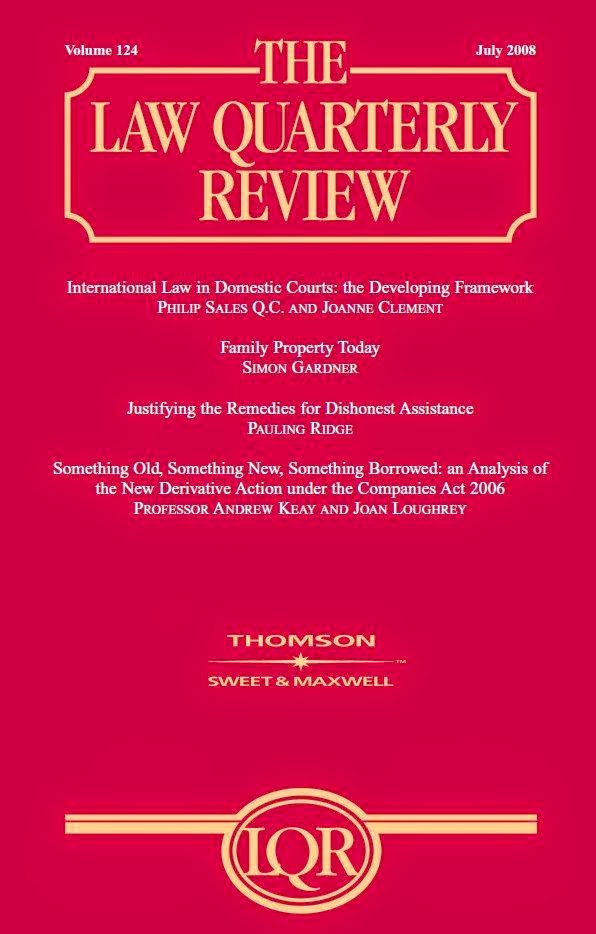
Maisie Ooi on the Effect of Intermediation on Investor Rights (LQR)

"Intermediation and its Effect on Investor Rights"
Maisie Ooi
Law Quarterly Review
2015, Vol 131, pp. 536-542
Secure Capital SA v Credit Suisse AG [2015] EWHC 388 (Comm); [2015] 1 Lloyd’s Rep. 556 considered an issue of immense importance to investors who purchase and hold securities on an intermediated holding system. Do they enjoy the same rights in relation to those securities as would have accrued to them had the securities not been on the intermediated system? The answer was decided by the court’s choice of the applicable law, underlining the importance of conflicts law to corporate and securities transactions these days. As these transactions are increasingly cross-border it is no longer sufficient for corporate and securities lawyers to be familiar only with the substantive law relating to these matters. 
     This note analyses the scope and application of the court’s choice of the governing law of the securities to determine the investor’s rights in relation to intermediated securities. The securities were two tranches of notes (Notes), a form of debt security, which had been issued by Credit Suisse. Secure Capital sued Credit Suisse for breach of a term of the Notes that it had taken all reasonable care to ensure accuracy of information on the Notes. 
     The Notes had been issued in bearer form which meant that transfer of title was by delivery of their certificates. Had Credit Suisse (very unusually) decided against placing the Notes on an intermediated system, Secure Capital, which acquired some of the Notes at issuance, would have been issued with the relevant certificates making it the legal owner. This would also have made Secure Capital counterparty to Credit Suisse in relation to the Notes contracts. Secure Capital would, then, indubitably have been entitled to sue for breach of the terms of the Notes. 
     Credit Suisse had however, as is common these days, placed the Notes on an intermediated system, specifically Clearstream. This was done by depositing with the Common Depository, which held the Notes for Clearstream, a global certificate representing the entire issue of each tranche, constituting it their legal owner. In place of the certificates Secure Capital’s acquisition was reflected by a credit entry in its securities account with its intermediary on Clearstream.... Full article is available from Westlaw or from the author.