Showing posts with label human rights. Show all posts

Friday, September 12, 2025

Yanru Chen on Applying human rights discourse in cultural objects restitution (International Journal of Cultural Policy)

"Applying human rights discourse in cultural objects restitution"
Yanru Chen (PhD Candidate)
International Journal of Cultural Policy
Published online: August 2025

Abstract: The landscape of cross-border restitution claims is shifting from state-centric approaches towards a greater focus on the rights and concerns of non-state actors, highlighting the critical importance of the human rights dimension in cultural objects that manifest the identity of a specific community. Human rights discourses encompass the right of participation and self-determination, as well as cultural heritage rights framed by cultural heritage instruments. These discourses play a key role in bridging the gaps within the current international legal framework, thereby promoting fair and just solutions to preserve and protect cultural objects. Despite ongoing debates around cultural internationalism versus cultural nationalism, the identification of rightful holders, conflicts of rights, alternative dispute resolution, and human rights courts may serve as effective forums to reinforce the impact of human rights in claims about the restitution of cultural objects. These forums can strengthen the enforcement of human rights principles in restitution claims, fostering solutions that respect the cultural and historical significance of disputed objects.

Wednesday, August 6, 2025

Cora Chan’s book awarded Special Mention for ICON-S Book Prize

Congratulations to Professor Cora Chan for winning a Special Mention for the International Society of Public Law (ICON-S) Annual Book Prize with her book Deference in Human Rights Adjudication (Oxford University Press 2024). This prize is one of the most prestigious book awards in the field of public law. The judges awarded the honorary mention to Cora’s book for its “sophistication, analytical depth, and comprehensiveness with which [it] tackles the subject matter, promising to be a guide not just to courts and practitioners, but also to academics interested in the theoretical problems raised by the question of deference in adjudication.” 

Cora’s book was also one of two finalists for the 2024 Book of the Year Award from the International Forum on the Future of Constitutionalism.


Friday, April 11, 2025

Puspa Pokharel on Interface between the Judiciary and National Human Rights Institutions (Brill book chapter)

"Interface between the Judiciary and National Human Rights Institutions: A Means to Ensure Effective Remedies for Business-Related Human Rights Abuses?"
Puspa Pokharel (PhD Candidate)
in Andreas R. Ziegler (ed), Damiano Canapa (ed), and Maria Izabel Cardozo (ed), Business and Human Rights (Brill, March 2025),Chapter 14, pp. 387-406

Introduction: This chapter deals with the means of interface between the judiciary and National Human Rights Institutions (“nhris”) to ensure effective remedies to the victims of business-related human rights abuses. While nhris are considered as one of the state-based non-judicial grievance mechanisms for redressing the human rights abuses by business enterprises, lack of enforcement of their recommendations questions the overall effectiveness of the mechanism. This chapter thus looks into the fundamental relationship, including the interconnection and interaction, between the judiciary and nhris to ensure the enforceability of the nhris’ recommendations to have an actual outcome for the victims.

In the first section, the chapter provides the general background as to how nhris have been incorporated within the business and human rights regime and what are their expected roles within the regime. For the matter, the United Nations Guiding Principles, 2011 (“ungps”) is the primary instrument considered for the study. The second section deals with the concept and ways of interface between the judiciary and nhris. It explores the possible avenues to ensure the enforceability of the nhris’ recommendations. The third section considers the National Human Rights Commission of Thailand (“nhrct”) and National Human Rights Commission of Nepal (“nhrcn”) as case studies. The associated laws that provide grounds for the interface between these two state institutions are identified and analyzed. The chapter also explores the possibilities of interface for cases that have extra-territorial implications. While doing so, the possible challenges associated with them and recommendations are also discussed.

Wednesday, November 27, 2024

New book by Alec Stone Sweet and Wayne Sandholtz: The Law and Politics of International Human Rights Courts: The Dilemma of Effectiveness (Oxford University Press)

The Law and Politics of International Human Rights Courts: The Dilemma of Effectiveness
Alec Stone Sweet, Wayne Sandholtz
Oxford University Press
Published online: July 2024

Abstract: The Law and Politics of International Human Rights Courts addresses three key topics. First, the book provides an account of the origins and evolution of six regional human rights courts. In each, judges sought to overcome political forces and legal obstacles that threatened to neutralize the regime and render it irrelevant to the daily lives of the people. Second, it analyzes the emergence of a common “jurisprudence of effectiveness,” the express purpose of which has been to raise standards of rights protection within nascent, multi-level “transnational systems of justice.” A transnational system of justice is comprised of three components: a charter of rights, a court tasked with enforcing the charter, and the right of individuals to petition the court with a claim that their rights have been violated. The book analyzes the case law on diverse topics, covering both absolute rights (the right to life and prohibitions of torture and slavery) and selected qualified rights (self-determination, abortion and privacy, family law, and indigenous rights to property). Third, the book examines how state officials respond to the development of systems of transnational justice (STJs), in particular, the extent to which the prospect of more effective rights protection is embraced by state officials. In each of the cases, the activities of the STJ have generated significant political “backlash,” leading some states to seek to curb the court’s authority or to exit the regime. The book describes and evaluates these attempts, the results of which have been mixed, with most court-curbing exercises failing.

New book review available in March 2025 (Click here for details)
New book review available in November 2025 (Click here for details)

Wednesday, November 13, 2024

Sida Liu et al on China’s Pragmatic Approach to International Human Rights Law (JITCL)

"China’s Pragmatic Approach to International Human Rights Law"
Sida Liu,Yun Xian, Sitao Li
The UC Irvine Journal of International, Transnational, and Comparative Law, Volume 9, Issue 1, 2024
Published online: October 2024

Abstract: China has adopted a pragmatic approach to international human rights law in the early 21st century, characterized by pragmatic experimentation in the appropriation and modification of human rights norms, selective decoupling of international and domestic human rights rules, and divergent enforcement in the legislative and practical responses to various human rights issue areas. This approach permits significant gaps between “law on the books” and “law in action,” as well as between domestic rules and international law. Analysis of China’s engagement with the ICCPR and CEDAW, respectively focused on criminal procedural rights and women’s rights, reveals the complex and uneven nature of China’s human rights governance. While China has gradually reduced overt violations of human rights within criminal procedures, it has concurrently developed a more opaque and institutionalized punitive system. In comparison, despite recent legislative advances, limited practical enforcement and increased state control on feminist activists characterize women’s rights protections in China. Understanding China’s pragmatic approach is crucial for effectively addressing human rights concerns within the country.

Monday, November 11, 2024

Welcome the new Global Academic Fellow Dr Suhong Yang!

Welcome to Dr Suhong Yang who joined the Faculty of Law as a Global Academic Fellow. Dr. Suhong Yang is an international lawyer interested in criminal law, human rights, and environmental law issues. Her S.J.D. dissertation investigates the legitimacy of international and hybrid criminal tribunals that try atrocity crimes in post-conflict situations. Suhong was awarded as a David D. Caron Fellow and a Salzburg Cutler Fellow for her research. Her work has appeared or is forthcoming in the Chinese Journal of International Law, Denver Journal of International Law & Policy, European Papers, George Mason International Law Journal, International Legal Materials, and Proceedings of the ASIL Annual Meeting.

At the HKU Faculty of Law, Suhong is engaged in teaching activities and assisting the Director of the Centre for Comparative and Public Law in research-related activities. Prior to joining the HKU, Suhong was a Judicial Fellow at the International Court of Justice, working with Judge H.E. XUE Hanqin. She also served the Office of the President of the U.N. International Residual Mechanism for Criminal Tribunals, the Office of the Prosecutor of the International Criminal Court, and the Legal Policy Office of the U.N. High Commissioner for Human Rights.

Suhong holds a Bachelor of Laws degree from Renmin University of China, and LL.M. and S.J.D. degrees from Georgetown University Law Center. In addition to the academic degrees, she also studied at the University of Oxford, Kathmandu School of Law, and Cheng-Chi University (Taiwan) in different capacities. Suhong has facilitated teaching or been invited to give guest lectures on tort law, international law, US law, and Chinese law at Georgetown University, Leiden University, and Renmin University.

Suhong is currently Vice-Chair of the International Criminal Law Interest Group of the American Society of International Law (ASIL), and Secretary of ASIL Women in International Law Interest Group. She served as Co-Chair of ASIL New Professionals Interest Group from 2019 to 2023.

Wednesday, September 4, 2024

New book by Cora Chan: Deference in Human Rights Adjudication (Oxford University Press)

Deference in Human Rights Adjudication
Cora Chan
Oxford University Press
Published in June 2024
224 pp.

Abstract: In human rights adjudication, courts sometimes face issues that they lack the expertise or constitutional legitimacy to resolve. One way of dealing with such issues is to ‘defer’, or accord a margin of appreciation, to the judgments of public authorities. Although there is a rich literature on the subject of deference, two important questions remain unresolved: what devices courts should use to exercise deference, and how deference can be made more workable for judges and predictable for litigants. This book offers the first comprehensive analysis of these questions. It introduces six devices for deference (namely, the burden of proof, standard of proof, standard of review, giving of weight, choice of interpretation, and choice of remedy), analyses how courts should choose amongst them, and proposes techniques for rendering deference practicable. The book’s arguments will enable human rights adjudication to be more principled and more in line with the rule of law and separation of powers. The book has two distinctive features. First, it engages with the jurisprudence of six common law jurisdictions that apply a structured proportionality test in rights adjudication, namely, Canada, Hong Kong, Ireland, Israel, New Zealand, and the United Kingdom. Second, the book offers guidelines for judges who wish to apply its theoretical arguments. Combining theory with practice in a broad range of jurisdictions, the book will be an important reference for researchers and students of constitutional theory, comparative constitutional law, and human rights law around the world. It will also assist practitioners, judges, and policymakers who have to grapple with issues of deference in adjudication.

Tuesday, May 28, 2024

Sida Liu and Sitao Li on Rights in China: Myths, Abuses, and Politics (Annual Reviews)

"Rights in China: Myths, Abuses, and Politics"
Sida Liu and Sitao Li
Annual Review of Sociology
Published online: May 2024

Abstract: This article presents a sociological perspective on understanding rights in China, examining the interplay between multiple myths of rights, rights abuses, and the politics of rights within various social and physical spaces. It highlights competing myths of rights held by the state, ordinary citizens, rights activists, and legal professionals. The article examines how rights abuses contribute to rights consciousness and mobilization across different human rights domains in a repressive political context. By analyzing the politics of rights in interconnected spaces, such as the street, the legal system, the global arena, and cyberspace, it emphasizes the importance of continuous engagement between domestic and overseas actors in shaping China's human rights future. The article encourages social science researchers to thoroughly examine the myths, abuses, and politics of rights before making normative judgments about China's human rights conditions.


Tuesday, October 24, 2023

Hualing Fu on High Policing and Human Rights Lawyering in China (CUP book chapter)

"High Policing and Human Rights Lawyering in China"
Hualing Fu
in Weitseng Chen (ed) and Hualing Fu (ed), Regime Type and Beyond: The Transformation of Police in Asia(Cambridge University Press, May 2023), pp. 53-86

Summary: This chapter studies the interaction between human rights lawyers and activists and political policing in China. While coercion is key to authoritarian governance, coercive and repressive measures in and of themselves do not produce regime resilience and deliver orders, compliance, and effective governance that is commonly observed in China. This chapter examines the systemic use of “soft repression,” which is preventive and preemptive in nature, characterized by surveillance, early intervention, and political persuasion. The process is informal and interactive in which the Chinese political policing systems bring government pressure and other non-state forces to bear on target groups and individuals to achieve compliance. Subtle intimidation, consent under duress, relational repression, and voluntary detention, all hallmarks of China’s political policing, which is referred to as coercive political persuasion, have worked to constrain legitimate advocacy without frequently resorting to direct violence or blatant violation of legal rules.

Thursday, August 10, 2023

Shiling Xiao (PhD graduate) on State-centric Proportionality Analysis in Chinese Administrative Litigation (International Journal of Constitutional Law)

Shiling Xiao
Published: 26 May 2023
Abstract: This article examines the application of proportionality in Chinese administrative litigation over the last two decades and argues that courts in administrative litigation that serve the party-state and tend to uphold state/collective interest have altered proportionality to be state-centric. It finds that the courts invoked proportionality in a negligible portion of all administrative litigation judgments and had inadequate emphases on protecting individual rights. Proportionality has not appreciably assisted the courts in enhancing their oversight of governmental power and protection of individual rights. This article suggests that this is attributable to the restricted function of administrative litigation in China’s party-state governance structure and owing to the country’s long-held belief that public interest takes precedence over individual rights. Administrative litigation, which China’s ruling party employs to resolve principal–agent issues, is seriously constrained. The courts are expected to review the formal legality of executive actions, but not their substance. Informed by the Chinese human rights belief, which favors collectivism over individualism, the courts are skewed toward public interest in the balancing analysis when applying proportionality. 

Monday, February 13, 2023

Kelley Loper on Intersecting Crises and Exponential Inequalities: The View from Hong Kong (new book chapter)

"Intersecting Crises and Exponential Inequalities: The View from Hong Kong"
Kelley Loper
in Exponential Inequalities: Equality Law in Times of Crisis,
edited by Shreya Atrey and Sandra Fredman (Oxford University Press, 2023),
Chapter 6, pp.97-117
Introduction: This chapter considers the limits and the potential of equality law to address inequalities arising from intersecting crises, that is, when more than one crisis occurs simultaneously or in close succession. It examines the case of Hong Kong, a Special Administrative Region (SAR) of China, which has recently faced multiple crises, with different, but interrelated, root causes and effects. While concurrent crises may have distinct features, their impacts frequently overlap, and mutually reinforce each other. As other contributions to this volume illustrate, a single crisis on its own is often enough to exacerbate existing inequalities (or produce new forms of marginalization) in many societies. Indeed, unresolved inequality itself may be characterized as 'a crisis' in its own right, whatever else is happening. Additional traumas are all the more likely to amplify disadvantage. 

Saturday, January 14, 2023

Darcy Lynn Davison-Roberts: "A HANDBOOK FOR PRACTITIONERS | HONG KONG" (chapter in Civil Liability for Human Rights Violations: A Handbook for Practitioners, KE)

"A HANDBOOK FOR PRACTITIONERS | HONG KONG"
by Darcy Lynn Davison-Roberts, Senior Lecturer,
Faculty of Law, The University of Hong Kong
in 
Civil Liability for Human Rights Violations:
A Handbook for Practitioners

pp.1-38 (online version of the Hong Kong Chapter)

The Bonavero Institute of Human Rights at the University of Oxford, led a project on civil liability for human rights violations from 2019 to 2022. Funded by the Oak Foundation, the project involved a comparative study of the legal systems of a wide range of jurisdictions to analyze existing domestic law mechanisms or principles for imposing civil liability on public bodies, corporations, and individuals in three specified categories of human rights violations: (1) assault or unlawful arrest and detention of persons, (2) environmental harm, and (3) harmful or unfair labor conditions.
One of the project’s outcomes is a Handbook for Practitioners. The handbook is intended to serve as a practical resource for understanding when and how civil claims can be used as a tool to vindicate human rights in 19 jurisdictions. The country report for Hong Kong SAR was authored by Darcy Davison-Roberts, Senior Lecturer at the University of Hong Kong's Faculty of Law.
Designed for practitioners, the handbook allows readers to refer directly to a specific jurisdiction, with each report following a uniform template. The Editor's Introduction explains the handbook's scope and provides comparative insights drawn from the reports.
The handbook can be downloaded as one complete PDF file or as individual country reports and the Editor's Introduction as separate PDF files. This resource serves as a comprehensive guide for legal professionals and human rights advocates looking to understand and utilize civil liability mechanisms for human rights violations in different countries.

Abstract of the Hong Kong Chapter: Hong Kong is a special administrative region that exists as part of the People’s Republic of China under the ‘One Country, Two Systems’ principle. Until 2047, the legal system of Hong Kong is one of common law inherited from the British colonial government. The judge-decided case law is augmented through ordinances enacted by the Legislative Council. The Basic Law and the Hong Kong Bill of Rights Ordinance are the primary statutory sources of fundamental human rights in Hong Kong, but they apply to and bind only public bodies. Civil claims against private actors are commenced based on the common law of torts and statutory remedies.

Introduction of the Hong Kong Chapter:  
1. The legal system of Hong Kong is one of common law, inherited from the British colonial government that governed Hong Kong as a crown colony from 1842 to 1997. Upon the resumption of sovereignty of Hong Kong by the People’s Republic of China in 1997, and under the principle of 'One Country, Two Systems' (1C2S), Hong Kong was designated as a ‘special administrative region’ of the People’s Republic of China and was to enjoy a ‘high degree of autonomy’. Fundamental to the 1C2S principle was the promise that the Hong Kong Special Administrative Region (HKSAR) was to retain its governmental, political and economic systems for 50 years, ending in 2047. This means that the systems implemented by the British colonial government, including the common law legal system, the rule of law, an independent judiciary, and a tradition of protecting human rights, are to remain untouched during this period. Furthermore, all laws in force in Hong Kong at the time of the Handover are to remain in force in the post-Handover period, being the common law, rules of equity, ordinances, subordinate legislation and customary law, with limited exceptions.
2. While the HKSAR is a common law jurisdiction, the common law, comprised primarily of judge-decided case law, is augmented by way of ordinances (legislative instruments) that are enacted by the HKSAR Legislative Council (LegCo). The Special Administrative Region’s ordinances and subordinate legislation can be accessed through a bilingual, free and searchable database. Additional sources of law in the HKSAR include national law of the People’s Republic, the Basic Law (which is the HKSAR’s constituting document) and interpretations of the Basic Law by the Standing Committee of the National People’s Congress of the People’s Republic of China (NPCSC), customary law and international law.

Thursday, September 15, 2022

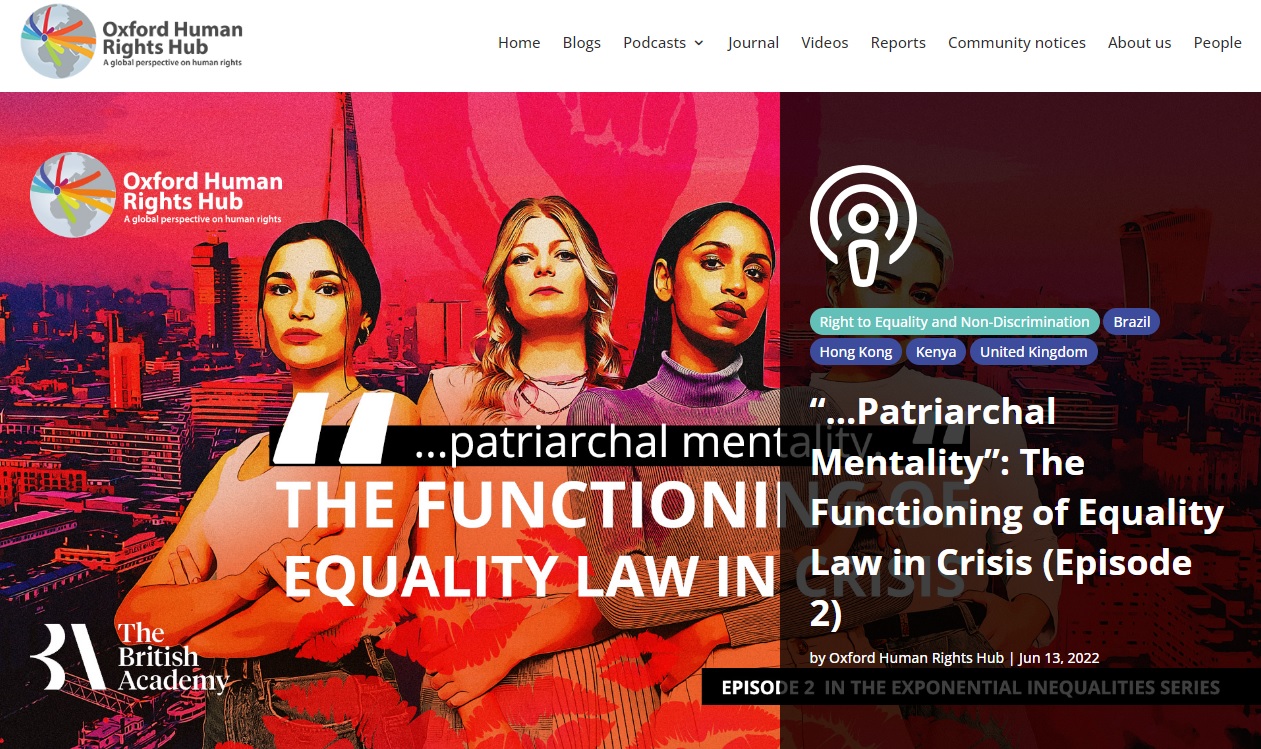
Kelley Loper in Podcast for the Oxford Human Rights Hub: Exponential Inequalities: Equality Law in Times of Crisis

A podcast for the Oxford Human Rights Hub: part of the Exponential Inequalities project led by Shreya Atrey which is also producing the book Exponential Inequalities: Equality Law in Times of Crisis, edited by Shreya Atrey and Sandra Fredman.  Kelley Loper has a chapter in that book on Hong Kong.
     Human rights experts help us determine whether equality law is set up to protect the most vulnerable in times of crisis.   This is Episode Two of a four-part series. The series takes a deep dive into whether equality law is cut out to protect the most vulnerable in times of crisis, and if not, then why not and what can we do about it?  This podcast series is part of the Exponential Inequalities project, led by Shreya Atrey as the Principal Investigator of the British Academy Leverhulme Small Research Grant on Equality Law in Times of Crisis.
    Transcript and show notes available on the Oxford Human Rights Hub website at ohrh.law.ox.ac.uk. Producer, Presenter, Sound Editor: Christy Callaway-Gale. Executive Producers: Shreya Atrey, Meghan Campbell, Sandra Fredman. Assistant Producers: Mónica Arango Olaya, Gauri Pillai, Natasha Holcroft-Emmess. Transcript and show notes: Sarah Dobbie
     EPISODE 2 is titled “…Patriarchal Mentality” : The Functioning of Equality Law in Crisis. It features Anna Lawson, Kelley Loper, Christy Callaway-Gale, Victoria Miyandazi, Aaron Reeves, Marta Machado, Helena Alviar García, and Beth Gaze.  To listen to the episode, click here.

Wednesday, April 20, 2022

Alec Stone Sweet et al on Dissenting Opinions and Rights Protection in the European Court (EJIL)

"Dissenting Opinions and Rights Protection in the European Court: A Reply to Laurence Helfer and Erik Voeten"
Alec Stone Sweet, Wayne Sandholtz, and Mads Andenas
Volume 32, Issue 3, August 2021,
pp. 897–906, https://doi.org/10.1093/ejil/chab057
Published on 22 November 2021
Abstract: In their article ‘Walking Back Human Rights in Europe?’, Helfer and Voeten (hereinafter ‘H-V’) argue that a series of High Level Conferences (2012–2018), specifically Brighton (2012), dramatically altered the style of the European Court of Human Rights’ (ECtHR) decision-making. The Grand Chamber began to adopt judgments which, in turn, provoked an unprecedented wave of ‘Walking-Back Dissents’. Such dissents are separate opinions that, in effect, accuse the majority of a Grand Chamber of ‘tacitly overturn[ing] prior rulings or settled doctrine in favour of national governments’ (H-V, p. 823). In an expansive conclusion, H-V suggest that the ECtHR has also generated a rising number of ‘Walking-Back Judgments’, which lower standards of rights protection. We reject H-V’s major claims on the empirical evidence. The outcomes of Brighton and subsequent conferences did not pose a credible threat to the Court, and could not have induced it to ‘walk back’ rights protection. We also closely examined two sets of Walking-Back Dissents identified by H-V, focusing on judgments that would be ‘most likely to fit’ H-V’s ‘expectations’. We found that fewer than one in four judgments analysed actually contained a Walking-Back Dissent. And we identified only one plausible Walking-Back Judgment. We are confident that H-V’s results are inaccurate and cannot be reproduced by external analysts. We conclude by noting factors that H-V do not consider, but that are crucial to understanding the ECtHR’s decision-making. In appendices, posted online, we summarize and give reasons for our coding decisions.

Friday, December 31, 2021

New Issue of Asia-Pacific Journal on Human Rights and the Law (Volume 22, Issue 2, Dec 2021)


Editors-in-Chief: Simon NM Young and Kelley Loper
Publisher: Brill, Leiden

Table of Contents

Protecting the Identity of Juveniles in Criminal Proceedings in Viet Nam and Victoria
Open Trials and Restricted Publication
Authors: Le Huynh Tan Duy and Marilyn McMahon
Pages: 115–149
Online Publication Date: 31 May 2021

Procedural Rights Supporting Expeditious Trials for Juveniles (Open Access)
Effective Remedies and Legal Representation
Author: Aekje Teeuwen
Pages: 150–185
Online Publication Date: 29 Nov 2021

Development and Economy in Mongolia through a Human Rights Law Lens
Author: Juan Pablo Bohoslavsky
Pages: 86–221
Online Publication Date: 29 Nov 2021

Climate Change and the Challenges for Developing Countries in the Implementation of the Human Right to a Healthy Environment: Case of Vietnam
Authors: Nguyen Thi Hong Yen and Nguyen Phuong Dung
Pages: 222–254
Online Publication Date: 29 Nov 2021

Legal Pluralism, Human Rights and the Right to Vote: The Case of the Noken System in Papua
Author: Ignatius Yordan Nugraha
Pages: 255–286
Online Publication Date: 29 Nov 2021

We are pleased to announce that publication of APJHRL will expand to three issues per year starting in 2022.

Friday, July 30, 2021

HKU Law Welcomes the Chair of Comparative and International Law, Professor Alec Stone Sweet

HKU Law Welcomes Professor Alec Stone Sweet who joins the Department of Law as the Chair of Comparative and International Law, working in the fields of comparative and international politics, comparative and international law, international arbitration and human rights. 
     Prior to moving to HKU, Alec was the Saw Swee Hock Centennial Professorship at NUS, and held chaired professorships at the Yale Law School and Nuffield College, Oxford. He has also held visiting appointments at the Columbia Law School, as well as in universities in Aix-en-Provence, Bologna, Florence, Hong Kong, Leiden, Madrid, Milan, Paris, Stockholm, Sydney, and Vienna.
     Alec has published thirteen books, ten with Oxford University Press, including the most recent: Proportionality Balancing and Constitutional Governance: A Comparative and Global Approach (2019); A Cosmopolitan Legal Order: Kant, Constitutional Justice, and the European Convention on Human Rights (2018); and The Evolution of International Arbitration: Judicialization, Governance, Legitimacy (2017). His current book project is a comparative analysis of regional human rights courts. A regular contributor to assorted American law reviews, he has also published articles in peer-reviewed journals, including the American Journal of Sociology, the American Political Science Review, Comparative Political Studies, the German Law Journal, the International Journal of Comparative Constitutional Law, the Journal of Common Market Studies, the Journal of Global Constitutionalism, the Journal of European Public Policy, the Journal of Law and Courts, and West European Politics.

Research Area
  • International Law and Politics
  • Comparative Law and Politics
  • International Arbitration
  • Human Rights

Wednesday, May 26, 2021

Jane Richards (PhD candidate) on An Incremental Approach to Filling Protection Gaps in Equality Rights for Persons with Disabilities (Human Rights Law Review)

"An Incremental Approach to Filling Protection Gaps in Equality Rights for Persons with Disabilities"
Jane Richards (PhD candidate)
Human Rights Law Review
Published on 15 May 2012
Abstract: The Convention on the Rights of Persons with Disabilities (CRPD) guarantees that persons with disabilities (‘PWD’) are to be equal before and under the law. There are almost identical equality guarantees in the Canadian Charter of Rights and Freedoms and Hong Kong's mini constitution – the Basic Law. Australia boasts similar legislative equality guarantees for PWD. The CRPD Committee has interpreted the right broadly, whereas constitutional courts have taken a proportionality approach, balancing the right to substantive equality against competing concerns. The tension between these methods of rights protection means the CRPD is being positioned as an alternative model of rights protection, but it is not an alternative mechanism for enforcement. This article calls on the Committee to modify its guidance to make suggestions to state parties as to how incremental advances in rights protection can be immediately implemented, even if in the short-term, these advances fall short of full inclusion.

Friday, May 7, 2021

Melissa Loja (PhD 2018) on Recent Engagement with International Human Rights Norms by the Courts of Singapore, Malaysia, and Philippines (International Journal of Constitutional Law)

International Journal of Constitutional Law
Published in March 2021
Abstract: This article makes two claims about international human rights norms in three English-speaking courts in Southeast Asia. First, the courts are engaging with the norms, contrary to the prevailing view that the four-walls and dualist doctrines maintain a stranglehold on the region. Singapore courts relied on foreign case law applying the European Convention on Human Rights to rationalize a liberal interpretation of arbitration agreements; Malaysia’s Court of Appeal based its decision on the Association of Southeast Asian Nations Human Rights Declaration, despite lack of legislative incorporation; and the Philippine Supreme Court applied the Convention on the Protection of Persons against Enforced Disappearances (CPPED) as evidence of customary international law, notwithstanding that the government had repeatedly refused to ratify CPPED. Second, their engagement is characterized by inconsistency and arbitrariness as it is governed more by exigency than by human rights philosophy. The Philippine court invoked universality to give direct but selective effect to the norms. In the name of pluralism, Malaysian courts gave direct effect to the norms, but the effect has been transitory. In Singapore, the norms have teleological effect in private law cases involving commercial and investment interests, but not in public law cases involving individual and political rights. The lack of principled practice and the ensuing uncertainty undermine the ethos of human rights and raise the question of whether more practice makes right.

Sunday, October 25, 2020

Haochen Sun on Reinvigorating the Human Right to Technology (Michigan J of Int'l L)

"Reinvigorating the Human Right to Technology"2020, 41 Michigan Journal of International Law 279
Published in August 2020
Abstract: The right to technology is a forgotten human right. Dating back to 1948, the right was established by the Universal Declaration of Human Rights (“UDHR”) in response to the massive destruction wrought by technologically advanced weapons in the Second World War. This human right embodies one of the most profound lessons the framers of the UDHR learned from this war: Technology must benefit humanity rather than harm it.
     It has been more than seventy years since the adoption of the UDHR, and technology has advanced at a rapid pace and become more important than ever in our daily lives. Yet in this age of technology, the right to technology remains obscure, dormant, and ineffective. No other human right has received such scant attention, and the right to technology has indeed become an “orphan” in the international human rights regime. This article traces the origins of society’s disregard for the right and attributes it to the confluence of three main contributing factors: (1) the right’s inherent obscurity, (2) the ineffective human rights enforcement system, and (3) the international community’s overemphasis on intellectual property protection. The current human rights regime is unable to sufficiently address these complex factors, as it remains deeply rooted in the individual rights system and lacks a fully-fledged distributive justice vision.
     Against this backdrop, this article reinvigorates the right to technology by recommending its protection as a collective right. It considers how and why the right to technology should be redefined as a collective right that entitles people to enjoy the benefits of technological progress and minimizes the harms that such progress may cause. A collective right to technology can protect both larger societal interests in maintaining public freedom and dignity, as well as specific group interests in guarding against the use of technologies to prejudice group freedom and dignity. This new understanding of the right to technology, therefore, sets distributive justice agendas for promoting the development of intellectual property law into the public interest.

Haochen Sun on The Fundamental Right to Technology (Hofstra L Rev)

"The Fundamental Right to Technology"2020, 48 Hofstra Law Review 445
Published in August 2020
Abstract: Waves of technological progress in recent decades have tremendously improved quality of life. Meanwhile, concerns about technology-driven injustices, such as unfair distribution of wealth and racial discrimination, have deepened. Experts have cautioned that new technologies could have potentially devastating effects, claiming for instance that artificial intelligence may lead to World War III. We are at a crossroads, and how we harness technology now will determine the future of humanity.
     This Article presents a thought experiment, proposing that a new fundamental right to technology be recognized under the U.S. Constitution. Given that technology is of fundamental importance to human dignity and equality, this new constitutional right is designed to promote equitable distribution of technological benefits and to prevent harmful applications of technologies. This proposal is made with the hope that other countries may also recognize this fundamental right in constitutional law, ensuring global protection of the right to technology.
     Based on an overview of fundamental rights protection under the U.S. Constitution, the Article first discusses how the U.S. Supreme Court has developed a liberal approach to identifying fundamental rights not enumerated by the Constitution. It then applies this liberal approach to a consideration of why the right to technology should be deemed an un-enumerated fundamental right. This Article further canvasses how this new fundamental right would protect collective interests in technological benefits. It also explores how to resolve the potential tension between the Intellectual Property Clause and protection of the right to technology.