Showing posts with label Jing Hui. Show all posts

Tuesday, July 28, 2026

RGC Awards $5 Million in Research Funding to HKU Law 2026/27

Congratulations to our eight colleagues who were successful in the 2026-2027 round of research grant funding by Hong Kong's Research Grants Council (RGC). Seven General Research Fund (GRF) projects were funded to evaluate the Infrastructure Consultation in the Asia Pacific; to explore Human-AI Interaction in Legal Processes; to regulate Donation-Based Crowdfunding Platforms in China; to assess how can AI help Debt Mediation; to analyse Damage in Hong Kong's Law of Negligence; to examine the role of corporate law in advancing ESG in China; to evaluate the structured issues of FILs and identifying ways to minimize FILs’ impact on citizens’ rights. One Early Career Scheme (ECS) project was funded to evaluate the Necessity and Feasibility of a Sentencing Council in Hong Kong. The details of the new funded projects are as follows:

GRF:
Professor Shahla Ali
Infrastructure Consultation in the Asia Pacific, HK$827,180

Professor Benjamin Chen
Artificially Enhanced Justice: An Exploration of Human-AI Interaction in Legal Processes, HK$777,600

Professor Hui Jing
Regulating Donation-Based Crowdfunding Platforms in China: Challenges and Future Directions, HK$633,900

Professor John Liu
Can Artificial Intelligence Help Debt Mediation? A Field Experiment, HK$650,000

Professor Craig Purshouse
Damage in Hong Kong's Law of Negligence, HK$147,500

Professor James Zeng
Corporate Law and ESG in China, HK$816,000

Dr. Han Zhu
Rule of Law or Rule of Values? A Critical Comparative Analysis of Foreign Influence Laws, HK$549,240

ECS:
Professor Florence Lee
Evaluating the Necessity and Feasibility of a Sentencing Council in Hong Kong: Lessons from Comparative Perspectives, HK$599,984

Friday, December 26, 2025

Congratulations to Professor Hui Jing!

Congratulations to Prof. Hui Jing on his promotion to Associate Professor! Prof. Jing is a prolific researcher with an excellent publication record. He is a rare scholar of comparative trust law who can effectively cover both the Chinese and common law jurisdictions. He is one of the few experts worldwide capable of engaging deeply with both legal traditions. Prof. Jing is a valuable member of our Faculty, and this promotion is a well-deserved recognition of his contributions. To read more about Prof. Jing's research and publications, click here.

Friday, September 19, 2025

Hui Jing on The Concept of Beneficial Ownership in Express Trust: A Necessity? (Journal of Equity)

"The Concept of Beneficial Ownership in Express Trust: A Necessity?"
Hui JING
Journal of EquityVol 18 issue 2, pp.131-164
Published: February 2025

Abstract: The symmetry between legal and equitable estate is often considered a defining characteristic of an express trust. Consequently, the concept of beneficial ownership plays a crucial role in understanding how an express trust is established and operated. However, concentrating solely on beneficial ownership leads to the categorisation of charitable and non-charitable purpose trusts as exceptions within the express trust framework. This also creates challenges in understanding the entitlement of discretionary trust beneficiaries to initiate legal proceedings regarding the mismanagement of trust property by trustees. This article argues that due administration, instead of beneficial ownership, is a shared concern applicable to all kinds of express trusts. By shifting the focus from beneficial ownership to due administration, it is possible to establish a doctrinal connection among all types of express trusts. Furthermore, the increasing adoption of express trusts in civil law jurisdictions demonstrates that trust law has surpassed the confines of the common law sphere, and the understanding of trusts is no longer limited to the context of common law. By emphasising due administration, it becomes feasible to encourage a conversation between civil and common law jurisdictions regarding their unique approaches to express trusts.

Please click here to read the full article on SSRN.

Monday, June 9, 2025

Lusina Ho and Hui Jing on The Dominance of Regulatory Oversight in Chinese Investment Trusts (Asia-Pacific Trusts Law, Volume 3)

"The Dominance of Regulatory Oversight in Chinese Investment Trusts"
Lusina Ho and Hui Jing
Asia-Pacific Trusts Law, Volume 3, Boundaries in Context, Part II, Chapter 10
Hart Publishing
Published online: May 2025

Abstract: A fundamental tenet in the relationship between regulations and private law is their functional dichotomy. Private law deals with the adjudication of bilateral rights and duties between individuals. Its main purpose is to protect the rights of individuals from infringement by others. In contrast, regulations primarily serve public interests, and are typically enforced by regulatory agencies through administrative sanctions or criminal liability. In this chapter, we argue that the Chinese legal regime for investment trusts departs from this paradigmatic dichotomy. Regulatory supervision not only addresses public interest concerns, but also frequently displaces private law in resolving disputes amongst trust parties, blurring the boundary between private law and regulations. We examine the unique circumstances in China that account for this regulatory dominance and argue that it can be justified only as a temporary measure.

Following this introduction, Part II discusses the main reason for regulatory dominance in China. We examine how the widespread use of investment trusts for shadow banking raises public interest concerns when private law rights are enforced in such trusts. In Part III, we explore the use and limitations of regulatory supervision to address both the public interest and private law concerns raised by trust (mal)practice. Part IV contends that whilst regulations can be an effective interim measure for addressing private law disputes, legislators should in the long term adopt a proactive approach and enact trust laws that clearly define the rights and responsibilities of the trust parties. Part V concludes.

Full text of this chapter is available on SSRN, please click here.

Wednesday, February 26, 2025

Hui Jing and Wanyi Zhang on Enforcing Chinese charitable trusts (Trusts & Trustees)

"Enforcing Chinese charitable trusts"
Wanyi Zhang, Hui Jing
Trusts & Trustees, ttaf002
Published Online: January 2025

Abstract: This article examines the enforcement mechanisms of Chinese charitable trusts, highlighting the limitations of public law enforcement by civil affairs departments due to resource constraints. Through a comparative analysis of the English particular interest rule, it explores alternative enforcement frameworks, arguing that the beneficiary–recipient debate, while academically insightful, does not address practical enforcement challenges. The study suggests that the public law elements of charitable trusts necessitate a flexible, context-sensitive enforcement approach. For Chinese courts, the focus should be on whether supporting a plaintiff-charitable trust beneficiary’s claim ensures proper management of trust property and preserves the public benefit.

Monday, January 20, 2025

HKU Awards for Research Excellence 2023-24

Congratulations to all Faculty of Law colleagues who were recognised in HKU Awards for Research Excellence 2023-24:

Outstanding Researcher Award 2023-24
Thomas Cheng

Outstanding Young Researcher Award 2023-24
Zhuang Liu

University’s Research Output Prize 2023-24 (Faculty of Law)
'The Governance of Chinese Charitable Trusts'
By Hui Jing, published by Cambridge University Press in September 2023

More details of the HKU Awards for Research Excellence can be found here

Monday, July 22, 2024

New Issue of Hong Kong Law Journal (Vol. 54, Part 1 of 2024)

HONG KONG LAW JOURNAL
Vol. 54, Part 1 of 2024
Editor-in-Chief: Prof. Eric C Ip
Deputy Editor-in-Chief: Prof. Julius Yam
Publisher: Sweet & Maxwell

TABLE OF CONTENTS


Obituary

In Memoriam: Professor Julius Yam (1992-2024), Deputy Editor-in-Chief of Hong Kong Law Journal 
Cora Chan and Hualing Fu...1

Articles
Kemal Bokhary...5
Wanli Wang...13
Han Zhu...53

Ting Zhou, Jingwen Chen and Qiuning Luan...65
Jie Long and Wenzhen Chen...85

Xingmei Zhang and Jieren Hu...109
Min Yan...133
Na Zhang and Li Liu...157
Tietie Zhang...179
Peter CH Chan and Wanqiang Wu...203
Dejian Li and Hui Jing...231

Book Review

Samuli Seppänen...285


Hui Jing and Dejian Li on The Accountability of Non-charitable Donation-based Crowdfunding Platforms in China (HKLJ)

"The Accountability of Non-charitable Donation-based Crowdfunding Platforms in China"
Dejian Li and Hui Jing
Hong Kong Law Journal, Vol. 54, Part 1 of 2024, pp.231 - 252

Abstract: Due to the wide application of internet tools, non-charitable donation-based crowdfunding platforms (NDCPs) serving personal requests for help have been developing rapidly in China. However, due to the lack of a specific regulatory framework for the administration of donation funds by NDCPs, risks regarding the misuse of donation funds by beneficial objects and the mismanagement of donation funds by NDCPs have been frequently realised. To address these risks, Chinese legislators intend to authorise the Ministry of Civil Affairs and related departments to establish a systemic regulatory framework for NDCPs. Against this backdrop, this article explores one specific question: What measures can be implemented to ensure that NDCPs are held accountable for their administration of donation funds in China? This is the first English-language article to explore this question in the Chinese law context. First, it analyses the emergence of NDCPs in China and identifies the problems inherent in the administration of donation funds by these NDCPs. Second, it proposes a trust law framework to regulate the administration of donation funds by NDCPs.

Please click here to view the full article on SSRN.

Monday, May 27, 2024

Hui Jing on Third-Party and Bankruptcy Effects under Chinese Trust Law: Comparisons with English Trust Law (Asian Journal of Comparative Law)

"Third-Party and Bankruptcy Effects under Chinese Trust Law: Comparisons with English Trust Law"
Hui Jing
Asian Journal of Comparative Law
Published online: April 2024

Abstract: In English law, the trust's third-party and bankruptcy effects contribute significantly to its wide use in commercial transactions. In view of the trust's attractiveness in conducting commercial dealings, China has also introduced the trust model into its domestic legal system to enhance its financial infrastructure. However, given the extent to which Chinese law has been influenced by the Roman-Germanic tradition, China's replication of the trust's third-party and bankruptcy effects has encountered doctrinal obstacles. Drawing upon the experience of its Northeast Asian forerunners, China has established two mechanisms to achieve the third-party and bankruptcy effects: the regime of trust fund independence and the granting of the right of rescission to beneficiaries. These two mechanisms represent the adjustments made by Chinese legislators in the process of transplanting the trust model into the Chinese legal context. Adopting a comparative law perspective, this article examines these mechanisms in the Chinese law setting for two reasons: first, to explore the mechanisms’ constituent elements and their operation, as well as the roles of both mechanisms in the Chinese trust law system; and second, to furnish comparative law scholarship with broader insights into rule transplantation and reconciliation.

Monday, April 15, 2024

Hui Jing on Regulating donation-based crowdfunding platforms in Hong Kong: A trust law framework (Common Law World Review)

"Regulating donation-based crowdfunding platforms in Hong Kong: A trust law framework"
Hui Jing
Common Law World Review
Published online: March 2024

Abstract: With the advance of technology, several crowdfunding platforms have emerged in Hong Kong to host informal public donation appeals. Unlike charitable crowdfunding activities, these appeals focus on crowdfunding to provide relief to specific individuals or groups in need. Due to the recent emergence of online informal public donation appeals and their lack of public benefit, regulatory bodies have not paid much attention to their regulation. However, recent media coverage highlighting scandals of maladministration of donation funds in the context of informal public donation appeals has impelled regulators to establish a systemic framework to govern crowdfunding platforms that host informal public donation appeals. This article addresses two main aspects of this topic. First, it discusses the operation of crowdfunding platforms that host informal public donation appeals and the risks associated with them. Second, it explores the feasibility of utilising trust law to regulate the administration of donation funds by these crowdfunding platforms.


Sunday, October 8, 2023

RGC Awards $4.8 Million in Research Funding to HKU Law 2023/24

Congratulations to our eight colleagues who were successful in the 2023-2024 round of research grant funding by Hong Kong's Research Grants Council (RGC). Six General Research Fund (GRF) projects were funded to study the abuse of dominance in the digital age; to examine the reformation of administrative law for the coming age of algorithmic government in Hong Kong; to evaluate the process of transnational law-making and its boundaries in trust and succession planning in Hong Kong and Singapore; to conduct field experiments of using cameras in Chinese trials; to study the implications for enhanced intellectual property protection in China through the Chinese music streaming market; to explore possible changes and impacts on the Hong Kong tax system after the social unrest, COVID-19 and PRC factor. Two Early Career Scheme (ECS) project were funded to study political crowdfunding in authoritarian regimes and to conduct a comparative study (Hong Kong, Australia, and England) of trustees’ discretionary powers in express private trusts and their possible control. The details of the new funded projects are as follows:

GRF:


Wednesday, September 27, 2023

New book by Dr Jing Hui: The Governance of Chinese Charitable Trusts (Cambridge University Press)

Published on 7 September 2023
350 pp.
Overview: Legislators in China introduced the charitable trust model in 2016 with the passage of the Chinese Charity Law. They constructed a new legal framework for this model, in order to unlock the potential of trust institutions to further and develop charitable causes. This is the first English-language monograph exploring the governance of Chinese charitable trusts from the perspective of law and sociology. Through the application of doctrinal analysis and semi-structured qualitative interviews, this book reveals that China's particular political, social, and economic conditions are essential to understanding the legislated governance framework for charitable trusts and its implementation in practice. Embedded in China's unique institutional context, the governance of Chinese charitable trusts can only be fully understood in light of relevant law, administrative practice, and private actions taken by charitable trust parties.

Tuesday, March 14, 2023

Jing Hui on Proprietary Estoppel Remedies in Hong Kong (HKLJ)

Proprietary Estoppel Remedies in Hong Kong
Jing Hui
in Hong Kong Law Journal (Vol. 52, Part 3 of 2022), pp.789 - 798
Abstract: In Hong Kong law, the courts have always declined to introduce the remedial constructive trust device, characterising it as a moot point or as a device that does not exist in Hong Kong. However, the most recent Court of Final Appeal (CFA) decision in Cheung Lai Mui v Cheung Wai Shing [2021] HKCFA 19 deviated from the foregoing attitude to remedial constructive trusts. It recognised “unconscionability” as the basis of relief, demonstrating the departure of Hong Kong law from the principles of proprietary estoppel currently applied in the English law. Contrary to the English approach of minimum equity to do justice, the exercise of broad discretion by the CFA in Cheung Lai Mui was more similar to the Australian approach to proprietary estoppel remedies. This case note analyses the reasons why the CFA adopted the remedial constructive trust approach in Cheung Lai Mui, as well as the problems that arise from the adoption of such an approach in Hong Kong law.

Monday, March 13, 2023

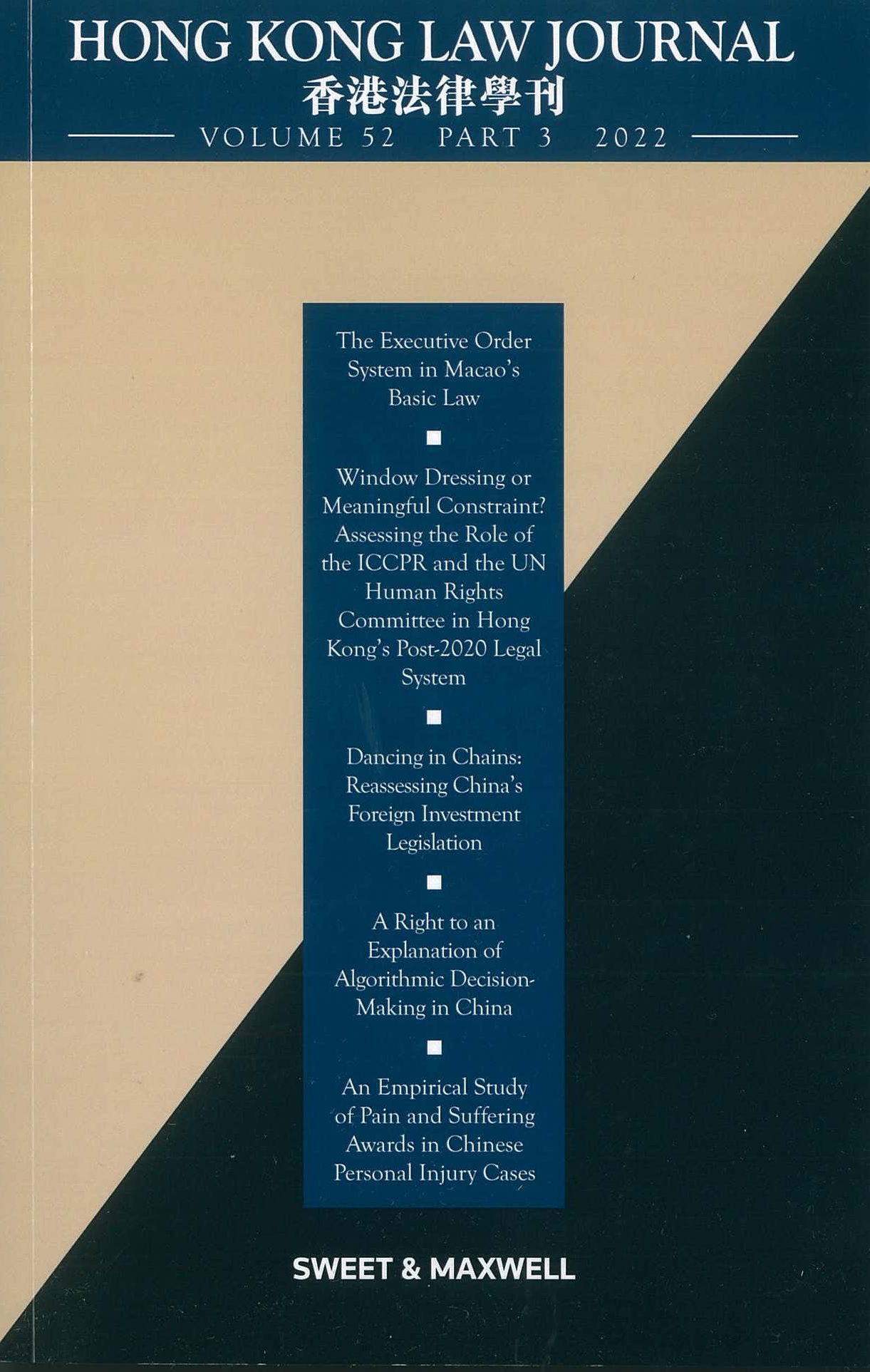
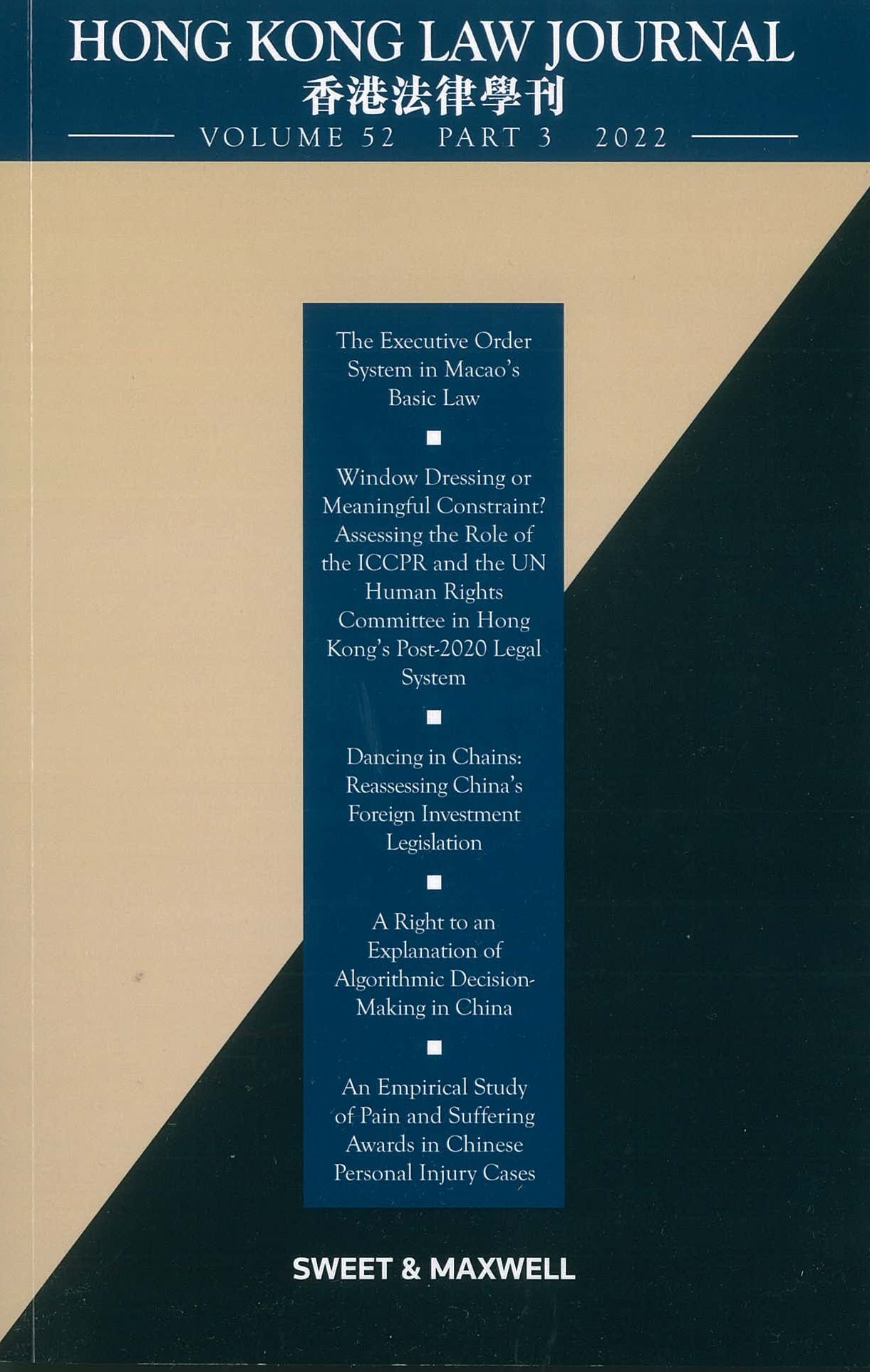
New Issue of Hong Kong Law Journal (Vol. 52, Part 3 of 2022)

HONG KONG LAW JOURNAL
Editor-in-Chief: Professor Rick Glofcheski
Associate Editor: Professor Albert Chen
Publisher: Sweet & Maxwell

TABLE OF CONTENTS

Analysis

Proprietary Estoppel Remedies in Hong Kong
Jing Hui...789

In Hong Kong law, the courts have always declined to introduce the remedial constructive trust device, characterising it as a moot point or as a device that does not exist in Hong Kong. However, the most recent Court of Final Appeal (CFA) decision in Cheung Lai Mui v Cheung Wai Shing [2021] HKCFA 19 deviated from the foregoing attitude to remedial constructive trusts. It recognised “unconscionability” as the basis of relief, demonstrating the departure of Hong Kong law from the principles of proprietary estoppel currently applied in the English law. Contrary to the English approach of minimum equity to do justice, the exercise of broad discretion by the CFA in Cheung Lai Mui was more similar to the Australian approach to proprietary estoppel remedies. This case note analyses the reasons why the CFA adopted the remedial constructive trust approach in Cheung Lai Mui, as well as the problems that arise from the adoption of such an approach in Hong Kong law.

Falsehoods, Foreign Interference and Free Speech in Singapore
Kenny Chng and Jeremy Chai...799

Lecture

The Essence of Advocacy
Kemal Bokhary...811

Basic Law Anniversary Focus

Focus: 25th Anniversary of the HKSAR
Albert HY Chen...825

The Changing Constitutional Order of the HKSAR: A Retrospective Reflection
Zhu Guobin...827

Identity Politics and Constitutional Change in Hong Kong: The National Security Law and 25 Years of the Basic Law
Jie Cheng...851

Two Years On: Reviewing the Implementation of the NationalSecurity Law in the HKSAR
Michael Jackson...875

This review surveys the case law dealing with the Hong Kong National Security Law (NSL) offences in the two years since the enactment of the NSL, with a view to identifying what we have learned about the four categories of NSL offences. The article is concerned primarily with Ch III of the NSL, headed “Offences and Penalties”, but also covers to a lesser extent Ch IV, dealing with “Jurisdiction, Applicable Law and Procedure”. Part 1 introduces the NSL offences regime. Part 2 will briefly summarise the enforcement of the NSL since its enactment. Part 3 will outline several key themes or rulings emerging from the case law relating to the integration of the NSL with existing HK criminal law and procedure. Part 4 will explore what we have learned about the NSL offences themselves and their elements, and how the courts have begun to shape these offences within HK’s existing common law legal system. Part 5 will offer some brief conclusions.

Reactivated and Re-energised: The Sedition Offences in “New Era” Hong Kong
Pui-yin Lo ...913

Sections 9 and 10 of the Crimes Ordinance (Cap 200), which prescribe the offences of sedition in Hong Kong, have had an extraordinary history since the establishment of the Hong Kong Special Administrative Region (HKSAR). Notwithstanding that it was once proposed to put them into the proverbial dustbin, the sedition offences have, since the introduction of the Law of the People’s Republic of China on Safeguarding National Security in the Hong Kong Special Administrative Region (NSL) in mid-2020, been vigorously enforced as an “offence endangering national security” within the meaning of the NSL by the National Security Department of the Hong Kong Police Force and the Department of Justice. This article considers this recent history of reactivation of the sedition offences in conjunction with the system of enforcement provided under the NSL in order to explain the boosted position held of the sedition offences by the local law enforcers and their supervisors. This article then examines several completed prosecutions of sedition to date to discern how the courts of the HKSAR have viewed these offences, both in light of the attempts to impugn the offences by the defence and the comparable cases of sedition-like offences from other common law jurisdictions. Finally, this article offers three strategies for persuading the appellate courts that the sedition offences and their enforcement per the NSL could be curtailed or circumscribed: (1) sections 9 and 10 had been repealed by operation of the Hong Kong Bill of Rights Ordinance (Cap 383), and accordingly there is nothing to be revived for enforcement; (2) remedial interpretation(s) can be suitably imposed to resolve the issues of legal certainty and necessity of criminalising speech and expressive acts merely and plainly for their ascribed “intentions” and (3) several of the seven categories of “seditious intention” have a reasonably doubtful connection with the safeguarding of national security and the obligation of the institutions of the HKSAR to prevent, suppress and punish acts and activities endangering national security, so that it is appropriate on balance with the protection of fundamental rights and the rule of law to disapply the NSL’s system of enforcement against persons alleged to have committed acts under those categories of “seditious intention”.

Taking Rights Seriously — the Judiciary at a Challenging Time
Johannes Chan...937

While the judiciary is generally regarded as the defender of the rule of law and fundamental rights, it is not uncommon that judges could also suppress democratic values. Courts around the world have legitimised undemocratic or even repressive law and practices. Authoritarian regimes tend to capture the judiciary, not only because the judiciary would provide the legitimacy for anti-democratic measures, but the nature of the institution could also masquerade such measures as a legitimate exercise of power that makes it more difficult to detect and respond to. This article examines the relationship between the Central Government and the judiciary of the Hong Kong Special Administrative Region (HKSAR). It focuses on the judicial responses when the Central Government decided to shift the emphasis from “Two Systems” to “One Country” under the constitutional design of the HKSAR and to exercise “full jurisdiction” over Hong Kong. By focusing on the reasoning and the context of the relevant cases, it argues that the responses of the judiciary amount to a weak form of “abusive judicial review”. The constitutional model of “One Country, Two Systems” implies mutual accommodation of the two systems, and convergence means reconciliation of the two systems rather than changing one system to conform with the other system. While there are incidents suggesting a strong form of “abusive judicial review”, it is argued that it is too early to draw this conclusion. The article also cautions that when the pendulum has swung from one extreme to the other, it is even more important for the judiciary to make full use of the tapestry of common law principles to strike a better balance between fundamental rights and protection of national security.

Reflections on the Meaning of the Right to Vote in Hong Kong
Simon NM Young ...965

If rights are interpreted purposively, what is the purpose of the right to vote in Hong Kong? It means more than casting a ballot or being a candidate in elections. The right to vote serves to enable permanent residents to participate meaningfully in the electoral process and public affairs more generally. Meaningful participation implies that voters are informed of the relevant issues. Hong Kong underwent major reforms in its electoral systems in 2021. In the eyes of the public, the reforms had the effect of rendering the right to vote less meaningful, if not meaningless. In the future, the central and regional governments need to restore people’s confidence in the elections and bring back vibrancy to the right to vote in Hong Kong.

Articles

Enforceability of Excessive Pricing Rules under Hong Kong Competition Law
Jae Woon Lee and Yiu Yeung Tong...977

The Executive Order System of the Basic Law of the Macao Special Administrative Region
Yumei Kang and Ziyu Liu...997

Window Dressing or Meaningful Constraint? Assessing the Role of the International Covenant on Civil and Political Rights and the United Nations Human Rights Committee in Hong Kong’s Legal System Carole J Petersen...1031

The Challenges of the Singapore Convention to the Chinese Mediation System
Xiong Hao...1057

China Law

Dancing in Chains: Reassessing China’s Foreign Investment Legislation (Part II)
Li Yang, Hui Pang and Charlie Xiao-chuan Weng...1083

Chengwei Liu and Kang Wang...1111

A Right to an Explanation of Algorithmic Decision-Making in China
Huanmin Lin and Hong Wu...1163

An Empirical Study of Pain and Suffering Awards in Chinese Personal Injury Cases
Ding Chunyan and Zhi Pei...1193

Book Review

Sinchit Lai...1229

Tuesday, February 7, 2023

Hui Jing on Political Influence in the Regulation of Chinese Charitable Trusts (Canadian Journal of Law and Society)

"Political Influence in the Regulation of Chinese Charitable Trusts"
Hui Jing
Canadian Journal of Law and Society / La Revue Canadienne Droit et Société
Published online on 26 January 2023
Abstract: With the 2016 Charity Law, Chinese legislators created a public-private hybrid model for the governance of charitable trusts. By endowing private actors with greater rights in the creation and management of charitable trusts, this hybrid model demonstrates the State’s intention of changing the functioning of the charitable trust sector from complete dependence on the State to a partnership. However, embedded in China’s particular institutional environment, the partnership relationship still bears the mark of strict government control, which is secured by granting extensive powers to regulators. This article analyzes the newly established regulatory framework for charitable trusts and outlines how regulators exercise their power in practice. The findings show that the tradition of regulators being subject to intense administrative pressures remains unchanged and that political concerns permeate every aspect of the regulation of charitable trusts.

Thursday, October 13, 2022

New Issue of Hong Kong Law Journal (Vol. 52, Part 1 of 2022)

HONG KONG LAW JOURNAL
Editor-in-Chief: Professor Rick Glofcheski
Associate Editor: Professor Albert Chen
Publisher: Sweet & Maxwell

TABLE OF CONTENTS


Lecture

Food, Clothing and Housing as Human Rights 

Kemal Bokhary… 1

Articles

The 2019 Rendition Saga in Hong Kong: A Perspective on the Tensions Inherent in “One Country, Two Systems”

Fan Xiang… 9

The 2019 political storm in Hong Kong, triggered by resistance to a proposed law that would have created an institutional channel for the extradition of fugi¬tives from Hong Kong to Mainland China, resulted in the most severe and prolonged civil unrest in this city since China resumed exercise of sovereignty over Hong Kong in 1997. This article considers the nature of the 2019 rendi¬tion saga in the context of the tensions inherent in the constitutional framework of “One Country, Two Systems”. It is contended that there are contradictions within the structure of the “One Country, Two Systems” formula such that it encourages and yet limits a Western-style liberal democracy in Hong Kong. It is argued that the prolonged anti-extradition movement is no more than a reflection of the internal contradictions of “One Country, Two Systems” but in a more ferocious way than before. If this paradox is not resolved properly, it is doomed to plague Hong Kong in the future.

Recordation and Review by the National People’s Congress Standing Committee under the Hong Kong Basic Law 

Paul Law and Trevor Wan… 43

This article explores the Recordation and Review Mechanisms anchored in art 17(2) and 17(3) of the Basic Law which provides for the obligation of Hong Kong to report enacted laws to the China’s National People’s Congress Standing Committee (NPCSC) for the record and the NPCSC’s corresponding powers to review and return any such laws. We argue that the Recordation and Review Mechanisms are an interconnected set of constitutional enforcement mecha¬nisms for the NPCSC to police the constitutional limits of Hong Kong’s auton¬omy. Furthermore, we highlight and examine two ambiguities in art 17(2) and 17(3), namely the lack of any mention of conditions under which the art 17(3) review process could be triggered and the ambiguous legal status of reported laws that have not been returned by the NPCSC. This article then undertakes a comparative study vis-a-vis the Chinese Filing and Review System, China’s key legislative supervisory system, which we argue is indispensable in fully understanding the operation of Hong Kong’s Recordation and Review Mechanisms and resolve the two ambiguities highlighted. We sketch, drawing on the Chinese Filing and Review System, how the review process could be activated and how NPCSC’s power of review could be reconciled with local courts’ jurisdiction of constitutional review through developing a framework elucidating the proper judicial responses to a “passive confirmation” by the NPCSC in not returning a submitted law under different circumstances.

The CISG and its Extension to a Territorial Unit of a Contracting State: The Case of HongKong 

Liu Qiao… 67

A Sophisticated Solution for Overlapping Maritime Areas: Is Joint Development Keyfor the East China Sea? 

Horus Qi, Pengfei Zhang and Tingting Ni… 89

Parent Company’s Joint Liability in Tort: An Alternative to Manage Corporate Tort Problems 

Xue Feng… 117

The Unity of Non-territoriality in Outer Space versus the Diversity of Territoriality in Intellectual Property: A Reconciliation Regime for Sustainable Space Commercialization 

Chen Zhijie… 157

No-Fault Divorce: The Right Direction towards Therapeutic Justice 

Leon Vincent Chan and Andrea Ang Si Min… 183

Regulating Weighted Voting Rights in Asia: Pragmatism or a Race to the Bottom?

Charlie Weng Xiaochuan… 209

Diversity of Mediation and its Impact on the Singapore Mediation Convention

Cai Wei… 237

China Law

The Doctrine of  Kompetenz-Kompetenz: A Sino-French Comparative Perspective 

Fu Panfeng… 259

The Mandatory Bid Rule’s Dispensation Regime for the Gratuitous Transfer of State-owned Shares in China: An Analysis from the Perspective of Efficiency 

Xue Renwei… 289

The Autonomy of Charities in China 

Hui Jing… 323

The Charity Law, which was promulgated in 2016, creates a public law-pri¬vate law hybrid model for the regulation of charities in China. The incorpora¬tion of private law norms into the new legislative framework demonstrates the state’s willingness to confer greater autonomy on charitable actors with regard to determining how their assets can be utilised for charitable purposes. This article analyses the associated post-2016 regulatory framework and outlines the extent to which private actors can voluntarily engage in charitable activities after the passage of the new charity law. It also reports the way in which the new regulatory framework has been implemented in practice based on data col¬lected through semi-structured interviews. Observations associated with regula¬tory practices suggest that the political philosophy underlying the new regulatory framework remains unchanged: strict government control remains predomi¬nant, and the scope for private actors to exercise their management rights is still considerably limited.

Unravelling the Paradigm Shift of Imposing Capital Punishment for Property Offences in Early Qing Dynasty

Meng Ye and Chen Li… 351

Government as a Platform Chinese Style: The Health Code in China’s Rapidly Developing Digital Ecosystem

June Wang Zhiqiong… 367

Book Review

Towering Judges: A Comparative Study of Constitutional Judges

Evan Rosevear... 397

Transnational Sex-Trafficking

Patricia Ho… 403

Thursday, September 22, 2022

HKU Law Welcomes Trust and Equity Scholar, Dr Jing Hui

Dr JING Hui has joined HKU Faculty of Law on 1 July 2022 as Assistant Professor. Dr Jing obtained his LLB and master degree (by research) in Intellectual Property Law from Peking University. He completed his PhD at the University of Melbourne. Prior to joining HKU, Dr Jing was Assistant Professor at the City University of Hong Kong's School of Law. His teaching and research interests encompass equity and trust, property, intellectual property law and charity law.  His recent publications include "Risk Allocation: the Contractual Practice of Chinese Charitable Trusts" and ""Enforcing Charitable Trusts: a Study on the English Necessary Interest Rule".

Hui Jing on Enforcing Charitable Trusts: a Study on the English Necessary Interest Rule (Legal Studies)

"Enforcing charitable trusts: a study on the English necessary interest rule"
Hui Jing
Legal Studies
Volume 42 , Issue 2, June 2022, pp. 228 - 245
Published in June 2022
Abstract: In England, Parliament introduced the ‘necessary interest rule’ through the enactment of section 115 of the Charities Act 2011 (England and Wales), allowing ‘any person interested’ in a charitable trust to initiate charity proceedings against defaulting trustees in their administration of charitable assets. Nevertheless, insufficient attention has been paid to this rule despite it being initially enacted in 1853. Parliament has refrained from clearly defining the rule, and the courts have long been grappling with its meaning in determining whether a person is eligible to sue. This paper studies the necessary interest rule by exploring the way in which the courts have interpreted it and the uncertainties surrounding its operation. It is shown that, in the context of charitable trusts, the concern of securing the due administration and execution of the trust lies at the heart of the rule. The final section of this paper discusses the significant theoretical implications of the necessary interest rule. It considers the beneficiary-enforcer debate concerning the conceptual nature of express trusts and highlights the insights that analysis of the rule can provide into this debate.

Friday, July 1, 2022

Hui Jing on Risk Allocation: The Contractual Practice of Chinese Charitable Trusts (Chinese J of Comp L)

"Risk Allocation: The Contractual Practice of Chinese Charitable Trusts"
Hui Jing
The Chinese Journal of Comparative Law
Published on 6 May 2022
Abstract: In 2016, the Charity Law of the People’s Republic of China (Charity Law) introduced the charitable trust into the Chinese domestic system, with a view to releasing the potential of trusts to promote charitable activities. Drawing upon the failure of public welfare trusts, the new charity law designates special regulators for charitable trusts and endows settlors with extensive powers in the utilization of the charitable trust device. However, the new law on charitable trusts is vague and incomplete in numerous respects. Because of the vagueness of the law, public supervision, and regulatory scrutiny, trust parties might perceive risks in the creation and management of charitable trusts, and such perceptions may in turn motivate trust parties to use contractual tools to allocate such risks among themselves. Through semi-structured qualitative interviews and the study of real-world charitable trust contracts, this article offers a comprehensive analysis of the role of contracts in the regulation of charitable trusts. It explores the main uses of contracts in the field of charitable trusts and the reasons leading to such uses; it also aims to better understand how the scope and function of the legislative framework for charitable trusts is shaped by contractual arrangements between trust parties.