Showing posts with label podcast. Show all posts

Tuesday, June 20, 2023

New Episode of Regulatory Ramblings Podcast: Dr Kuzi Charamba on Human Rights in the Metaverse

"How can corporations ensure human rights in the Metaverse"
Are we looking back to the 17th-18th century East India Company for clues in order to visualise regulations in the Metaverse?

In this episode of Regulatory Ramblings Briefs, Dr. Kuzi Charamba, a Postdoctoral Fellow at HKU’s Faculty of Law, speaks to host Ajay Shamdasani about his paper entitled “Beyond The Corporate Responsibility to Respect Human Rights In The Dawn Of A Metaverse”.

They discuss the need for regulators and policymakers to be more forward-looking rather than reactive in terms of regulation of and governance in a Metaverse; the possibility for global harmonization of rules in this new realm; how to govern multiple, disconnected Metaverses; the dichotomy between one’s physical and digital personality, and how to set up appropriate governance systems for that.


Monday, February 6, 2023

HKU Law alumna Dorothy Siron (Zhong Lun Law Firm) on Regulatory Ramblings Episode 11 podcast

Regulatory Ramblings Ep11. Dorothy Siron is the Co-Managing partner of Zhong Lun Law Firm’s Hong Kong office. She heads the Litigation and Dispute Resolution practice. Being born and raised in the territory, where she trained as a solicitor, before recertifying in Canada. Dorothy is also a veteran litigator.
     Her expertise encompasses white collar and financial crime in HK and overseas, crime, cyber fraud, enforcement of foreign judgments as well as trust and probate disputes, and family law matters. In her worldwide pursuit of wrongfully obtained assets.
     As crypto-related frauds, such as those involving cryptocurrency theft, initial coin offerings (ICOs) and ransomware attacks, become more pervasive and sophisticated, lawyers, Internet security experts, regulators and law enforcement are under greater pressure to respond swiftly and effectively to a relatively new field they are still struggling to understand. Ultimately, it will require a multidisciplinary and multi-party approach to provide the victims of fraud with appropriate redress and make them whole.
     An alumna of The University of Hong Kong - Faculty of Law, she discusses crypto fraud, remedies for victims and the creation of the Hong Kong chapter of the Crypto Fraud and Asset Recovery (CFAAR) network as well as gives advice on law students about how to specialise in crypto as a lawyer.
     This podcast is brought to you by The Reg/Tech Lab, The HKU-SCF FinTech Academy and HKU-edX Professional Certificated in FinTech.  Listen to the podcast and let us know what you think.

Thursday, January 12, 2023

Podcast on Anna Dziedzic's Foreign Judges in the Pacific: hosted by Jane Richards (RPg)

Podcast on 
November 25, 2022
Description: While it might ordinarily be assumed that judges who sit on constitutional courts will be local citizens, in the islands of the Pacific, more than three-quarters of judges are foreign. This is book about that unique phenomenon, but a phenomenon that has global implications. Foreign Judges in the Pacific (Hart, 2021) is a comprehensive study which brings together original empirical research, together with legal analysis and constitutional theory, and traces the impact and influence of foreign judging on nine states Pacific states: Fiji, Kiribati, Nauru, Papua New Guinea, Samoa, Solomon Islands, Tonga, Tuvalu, and Vanuatu.
     Dr Anna Dziedzic's study is a cutting-edge and pertinent contribution to constitutional law and jurisprudence. This work brings unique analysis of concepts such as cultural understanding, transnational knowledge sharing, and the importance of nationality in the task of judging. What really drew me to the book and kept me engaged in the work was not just the depth and richness of the study, but that practice of foreign judging in these under-studied Pacific does matter, and has broad lessons for all scholars, policy makers and lawyers who practice and research in all areas of constitutional law. There is a lot to be learnt from this study, and the quality of its analysis will arguably be found to be without parallel.

Interviewee: 
Dr Anna Dziedzic is a Postdoctoral Fellow in the Laureate Program in Comparative Constitutional Law at Melbourne Law School. She researches comparative constitutional law and judicial studies, with a particular focus on the Pacific region.
Host: 
Jane Richards is a doctoral student at the University of Hong Kong. You can find her on twitter where she follows all things related to human rights and Hong Kong politics @JaneRichardsHK

Thursday, September 15, 2022

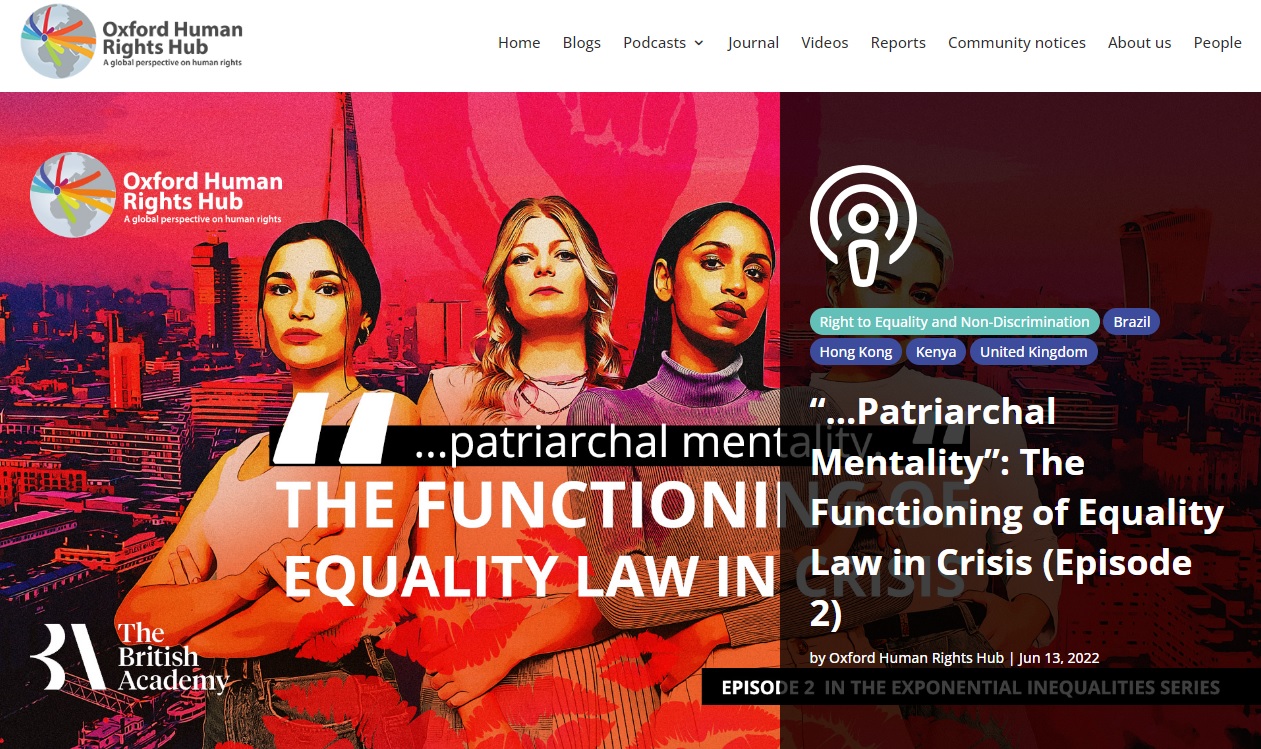
Kelley Loper in Podcast for the Oxford Human Rights Hub: Exponential Inequalities: Equality Law in Times of Crisis

A podcast for the Oxford Human Rights Hub: part of the Exponential Inequalities project led by Shreya Atrey which is also producing the book Exponential Inequalities: Equality Law in Times of Crisis, edited by Shreya Atrey and Sandra Fredman.  Kelley Loper has a chapter in that book on Hong Kong.
     Human rights experts help us determine whether equality law is set up to protect the most vulnerable in times of crisis.   This is Episode Two of a four-part series. The series takes a deep dive into whether equality law is cut out to protect the most vulnerable in times of crisis, and if not, then why not and what can we do about it?  This podcast series is part of the Exponential Inequalities project, led by Shreya Atrey as the Principal Investigator of the British Academy Leverhulme Small Research Grant on Equality Law in Times of Crisis.
    Transcript and show notes available on the Oxford Human Rights Hub website at ohrh.law.ox.ac.uk. Producer, Presenter, Sound Editor: Christy Callaway-Gale. Executive Producers: Shreya Atrey, Meghan Campbell, Sandra Fredman. Assistant Producers: Mónica Arango Olaya, Gauri Pillai, Natasha Holcroft-Emmess. Transcript and show notes: Sarah Dobbie
     EPISODE 2 is titled “…Patriarchal Mentality” : The Functioning of Equality Law in Crisis. It features Anna Lawson, Kelley Loper, Christy Callaway-Gale, Victoria Miyandazi, Aaron Reeves, Marta Machado, Helena Alviar García, and Beth Gaze.  To listen to the episode, click here.

Sunday, June 26, 2022

New Regulatory Ramblings Podcast Features ex-Undercover Tackling Financial Crimes and Regulations (Arner & Shamdasani)

New Regulatory Ramblings  Podcast Features ex-Undercover Tackling Financial Crimes and Regulations
HKU has launched a new podcast,  Regulatory Ramblings, discussing topics on the intersection of all things pertaining to finance, technology, law and regulation. It is  now available on Spotify, Apple Podcasts, YouTube, and Bilibili. 
    Hosted by the HKU Reg/Tech Lab, the HKU-Standard Chartered FinTech Academy and the HKU-edX Professional Certificate in FinTech, the new podcast is a forum for those that appreciate long-form conversations, with new content available every middle and end of the month.
    In the first episode, former covert agent Bill Majcher revisits his detailed operations involving financial crimes across the globe, from anti-money laundering investigations, surveillances on terrorist activities and infiltrating drug cartel operations. Bill reveals the defining moments in his career, predicating his discussions on financial crimes and regulations. 
   Regulatory Ramblings Podcasts is led by Douglas Arner and Ajay Shamdasani. Ajay is a veteran writer, editor and researcher based in Hong Kong with extensive knowledge in regulatory developments in Asia. His experience comes from a 15-year long career as a financial and legal journalist, editor and former correspondent with Thomson Reuters’ Regulatory Intelligence/Compliance Complete. Douglas (Kerry Holdings Professor in Law, HKU Law) is a global expert and thought leader on issues relating to digital finance/financial technology, sustainability development and regulation. 
     Part Two of the Financial Crimes episode with Bill Majcher, focusing entirely on the money-laundering activities happening in Hong Kong and the region, will be released on 15 June 2022. Visit https://www.hkufintech.com/regulatoryramblings to find out more! Contacts: Ajay Shamdasani (ajayshk@yahoo.com) | Prof. Douglas Arner (douglas.arner@hku.hk) Note: All quotes from the podcast must be attributed to “Regulatory Ramblings Podcasts”.  Actual Podcast and Video links will be available through the website: www.hkufintech.com/regulatoryramblings

Tuesday, October 5, 2021

Podcast Interview with Professor Scott Veitch on his latest book, Obligations: New Trajectories in Law (New Books Network)

Professor Scott Veitch was interviewed by Jane Richards, a doctoral student at the University of Hong Kong for the New Books Network. In the interview, Professor Veitch discusses his latest book Obligations: New Trajectories in Law. In his book, Professor Veitch challenges the normative assumptions that shape law and social practices, and shows how obligations and practices of obedience are core to sustaining the inequalities faced by members of the global community. In doing so, Professor Veitch explores the potential and enduring role that obligations have in furthering individual and collective well-being. He offers an alternative trajectory for the current crises faced by all citizens today, including environmental degradation and human inequality and injustice. Click here to listen to the podcast.

Sunday, November 8, 2020

RTHK Features Johannes Chan's Award Winning Book on The University

RTHK PODCAST ONE
10 October 2020
Books intervene in society, and the author defends value with words. Reading makes people reflect on what is right and wrong. The two award-winning books introduced in this episode are closely related to the present.
An ideological struggle: "Our Golden Age" 
Professor Zhou Baosong 
In the past ten years, Hong Kong has entered an era of resistance. Many people have taken to the streets to protect their beliefs. In the book, Professor Zhou records the deeds of these protesters and the values ​​behind the social movements, and explores the importance of these values ​​from different angles. By interpreting the current era, we can connect ourselves to the world, inject strength into our thoughts, and give meaning to life, thereby changing ourselves and the world.

University is the conscience of society: "The Right Way. University-written after the storm" 
Professor Johannes Chan
This book is a collection of articles published by Professor Chan in recent years. The content focuses on university and culture. It talks about ideal university education, and hopes that readers will rethink the value of universities and the mission of intellectuals. This book also records the turmoil in the appointment of the vice-principal of the University of Hong Kong. It allows us to experience the author's mental journey in the face of adversity while still adhering to principles through words, and brings a glimmer of hope to us in the great age.

Sunday, May 31, 2020

David Law on 'One Country, One Systems' (Verfassungsblog Podcast)

Podcast: "Corona Constitutional #30: One Country, One System"
Verfassungsblog: On Matters Constitutional
27 May 2020
Description: For a quarter of a century, Hong Kong has been a liberal, constitutional island in an authoritarian state. The Chinese government is now planning a new security law that may not leave much of liberalism and fundamental rights protection. In a podcast interview with Max Steinbeis, DAVID LAW from the University of Hong Kong examines the constitutional background of this potentially oppressive development and addresses the urgent question: What options and responsibilities do scholars have when the going gets tough in the struggle for freedom?

Saturday, April 25, 2020

Cora Chan Comments on Article 22 of the Basic Law and the Recent Arrests of Pro-Democracy Figures (Podcast@Verfassungsblog)

"Corona Constitutional #13: It's getting dark in Hong Kong" (Podcast)
In a podcast with Verfassungsblog’s “Corona Constitutional” series, Cora Chan commented on the recent arrests of pro-democracy figures in Hong Kong, as well as on the controversy surrounding whether the China Liaison Office and Hong Kong and Macau Affairs Office fall under the purview of Article 22 of the Hong Kong Basic Law, which states that “no department of the Central People’s Government… may interfere in the affairs which the Hong Kong Special Administrative Region administers on its own in accordance with this Law”. On the latter subject, Cora commented that whilst the distinction between “departments of the Central People’s Government” and organisations that are directly authorized by the Central People’s Government might be a genuine distinction in the Chinese political system, the revelation that Article 22 might be read subject to this distinction is shocking to a lot of Hong Kong people. The differences in the understandings of this provision between the two camps reflect fundamentally different conceptions of law and power, and just how profoundly different the Chinese and Hong Kong legal systems are. If Beijing resorts to its plenary power of interpretation under Article 158 of the Basic Law to resolve the dispute over Article 22, then it might be able to resolve the dispute in the short run, but it would not be able to earn the legitimacy that it needs to sustain its rule in the long run. In the parlance of constitutional lawyers, it would be seeking to rely on a culture of authority rather than a culture of justification.

Thursday, April 23, 2020

Syren Johnstone on "Fit for Purpose: Blockchain Regulation" (Podcast@Stanford Law School)

"Fit for Purpose: Blockchain Regulation"
Podcast@Stanford Law School
Syren Johnstone
March 2020
Summary: In this episode, Hong Kong University’s Syren Johnstone brings an international perspective to a discussion about blockchain regulation, and asks foundational questions about the relationship between emerging technologies and the law. Are our securities laws the best framework with which to examine cryptocurrencies? How can blockchain and AI help with things like a pandemic response? And, above all, what does it mean for regulation to be “fit for purpose”?  To listen, click here (total time: 1hr, 4min). For the transcript, click here.

Sunday, February 2, 2020

"BigTech" in the Financial Sector, In Conversation with Douglas Arner (SEACEN Podcast Season 3 Episode 1)

14 January 2020
Summary: “BigTech” in the Financial Sector: More Choice for the Consumer, More Challenges for the Regulator? SEACEN financial sector supervision experts Mark McKenzie and Glenn Tasky talk with prolific writer and educator Professor Douglas Arner, Kerry Holdings Professor in Law and Co-Founder, Asian Institute of International Financial Law, Faculty of Law, University of Hong Kong, about the entry of BigTech – companies such as Facebook, Apple, Google, Microsoft, Amazon, Alibaba, and Tencent – into the provision of financial services such as lending, payments, and even exotic cross-border instruments such as stablecoins. What are the benefits these big players bring, and what are the risks of allowing firms that are already big in other markets potentially dominate banking as well?

Saturday, September 28, 2019

Giuliano Castellano on UNCITRAL Secured Transactions (Podcast)

"UNCITRAL Podcast 3 Secured Transactions"
11 September 2019
Description: A panel of experts discusses the UNCITRAL Practice Guide to the Model Law on Secured Transactions adopted by the Commission in July 2019. The Practice Guide explains the key features and benefits of the Model Law and provides step-by-step explanations on how to use movable assets as security for financing purposes. Experts participating in the podcast are (in alphabetical order): Mr. Bruce Whittaker (University of Melbourne, Chair of Working Group VI that prepared the draft Practice Guide), Ms. Catherine Walsh (McGill University), Mr. Giuliano Castellano (University of Hong Kong), Mr. Marek Dubovec (Kozolchyk National Law Center) and Mr. Neil Cohen (Brooklyn Law School). Mr. Ryan Harrington (UNCITRAL) moderates the discussion.

Tuesday, August 13, 2019

Johannes Chan Podcast on The Rule of Law in Hong Kong (Part One) (UPenn)

The Rule of Law in Hong Kong (Part One)
Johannes Chan
Podcast, Episode 20
Center for the Study of Contemporary China, 
University of Pennsylvania School of Arts and Sciences
15 June 2019
Description: Dramatic protests in Hong Kong this month, over a draft law that would permit extraditions to mainland China, underscore broader fears amongst Hong Kong residents that their city is losing its distinctive legal and political characteristics, that were supposedly to be preserved under Chinese rule, according to the principle of “One Country, Two Systems”. A critical juncture in Hong Kong’s fascinating history appears to be fast approaching, with ramifications extending far beyond the city itself. In this special two-part episode, Neysun Mahboubi discusses with Hong Kong University law professor, and former dean, Johannes Chan the development of Hong Kong’s hybrid legal system, before and after the British handover of Hong Kong to China in 1997, and the challenges now before it. The episode was recorded on April 6-7, 2019.  Click here to listent to the podcast.