Showing posts with label Scott Veitch. Show all posts

Monday, October 19, 2026

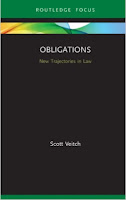
New Chinese book by Scott Veitch: Obligations: New Trajectories in Law (CUPSL Press)

認真對待義務:法律的新軌跡 (Obligations: New Trajectories in Law)
斯科特·韋奇(Scott Veitch)
中國政法大學出版社 (China University of Political Science and Law Press)
出版日期(Publication date): June 2026

簡介(Description): 《認真對待義務:法律的新軌跡》一書,對義務在當代法律與社會實踐中的角色進行了批判性分析。當權利成為現代政治與法律話語的核心特徵時,義務的作用卻長期被遮蔽。本書通過質疑並修正這一時代主流認知,以更契合當代社會生活現實的方式,重新審視義務的價值。在梳理義務在現代性語境中地位與優先性變遷的歷史脈絡後,本書揭示出義務與服從實踐實為理解法律如何維繫不平等條件的關鍵所在。但與此同時,本書也探討了義務在促進個人與集體福祉方面的持久作用——那些以人類與環境需求、共同利益及團結為重的實踐,無不彰顯著義務的重要意義。由此,本書對義務在當代社會中的效力與潛力作出了獨到而有力的評估。這一開創性的法理學成果,將吸引法學、政治學及社會科學領域的學者與學生讀者。 斯科特·維奇(Scott Veitch) 香港大學法理學講席教授,曾任格拉斯哥大學法理學教授。維奇的研究立足於廣義法理學,在繼承並反思分析法學傳統的基礎上,融合歷史學、哲學與社會學等多學科視角,探討法律制度的內在邏輯、社會運作機制及其政治維度。

The English version of the book was published in February 2021, click here for more details.
The translator is Dr. Liu Jia (HKU Law PhD 2017).

Wednesday, May 27, 2026

Professor Scott Veitch joined the Series Editors of Econormativities (A new Routledge book series)

Congratulations to Professor Scott Vietch, who has joined the Series Editors of Econormativities (A new Routledge book series). 

Econormativities is a new Routledge book series, publishing novel explorations of normativity for contemporary theorisations of life, in a rapidly evolving global technosocial ecology.

This book series invites original scholarship exploring the emerging realm of ‘econormativity’. A fundamentally interdisciplinary project, the series welcomes contributions from law and legal theory, political and social theory, science and technology studies, environmental studies, human geography, history, the history of ideas, design studies, creative arts research, Indigenous studies, philosophy, anthropology, and any discipline where novel ‘modes of existence’, new norms and new normativities, are challenging existing conceptual, and especially legal, frameworks.

Please click here to read more details about the book series on Critical Legal Thinking (CLT).

Monday, April 7, 2025

Scott Veitch on The Art of Complicity (Law and Literature)

"The Art of Complicity"
Scott Veitch
Law & Literature
Published online: March 2025

Abstract: This article considers the relation between art and complicity in wrongdoing. To do so, it offers a series of reflections on the theme of ‘Apollo and Daphne’, a story told in Ovid’s Metamorphoses and given sculptural form in the seventeenth century by Gianlorenzo Bernini. By understanding Bernini’s creation within the political, legal, and religious conflicts of its time, it analyses how artworks resonate in their ambient culture and beyond. Finally, it addresses the relationships amongst art, artist, and audiences and the risk of complicity in wrongdoing they share.

Monday, February 24, 2025

Scott Veitch on Friendship, Labour, Attention: Thinking with Simone Weil (CLT)

"What Matters?"
Scott Veitch
Critical Legal Thinking
Published online: January 2025

As part of a series on "Friendship, Labour, Attention: Thinking with Simone Weil" co-edited by Scott Veitch (HKU) and Maksymilian Del Mar (QMU London), Scott Veitch's contribution - 'What Matters?' - is here: 

Please click here to view full text.

Friday, November 29, 2024

Scott Veitch on The Perfect Storm: Artificial Intelligence, Financialisation, and Venture Legalism (Law and Critique)

"The Perfect Storm: Artificial Intelligence, Financialisation, and Venture Legalism"
Scott Veitch
Law and Critique
Published online: November 2024

Abstract: This article analyses the limits of legal norms and institutions in holding to account the emerging power of Artificial Intelligence (AI) and Machine Learning. It demonstrates how a symbiosis of capitalism and new forms of digital power is mutating to produce novel and dangerous styles of organised irresponsibility that go beyond the reach of conventional legal mechanisms. It draws on the work of Pashukanis, Baudrillard, and Alain Supiot to show how this transformation is taking place. Referring to the role of AI in the spread of Financial Technologies, it introduces a new term – ‘venture legalism’ – to describe how unprecedented risks are currently being created. It concludes by observing how ethical and democratic registers are equally implausible modes of accountability.

Friday, October 4, 2024

Scott Veitch et al on The Inhuman in the Human (CLT)

"The Inhuman in the Human"
Kathleen Birrell, Daniel Matthews and Scott Veitch
Critical Legal Thinking
Published online: 16 Sep 2024

"Law and the Inhuman" was the title of a workshop held at the University of Tilburg Law School in April this year. It addressed themes of climate change and the Anthropocene, of non-human agency, and of how the category of the human is becoming increasingly destabilized in legal and political thought and practice. In the dialogue linked here Professor Scott Veitch (HKU Law) and Dr Daniel Matthews (formerly HKU Law, now at Warwick University) explore the general theme through a discussion of "The Inhuman in the Human".

Please click here to view full text.

Thursday, February 2, 2023

New Book in translation by Paul KC Chung Professor Scott Veitch in Jurisprudence et al: Jurisprudence: Themes and Concepts (3rd Ed., Peking U Press)

Jurisprudence: Themes and Concepts (3rd edition) by Professor Scott Veitch, Paul KC Chung Professor in Jurisprudence, and Emilios Christodoulidis and Marco Goldoni (of the University of Glasgow) has just been published in translation by Peking University Press in January 2023. The translator introduces the book in a recent issue of the Shanghai Review of Books.
To view the book, please click here. 

Tuesday, January 11, 2022

On Veitch's Obligations: Four Reponses and the Author's Reply (Critical Legal Thinking)

In December 2021, Critical Legal Thinking published four responses to the recent book authored by Professor Scott Veitch, who is Paul KC Chung Professor in Jurisprudence at HKU Law.  Professor Veitch then responded to the responses.  An excerpt from the first response is provided below with links to the other responses and Professor Veitch's reply.

"Rights, Obligations and Torture: On Veitch’s Obligations"
Julen Etxabe
Critical Legal Thinking 
Published on 14 December 2021
We continue our series on contemporary critical (legal) books with a series of responses to Scott Veitch’s, Obligations: New Trajectories in Law (Routledge, 2021). We will post four responses to Scott’s new work, each picking distinct themes which together testify to the richness of the book’s scholarship. Next week Scott will respond.
Those familiar with Scott Veitch’s earlier body of work will not be surprised by the wide-ranging, incisive and witty style of Obligations, his contribution for Routledge’s series New Trajectories in Law. This is not to diminish the accomplishment: Veitch’s impressive capacity of condensation, its intellectual and historical breadth, and the clinical precision with which he dissects the subject-matter deserve high praise. His “new trajectory” is at once a retrieval of an overlooked genealogy, a critical diagnosis of the times, and the groundwork for its renewal.
     The book is not a critique of rights per se, but of their dominant role as the defining, almost exclusive, language of our age. Not only are obligations historically prior, but they are substantially more robust and perform a “connective work” that rights simply do not. Above and beyond a primordial “right to have rights,” then, Veitch envisages an antecedent world of obligations that ground human relations and their political institutions, which make rights possible (34). However, he is too acute a thinker simply to suggest a reversal: “To expose and understand the fact of their [obligations’] priority must not therefore entail necessarily valorizing it: context matters” (18). ... Click here to read the full commentary, here to read the commentary by Matt Stone, here to read the commentary by Margaret Davies, here to read the commentary by Stacy Douglas, and here to read Professor Scott Veitch's reply.

Tuesday, October 26, 2021

Scott Veitch's Observations on Hong Kong (Critical Legal Thinking)


Observations on Hong Kong
by
19 October 2021

It has been said that a poem is never finished, just abandoned. Academic writing has a touch of that too. The visions and revisions it has taken to get a text into decent shape could always do with one more run through, one more update, one more check for meaning and style. It is true also of research. It could be – it is – endless, but one must just stop somewhere otherwise the writing will never get done. If one is doing research on contemporary issues, a decision must be made about what to include and when to end the period for analysis. The process of selection and exclusion is one of the skills of judgement in research and writing one seeks to learn, test out, pass on, but always facing it afresh with each new project. For as Borges illustrates so well with Funes the Memorious – who remembers every detail but knows nothing of meaning, which only comes with generalization – without selection and exclusion, no sense will be possible. And if this is a concern that applies to research on current issues, it applies even more to historical research, since in addition to the question of when to stop, there is the much more challenging question of when to start. Each event, each effect, has a range of causes, and each of them in turn a further range. And so selection and exclusion – methodology – become key to making any sense, contested as that will always be. In the end perhaps, all you might say about your research and writing is that there are better and worse ways of abandoning it; and that what is offered in the text is the best you are able to do for now. ...Click here to read the full article.

Tuesday, October 5, 2021

Podcast Interview with Professor Scott Veitch on his latest book, Obligations: New Trajectories in Law (New Books Network)

Professor Scott Veitch was interviewed by Jane Richards, a doctoral student at the University of Hong Kong for the New Books Network. In the interview, Professor Veitch discusses his latest book Obligations: New Trajectories in Law. In his book, Professor Veitch challenges the normative assumptions that shape law and social practices, and shows how obligations and practices of obedience are core to sustaining the inequalities faced by members of the global community. In doing so, Professor Veitch explores the potential and enduring role that obligations have in furthering individual and collective well-being. He offers an alternative trajectory for the current crises faced by all citizens today, including environmental degradation and human inequality and injustice. Click here to listen to the podcast.

Saturday, March 13, 2021

New Book by Han Peng (PhD 2015): Law and Social Solidarity in Contemporary China: A Durkheimian Analysis (Routledge)

Law and Social Solidarity in Contemporary China: A Durkheimian Analysis
Han Peng (PhD 2015)
Published in December 2020, 290 pp.
Description: This book adopts Durkheim’s legal perspective to treat law as a symbol of social solidarities to examine Chinese society. The work analyzes changes in the nature of social solidarity from observing changes in laws, thus drawing together western socio-legal theory and distinctive Chinese conditions. It draws on Durkheim’s theoretical framework and methodology to develop a more comprehensive understanding of the role of law using theories of others such as Habermas and by taking into account the discussion of power and the conflicts of interests in analyzing key social features during transition. The analysis of social anomie in terms of the changes of juridical rules as well as the changes in the nature of social solidarity provides an inspiring perspective to look into contemporary social problems. The book will be essential reading for researchers and academics working in the areas of socio-legal studies, legal theory and law and society in China.

Friday, March 12, 2021

New Book by Scott Veitch: Obligations: New Trajectories in Law (Routledge)

Obligations: New Trajectories in Law
Published on 24 February 2021, 132 pp.
Book Description: Obligations: New Trajectories in Law provides a critical analysis of the role of obligations in contemporary legal and social practices. As rights have become the preeminent feature of modern political and legal discourse, the work of obligations has been overshadowed. Questioning and correcting this dominant image of our time, this book brings obligations back into view in a way that fits better with the realities of contemporary social life. Following a historical account of the changing place and priorities of obligations in modernity, the book analyses how obligations and practices of obedience are core to understanding how law sustains conditions of inequality. But it also explores the enduring role obligations play in furthering individual and collective well-being, highlighting their significance in practices that prioritize human and environmental needs, common goods, and solidarity. In doing so, it also offers an alternative and cogent assessment of the force, and the potential, of obligations in contemporary societies. This original jurisprudential contribution will appeal to an academic and student readership in law, politics, and the social sciences.

Monday, October 7, 2019

Pursuing Democracy in an Authoritarian State: Protest and the Rule of Law in Hong Kong (Special Dialogue and Debate in Social & Legal Studies)

"Pursuing Democracy in an Authoritarian State: Protest and the Rule of Law in Hong Kong"
First Published 26 September 2019
pp 1-39
Introduction: Democrats in the Dock by Scott Veitch
On 14 December 2018, the month-long trial of nine co-accused in the Occupy Central (OC) trial in Hong Kong came to a close. They were being prosecuted 4 years after the democratic protests they had inaugurated, charged with various public order, conspiracy and incitement offences at common law. Facing up to 7 years in prison for their leadership role in the mass pro-democracy civil disobedience movement that occupied central Hong Kong for 79 days in 2014, the nine included a Christian pastor, a sociology professor, a legislator and barrister, and the legal academic Benny Tai. In his closing submission to the court, Tai quoted from a judgment of Lord Hoffmann which stated that ‘civil disobedience on conscientious grounds has a long and honourable history’, and made the case for its value in progressing justice and enhancing the principle of the rule of law. ‘If we were to be guilty’, he concluded, ‘we will be guilty for daring to share hope at this difficult time in Hong Kong. I am not afraid or ashamed of going to prison. If this is the cup I must take, I will drink with no regret’...

Challenges to the Rule of Law in a Semi-Authoritarian Hong Kong by Benny Tai 
Abstract: Hong Kong has been recognized for its well-established rule of law (ROL). After the Umbrella Movement in 2014, the Chinese Communist regime adjusted its strategy towards Hong Kong and closed the road to democracy. With the end of the era of semidemocracy, the governing system in Hong Kong is now going in an authoritarian direction. In this new era of semi-authoritarianism, Hong Kong’s ROL faces the most serious challenges. The meaning of the ROL is now being redefined by the Chinese Communist regime. Hong Kong is fighting a battle on the discourse of the ROL. The legal culture of Hong Kong people may not be strong enough to withstand such an ideological encroachment. The legal professionals in Hong Kong play a critical role in defending more advanced understandings of the ROL which is not just about maintaining social order and compliance with law but concerns constraints on arbitrary powers and protection of the civil and political rights of citizens. There are worries as well as hopes. One thing is sure, the battle will be long and tough.

One Country, Two Systems: A Critical Analysis of Benny Tai’s Account by Fu Hualing 
Few constitutional scholars write like Benny Tai does. As a leader in Hong Kong’s democracy promotion and a constitutional scholar, Tai writes to reflect his democratic practices and, more importantly, to offer a road map for Hong Kong’s constitutional odyssey. As one of the chief architects of the powerful Occupy Central Movement (OCM) that shocked the world and a coordinator for strategic voting among pandemocratic groups, Tai writes as a legal practitioner and, for many in his community, a spiritual leader of sorts, in a passionate pursuit and a desperate search for solution. His work demonstrates that Hong Kong society has acquired sophisticated democratic thinking, but it also shows its weaknesses in its conceptualization of Hong Kong’s democratic journey in these unchartered waters. Tai should be taken seriously and his thinking, because of its importance, should be subject to rigorous scrutiny. I will take issue with Tai’s essay on its normative framing of authoritarianism, its positive analysis of the contention between Hong Kong and the Central Authority in Beijing and the future strategies it plans...

Response to Benny Tai by Richard Cullen
I am pleased to respond to Benny Tai’s engaging contribution to the fundamental discussion about the future of the Hong Kong Special Administrative Region (HKSAR) within the People’s Republic of China (PRC).
     Emma Woodhouse, one of Jane Austen’s most remarkable characters, concludes a particular analysis of life around her with the observation that what she has just said ‘is the exact truth’. Regardless of how firmly grounded Miss Woodhouse’s claim may be, in this discussion there are, I believe, no exact truths. Here we are absorbed, instead, in a debate based on sincere, differing, extensive reflections.
     It is clear that the PRC is poorly ranked internationally (and within the West, especially) for its failure to apply (Western-hewed) Rule of Law (ROL) governance principles – and for the continuing grim examples within the PRC of abuse of State power.1 However, this perspective, by itself, provides a measurably incomplete picture of the broad political-economic operation of the PRC...   Click here to read the full text. 

Thursday, August 29, 2019

HKU Law 50th Anniversary Lectures

4 Oct 2018. Jurisprudence is the study of law and legal institutions in their social, philosophical, and historical contexts. This lecture is an anniversary celebration of five decades of jurisprudential reflection, engaging with old and new questions that confront lawyers, judges, and citizens. It discusses thinkers familiar to generations of law students such as Hart, Fuller, and Dworkin as well as survey more recent developments in order to address topics of wider contemporary relevance. Professor Veitch holds the Paul KC Chung Professorship in Jurisprudence. Click here to watch the lecture.

Professor Douglas Arner, "Digital Financial Transfromation – Finance, Technology and Regulation"
22 Nov 2018. Over the past decade, technology has transformed finance more rapidly than ever before. This transformation brings with it new regulatory challenges. What factors underlie digital financial transformation? This presentation presents a strategy for developing an ecosystem to support digital financial and economic transformation, based on an analysis of experiences around the world over the past decade. Professor Arner holds the Kerry Holdings Professorship in Law.  Click here to watch the lecture.

Professor Albert Chen, "Five Decades of Constitutional Change in Hong Kong and East Asia: A Macro-historical Perspective"
15 Mar 2019. Inspired by the edited volume The Law in Hong Kong 1969-1989 published in celebration of the 20th anniversary of the law school at HKU, this lecture commemorates its 50th anniversary by reviewing constitutional developments in Hong Kong and its neighbouring Asian jurisdictions in 1969-2019.  Professor Chen holds the Cheng Chan Lan Yue Professorship in Constitutional Law.  Click here to watch the lecture.

Monday, August 20, 2018

New Book: Law, Obligation and Community (Dan Matthews and Scott Veitch)

Law, Obligation and Community
Edited by Daniel Matthews and Scott Veitch
Routledge: Taylor and Francis Group
June 2018, 272 pp.
Description: Against an ever-expanding and diversifying ‘rights talk’, this book re-opens the question of obligation from not only legal but also ethical, sociological and political perspectives. Its premise is that obligation has a primacy ahead of rights, because rights attach to practices and modes of being that are already saturated with obligations. Obligations thus lie at the core not just of law but of community. Yet the distinctive meanings, range and situations of obligation have tended to remain under-theorised in legal scholarship. In response, this book examines the sense in which we are multiply ‘bound beings’, to law and legal institutions, as much as we are to place, community, memory and the various social institutions that give shape to collective life. Sharing this set of concerns, each of the international group of scholars contributing to this volume traces the specificity of the binding force of obligations, their techniques and modes of expression, as well as their centrally important role in giving form to lawful relations. Together they provide an innovative and challenging contribution to legal scholarship: one that will also be of relevance to those working in politics, philosophy and social theory.

Scott Veitch on Duty Free (new book chapter)

in Daniel Matthews & Scott Veitch (eds), Law, Obligation, Community (Routledge, June 2018), Chapter 5
Introduction: The Panama Papers exposé went some way to revealing the mechanisms and magnitude of global asset distribution as a way of circumventing state accountability techniques (Obermayer & Obermaier 2016). Two things stand out about this: one is the exposure to publicity of that which had hitherto been secret, and the other, that despite such secrecy much of what was exposed was legal. In the following, I attempt to understand the interplay of legal concepts and practices that make people, assets and obligations disappear from the radar of state and public accountability. I argue that the work of obligations and regulation is, ironically, key to this. I then consider how this ‘duty free’ scenario reveals the asymmetrical treatment of property rights and social rights, the conceptual labour that underpins this and some implications with respect to austerity and free riders.

Thursday, July 12, 2018

New Issue of Hong Kong Law Journal (Part 1 of 2018)


Editor-in-Chief: Professor Rick Glofcheski
Associate Editor: Professor Albert Chen
Publisher: Sweet & Maxwell

TABLE OF CONTENTS

Comment
The Law Society’s Power to Introduce a Common Entrance Examination Johannes Chan  1

Analysis
Malice through the Looking Glass Brendan Clift  11

Alternate Dispute Resolution for Medical Disputes Albert Lee  23

Co-location is Constitutional Po Jen Yap and Jiang Zixin 37

ARTICLES
Rights, Proportionality and Deference: A Study of Post-Handover Judgments in Hong Kong Cora Chan  51

The Doctrine of Legitimate Expectations: International Law, Common Law and Lessons for Hong Kong Julien Chaisse and Ruby Ng 79

Reasonableness Review in Investor-State Dispute Settlement: Fostering Normative Coherence through Interpretative Flexibility Collins C Ajibo 105

Managing the Risks of Corporate Fraud: The Evidence from Hong Kong and Singapore Wai Yee Wan, Christopher Chen, Chongwu Xia and Say H Goo 125

The Duty of Hong Kong Courts to Follow the NPCSC’s Interpretation of the Basic Law: Are There Any Limits? Lin Feng 167

Less is More? Different Regulatory Responses to Crowdfunding and Why the Hong Kong Model Stacks Up Well Alexa Lam 191

CHINA LAW 
Politicised Legal Discourse and Judicial Accommodation of Petitioners in Chinese Courts Yuqing Feng and Qing Xu  233

Re-conceptualising Private Law: The Struggle for Civil Codification in China Jianfu Chen 257

Rights Protection for Persons with Mental Disability in China: An International Human Rights Law Perspective Zhiyuan Guo 283

Regulation of Sponsors in China: Political Will, Regulators’ Desire and Market Demands Tianshu Zhou and Wenjing Li 323

Book Review
In Search of the Way: Legal Philosophy of the Classic Chinese Thinkers Scott Veitch 359

Friday, March 30, 2018

Call for Papers: 11th East Asian Conference on Philosophy of Law @ HKU (13-14 Dec 2018)

11th East Asian Conference on Philosophy of Law
“Justice, Dignity and the Rule of Law”

*Call for Panels and Papers*


Faculty of Law, The University of Hong Kong 
13-14 December 2018

We are pleased to announce that the 11th East Asian Conference on Philosophy of Law will be held in Hong Kong on December 13-14, 2018, under the auspices of the University of Hong Kong’s Faculty of Law and its Centre for Chinese Law. The event is also part of the celebration of the 50th anniversary of the Faculty of Law of the University of Hong Kong. The overarching theme of the conference is “Justice, Dignity and the Rule of Law”.
     The East Asian Conference on Philosophy of Law has been held once every two years since 1996. The China University of Political Science and Law in Beijing hosted the 10th conference in 2016, and Hankuk University of Foreign Studies in Seoul hosted the 9th conference in 2014. The conferences provide a forum for dialogue among East Asian scholars of legal philosophy and other scholars interested in Asian legal philosophy. 
     The 11th Conference will be divided into plenary sessions and parallel sessions. We now invite proposals to present papers at the Conference.  A proposal to present a paper at the Conference should include the title and abstract of the paper. If you are interested in submitting a proposal for the conference, please note the following:
1.  The closing date for submission of proposals is 30 June 2018. 
2. The conference will be mainly in English and Chinese. Proposals to present papers at the Conference and panel proposals (mentioned below) should be written in English or Chinese. Oral presentations at the Conference should be in English or Chinese, except that (1) in panels formed (according to the procedure mentioned below) by Japanese or Korean scholars, the oral presentations may be in English, Japanese or Korean (scholars speaking in Japanese or Korean are strongly encouraged to provide a written English translation of their presentations); (2) interpretation will be provided for specially invited speakers at the plenary sessions who speak in Japanese or Korean (who will provide a written English translation of their speeches). 
3.  The proposed papers may relate to any aspect of philosophy of law or related fields, and need not be limited to the general theme of the conference (“Justice, Dignity and the Rule of Law”). 
4.  Every participant at the Conference (including paper presenters, and chairmen and discussants at the panels mentioned below who are not presenting papers themselves) should submit the ‘individual proposal form’. Paper presenters will make an oral presentation at the conference (approximately 15 minutes). Submission of full papers is welcomed but not required. 
5.  Proposals to form a panel at a parallel session are welcomed. Panel organisers should submit a ‘panel proposal form’. Panel members presenting papers at the panel should also submit ‘individual proposal forms’. The ‘panel proposal form’ should include the panel topic, the name of the chair and/or discussant, the names of the presenters of papers, and the title of each paper. The chair and discussant may also serve as a paper presenter. The same person may serve as both chair and discussant. 
6.  The conference registration fee is waived; however, participants who would like to join the conference dinner will be required to make a payment in advance. Conference participants are responsible for their own travel and accommodation expenses. A list of recommended hotels will be provided on the conference website. 
7.  Inquiries may be emailed to: shelbyc@hku.hk.
     The Conference will be an excellent opportunity for you to meet East Asian scholars of the philosophy of law to discuss topics of common interest. We hope you will be able to join us in Hong Kong!  To access the Conference website, click here.

Friday, October 6, 2017

Scott Veitch's "The Sense of Obligation" (Jurisprudence)

"The Sense of Obligation"
Scott Veitch
Jurisprudence
September 2017, published online
Abstract: This article is based on the Inaugural Adam Smith Lecture in Jurisprudence given at the University of Glasgow in 2016. It asks this question: is it not an age of obligation that we live in as much as, if not more so than, an age of rights? To answer this it explores a number of different senses of obligation to be found across a range of social practices. After an overview of some of the main concerns of Smith’s work, it looks at two types of ‘obligation practices’ prominent in contemporary society: those that make rights effective, and those that operationalise debt. In paying attention to the often less visible work done by and through obligations, it also highlights certain vulnerabilities citizens are susceptible to when the distinction between obligation and obedience threatens to collapse.

Wednesday, July 19, 2017

Scott Veitch on Law in the Risk Society, Challenging Legal Concepts (new book chapter)

"Law in the Risk Society: Challenging Legal Concepts"
in Ubaldus de Vries and John Fanning (eds), Law in the Risk Society (Eleven International Publishing, 2017) pp 39-60.
Introduction: Ulrich Beck's seminal contribution to sociological enquiry lies in the development of his theory of "risk society". In this essay I outline several keys aspects of this, and make specific some implications for the role of law and legal institutions. I then proceed to consider three examples whereby the theory of risk society may be further enhanced, albeit with some caution. These examples refer to the implications of 'virtue risk society'; the question of competing modernities (with reference to China) and the politics of the commons today. I conclude with some reflections on the matter of legal responses to the condition Beck describes.