Showing posts with label democracy. Show all posts

Friday, March 7, 2025

Cora Chan on Gender, democracy, and the legal academy: Afterword to the Foreword by Gráinne de Búrca, Rosalind Dixon, and Marcela Prieto Rudolphy (ICON)

"Gender, democracy, and the legal academy: Afterword to the Foreword by Gráinne de Búrca, Rosalind Dixon, and Marcela Prieto Rudolphy"
Cora Chan
International Journal of Constitutional Law
Published online: February 2025

Abstract: This Afterword reflects on the Foreword’s three key contributions—proof of a gender gap in the legal academy, revelation of the problem’s complexity, and an exploration of solutions—from the perspective of a woman scholar specializing in constitutional law in Hong Kong, a former British colony and now a special administrative region of China. While Hong Kong is an international financial center with a strong higher education sector, and its government is explicitly committed to gender equality, the territory is steeped in traditional Chinese values and culture and has undergone a sharp authoritarian turn since the protest movement in 2019. It therefore provides an interesting vantage point from which to assess issues of gender in the legal academy. In particular, this Afterword cites and provides data substantiating the existence of a gender gap in Hong Kong’s legal academy, highlights the intersectional challenges arising from authoritarianism, marketization, and gender as well as other forms of marginalization, and underscores the relationship between gender equality and democratic governance.

Friday, February 14, 2025

Jedidiah Kroncke on An Empire of Anti-Democracy: The Imperial Legacies of American Territorial Labor (WLR)

"An Empire of Anti-Democracy: The Imperial Legacies of American Territorial Labor"
Jedidiah J. Kroncke
Washington Law Review (Vol. 99, No. 4 (2024))
Published online: January 2025

Abstract: A great deal of recent attention has been given to acknowledging the full historical scope of American empire and its legal foundations. A recurrent focus of this attention has been the impact of the Insular Cases—a set of early twentieth century doctrines that legitimate American territorial acquisitions while denying their full incorporation under the United States Constitution. Issues of political citizenship and property have thus predominated critical work on the Insular Cases.

This Article expands on this resurgent interest by focusing on another critical element of this acknowledgment: the history of territorial labor which has long been central to the political economy of American empire. Explicating the role and regulation of territorial labor enables a more complete picture of American empire and centers its evolving pursuit of new legal forms to project national power while avoiding democratic accountability.

Most concretely, the unprincipled doctrines of the Insular Cases have led to a paradigm of perpetually precarious bargaining in which territorial labor only enjoys the formal protection of labor and employment law subject to complete federal discretion and potential revocation. Mapping the diverse and contingent legal regimes this bargaining has produced unearths all too many tragedies past and present as the largely invisible labor of territorial people has been circulated throughout American empire while building its economic and military foundations.

Further complicating this formally inchoate set of rights are the practical realities territorial labor has historically been subject to under conditions of American empire: localized employer domination, tactics of racialized labor migration, and the overshadowing anti-democratic disciplinary rationales of U.S. national security. These realities are evident throughout the diverse range of contemporary territories as well as in their scarring effects within former American territories and military occupations. Moreover, imperial labor’s roaming logics of dehumanization are today increasingly displaced onto even more vulnerable foreign migrant workers within many territories themselves.

Acknowledging the role of territorial labor in American empire blurs the line between territorial and incorporated life and law. Most powerfully, it reveals how the conditions of territorial labor reflect back the enervated nature of American economic citizenship writ large. This reflection is just one of the many ways in which territorial history presents lessons increasingly applicable to broader swaths of American life under conditions of modern economic globalization. The Article ultimately integrates territorial history into renewed demands for a democratic political economy for all those living under American sovereignty.

Wednesday, November 1, 2023

Johannes Chan on Responsive Judicial Review without Democracy: The Hong Kong Experience (HKLJ)

"Responsive Judicial Review without Democracy: The Hong Kong Experience"
Johannes Chan
Hong Kong Law Journal, Vol. 53, Part 2 of 2023, pp.507 - 538
Abstract: This article argues that Professor Dixon’s theory of responsive judicial review works reasonably well for Hong Kong between 1990 and the mid-2010s, even when the monopoly of anti-democratic powers, one of the democratic dysfunctions, is a systemic issue in Hong Kong. However, without a democratic system, responsive judicial review may be unstable and precarious when the political climate changes. When the conditions for responsive judicial review no longer exist, judicial choices are dominated by considerations of law and order at the expense of protecting core democratic values and in so doing, the judiciary is running the risk of becoming abusive.

Tuesday, October 24, 2023

Jedidiah Kroncke on Discipline or Democracy: The Endogeneity of Police Accountability (CUP book chapter)

"Discipline or Democracy: The Endogeneity of Police Accountability"
Jedidiah Kroncke
in Weitseng Chen (ed) and Hualing Fu (ed), Regime Type and Beyond: The Transformation of Police in Asia, (Cambridge University Press, May 2023), pp. 26-50

Summary: Traditionally there has been a reflexive assumption that democratic regimes have more accountable and less violent policing practices than those in authoritarian regimes. Yet modern authoritarian regimes have pursued policies of police professionalization while democratic regimes continue to often suffer from comparatively higher levels of police violence. This chapter argues that an examination of policing in Japan, the Philippines, and China supports the growing irrelevance of regime-type for understanding police violence and accountability. While modern policing has been subject to increased empirical study, a technocratic emphasis on policing practices has been unable to overcome both the core sociogenic drivers of crime and the intransigent moralism through which publics evaluate police action. Consequently, historical and cultural factors are the primary drivers of how any given society perceives the legitimate objects of police violence, and thus police violence strongly resists reduction through technical revisions or the reform of formal police institutions.

Friday, November 12, 2021

Roda Mushkat on China and the Elusive Search for a Viable Governance Regime in the Era of Coronavirus (Eur J of Comp L and Gov)

"From China’s “Political Meritocracy” to “Just Hierarchy”: the Elusive Search for a Viable Post-Democratic Governance Regime in the Era of Coronavirus"
Roda Mushkat
European Journal of Comparative Law and Governance
Published online on 26 May 2021
Abstract: Students of comparative constitutional design grapple with myriad complex normative and empirical issues. Prominent among them is the relative effectiveness of different governance regimes. Concerns stemming from the perceived malfunctioning of modern democracies have intensified efforts to diagnose and rectify the supposedly proliferating ills. The seemingly solid post-1978 Chinese record of steadily managing intricate societal challenges has highlighted the possible advantages of the country’s tightly controlled top-down institutional apparatus and its potential value as a model worth broadly exploring and even embracing on a meaningful scale. This view, authoritatively and vigorously articulated by an influential and prolific political philosopher and his academic associates, has evolved to a point whereby the Chinese constitutional order and contemporary experience are portrayed as being capable of fruitfully supplanting democratic structures or, alternatively, productively revitalising them. Yet, on the whole, this remains a controversial politico-legal proposition, conceptually problematic and lacking sufficient factual support.

Friday, October 1, 2021

Guanghua Yu on The Rise of Germany in the 19th and 20th Centuries and Sustaining Democracy (Law and Development Review)

Guanghua Yu
Law and Development Review
Published in August 2021 online
Abstract: This article examines the rise of Germany from the nineteenth century to explain that it is open access in the economic sphere, as well as institutional building related to the protection of property rights, contract enforcement, financial markets, rule of law, and human resource accumulation that determine economic and human development. The case of Germany is not very consistent with the logic of the open access orders of North et al. or the theory of extractive political institutions of Acemoglu and Robinson along the line of contestation and inclusiveness. The case of Germany is, however, able to support the research of Przeworski and Limongi that economic development is more likely to sustain democracy. Germany is certainly not the only case in explaining that stable democracy is not the cause but rather the consequence or outcome of lengthy economic development. The historical evidence from South Korea and Taiwan similarly supports the position that democracy is the outcome of economic and political development. This article, however, does not examine whether western values of human equality and human freedom are essential in economic and human development. They are very likely to be so as human equality is the precondition of open access in the economic sphere and human freedom is closely integrated with the interconnected institutions examined in this article. Future research may investigate the roles of these values in different political systems regardless of whether a political system is under the rule of one party, by a dominant party, or through the utilization of a multiparty system.

Friday, August 7, 2020

New Book: Authoritarian Legality in Asia Formation, Development and Transition (CUP)

Authoritarian Legality in Asia: Formation, Development and Transition
Edited by Weitseng Chen and Hualing Fu
July 2020, 500 pages
Description: A cluster of Asian states are well-known for their authoritarian legality while having been able to achieve remarkable economic growth. Why would an authoritarian regime seek or tolerate a significant degree of legality and how has such type of legality been made possible in Asia? Would a transition towards a liberal, democratic system eventually take place and, if so, what kind of post-transition struggles are likely to be experienced? This book compares the past and current experiences of China, Hong Kong, South Korea, Japan, Taiwan, Singapore, and Vietnam and offers a comparative framework for readers to conduct a theoretical dialogue with the orthodox conception of liberal democracy and the rule of law.
  • Provides a comparative perspective of authoritarian legality to enrich the understanding of legality and liberal rule of law and democracy
  • Introduces an intra-Asia comparison approach that provides a new set of metrics for evaluating legal reforms in authoritarian countries such as China
  • Explores various phases of authoritarian legality development and discusses not only the transition of authoritarian legality but also the post-transition struggles in various countries
Editors
Weitseng Chen is Associate Professor at the National University of Singapore (NUS) Faculty of Law and Deputy Director at the NUS Center for Asian Legal Studies. He specializes in comparative Chinese law within greater China as well as law and development in East Asia. Before joining NUS Faculty of Law, he was Hewlett Fellow of the Center on Democracy, Development and the Rule of Law at Stanford University and also practiced as a corporate lawyer at Davis Polk & Wardwell.
     Hualing Fu holds the Warren Chan Professorship in Human Rights and Responsibilities at The University of Hong Kong, Faculty of Law and is Interim Dean of The University of Hong Kong Faculty of Law. He specializes in constitutional law and human rights with a particular focus on the Chinese criminal justice system, Chinese media law and land law. Other areas of research include the constitutional status of Hong Kong and its legal relations with China. He has previously taught at the City University of Hong Kong, University of Washington, New York University and University of Pennsylvania.

Contributors
Weitseng Chen, Hualing Fu, Jacques deLisle, Michael Dowdle, Eva Pils, Thomas E. Kellogg, Richard Cullen, David Campbell, Michael C. Davis, Kevin Y. L. Tan, Tom Ginsburg, Do Hai Ha, Pip Nicholson, Jianlin Chen, Yen-Tu Su, Koichi Nakano, Erik Mobrand

Friday, May 15, 2020

"Democracy and Judicial Behaviour in Asia" (Po Jen Yap Profiled in HKU's The Bulletin)

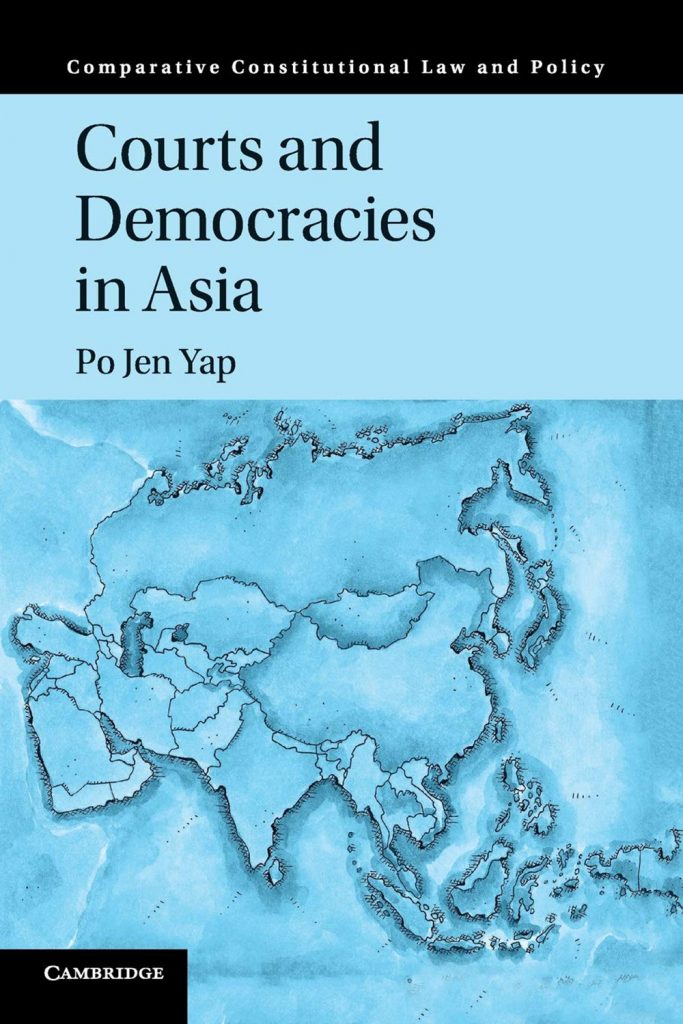
Book cover

"Democracy and Judicial Behaviour in Asia"
The Bulletin, May 2020
Judiciaries can shape – and are shaped by – the political systems they operate within, for better or worse. Professor Yap Po-jen of the Faculty of Law has been investigating this interplay between law and politics in Asia.
Democracies come in different forms. Some are effectively ruled by a dominant party that has muted most opposition. Some are dynamic, with two or more parties that have taken turns in power. Others are more fragile, with a strong military that may seize power if there is a vacuum. Each system shapes judicial behaviour in different ways, according to Professor Yap Po-jen.
     Professor Yap has studied the political factors that strengthen or constrain judiciaries in Asia. He has also been looking at how some of these judicial systems are converging by intentionally adopting constitutional practices from the West. 
     “Judges today no longer simply interpret the law, they also make law that binds their governments and citizens. The level of democratisation in a political system can impact judicial behaviour, and judicial behaviour can also facilitate the democratisation of a system,” he said. 
      His first major study on the topic, the monograph Courts and Democracies in Asia published in 2017, examined nine Asian democracies – three dominant-party (Hong Kong, Singapore and Malaysia), three dynamic (Taiwan, South Korea and India) and three fragile (Pakistan, Thailand and Bangladesh).

Protecting independence
The dominant democracies are practically ruled by one coalition or its proxies (in Hong Kong, the pro-Beijing forces) and their judiciaries can be easily overruled by the political branches of government. 
     Nevertheless, the courts in these places can still assert some autonomy within bounds – for instance, Hong Kong courts have ruled against the government on multiple occasions on issues relating to social welfare and gay rights. Where the courts cross the tolerance threshold of the government, they will be punished or overridden, as seen in Singapore and Malaysia.
     “All dominant parties will eventually fade away with time, even if this may take a long while. In the meantime, the role of their courts is to do what they can, while protecting their institutional independence. If they rule too aggressively, the dominant party will clip their wings,” Professor Yap said...  Click here to read the full text.

Friday, April 26, 2019

Han Zhu on Beijing’s “Rule of Law” Strategy for Governing Hong Kong (China Perspective)

Han Zhu (PhD 2016)
China Perspectives
2019, Issue 1, pp 22-33
Abstract: This paper examines the evolution of legal strategies that the central government has used in managing Hong Kong affairs in the past three decades. It demonstrates that the Beijing government appears to have successfully employed the tactic of “legalisation without democratisation” to neutralise political resistance, to resolve thorny issues, and to stifle pro-independence voices. However, as Beijing’s legal strategies for Hong Kong have become more hands-on and assertive, the flaws and instrumentalism of Chinese-style “rule of law” have become increasingly salient, giving rise to deepening conflicts with the Hong Kong common law system. Legalisation without democratisation has given rise to a worrying trend of rising authoritarian legalism in Hong Kong.

Tuesday, April 23, 2019

Benny Tai on Round Three of Hong Kong's Constitutional Game (HKLJ)

"Round Three of Hong Kong's Constitutional Game: From Semi-Democracy to Semi-Authoritarianism"
Benny YT Tai
Hong Kong Law Journal
Vol 49, Part 1 of 2019, pp 335-356
Abstract: A game-analytical framework is used to understand the constitutional development of Hong Kong. The constitutional game of Hong Kong has entered into Round Three. The theme for Round Three is “from semi-democracy to semi-authoritarianism”. The existing game-field is neither genuinely democratic nor totally authoritarian. The Civil Society of Hong Kong, a key game player, adopted a new strategy to put pressure on the Central Government (CG) aiming to transform the game-field from semi-democratic to genuinely democratic. A large-scale civil disobedience movement by occupying main streets at the heart of the city was organised in 2014. The CG, the most powerful and resourceful game player, responded by blocking Hong Kong’s road to democracy. The CG worries that Hong Kong could be used as a subversive base to threaten its rule in the Mainland if democratic elections were to be fully implemented. The game-field is further transformed by the CG from semi-democratic to semi-authoritarian. The Opposition, the Legislative Council, the Courts and the Civil Society of Hong Kong are weakened so that the Chief Executive under the direction of the CG could have a free hand to gain legitimacy through implementing policies to improve people’s livelihood. The voices demanding for democracy might then be silenced. This article analyses how these changes happened and illustrates how these changes may affect all the players in the next round of the constitutional game.

Benny Tai on 30 Years After Tiananmen (J of Democracy)

"30 Years After Tiananmen: Hong Kong Remembers"
Benny Tai
Journal of Democracy
April 2019, Vol 30, Issue 2, pp 64-69
Abstract: The three landmark events in Hong Kong’s ongoing struggle for democracy over the past thirty years were directly or indirectly connected with the Tiananmen Square protests of 1989. Inspired by the sacrifices of the students and citizens in Beijing, Hong Kong people continue to strive to establish a democratic system to defend Hong Kong’s way of life against interference by the Chinese Communist Party. The souls of Tiananmen Square have not left Hong Kong, and Hong Kong’s persistent struggle for democracy may have preserved the seeds of change in China.

Tuesday, January 22, 2019

Benny Tai on the Stages of Hong Kong’s Democratic Movement (Asian J of Comp Politics)

published on 10 December 2018
Abstract: Bill Moyer observed that there are eight stages in a social movement: seeming normal, exposing injustice, ripening conditions, taking off, losing heart, winning the majority, reaping success and consolidating achievement. For more than 30 years, Hong Kong people have been striving for democracy. Applying Moyer’s model, Hong Kong should be now at a stage close to reaching its ultimate goal of establishing a genuine democratic system in the territory after years of work, especially the triggering event in September 2014 and the occupation during the Umbrella Movement. However, Moyer’s model cannot be mechanically applied to the case of Hong Kong in light of the unique situation faced by Hong Kong people. Hong Kong’s authoritarian sovereign holds the final key to Hong Kong’s door to democracy. Unless there is a significant shift in the balance of powers in the Chinese polity, Hong Kong’s democracy may be so near and yet so far.

Tuesday, January 23, 2018

David Law on Alternatives to Liberal Constitutional Democracy (Maryland Law Review)

December 2017, Volume 77, Issue 1, pp 223-243
Abstract: The global appeal of liberal constitutional democracy—defined as a competitive multiparty system combined with governance within constitutional limits—cannot be taken for granted due to the existence of competing forms of government that appear successful along a number of practical dimensions and consequently enjoy high levels of public acceptance. Proponents of liberal constitutional democracy must be prepared to proactively explain and defend its capacity to satisfy first-order political needs. A system of government is unlikely to command popular acceptance unless it can plausibly claim to address the problems of oppression, tribalism, and physical and economic security.
     Along these dimensions, the advantages of liberal constitutional democracy over the alternatives of social democracy of the type seen in Scandinavia, and bureaucratic authoritarianism of the type seen in parts of Asia, are not self-evident. Within Asia alone, seemingly functional alternatives to liberal constitutional democracy run the gamut from illiberal nondemocracy in China, to liberal one-party rule in Japan, to illiberal constitutional democracy in Singapore, to liberal constitutional nondemocracy in Hong Kong, to hereditary monarchy in Bhutan.  Click here to download the full article.

Monday, October 9, 2017

New Book by Po Jen Yap - Courts and Democracies in Asia (CUP)

Courts and Democracies in Asia
Po Jen Yap
Cambridge University Press, 224 pp
September 2017
Description: What is the relationship between the strength of a country's democracy and the ability of its courts to address deficiencies in the electoral process? Drawing a distinction between democracies that can be characterised as 'dominant-party' (for example Singapore, Malaysia, and Hong Kong), 'dynamic' (for example India, South Korea, and Taiwan), and 'fragile' (for example Thailand, Pakistan, and Bangladesh), this book explores how democracy sustains and is sustained by the exercise of judicial power. In dominant-party systems, courts can only pursue 'dialogic' pathways to constrain the government's authoritarian tendencies. On the other hand, in dynamic democracies, courts can more successfully innovate and make systemic changes to the electoral system. Finally, in fragile democracies, where a country regularly oscillates between martial law and civilian rule, their courts tend to consistently overreach, and this often facilitates or precipitates a hostile take-over by the armed forces, and lead to the demise of the rule of law.

Advance praise:
‘Po Jen Yap's new book is a must-read in the growing literature on the role of constitutional courts in democratic stabilization. Its fine-grained analyses demonstrates that the political power and vulnerability of courts in protecting democratic processes as well as their own independence is not fixed or prescribable in the abstract, but varies with the state of democratization and party contestation in which they operate.'
Stephen Gardbaum - MacArthur Foundation Professor of International Justice and Human Rights, University of California, Los Angeles
‘A fascinating tour through the fraught relations between courts and political power. Professor Yap provides a nuanced account of how constitutional courts in Asia balance precariously between semi-authoritarian dominant regimes and the live wire of electoral politics. A magnificent, sophisticated contribution that enriches our understanding of judicial politics in an era of weak democratic institutions.'
Samuel Issacharoff - Reiss Professor of Constitutional Law, New York University
'Po Jen Yap's analysis of the role of Asian courts in three types of democracies illuminates how the possibilities for effective judicial action in connection with major political issues varies according to the type of democracy in which the courts are located. It is an important contribution to the project of integrating comparative constitutional law with comparative political studies.'
Mark Tushnet - William Nelson Cromwell Professor of Law, Harvard University

Wednesday, July 19, 2017

Po Jen Yap on New Democracies and Novel Remedies (Public Law)

"New Democracies and Novel Remedies"
Public Law
Abstract: Discusses the novel constitutional remedies adopted by courts in emerging democracies to ensure the Government's observance of the law. Reviews, with reference to case law, the approach of courts in South Africa, India and Hong Kong to: (1) the granting of engagement orders; (2) the making of suspension orders with "bite"; and (3) the making of judicial directives in response to political incompetence or intransigence.

Saturday, January 23, 2016

Michael Davis Interviewed on Taiwan Election, China and Hong Kong (Christian Science Monitor)

"For Hong Kong democrats, a deeper resonance in Taiwan's orderly election"
Robert Marquand
The Christian Science Monitor
21 January 2016
In the weeks ahead of Taiwan’s Jan. 16 elections, Yueng Wen estimates that “nearly half” his student friends went from Hong Kong to Taipei. They watched, participated, tweeted and got to know every detail of the voting, which saw Taiwanese elect their first female president, Tsai Ing-wen, and deliver a knockout blow to the long-ruling Nationalist Party (KMT).
    Mr. Wen, a slender graduate student at Hong Kong University, took part in mass protests in 2014 to demand free and fair elections in this former British colony. Like many residents, he worries that Hong Kong, which reverted to Chinese rule in 1997, is losing its distinct identity and freedoms as Beijing asserts tighter control.
     “We really appreciate the Taiwan elections,” Wen says. “I am skeptical of both political camps there and it would take me 30 minutes to tell you why. But what we appreciate is choice. Taiwanese have a real choice, and we in Hong Kong do not.”
     For years, Hong Kong and Taiwan have lived in largely separate realms and have not paid much attention to each other. Beijing has not encouraged any official ties between the two entities, one of which it rules under special laws of autonomy (Hong Kong), and one of which it claims (Taiwan). Hong Kong chief executives do not visit Taiwan; official traffic from Taiwan to Hong Kong has mostly included city mayors.
     Yet in the past three years, youth in Hong Kong and Taiwan are being drawn together, online and in person, by shared interests that revolve around Chinese politics and their own future. They are meeting, holding conferences, and for the first time sharing insights into how their own leaders are dealing with superpower China.
     In Hong Kong last weekend one of the most-read tweets came from Taiwanese rocker-turned-politician Freddy Lim: “Don’t let Taiwan’s future be like Hong Kong’s present.”
      Mr. Lim’s politics emerged out of Taiwan’s student-led “Sunflower movement” that staged a weeks-long sit-in in 2014 of government buildings in Taipei to protest trade deals with China that the KMT was trying to enact in ways that students said lacked transparency. His political party, formed in November, now holds five seats in that legislature.
     In Hong Kong, Taiwan’s elections came amid fears over the apparent abduction of five members of a publishing firm and bookstore that specializes in gossipy accounts of Chinese politics. One was later paraded on Chinese TV making a confession. The Global Times, a hawkish Chinese newspaper, commented that it was “not only reasonable but legal” to investigate the company because it had undermined China’s “rule of law system.” 
'One country, two systems'
      The "one country two systems" formula by which China has ruled Hong Kong since 1997 was initially conceived as the formula by which China would someday govern Taiwan, according to Hong Kong University law professor Michael Davis.
      “China’s heavy handed policies – the abduction of the bookseller is one example – are driving Hong Kong and Taiwan into each other’s arms,” says Prof. Davis, who is active in human rights and democracy groups. “For Taiwanese it says, look at what “one country two systems” actually looks like. We don’t want any part of it.”
       For the democratic camp in Hong Kong that seeks freer elections including a direct vote for its leader, Taiwan’s orderly and peaceful election serves as a counter to the Chinese Communist Party’s oft-stated message that democracy breeds instability... Click here to read the full article.

Tuesday, January 19, 2016

New Book: Benny Tai on the Future of Hong Kong's Constitutionalism (3 Volumes in Chinese)

Benny Tai has published a three-volume work in Chinese on the future of Hong Kong's constitutionalism.

1. The Future of Hong Kong’s Constitutionalism Part I: The Future of the Rule of Law (Hong Kong: Step Forward Multi Media Co Ltd., 2015)(《香港憲政的未來系列之一:法治的未來》,進一步多媒體有限公司,香港,2015 年).  This book features articles analysing the relationship between civil disobedience and the maintenance of the rule of law in Hong Kong.  

2. The Future of Hong Kong’s Constitutionalism Part II: The Future of Democracy (Hong Kong: Step Forward Multi Media Co Ltd., 2015)(《香港憲政的未來系列之一:民主的未來》,進一步多媒體有限公司,香港,2015 年).  This book features articles analysing the future direction of Hong Kong’s democratic development after the Umbrella Movement. 


3. The Future of Hong Kong’s Constitutionalism Part III: The Future of “Two Systems” and “One Country” (Hong Kong: Step Forward Multi Media Co Ltd., 2015)(《香港憲政的未來系列之一:「兩制」與「一國」的未來》,進一步多媒體有限公司,香港,2015 年). This book features articles analysing the conflict between “One Country” and “Two Systems” in light of the political development in Mainland China. 


Friday, January 15, 2016

CCPL Launches 'Dialogue Series on Hong Kong's Constitutional Future'

On 12 January 2016, CCPL launched the first in a three-part "Dialogue Series on Hong Kong's Constitutional Future". Associate Professor Benny Tai was joined by Martin Lee (Founding Chairman of the Democratic Party and Legislative Councillor from 1985 - 2008) and Joshua Wong (Fonder of Scholarism) for a discussion on the Future of Hong Kong's Democracy. The three speakers represented three generations in the quest for Hong Kong’s democracy and took the opportunity to debate avenues that could lead towards a more democratic future in Hong Kong.
     Attending the event were members of the public, legal practitioners, academics and members of the Faculty of Law's staff, including CCPL Director Puja Kapai and Visiting Professor and former CCPL Director Andrew Byrnes. Photos from the event can be found on the Centre’s Facebook page at https://www.facebook.com/ccplhk and the video can be viewed at https://youtu.be/pigl967i724.
     The Centre has long been involved with organising its Political Reform Seminar Series and this event marks the first of the year with more planned for 2016. The remaining two events in the series are as follows:
No. 2: A Dialogue on the Future of Hong Kong’s Rule of Law
Date: 26 February 2016
Time: 18:00 p.m. - 19:30 p.m.
Johannes Chan (Professor, Faculty of Law, University of Hong Kong)(TBC)
Benny Tai (Convenor, Rule of Law Education Project, Faculty of Law, University of Hong Kong)
Kevin Yam (Convenor, Progressive Lawyers Group)
No. 3: A Dialogue on the Future of One Country Two Systems
Date: 15 March 2016
Time: 18:00 p.m. - 19:30 p.m.
Albert Chen (Professor, Faculty of Law, University of Hong Kong)
Benny Tai (Associate Professor, Faculty of Law, University of Hong Kong)
Brian Fong (Assistant Professor, Hong Kong Institute of Education)
Further details of the content and registration for these two events can be found on the CCPL website at http://www.law.hku.hk/ccpl/.  For Suzanne Pepper's detailed report of the event published in Hong Kong Free Press, click here.