Showing posts with label Kelley Loper. Show all posts

Wednesday, March 13, 2024

New Book Edited by Kelley Loper et al: Gender, Sexuality and Constitutionalism in Asia

Gender, Sexuality and Constitutionalism in Asia
Edited by Wen-Chen Chang, Kelley Loper, Mara Malagodi, Ruth Rubio-Marín
Bloomsbury Publishing
Published in January 2024
384 pp.

Description: This book analyses the equal citizenship claims of women and sexual and gender diverse people across several Asian jurisdictions. The volume examines the rich diversity of constitutional responses to sex, gender and sexuality in the region from a comparative perspective. Leading comparative constitutional law scholars identify 'opportunity structures' to explain the uneven advancement of gender equality through constitutional litigation and consider a combination of variables which shape the diverging trajectories of the jurisdictions in this study. 
     The authors also embed the relevant constitutional and legal developments in their historical, political and social contexts. This deep contextual understanding of the relationship between sex, gender, sexuality and constitutionalism greatly enriches the analysis. The case studies reflect a variety of constitutional structures, institutional designs and contextual dynamics which may advance or impede developments with respect to sex, gender and sexuality. As a whole, the chapters further an understanding of the constitutional domain as a fruitful site for advancing gender equality and the rights of sexual and gender diverse people. 
     The jurisdictions covered represent all Asian sub-regions including: East Asia (Japan, Taiwan, Hong Kong and South Korea), South East Asia (Malaysia, Singapore, Philippines and Indonesia), and South Asia (India, Nepal, Pakistan and Sri Lanka). The introductory framework chapter situates these insights from the region within the broader global context of the evolution of gender constitutionalism.

Friday, September 29, 2023

New Issue of Asia-Pacific Journal on Human Rights and the Law (Volume 24, Issue 2, Special Issue: Contemporary Challenges in Comparative Equality Law, August 2023)


Editors-in-Chief: Simon NM Young and Kelley Loper

Publisher: Brill, Leiden

Table of Contents

Author: Kelley Loper
Pages: 155–159
Online Publication Date: 31 Aug 2023

Judicial Perspectives on Transforming Equality
Author: Geoffrey Ma
Pages: 160–164
Online Publication Date: 31 Aug 2023

Empathy, a Hallmark of Equality: Shaping Fearlessness Into Transformative Decision-Making and Teaching
Author: Naina Kapur
Pages: 165–185
Online Publication Date: 31 Aug 2023

Microverse, Mezzoverse, Macroverse: Protection Against Discrimination in an Artificialised World?
Author: Vitit Muntarbhorn
Pages: 186–197
Online Publication Date: 31 Aug 2023

Bangladesh’s Body Parts Trade: A Critical Analysis of Gaps in Justice
Pages: 198–229
Online Publication Date: 31 Aug 2023

A Human Rights-Based Approach to Combating Corruption in the Education Sector in Indonesia
Author: Ratna Juwita
Pages: 230–265
Online Publication Date: 31 Aug 2023

Tuesday, August 29, 2023

CCPL Survey finds A Growing Share of Hong Kong People Support Same-Sex Couples’ Rights 60 Percent Support Same-Sex Marriage

Press Release: A new report shows that Hong Kong public opinion on same-sex couples’ rights has changed markedly over the past ten years. Earlier this year, 60% of Hong Kong people said they supported same-sex marriage, while only 17% said they were not supportive, and 23% were neutral. In comparison, 50.4% supported same-sex marriage in 2017, and 38% did so in 2013.
    The new report is jointly issued by the Centre for Comparative and Public Law at the Faculty of Law, The University of Hong Kong; the Sexualities Research Programme at The Chinese University of Hong Kong; and the Human Rights Law Program at the University of North Carolina School of Law. The report is based on the longest running study to track public opinion in Hong Kong concerning same-sex marriage using representative samples. The research was led by Holning Lau from the University of North Carolina, Kelley Loper from the University of Hong Kong, and Yiu Tung Suen from the Chinese University of Hong Kong. The team conducted a telephone survey of Hong Kong residents in 2013, repeated the survey in 2017, and repeated it again earlier this year.
    The survey asked about other issues in addition to same-sex marriage. It found growth in support for gay men and lesbians and their rights across various domains. For example, 71% of people in 2023 said that Hong Kong should have a law to protect against sexual orientation discrimination, compared with 69% in 2017 and 58% in 2013. A remarkably small percentage of people in 2023—only 6%—disagreed with having such legislation. The share of Hong Kong people who said they were unaccepting of gay men and lesbians dropped nearly 20 percentage points between 2013 and 2023 (from 32% to 13%).
    “Our study shows that support for the rights of same-sex couples has grown quite considerably in the last decade,” said Suen. “The increase in support for same-sex marriage and the decrease in opposition to sexual orientation discrimination legislation are particularly striking.”
    Lau noted the legal and social backdrop to the survey.  “A lot has changed over the past ten years. Hong Kong courts have made headlines with rulings that protect same-sex couples. The list of jurisdictions around the world that have legalised same-sex marriage has grown rapidly. Representation of lesbians and gay men in local and global media has also grown. These are some of the factors that formed the backdrop to the shifts in public opinion that we found in our research.”
    Still, Loper highlighted persisting discrepancies between public opinion and law: “Although 71% of Hong Kong people said they favor having a law to protect against sexual orientation discrimination, and only a small proportion of people disagree, the government of Hong Kong has yet to enact such legislation. Same-sex couples also continue to be excluded from marriage, despite majority support.”
    The release of the report coincides with the International Day Against Homophobia, Biphobia and Transphobia (IDAHOBIT), which is observed annually on 17 May. For the full report see here.
   Professor Holning Lau (hslau@email.unc.edu) and Associate Professor Kelley Loper (kloper@hku.hk) are available for press inquiries in English by email. Associate Professor Yiu Tung Suen is available for press inquiries in Chinese and English by email (suenyiutung@cuhk.edu.hk) .

Thursday, March 9, 2023

New Issue of Asia-Pacific Journal on Human Rights and the Law (Volume 23, Issue 3, Nov 2022)


Editors-in-Chief: Simon NM Young and Kelley Loper

Publisher: Brill, Leiden

Table of Contents

The Right to Political Participation of Ethnic Minority Women in Vietnam  

Barriers and Challenges

Authors: 

Nguyen Thi Hong Yen and Nguyen Toan Thang

Pages: 

281–314

Online Publication Date: 

16 Nov 2022


Human Rights During the Pandemic and the National Human Rights Commission of Bangladesh

A Dispirited Performance in a South Asian Context?

Author: 

Raihan Rahman Rafid

Pages: 

315–353

Online Publication Date: 

16 Nov 2022


The Malaysian Media Council: Will Self-Regulation Work?

Learning From the United Kingdom’s Press Self-Regulation Experience

Authors: 

Hafidz Hakimi Haron and Farid Sufian Shuaib

Pages: 

354–380

Online Publication Date: 

16 Nov 2022


Human Rights Protection in the Surrender of Fugitive Offenders between Mainland China, Hong Kong and Macau

Author: 

Yanhong Yin

Pages: 

381–413

Online Publication Date: 

16 Nov 2022


Publisher’s Note

Author: 

Lauren Danahy

Pages: 

414

Online Publication Date: 

16 Nov 2022


Back matter

Pages: 

415–416

Online Publication Date: 

16 Nov 2022

Tuesday, March 7, 2023

Kelley Loper on Dignity as a Constitutional Value in Hong Kong: Toward a Contextual Approach? (new book chapter)

"Dignity as a Constitutional Value in Hong Kong:
Toward a Contextual Approach?"
Kelley Loper
in  Human Dignity in Asia: Dialogue between Law and Culture, 
edited by Jimmy Chia-Shin Hsu (Cambridge University Press, 2022),
Chapter Seven, pp. 160-186
Introduction: This chapter considers the development of “dignity” as a constitutional value in Hong Kong, a special administrative region (SAR) of the People’s Republic of China (PRC). Hong Kong has maintained a separate legal system since its reversion to Chinese sovereignty in 1997 after more than 150 years as a British colony. The 1984 Sino-British Joint Declaration promised Hong Kong a high degree of autonomy in all areas except foreign affairs and defence. The Basic Law, Hong Kong’s constitutional document, sets out the terms of this “One Country, Two Systems” arrangement, including guarantees of fundamental rights. In particular, it provides for the continuing application of the International Covenant on Civil and Political Rights (ICCPR) and the International Covenant on Economic, Social and Cultural Rights (ICESCR). The PRC has not ratified the ICCPR, so its place in Hong Kong’s regional constitutional framework is a key feature of the SAR’s autonomy. The ICCPR has also been directly incorporated in the Bill of Rights Ordinance (BOR), a statute which has achieved constitutional status. While dignity is not mentioned in the Basic Law, these international standards have supported the judiciary’s use of dignity as a core value that underpins constitutional rights and informs a purposive approach to their interpretation. 

Monday, March 6, 2023

Kelley Loper on Hong Kong’s Top Court Rules Surgery is Not Needed to Register Gender Change (The Washington Post)

"Hong Kong’s top court rules surgery is not needed to register gender change"
Published on 6 February 2023
Introduction: HONG KONG — Hong Kong’s highest court handed down a landmark ruling Monday that will allow transgender people to amend their gender listing on their identity cards without undergoing full reassignment surgery.
Citations from Kelley Loper: ... Compared with other Asian countries, Hong Kong falls somewhere in the middle in terms of transgender rights, said Kelley Loper, director of the Master of Laws in Human Rights program at the University of Hong Kong,...Loper said that although Monday’s ruling is a significant step toward better protection of transgender people in Hong Kong, there is still a long way to go. She noted that the city still does not recognize nonbinary gender categories, unlike many other countries. 
“Hopefully this decision will spark or restart discussion about gender recognition in Hong Kong and what sort of legislation may be needed,” she said. 
Click here to read the full text.  

Tuesday, February 28, 2023

Kelley Loper & Carole J. Petersen on Academic Freedom in the Shadow of Hong Kong's National Security Law (new book chapter)

"Academic Freedom in the Shadow of Hong Kong's National Security Law"
Kelley Loper & Carole J. Petersen
in The National Security Law of Hong Kong: Restoration and Transformation,
Edited by Hualing Fu Michael Hor (Hong Kong University Press, July 2022),
Chapter 12, pp. 255-278
Introduction: This chapter analyses the impact of the Law of the People's Republic of China on Safeguarding National Security in Hong Kong (NSL) on educational autonomy and academic freedom, two core values that the "One Country Two, Systems" (OCTS) model of autonomy is supposed to protect.  Due to space constraints, this chapter primarily focuses on academic freedom in tertiary education.  However, it will also address certain contentious issues which have arisen in primary and secondary schools.
     Following this introduction, Part I reviews the concept of academic freedom, its value to society, and the ways in which it can be undermined.  Part II then analyses the situation in the Hong Kong Special Administrative Region (SAR) prior to the enactment of the NSL.  Although academic freedom and educational autonomy are expressly protected in the Hong Kong Basic Law (BL), changes to university governance in the past two decades have made universities and individual academics more vulnerable to political pressures.
      Part III of the chapter analyses provisions in the NSL that could further inhibit academic freedom and educational autonomy.  The NSL obligates the local government to "promote national security education in schools and universities" and creates several new criminal offences, which also apply extraterritorially.  The NSL also created new security agencies and endowed them with extensive powers.  On the other hand, Article 4 provides that human rights shall continue to be protected, including the rights stated in the BL, the International Covenant on Civil and Political Rights (ICCPR) and the International Covenant on Economic, Social and Cultural Rights (ICESCR).  These two treaties have a special place in Hong Kong's legal framework due to Article 39 of the BL and the Bill of Rights Ordinance (Cap 383) (which duplicates most of the provisions of the ICCPR).  Thus, any policies adopted by Hong Kong's educational institutions should comply with both treaties.  When cases are litigated the local courts should use the ICCPR as a guide to interpret vague language in the NSL.  Thus, the views of the United Nations (UN)  Human Rights Committee, the expert body tasked with monitoring states parties' implementation of the ICCPR, are particularly relevant.  The UN Committee on Economic, Social and Cultural Rights, the monitoring body for the ICESCR, can also offer guidance, particularly in the context of the right to education.  These international standards and their direct incorporation into Hong Kong law allow room for the courts and others to support academic freedom.  At the same time, legal protection alone is unlikely to be sufficient.  Other non-legal strategies, such as the drafting and enforcement of robust academic freedom policies by tertiary institutions themselves, are needed to strengthen academic freedom in Hong Kong going forward.  Indeed,  we conclude that the academic community has an obligation to adopt such policies and that the Hong Kong government has a constitutional obligation to respect them.  Suggested language for a university policy on academic freedom is therefore included at the end of this chapter. 

Monday, February 13, 2023

Kelley Loper on Intersecting Crises and Exponential Inequalities: The View from Hong Kong (new book chapter)

"Intersecting Crises and Exponential Inequalities: The View from Hong Kong"
Kelley Loper
in Exponential Inequalities: Equality Law in Times of Crisis,
edited by Shreya Atrey and Sandra Fredman (Oxford University Press, 2023),
Chapter 6, pp.97-117
Introduction: This chapter considers the limits and the potential of equality law to address inequalities arising from intersecting crises, that is, when more than one crisis occurs simultaneously or in close succession. It examines the case of Hong Kong, a Special Administrative Region (SAR) of China, which has recently faced multiple crises, with different, but interrelated, root causes and effects. While concurrent crises may have distinct features, their impacts frequently overlap, and mutually reinforce each other. As other contributions to this volume illustrate, a single crisis on its own is often enough to exacerbate existing inequalities (or produce new forms of marginalization) in many societies. Indeed, unresolved inequality itself may be characterized as 'a crisis' in its own right, whatever else is happening. Additional traumas are all the more likely to amplify disadvantage. 

Thursday, September 15, 2022

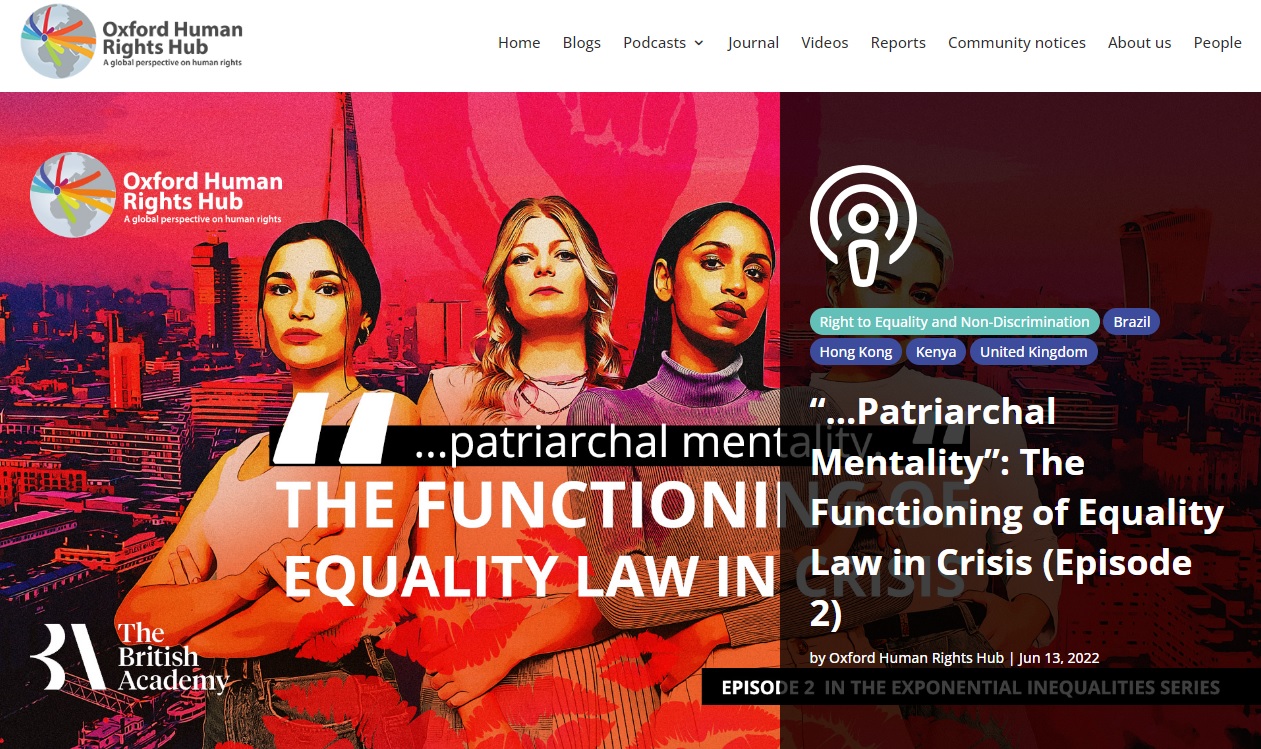
Kelley Loper in Podcast for the Oxford Human Rights Hub: Exponential Inequalities: Equality Law in Times of Crisis

A podcast for the Oxford Human Rights Hub: part of the Exponential Inequalities project led by Shreya Atrey which is also producing the book Exponential Inequalities: Equality Law in Times of Crisis, edited by Shreya Atrey and Sandra Fredman.  Kelley Loper has a chapter in that book on Hong Kong.
     Human rights experts help us determine whether equality law is set up to protect the most vulnerable in times of crisis.   This is Episode Two of a four-part series. The series takes a deep dive into whether equality law is cut out to protect the most vulnerable in times of crisis, and if not, then why not and what can we do about it?  This podcast series is part of the Exponential Inequalities project, led by Shreya Atrey as the Principal Investigator of the British Academy Leverhulme Small Research Grant on Equality Law in Times of Crisis.
    Transcript and show notes available on the Oxford Human Rights Hub website at ohrh.law.ox.ac.uk. Producer, Presenter, Sound Editor: Christy Callaway-Gale. Executive Producers: Shreya Atrey, Meghan Campbell, Sandra Fredman. Assistant Producers: Mónica Arango Olaya, Gauri Pillai, Natasha Holcroft-Emmess. Transcript and show notes: Sarah Dobbie
     EPISODE 2 is titled “…Patriarchal Mentality” : The Functioning of Equality Law in Crisis. It features Anna Lawson, Kelley Loper, Christy Callaway-Gale, Victoria Miyandazi, Aaron Reeves, Marta Machado, Helena Alviar García, and Beth Gaze.  To listen to the episode, click here.

Wednesday, January 5, 2022

Research Report on Accreditation and Regulation of Hong Kong Interpreters/Translators in Ethnic Minority Languages (HKU study commissioned by EOC)

Principal Investigator: Dr Eva Ng
Co-Investigators: Dr Janny Leung & Ms Kelley Loper 
Published in December 2021
Executive Summary (excerpt)The Equal Opportunities Commission (EOC) commissioned a research team from The University of Hong Kong (HKU) to conduct a project titled “A Study on a Potential Model for Accreditation and Regulation of Interpreters and Translators in Ethnic Minority Languages in Hong Kong”. This project primarily aims to explore the possibility of establishing an accreditation and regulation system for interpreters and translators (I/Ts) working in ethnic minority (EM) languages and how such a system should be implemented. The current research project commenced in December 2018 with the following specific objectives: 

(a) To provide a statistical profile of practising I/Ts in EM languages for public services, including, but not limited to, community support services, medical services and legal services; 

(b) To review overseas experiences in establishing an accreditation and regulation system, with particular focuses on major obstacles encountered and solutions adopted; 

(c) To identify options for a standardised accreditation mechanism for I/Ts in EM languages with reference to the current practice, overseas experiences and major stakeholders’ views; 

(d) To examine potential regulation models, including, but not limited to, voluntary registration and licensing, with reference to the current practice, overseas experience and major stakeholders’ views; 

(e) To provide options for a regulatory body with its functions, powers and accountability delineated; 

(f) To explore prospective pathways to introduce an accreditation and regulation system; and potential training needs for interpreters and translators to meet the requirements. 

The research team reviewed representative overseas accreditation and regulation models. It also conducted online surveys and focus group interviews with stakeholders, including EM language I/Ts in Hong Kong, users and operators of translation and interpreting (T&I) services in EM languages, to collect their views on the establishment of an accreditation and regulation system.   Click here to read the full report.

Kelley Loper & Carole Petersen on Legal Capacity and the UN Disabilities Convention: An Alternative Framework to Promote Law Reform in Hong Kong and Beyond (J of Comp Law)

Kelley Loper & Carole J. Petersen
2021, Vol 16, Issue 2
Abstract: Although widely ratified, the Convention on the Rights of Persons with Disabilities (CRPD) has proven challenging for governments to implement. This article focusses on the right to legal capacity, which is protected by Article 12. According to the UN Committee on the Rights of Persons with Disabilities (CRPD Committee), Article 12 requires governments to abolish all forms of substitute decision-making and provide, instead, mechanisms of supported decision-making for those who need assistance implementing decisions that reflect their own will and preferences. Rather than try to meet that standard, it appears that many governments are choosing not to engage in the process of reforming laws governing adult guardianship, compulsory treatment, and detention on the ground of disability. Hong Kong provides an excellent example of such a jurisdiction. Although bound by the CRPD since 2008, the government has not implemented Article 12 and largely ignored the issue in its 2018 report to the CRPD Committee. Meanwhile, the problems in Hong Kong’s legal framework have become critical. This is partly because the political unrest of 2019 and the crackdown by Beijing in 2020-21 have contributed to a mental health crisis in the territory. Fortunately, the CRPD Committee has requested more detailed information on the right to legal capacity for its upcoming review of Hong Kong. It is, therefore, an ideal time to consider what Hong Kong and other jurisdictions can do to better meet their obligations. This article recognises that the right to legal capacity is a contentious area of law and policy and that it is unrealistic to expect governments to immediately abolish all forms of substitute decision-making. We therefore propose an alternative theoretical framework for interpreting Article 12, one that we hope will promote law reform. Although our approach differs from that taken by the CRPD Committee, it is consistent with the holistic approach to rights that is the hallmark of the CRPD and with the doctrines of interpretation for human rights treaties.

Friday, December 31, 2021

New Issue of Asia-Pacific Journal on Human Rights and the Law (Volume 22, Issue 2, Dec 2021)


Editors-in-Chief: Simon NM Young and Kelley Loper
Publisher: Brill, Leiden

Table of Contents

Protecting the Identity of Juveniles in Criminal Proceedings in Viet Nam and Victoria
Open Trials and Restricted Publication
Authors: Le Huynh Tan Duy and Marilyn McMahon
Pages: 115–149
Online Publication Date: 31 May 2021

Procedural Rights Supporting Expeditious Trials for Juveniles (Open Access)
Effective Remedies and Legal Representation
Author: Aekje Teeuwen
Pages: 150–185
Online Publication Date: 29 Nov 2021

Development and Economy in Mongolia through a Human Rights Law Lens
Author: Juan Pablo Bohoslavsky
Pages: 86–221
Online Publication Date: 29 Nov 2021

Climate Change and the Challenges for Developing Countries in the Implementation of the Human Right to a Healthy Environment: Case of Vietnam
Authors: Nguyen Thi Hong Yen and Nguyen Phuong Dung
Pages: 222–254
Online Publication Date: 29 Nov 2021

Legal Pluralism, Human Rights and the Right to Vote: The Case of the Noken System in Papua
Author: Ignatius Yordan Nugraha
Pages: 255–286
Online Publication Date: 29 Nov 2021

We are pleased to announce that publication of APJHRL will expand to three issues per year starting in 2022.

Tuesday, October 19, 2021

Loper and Petersen on Legal Capacity, the Disability Convention, and Domestic Law Reform (J Comp Law)

Published in September 2021
Abstract:
Although widely ratified, the Convention on the Rights of Persons with Disabilities (CRPD) has proven challenging for governments to implement. This article focusses on the right to legal capacity, which is protected by Article 12. According to the UN Committee on the Rights of Persons with Disabilities (CRPD Committee), Article 12 requires governments to abolish all forms of substitute decision-making and provide, instead, mechanisms of supported decision-making for those who need assistance implementing decisions that reflect their own will and preferences. Rather than try to meet that standard, it appears that many governments are choosing not to engage in the process of reforming laws governing adult guardianship, compulsory treatment, and detention on the ground of disability. Hong Kong provides an excellent example of such a jurisdiction. Although bound by the CRPD since 2008, the government has not implemented Article 12 and largely ignored the issue in its 2018 report to the CRPD Committee. Meanwhile, the problems in Hong Kong’s legal framework have become critical. This is partly because the political unrest of 2019 and the crackdown by Beijing in 2020-21 have contributed to a mental health crisis in the territory. Fortunately, the CRPD Committee has requested more detailed information on the right to legal capacity for its upcoming review of Hong Kong. It is, therefore, an ideal time to consider what Hong Kong and other jurisdictions can do to better meet their obligations. This article recognises that the right to legal capacity is a contentious area of law and policy and that it is unrealistic to expect governments to immediately abolish all forms of substitute decision-making. We therefore propose an alternative theoretical framework for interpreting Article 12, one that we hope will promote law reform. Although our approach differs from that taken by the CRPD Committee, it is consistent with the holistic approach to rights that is the hallmark of the CRPD and with the doctrines of interpretation for human rights treaties.

Sunday, July 11, 2021

"On the Rohingya and the Andaman Sea Crisis: Six Years On" (Special Issue of the Asia-Pacific Journal on Human Rights and the Law)

                    ASIA-PACIFIC JOURNAL ON HUMAN RIGHTS AND THE LAW

Editors-in-Chief: Simon NM Young and Kelley Loper
Publisher: Brill, Leiden

Pages: 1-7
As this special issue goes to print, a boat believed to be carrying 81 stateless Rohingya refugees – including 23 children – is floating off the coast of India. It left Cox’s Bazar in southern Bangladesh on 11 February 2021 destined for Malaysia, but quickly suffered an engine failure and was left adrift in the Andaman Sea. The United Nations issued an urgent call for nearby governments to find and rescue the vessel which was eventually detected by the Indian coastguard two weeks after setting out on its ill-fated journey. There were eight dead on board, and the surviving passengers were reported to be suffering from starvation, extreme dehydration and illness. Their plight did not end with this ‘rescue’, however. India provided food, water and medical supplies and repaired the boat, but refused to permit its entry to Indian waters or allow its passengers to disembark. India has claimed the Rohingya should return to Bangladesh, while Bangladesh argues they should be accepted by India or returned to Myanmar, from where they fled persecution.


The Peril and Potential of Ambiguity: How National Laws and Policies Can Strengthen and Protect the Rights of Rohingya Refugees
By: Sumaiya Islam, Coline Schupfer, Zaid Hydari, Alexandra Zetes, and Kevin Cole
Pages: 8-27


Rights Adrift: Sexual Violence Against Rohingya Women on the Andaman Sea
By: Natasha Yacoub, Nikola Errington, Wai Wai Nu, and Alexandra Robinson
Pages: 96-114

Tuesday, October 6, 2020

Holning Lau & Kelley Loper on The European Union as Promoter of Equality in Asia: Beyond Economic Tools of Influence (new book chapter)

Holning Lau & Kelley Loper
in Thomas Giegerich (ed), The European Union as Protector and Promoter of Equality (Springer 2020) pp 487-502
Published online in July 2020
Abstract: The European Union’s (EU’s) foreign policy objectives include promoting equality rights around the world. Commentary on such efforts in Asia has focused on the EU’s application of economic pressure to influence Asian states. This chapter seeks to shift the focus to a range of non-economic tools that the EU uses to promote equality rights in Asia. These “soft power” options include, but are not limited to, conducting official “human rights dialogues” with Asian leaders, providing technical assistance to government and civil society actors, developing social media campaigns, and setting positive examples through progressive law reforms in the EU. This chapter first explains why it is important for the EU to support equality rights through the exercise of soft power. It then specifically considers the EU’s highest court, the European Court of Justice (ECJ), as a source of soft power. Some Asian courts cite the ECJ as persuasive authority. The ECJ thus indirectly promotes equality rights in Asia by setting examples. It is problematic, however, that Asian courts learn from the ECJ while the ECJ and other EU institutions fail to reciprocate by learning from rights-protective Asian courts. This unidirectional flow of information reflects and reinforces neocolonial dynamics. The EU could allay concerns about neocolonialism, and perhaps increase its influence in Asia, by engaging Asian courts in a two-way dialogue on equality rights.

Saturday, June 13, 2020

New Issues - HKU Law's SSRN Legal Studies Research Paper Series (May - June 2020)


Vol. 10, No. 7: June 1, 2020

SIMON N. M. YOUNG, EDITOR

Frederick J. Long, Olympus Capital Asia, Hong Kong
Syren Johnstone, Faculty of Law, University of Hong Kong, Asian Institute of International Financial Law

Cora Chan, The University of Hong Kong - Faculty of Law
Albert H. Y. Chen, The University of Hong Kong - Faculty of Law

Albert H. Y. Chen, The University of Hong Kong - Faculty of Law

Weixia Gu, University of Hong Kong - Faculty of Law

Weixia Gu, University of Hong Kong - Faculty of Law

Holning Lau, University of North Carolina School of Law
Kelley Loper, The University of Hong Kong - Faculty of Law, University of California, Berkeley - Berkeley Center on Comparative Equality & Anti-Discrimination Law

Vol. 10, No. 6: May 1 , 2020
Table of Contents

David S. Law, The University of Hong Kong - Faculty of Law, University of California, Irvine School of Law
Ryan Whalen, The University of Hong Kong - Faculty of Law

Douglas W. Arner, The University of Hong Kong - Faculty of Law
Janos Nathan Barberis, The University of Hong Kong - Faculty of Law, CFTE - Centre for Finance Technology & Entrepreneurship
Julia Walker, Thomson Reuters - Refinitiv (formally Thomson Reuters)
Ross P. Buckley, University of New South Wales (UNSW) - Faculty of Law
Andrew M. Dahdal, Qatar University - College of Law
Dirk A. Zetzsche, Universite du Luxembourg - Faculty of Law, Economics and Finance, Heinrich Heine University Dusseldorf - Center for Business & Corporate Law (CBC)

Giuliano G. Castellano, The University of Hong Kong, Faculty of Law
Andrea Tosato, University of Nottingham, School of Law, University of Pennsylvania Law School

Thursday, June 11, 2020

"On Street Protests and Human Rights" (Special Issue of the Asia-Pacific Journal on Human Rights and the Law)

Editors-in-Chief: Simon NM Young and Kelley Loper
Publisher: Brill, Leiden

Table of Contents

As 2019 came to an end, many labelled it ‘the year of street protest’. One estimate counted 71,790 protest events around the world in 2019, compared to 35,707 in 2018 and 23,990 in 2017. Rachman could see no ‘convincing global explanation’ for the 2019 protests, but they were obviously ‘connected’ in terms of ‘inspiring emulation’ and ‘shared tactics’. The bbc identified several common themes: inequality, corruption, political freedom, and climate change. Wright noted that ‘virtually all protests worldwide quickly escalated, and began issuing ultimatums for their governments to embrace sweeping changes – or to move aside’. Social media has been a ‘powerful organising tool everywhere’. It was assumed protests would continue unabated into 2020, but then the coronavirus pandemic struck. With global lockdowns and other social distancing measures, the first four months of 2020 have seen a substantial decrease in street protests worldwide. Governmental responses to prevent the spread of Covid-19 have severely restricted public gatherings and assemblies, not to mention other rights and freedoms. For example, in Hong Kong, gatherings of more than four persons in a public place were criminalised on 29 March 2020, punishable by up to 6 months imprisonment or a fine of HK$25,000. While these extraordinary measures are aimed at flattening the curve of new infections, there are growing concerns some governments are using these emergency powers for repressive ends, a situation that may possibly continue even after the pandemic has been contained... Click here to read the full Introduction.

To Facilitate and Protect: State Obligations and the Right of Peaceful Assembly in International Human Rights Law
By: Michael Hamilton
Pages: 5–34

The Democracy Dichotomy: Framing the Hong Kong 2019 Street Protests as Legitimacy Counterclaims against an Incoherent Constitutional Morality
By: James Greenwood-Reeves
Pages: 35–62

‘It was you who taught me that peaceful marches did not work’, Uncivil Disobedience and the Hong Kong Protests: Justification, Duty and Resistance
By: Jane Richards
Pages: 63–97

Implications of Easter Island Protests – Breach of Rapa Nui Rights by Chile in the Context of National, American and Universal Legal Systems
By: Joanna Siekiera
Pages: 98–120

The Law and Policy of Police and Prosecutorial Control of Detention in China
By: Kuibin Zhu and David M Siegel
Pages: 121–137