Showing posts with label HK. Show all posts

Monday, September 18, 2023

New Book by Albert Chen and Po Jen Yap: The Constitutional System of the Hong Kong SAR: A Contextual Analysis (Hart Publishing)

Published on 17 August 2023
264 pp.

Description: This book provides an account of the evolving constitutional arrangement known as “One Country, Two Systems”, as practised in the Hong Kong Special Administrative Region of the People's Republic of China (PRC).
The British colony of Hong Kong, one of the “Four Little Dragons” of East Asia, reverted to Chinese rule in 1997. Since then, Hong Kong has continued to be an international financial centre, a free market, and a cosmopolitan city. At the same time, the tensions and contradictions inherent in “One Country, Two Systems” have given rise to constitutional controversies and social movements, culminating in the Umbrella movement of 2014, the anti-extradition law movement of 2019, the enactment of a National Security Law in 2020, and the electoral overhaul of 2021. This book discusses the structure and operations of Hong Kong's legal, judicial and political systems and their interactions with the national authorities of the PRC.
     The book provides a useful case study in comparative constitutional law, especially on autonomy and devolution issues within sovereign States. This comparative study is particularly interesting because Hong Kong is a common law jurisdiction within the PRC's socialist legal system. It will therefore be of interest to students and scholars of Chinese law, Hong Kong law and comparative politics, as well as lawyers whose practice involves Hong Kong.

New book review available in 2024 (Click here for details)
New book review available in 2025 (Click here for details)

Tuesday, March 21, 2023

Pui-yin Lo on Reactivated and Re-energised: The Sedition Offences in “New Era” Hong Kong (HKLJ)

Reactivated and Re-energised: The Sedition Offences in “New Era” Hong Kong
Pui-yin Lo
Abstract: Sections 9 and 10 of the Crimes Ordinance (Cap 200), which prescribe the offences of sedition in Hong Kong, have had an extraordinary history since the establishment of the Hong Kong Special Administrative Region (HKSAR). Notwithstanding that it was once proposed to put them into the proverbial dustbin, the sedition offences have, since the introduction of the Law of the People’s Republic of China on Safeguarding National Security in the Hong Kong Special Administrative Region (NSL) in mid-2020, been vigorously enforced as an “offence endangering national security” within the meaning of the NSL by the National Security Department of the Hong Kong Police Force and the Department of Justice. This article considers this recent history of reactivation of the sedition offences in conjunction with the system of enforcement provided under the NSL in order to explain the boosted position held of the sedition offences by the local law enforcers and their supervisors. This article then examines several completed prosecutions of sedition to date to discern how the courts of the HKSAR have viewed these offences, both in light of the attempts to impugn the offences by the defence and the comparable cases of sedition-like offences from other common law jurisdictions. Finally, this article offers three strategies for persuading the appellate courts that the sedition offences and their enforcement per the NSL could be curtailed or circumscribed: (1) sections 9 and 10 had been repealed by operation of the Hong Kong Bill of Rights Ordinance (Cap 383), and accordingly there is nothing to be revived for enforcement; (2) remedial interpretation(s) can be suitably imposed to resolve the issues of legal certainty and necessity of criminalising speech and expressive acts merely and plainly for their ascribed “intentions” and (3) several of the seven categories of “seditious intention” have a reasonably doubtful connection with the safeguarding of national security and the obligation of the institutions of the HKSAR to prevent, suppress and punish acts and activities endangering national security, so that it is appropriate on balance with the protection of fundamental rights and the rule of law to disapply the NSL’s system of enforcement against persons alleged to have committed acts under those categories of “seditious intention”.

Friday, March 17, 2023

Johannes Chan on Taking Rights Seriously — the Judiciary at a Challenging Time (HKLJ)

Johannes Chan
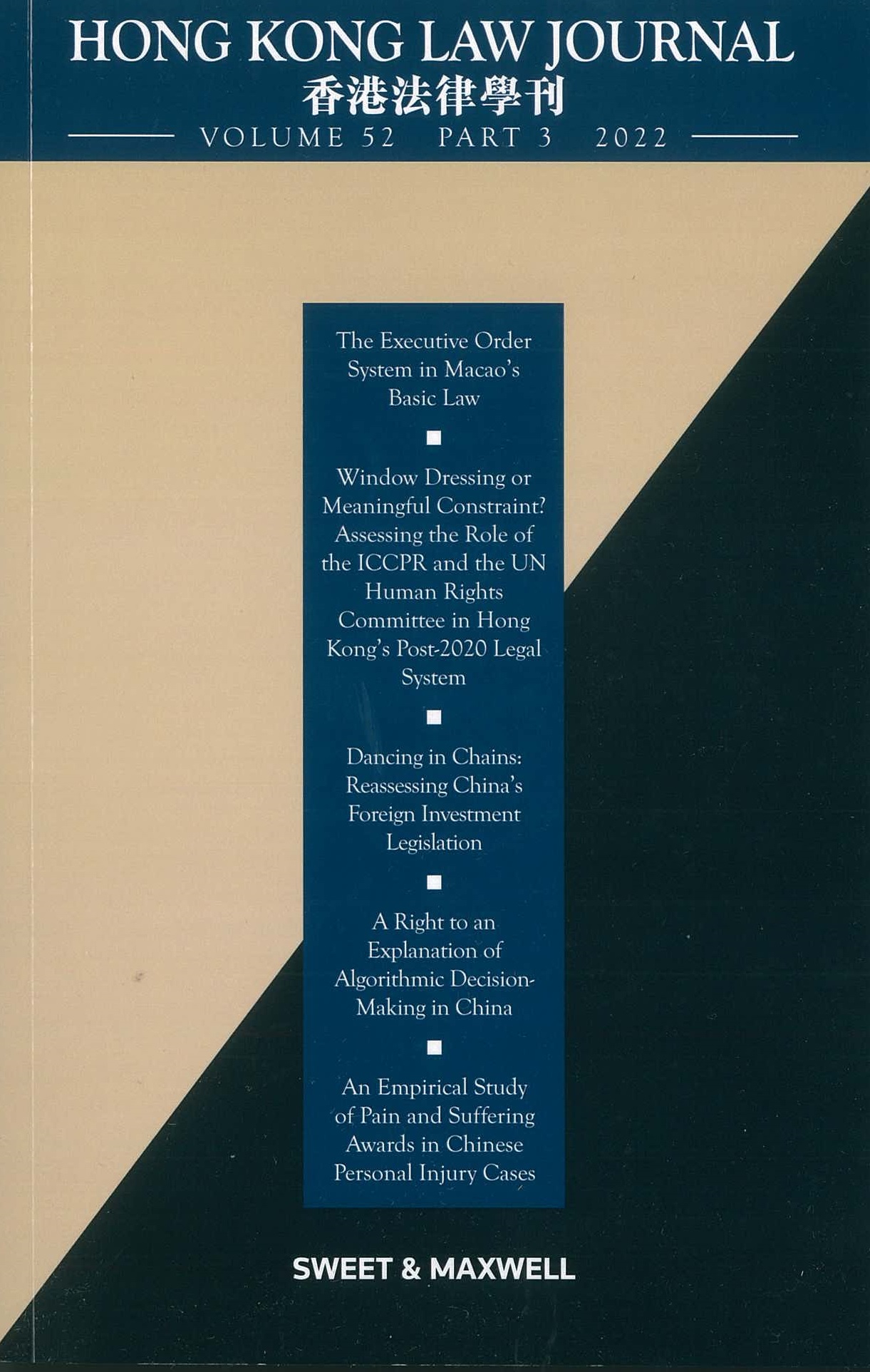
in Hong Kong Law Journal (Vol. 52, Part 3 of 2022), pp. 937-964
Abstract: While the judiciary is generally regarded as the defender of the rule of law and fundamental rights, it is not uncommon that judges could also suppress democratic values. Courts around the world have legitimised undemocratic or even repressive law and practices. Authoritarian regimes tend to capture the judiciary, not only because the judiciary would provide the legitimacy for anti-democratic measures, but the nature of the institution could also masquerade such measures as a legitimate exercise of power that makes it more difficult to detect and respond to. This article examines the relationship between the Central Government and the judiciary of the Hong Kong Special Administrative Region (HKSAR). It focuses on the judicial responses when the Central Government decided to shift the emphasis from “Two Systems” to “One Country” under the constitutional design of the HKSAR and to exercise “full jurisdiction” over Hong Kong. By focusing on the reasoning and the context of the relevant cases, it argues that the responses of the judiciary amount to a weak form of “abusive judicial review”. The constitutional model of “One Country, Two Systems” implies mutual accommodation of the two systems, and convergence means reconciliation of the two systems rather than changing one system to conform with the other system. While there are incidents suggesting a strong form of “abusive judicial review”, it is argued that it is too early to draw this conclusion. The article also cautions that when the pendulum has swung from one extreme to the other, it is even more important for the judiciary to make full use of the tapestry of common law principles to strike a better balance between fundamental rights and protection of national security.

Wednesday, March 15, 2023

Michael Jackson on Two Years On: Reviewing the Implementation of the National Security Law in the HKSAR (HKLJ)

"Two Years On: Reviewing the Implementation of the National Security Law in the HKSAR"
Michael Jackson 
in Hong Kong Law Journal (Vol. 52, Part 3 of 2022), pp.875-912
Abstract: This review surveys the case law dealing with the Hong Kong National Security Law (NSL) offences in the two years since the enactment of the NSL, with a view to identifying what we have learned about the four categories of NSL offences. The article is concerned primarily with Ch III of the NSL, headed “Offences and Penalties”, but also covers to a lesser extent Ch IV, dealing with “Jurisdiction, Applicable Law and Procedure”. Part 1 introduces the NSL offences regime. Part 2 will briefly summarise the enforcement of the NSL since its enactment. Part 3 will outline several key themes or rulings emerging from the case law relating to the integration of the NSL with existing HK criminal law and procedure. Part 4 will explore what we have learned about the NSL offences themselves and their elements, and how the courts have begun to shape these offences within HK’s existing common law legal system. Part 5 will offer some brief conclusions.

Tuesday, March 7, 2023

Kelley Loper on Dignity as a Constitutional Value in Hong Kong: Toward a Contextual Approach? (new book chapter)

"Dignity as a Constitutional Value in Hong Kong:
Toward a Contextual Approach?"
Kelley Loper
in  Human Dignity in Asia: Dialogue between Law and Culture, 
edited by Jimmy Chia-Shin Hsu (Cambridge University Press, 2022),
Chapter Seven, pp. 160-186
Introduction: This chapter considers the development of “dignity” as a constitutional value in Hong Kong, a special administrative region (SAR) of the People’s Republic of China (PRC). Hong Kong has maintained a separate legal system since its reversion to Chinese sovereignty in 1997 after more than 150 years as a British colony. The 1984 Sino-British Joint Declaration promised Hong Kong a high degree of autonomy in all areas except foreign affairs and defence. The Basic Law, Hong Kong’s constitutional document, sets out the terms of this “One Country, Two Systems” arrangement, including guarantees of fundamental rights. In particular, it provides for the continuing application of the International Covenant on Civil and Political Rights (ICCPR) and the International Covenant on Economic, Social and Cultural Rights (ICESCR). The PRC has not ratified the ICCPR, so its place in Hong Kong’s regional constitutional framework is a key feature of the SAR’s autonomy. The ICCPR has also been directly incorporated in the Bill of Rights Ordinance (BOR), a statute which has achieved constitutional status. While dignity is not mentioned in the Basic Law, these international standards have supported the judiciary’s use of dignity as a core value that underpins constitutional rights and informs a purposive approach to their interpretation. 

Monday, March 6, 2023

Kelley Loper on Hong Kong’s Top Court Rules Surgery is Not Needed to Register Gender Change (The Washington Post)

"Hong Kong’s top court rules surgery is not needed to register gender change"
Published on 6 February 2023
Introduction: HONG KONG — Hong Kong’s highest court handed down a landmark ruling Monday that will allow transgender people to amend their gender listing on their identity cards without undergoing full reassignment surgery.
Citations from Kelley Loper: ... Compared with other Asian countries, Hong Kong falls somewhere in the middle in terms of transgender rights, said Kelley Loper, director of the Master of Laws in Human Rights program at the University of Hong Kong,...Loper said that although Monday’s ruling is a significant step toward better protection of transgender people in Hong Kong, there is still a long way to go. She noted that the city still does not recognize nonbinary gender categories, unlike many other countries. 
“Hopefully this decision will spark or restart discussion about gender recognition in Hong Kong and what sort of legislation may be needed,” she said. 
Click here to read the full text.  

Tuesday, February 28, 2023

Kelley Loper & Carole J. Petersen on Academic Freedom in the Shadow of Hong Kong's National Security Law (new book chapter)

"Academic Freedom in the Shadow of Hong Kong's National Security Law"
Kelley Loper & Carole J. Petersen
in The National Security Law of Hong Kong: Restoration and Transformation,
Edited by Hualing Fu Michael Hor (Hong Kong University Press, July 2022),
Chapter 12, pp. 255-278
Introduction: This chapter analyses the impact of the Law of the People's Republic of China on Safeguarding National Security in Hong Kong (NSL) on educational autonomy and academic freedom, two core values that the "One Country Two, Systems" (OCTS) model of autonomy is supposed to protect.  Due to space constraints, this chapter primarily focuses on academic freedom in tertiary education.  However, it will also address certain contentious issues which have arisen in primary and secondary schools.
     Following this introduction, Part I reviews the concept of academic freedom, its value to society, and the ways in which it can be undermined.  Part II then analyses the situation in the Hong Kong Special Administrative Region (SAR) prior to the enactment of the NSL.  Although academic freedom and educational autonomy are expressly protected in the Hong Kong Basic Law (BL), changes to university governance in the past two decades have made universities and individual academics more vulnerable to political pressures.
      Part III of the chapter analyses provisions in the NSL that could further inhibit academic freedom and educational autonomy.  The NSL obligates the local government to "promote national security education in schools and universities" and creates several new criminal offences, which also apply extraterritorially.  The NSL also created new security agencies and endowed them with extensive powers.  On the other hand, Article 4 provides that human rights shall continue to be protected, including the rights stated in the BL, the International Covenant on Civil and Political Rights (ICCPR) and the International Covenant on Economic, Social and Cultural Rights (ICESCR).  These two treaties have a special place in Hong Kong's legal framework due to Article 39 of the BL and the Bill of Rights Ordinance (Cap 383) (which duplicates most of the provisions of the ICCPR).  Thus, any policies adopted by Hong Kong's educational institutions should comply with both treaties.  When cases are litigated the local courts should use the ICCPR as a guide to interpret vague language in the NSL.  Thus, the views of the United Nations (UN)  Human Rights Committee, the expert body tasked with monitoring states parties' implementation of the ICCPR, are particularly relevant.  The UN Committee on Economic, Social and Cultural Rights, the monitoring body for the ICESCR, can also offer guidance, particularly in the context of the right to education.  These international standards and their direct incorporation into Hong Kong law allow room for the courts and others to support academic freedom.  At the same time, legal protection alone is unlikely to be sufficient.  Other non-legal strategies, such as the drafting and enforcement of robust academic freedom policies by tertiary institutions themselves, are needed to strengthen academic freedom in Hong Kong going forward.  Indeed,  we conclude that the academic community has an obligation to adopt such policies and that the Hong Kong government has a constitutional obligation to respect them.  Suggested language for a university policy on academic freedom is therefore included at the end of this chapter. 

Friday, February 24, 2023

Michael Hor on The New National Security Law: Exploring a Meaningful Comparison with Singapore (new book chapter)

"The New National Security Law: Exploring a Meaningful Comparison with Singapore"
Michael Hor
in The National Security Law of Hong Kong: Restoration and Transformation,
Edited by Hualing Fu Michael Hor (Hong Kong University Press, July 2022),
Chapter 16, pp. 358-376
Introduction: This chapter compares the National Security Law in Hong Kong and the Internal Security Act in Singapore from the angle of their capacity to cause persons or entities dealing with or observing these jurisdictions to fear unacceptable abridgement of human rights and liberties.  A technical analysis of the letter of the law reveals a potentially far more authoritarian executive detention without trial in Singapore, compared with even the modified criminal law embodied in the National Security Law of Hong Kong.  Yet, the contrasting rights trajectory of Singapore and Hong Kong and the more ominous current political context of the National Security Law, more than makes up for the initial favourable comparison.  The chapter ends with a brief thought, gleaned from the Singapore experience, of how those who still care about human rights in Hong Kong should respond. 

Thursday, February 23, 2023

Hualing Fu & Michael Hor on Introduction: Re-balancing Freedom and Security in Post-NSL Hong Kong (new book chapter)

"Introduction: Re-balancing Freedom and Security in Post-NSL Hong Kong"
Hualing Fu & Michael Hor 
in The National Security Law of Hong Kong: Restoration and Transformation,
Edited by Hualing Fu Michael Hor (Hong Kong University Press, July 2022),
Chapter 1, pp. 1-19
Introduction: This book offers a dialogic study of the Law of the People's Republic of China on Safeguarding National Security Law (NSL) in the Hong Kong Special Administrative Region (HKSAR).  It examines the text and the context of the NSL, what caused it and what it has caused, and highlights the changes - real, potential or merely imagined - that the NSL has brought and is likely to bring to Hong Kong.  Constitutional development is not brought about by isolated events but by a series of connected episodes that have taken place over a long duration with each act done in response to an earlier one and, in turn, generating future dialectical reactions in multiple fields, some contemplated and others unforeseen, or perhaps, still unforeseeable.  It is a complicated process and emotions may run high, but there is always a logic to be discovered and explained to make sense of what, at first sight, appear to be chaotic, random occurrences.  This book studies the political and constitutional roots of the NSL as well as its practical operation in Hong Kong.  The book also attempts to view the NSL in the larger Chinese, and comparative law, perspectives.  
         This introductory chapter first situates the enactment of the NSL in the context of Hong Kong's own constitutional context and in particular, the failed attempt to enact Hong Kong national security law in 2003 as required by the Basic Law (BL), and the tortuous path of democratic pursuit that Hong Kong had trodden.  The chapter then explores the constitutional and political roots of the NSL in the Chinese constitutional order.  Part Three addresses several key issues on the impact of the NSL on the legal system, academic freedom, business, and media among others.  Finally, part four assesses the future prospects of Hong Kong's one country two systems doctrine (OCTS) and Hong Kong's freedoms under rule of law in the post NSL era, assessed from a comparative perspective by referencing the development in national security law in mainland China, Singapore and liberal democracies.

Wednesday, February 22, 2023

Johannes Chan on National Security and Judicial Independence: A Clash of Fundamental Values (new book chapter)

"National Security and Judicial Independence: A Clash of Fundamental Values"
Johannes Chan
in The National Security Law of Hong Kong: Restoration and Transformation,
Edited by Hualing Fu Michael Hor (Hong Kong University Press, July 2022),
Chapter 6, pp. 119-148
Introduction: Drafted in Beijing without any meaningful local public consultation and promulgated only an hour before it came into force, the National Security Law (NSL) was imposed on the people of Hong Kong just before 1 July 2021.  In less than a year, it has dramatically changed the civil and political scene in Hong Kong.  One of the features of the NSL is the Central Government's distrust and determination to curb the power of the judiciary in Hong Kong.  An independent judiciary is the hallmark of the rule of law, the only thing that still distinguishes the two systems between the Hong Kong Special Administrative Region (HKSAR) and the Mainland.  Yet China has a very different conception of the judiciary, and an independent judiciary that could challenge the sovereign power is beyond tolerance.  How this ideological difference led to the enactment of the NSL will be outlined in Part I of this chapter.  Part II will examine the impact of the NSL on judicial independence.  Judicial responses to the NSL will be discussed in Part III.  Part IV explores the room for judicial creativity under the NSL in light of decided cases.  It argues that the worst fear indeed comes from within.  By adopting a differential attitude towards any exercise of sovereign power, the judiciary will inevitably become compliant and there are already signs that the judiciary is losing public confidence in its independence.  Sadly, while the judiciary at the moment is still robust and independent, there is little room for optimism for the future of judicial independence in the HKSAR.

Tuesday, February 21, 2023

Albert Chen on The National Security Law of the HKSAR: A Contextual and Legal Study (new book chapter)

"The National Security Law of the HKSAR: A Contextual and Legal Study"
Albert H. Y. Chen
 in The National Security Law of Hong Kong: Restoration and Transformation,
Edited by Hualing Fu Michael Hor (Hong Kong University Press, July 2022),
Chapter 2, pp. 20-48
Introduction: The adoption by the National People's Congress (NPC) in May 2020 of a Decision on Safeguarding National Security in the Hong Kong Special Administrative Region (HKSAR) and the enactment shortly thereafter by the Standing Committee of the National People's Congress (NPCSC) of the HKSAR National Security Law (NSL) were momentous events in the history of the HKSAR, marking a new era in the implementation of the "One Country, Two Systems" (OCTS) policy.  Critics have suggested that these acts by the government of the People's Republic of China (PRC) portend the end of OCTS.  On the other hand, defenders of the Chinese action argue that, given the riots and turmoil Hong Kong had experienced in 2019, the imposition of the NSL was necessary and was designed to and likely to ensure the continued operation of OCTS.
     This chapter attempts to understand the nature, significance, and implications of the NSL.  Part I situates the Chinese action within the relevant constitutional, legal, political and historical contexts.  Part II examines the NSL in the light of Chinese law relating to matters of national security.  Part III considers the impact of the NSL on Hong Kong's existing law.  Part IV concludes by reflecting on the significance and implications of the NSL in the context of the evolution of the OCTS policy and changing circumstances in Hong Kong.

Monday, February 13, 2023

Kelley Loper on Intersecting Crises and Exponential Inequalities: The View from Hong Kong (new book chapter)

"Intersecting Crises and Exponential Inequalities: The View from Hong Kong"
Kelley Loper
in Exponential Inequalities: Equality Law in Times of Crisis,
edited by Shreya Atrey and Sandra Fredman (Oxford University Press, 2023),
Chapter 6, pp.97-117
Introduction: This chapter considers the limits and the potential of equality law to address inequalities arising from intersecting crises, that is, when more than one crisis occurs simultaneously or in close succession. It examines the case of Hong Kong, a Special Administrative Region (SAR) of China, which has recently faced multiple crises, with different, but interrelated, root causes and effects. While concurrent crises may have distinct features, their impacts frequently overlap, and mutually reinforce each other. As other contributions to this volume illustrate, a single crisis on its own is often enough to exacerbate existing inequalities (or produce new forms of marginalization) in many societies. Indeed, unresolved inequality itself may be characterized as 'a crisis' in its own right, whatever else is happening. Additional traumas are all the more likely to amplify disadvantage. 

Thursday, January 5, 2023

Pui-yin Lo on Involving and Integrating ‘Capitalist’ Special Administrative Regions in ‘Socialist’ National Development of China (new book chapter)

in Routledge Handbook of Constitutional Law in Greater China, ed. by Ngoc Son Bui, Stuart Hargreaves, and Ryan Mitchell (Routledge, Dec 29 2022), Chapter 15, pp. 236-250
Abstract: This chapter considers the tensions and flexibility in the implementation of the basic policies of the People's Republic of China (PRC) regarding Hong Kong and Macao of ‘One Country, Two Systems’, whereby, upon resumption of exercise of Chinese sovereignty over these territories, the PRC was to establish Special Administrative Regions of separate systems to maintain the territories as ‘capitalist’ economically and socially. National reunification was on the agenda of the Communist Party of China when it emerged from the chaos of the Cultural Revolution, began to chart a course for modernization of China and achieved normalized relations with Japan and the United States. The CPC leadership decided in March 1981 to recover Hong Kong from the United Kingdom and to adopt Deng Xiaoping's approach of the PRC, which practises the socialist system, allowing Hong Kong to continue to practise its capitalist system. The PRC's State Authorities, in the meantime, prepared the mechanism for the administration of the reunified territories.

Albert Chen on The History of the Drafting and Implementation of the Basic Law of the Hong Kong Special Administrative Region (new book chapter)

"The History of the Drafting and Implementation of the Basic Law of the Hong Kong Special Administrative Region"
Albert Chen
in Routledge Handbook of Constitutional Law in Greater Chinaed. by Ngoc Son Bui, Stuart Hargreaves, and Ryan Mitchell (Routledge, Dec 29 2022), Chapter 3, pp. 34-48
Abstract: The Hong Kong Special Administrative Region (HKSAR) of the People's Republic of China (PRC) was established in 1997 upon the termination of British colonial rule in Hong Kong. The Basic Law of the HKSAR is the constitutional instrument of post-colonial Hong Kong. This chapter discusses the history of the drafting and implementation of the Basic Law. The Chinese government never recognised publicly that the British or the colonial Hong Kong government had any role to play in the drafting of the Basic Law. The Chinese government considered the making of the Basic Law a purely domestic affair of the PRC. The political elite and public opinion in Hong Kong had divided views on certain fundamental issues arising from the drafting of the Basic Law, particularly as regards the degree of Hong Kong's democratisation that should be codified in the Basic Law.