Showing posts with label economy. Show all posts

Friday, March 10, 2023

Angela Zhang on Agility Over Stability: China’s Great Reversal in Regulating the Platform Economy (Harvard International Law Journal)

"Agility Over Stability: China’s Great Reversal in Regulating the Platform Economy"
Angela Zhang
Harvard International Law Journal, Volume 63, Issue 2, pp. 457-514
Published in February 2023
Abstract: This Article develops the five-element HAPPY model to study Chinese regulation: the regulatory process is hierarchical, the top leadership is adaptable, the Chinese regulators are parochial, the firms are pliant and the Chinese public need to yelp to be heard. By focusing on China’s great reversal in regulating the platform economy, I show that Chinese policy volatilities have stemmed from the hierarchical structure in which power is centralized among top leaders, who also suffer from a chronic deficit of information. I particularly highlight how favorable support from the top leadership, aggressive lobbying from tech firms, and the bureaucratic inertia of the regulators together contributed to a lag in regulating Chinese online platforms. When a crisis looms, the top leadership quickly mobilizes all administrative resources and propaganda to initiate a law enforcement campaign against tech giants. However, without strong judicial oversight, aggressive agency interventions create the risk of over-enforcement and administrative abuse. Thus far, China’s reorientation of its policy control has significantly bolstered its regulatory capacity across various fronts including financial, antitrust, and data regulation. By exerting greater oversight over platform governance, the government has enhanced the bargaining power of the various platform participants in dealing with the platforms. The government’s heavy-handed approach has also afforded it great leverage to nudge tech firms to prioritize developing cutting-edge technologies, and to steer them away from foreign stock markets, thus reducing reliance on the West for both technologies and capital. Despite the campaign’s immediate impact, it remains to be seen whether it will bring about lasting changes, especially in light of the persistent lobbying from tech firms and the risk of regulatory capture. At the same time, the volatile policy swing has itself generated risks and uncertainties, which in turn could cause turmoil to domestic social and financial stability. As the rest of the world is similarly confronted with thorny questions about how to rein in Big Tech, China’s experience with platform regulation could offer some lessons that inform the global policy debate. Although this Article focuses primarily on the platform economy, the HAPPY model has the promise to shed light on the complexity and dynamics in other areas of regulatory governance in China and beyond.

Friday, March 3, 2023

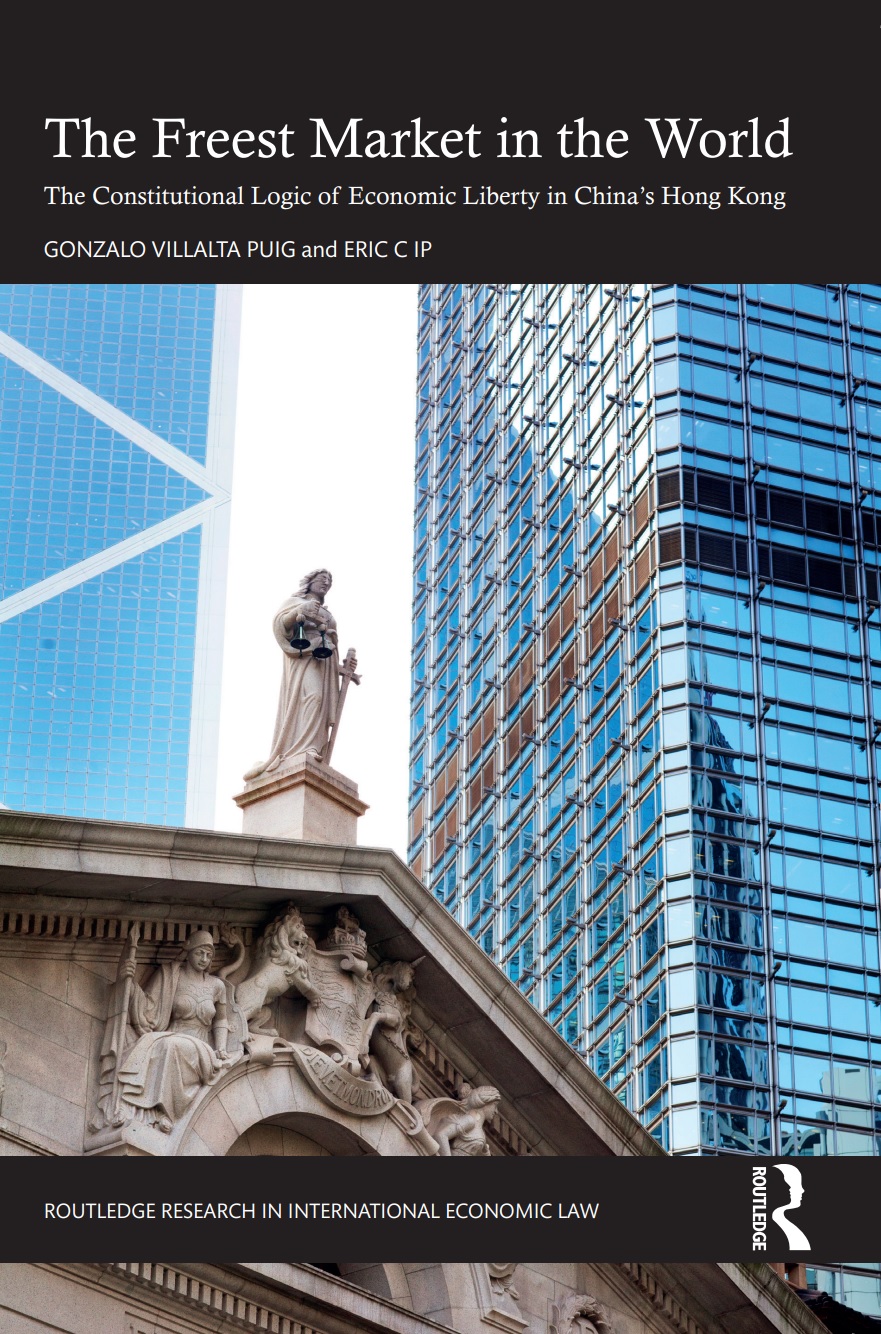
New Book by Gonzalo Villalta Puig & Eric Ip: The Freest Market in the World: The Constitutional Logic of Economic Liberty in China's Hong Kong (Routledge)

Gonzalo Villalta Puig & Eric Ip
Routledge
Published on 22 February 2023
204 pp.
Book Description: On the 25th anniversary of the establishment of the Hong Kong Special Administrative Region of the People’s Republic of China, this book presents the first monographic study of the Hong Kong Basic Law as an economic document. The Basic Law codifies what Gonzalo Villalta Puig and Eric C Ip call free market constitutionalism, the logic of Hong Kong’s economic liberty as the freest market economy in the world.
     This book, which is the outcome of several years of study with the financial support of the General Research Fund of Hong Kong’s Research Grants Council, evaluates the public choice rationale of the Basic Law and its projection on the Hong Kong economy, with a focus on the policy development of economic liberty both internally and externally. In the academic tradition of James M Buchanan’s constitutional political economy, the book opens with a conceptualisation of free market constitutionalism in Hong Kong. It studies the origins of this concept in the 19th-century classically liberal common law and how it developed into a Hayekian laissez-faire convention under British colonial rule, was codified into the Basic Law and is interpreted and applied by the branches of the Government of the Region. The book closes with remarks on the future of Hong Kong’s free market constitutionalism in face of recent challenges as the year 2047 approaches and the 50 years of ‘unchanged’ capitalist system under the Basic Law pass.
     This book will appeal to students, scholars and practitioners of law, economics, political science and public administration. It will especially appeal to those with an interest in Hong Kong law, international economic law or comparative constitutional law.
Reviews:
‘[G]overnments and regulators often appear to me to forget that the volume and complexity of laws and regulations, or the level of tax, should not be such as to deter commercial activity and stifle entrepreneurism. … As the authors of this book show, Hong Kong is not in danger of falling into this particular trap: the Region is unusual in the extent to which it leaves people in the financial and commercial worlds free to carry on their businesses as they see fit without extensive legislative or regulatory interference or excessive taxation.’

The Right Honourable the Lord Neuberger of Abbotsbury, Non-Permanent Judge of the Hong Kong Court of Final Appeal; former President of The Supreme Court of the United Kingdom.

‘[T]he present volume makes an original and unique contribution to both the international and domestic understanding of the essence of the "Hong Kong system" that constitutes one of the "Two Systems" under "One Country, Two Systems". The authors point out that from the legal and constitutional point of view, the Hong Kong system is one of "free market constitutionalism".’

Professor Albert HY Chen, Cheng Chan Lan Yue Professor of Constitutional Law at The University of Hong Kong; Member of the Committee for the Basic Law of the Hong Kong Special Administrative Region under the Standing Committee of the National People’s Congress of the People’s Republic of China.